Part 2: The Radio Call That Froze Her Smile
The radio on the security desk cracked like a broken bone.
“Madelyn Cross to the front table. Now.”
Madelyn’s laugh died halfway out of her mouth.
For one second, she still tried to wear that bright, expensive smile, the kind that told everyone she had never lost anything in public before. But her eyes shifted toward the auditorium doors, then toward the teacher holding the school-drive PDF, then finally toward me.
My cheek still stung.
I could feel the exact shape of her hand on my skin, hot and humiliating, as if the whole room had pressed it there with her.
“Why are they calling me?” Madelyn said, but her voice came out too sharp.
Ms. Varga, the art teacher, did not answer her. She was staring at the printed PDF like the paper had turned into a witness.
“This is the original file,” she whispered.
Mr. Moreau from the finance committee leaned over her shoulder. His glasses slipped down his nose.
“Scroll history?” he asked.
Ms. Varga held up the page.
“It was downloaded from the school drive before the budget packet was changed.”
The room moved all at once.
Parents stood. Students craned their necks. Someone near the back muttered, “Changed by who?”
Madelyn crossed her arms.
“This is ridiculous,” she said. “Anyone could have printed that.”
My hands tightened around the strap of my bag.
I wanted to say everything. I wanted to say how I had found the missing page after cleaning the cafeteria office. How the supply funding had not disappeared by mistake. How the last page listed a reserved grant for students who could not afford paint, sketchbooks, brushes, clay, or entry fees.
But my throat felt locked.
Then Ms. Varga turned to me.
“Mina,” she said softly, “did you bring this because you knew?”
The whole auditorium watched me breathe.
I opened my mouth.
Nothing came out.
Madelyn stepped closer, smelling like vanilla perfume and cold anger.
“See?” she said. “She can’t even explain it. She probably stole it from the office.”
My face burned deeper, but this time something under the shame hardened.
I looked at Ms. Varga.
“I didn’t steal it,” I said. My voice shook, but it stayed alive. “I copied it because the original budget packet had a last page. The version handed out tonight didn’t.”
A man in the second row stood.
“My daughter was told art club scholarships were canceled,” he said.
A woman beside him raised her hand. “So was my son.”
Another voice followed.
“And my niece.”
Madelyn’s friends stopped laughing.
Mr. Moreau took the paper from Ms. Varga and read the bottom line aloud.
“Reserved materials fund… need-based student supply access… approved by the board last spring.”
He looked up slowly.
“That page should never have been removed.”
At the doors, two security staff entered with a woman in a navy coat. I recognized her from the district office. Elena Richter. She only came to school when something was serious enough to scare adults.
Madelyn saw her too.
Her face changed.
Not fear exactly.
Recognition.
Ms. Richter walked straight to the front table and held up a tablet.
“We received a report from the security desk ten minutes ago,” she said. “A school drive login was used to replace the budget packet file before tonight’s forum.”
Madelyn shook her head.
“That has nothing to do with me.”
Ms. Richter did not blink.
“The login belongs to your mother.”
The auditorium went silent so fast I heard the ceiling lights buzzing.
Madelyn’s mouth opened.
Then closed.
Her smartwatch lit up on her wrist, vibrating over and over, but she did not look down.
Ms. Richter turned the tablet toward the finance committee.
“And the recovery log shows the missing page was deleted from a laptop registered to the Cross household.”
Madelyn whispered, “No.”
But it was not the kind of no people say when they are innocent.
It was the kind they say when the locked door opens from the inside.
Part 3: The Mother Behind The Missing Page
Madelyn’s mother arrived like she expected applause.
Mrs. Cross swept through the auditorium doors in a camel coat, pearl earrings, and heels that clicked sharply against the floor. She did not look at Madelyn first. She looked at the crowd, measuring damage.
Then she looked at me.
Her mouth tightened.
“Why is my daughter being embarrassed?” she asked.
Ms. Richter stepped forward. “That is what we are trying to determine.”
Mrs. Cross gave a small laugh.
“There is nothing to determine. Madelyn is a student. This is an adult budgeting issue.”
“And yet,” Ms. Richter said, “your district volunteer login altered a school-drive document.”
Mrs. Cross’s face stayed smooth.
“That is impossible.”
Mr. Moreau raised the printed PDF. “The original included a final page protecting supply funding. The packet distributed tonight did not.”
Mrs. Cross glanced at the paper as if it were dirty.
“Mistakes happen,” she said.
A parent near the aisle snapped, “Mistakes don’t slap people.”
Madelyn flinched.
Her mother’s eyes flicked to her cheek, then to mine. For the first time, Mrs. Cross seemed to notice the red mark blooming on my face.
She did not apologize.
She only said, “Madelyn, did you touch her?”
Madelyn’s lips trembled with fury. “She was trying to make me look bad.”
I almost laughed, but it came out like a breath.
“I was trying to keep students from losing their materials.”
Mrs. Cross turned on me so quickly my stomach clenched.
“And who asked you to involve yourself?”
The words landed harder than the slap.
Who asked the quiet girl? Who asked the cafeteria worker’s daughter? Who asked the scholarship student wearing worn shoes and carrying proof in a backpack instead of a briefcase?
No one.
That was the whole point.
Ms. Varga placed herself beside me.
“I did,” she said.
Everyone looked at her.
Ms. Varga swallowed, then lifted her chin.
“I asked any student who had questions about the art budget to bring them to me. Mina tried. Twice. She emailed me last week.”
Mrs. Cross smiled thinly.
“Convenient.”
Ms. Varga’s eyes filled with hurt, but her voice did not break.
“I didn’t answer because I was told the supply fund had already been reviewed and closed.”
“By who?” Mr. Moreau asked.
Ms. Varga looked at Mrs. Cross.
The answer moved through the room before she spoke.
“By the parent budget liaison.”
Mrs. Cross’s pearls trembled once against her throat.
“That is a lie.”
Ms. Richter tapped her tablet.
“Then you will not mind if we open the document activity log on the projector.”
A ripple of breath passed over the auditorium.
Madelyn grabbed her mother’s sleeve.
“Mum,” she whispered.
Mrs. Cross pulled her arm away.
“Do it,” she said.
But her voice had lost its shine.
The projector screen blinked from the forum agenda to a school-drive activity report. Lines of timestamps appeared. File edited. Page removed. Packet exported. Shared externally.
Mr. Moreau read slowly.
“User: Helena Cross.”
Mrs. Cross’s name looked enormous on the screen.
Then Ms. Richter scrolled lower.
A second name appeared under the shared file.
Madelyn Cross.
A parent gasped.
Madelyn backed away from her mother as if the screen had burned her.
“I didn’t edit it,” she said.
Ms. Richter looked at her.
“No,” she replied. “But you opened the changed packet before the forum and forwarded it to three students with the message—”
She stopped.
Madelyn whispered, “Don’t.”
Ms. Richter read it anyway.
“If Mina talks, make sure everyone knows she stole from art club.”
The room turned toward me.
This time, they were not looking at the red mark on my face.
They were looking at the girl Madelyn had planned to bury.
Part 4: The Message That Made Her Friends Step Back
Madelyn’s friends moved first.
Not far. Just a few inches.
But I saw it.
The polished circle around her cracked with tiny, cowardly steps.
Isla Beaumont, who had laughed the loudest when Madelyn called me a thief, dropped her eyes to the floor. One of the boys behind her put his phone away so quickly it nearly slipped from his hand.
Madelyn noticed.
“Seriously?” she hissed. “You believe this?”
No one answered.
That silence hit her harder than any argument could have.
Mrs. Cross stepped in front of her daughter.
“My daughter was repeating information given to her,” she said. “She is not responsible for adult paperwork.”
Ms. Richter’s expression stayed calm. “She is responsible for accusing another student and striking her in public.”
Madelyn’s face twisted.
“She made me look like the bad person!”
Ms. Varga whispered, “Madelyn, you did that yourself.”
For a moment, I thought Madelyn might cry.
Then her anger found me again.
“You don’t even belong in art club,” she said. “You work in the cafeteria.”
The words were ugly enough to make several parents react at once.
My stomach sank, but I did not look down.
“I work there after school,” I said. “I’m still a student.”
She laughed once, brittle and cruel.
“You smell like fryer oil half the time.”
A woman in the front row stood so abruptly her chair scraped.
“That is enough.”
I knew her. Mrs. Novak. Her son Tomas had stopped coming to art club after his family could not afford the advanced drawing kit.
Mrs. Novak’s voice shook with anger.
“My son cried in our kitchen because he thought he was the reason we couldn’t pay. He thought he was a burden. That fund mattered.”
Madelyn looked away.
Mrs. Novak pointed at the screen.
“And you made it a game.”
Mr. Moreau rubbed his forehead.
“Why would anyone remove the need-based page?” he asked.
Mrs. Cross answered too quickly.
“Because it was outdated.”
Ms. Richter clicked another file.
“Then why was a replacement allocation created?”
The projector changed again.
A new spreadsheet appeared.
At the top was a neat title: Special Exhibition Enhancement Costs.
Under it were lines for display frames, branded banners, private opening reception, guest refreshments, photography package.
And one line that made Ms. Varga cover her mouth.
Student Curator Honorarium: M. Cross.
Madelyn went pale.
Mr. Moreau stared at the screen.
“An honorarium? For a student?”
Mrs. Cross’s jaw clenched. “It was symbolic.”
“It was five hundred euros,” Ms. Richter said.
The room erupted.
People spoke over one another, anger rising like heat from pavement. Someone asked if the exhibition was replacing student supplies. Someone else asked how many families had been told funding was gone.
I heard only one thing.
Five hundred euros.
That was more than my mother made in several long cafeteria shifts.
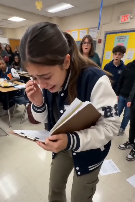
My fingers went numb.
Ms. Varga looked at me, and guilt broke across her face.
“Mina,” she said, “I didn’t know.”
I believed her.
That made it worse.
Madelyn’s voice came thin and frantic.
“I didn’t ask for that.”
Mrs. Cross snapped, “Be quiet.”
And there it was.
The first real crack between them.
Madelyn stared at her mother.
“You said it was just a title,” she whispered. “You said nobody would miss the supply page.”
Mrs. Cross turned slowly.
But the microphone on the front table was still on.
Everyone heard Madelyn’s words.
Nobody would miss the supply page.
Part 5: The Cafeteria Receipt Hidden In My Pocket
The room no longer felt like an auditorium.
It felt like a courtroom built out of folding chairs, fluorescent lights, and every humiliation I had swallowed that year.
Mrs. Cross moved toward the microphone.
“My daughter is upset and misspoke.”
Ms. Richter reached for the microphone first.
“No one else speaks until we finish reviewing the records.”
Mrs. Cross’s smile vanished.
“You are overstepping.”
“I am documenting,” Ms. Richter said.
Madelyn stood frozen beside her mother, staring at the screen like she wished she could climb inside it and delete herself too.
I wanted to disappear.
Then I felt the folded receipt in my pocket.
Thin paper. Soft from being handled too many times. A cafeteria register receipt printed two weeks ago, when I had used my own wages to buy six basic sketch pads and charcoal pencils for students who had been told the supply fund was canceled.
I had kept it because I planned to ask for reimbursement.
Then I had kept it because I was too embarrassed.
Now my fingers closed around it.
Ms. Varga noticed.
“Mina?”
I pulled it out.
“It’s not only the PDF,” I said.
My voice was still small, but the room leaned toward it.
I walked to the front table. Every step felt too loud.
“This is from the cafeteria register,” I said. “I bought supplies for Tomas Novak, Elise Weber, and two others. Not expensive ones. Just enough so they could keep attending.”
Mrs. Cross looked disgusted.
“That proves nothing except poor boundaries.”
“No,” Mr. Moreau said quietly. “It proves harm.”
He took the receipt and matched it to the missing fund page.
Ms. Varga pressed a hand to her chest.
“You paid for them yourself?”
I shrugged because I could not bear the tenderness in her voice.
“They were going to quit.”
Tomas Novak stood near the aisle. He was fourteen, tall and thin, always hiding his drawings under his arm like they were illegal.
He spoke without lifting his eyes.
“I thought the school paid,” he said. “Mina told me there were extras.”
My throat tightened.
He looked at me.
“You lied so I wouldn’t feel poor.”
Nobody laughed. Nobody whispered.
Madelyn did not look at him.
That was when Isla Beaumont, Madelyn’s friend, stepped forward.
“I have screenshots,” she said.
Madelyn whipped around. “Isla.”
Isla’s face was pale.
“I’m sorry,” she said, but she was looking at me, not Madelyn. “I thought it was just drama.”
She handed her phone to Ms. Richter.
Madelyn shook her head.
“Don’t do this.”
Isla’s voice broke.
“You told us to say Mina stole the money before she could prove anything.”
Mrs. Cross grabbed Madelyn’s shoulder. “Enough.”
But Isla kept speaking.
“You said your mum had fixed the budget so art club would look more elite. You said poor-kid supplies made the exhibition look like charity.”
The words hit the room like stones.
Madelyn covered her face.
Mrs. Cross did not comfort her.
She only whispered, “How could you be so stupid?”
That was the first time I felt something unexpected.
Not victory.
Not joy.
A sharp, uncomfortable pity.
Because Madelyn had slapped me with her own hand, but someone else had taught her where to aim.
Then Ms. Richter scrolled through Isla’s screenshots and stopped at one message.
Her eyes narrowed.
“This mentions a donor dinner.”
Mr. Moreau stiffened.
“What donor dinner?”
Ms. Richter turned the phone toward him.
On the screen, in Madelyn’s own message, were the words:
“Mum says once the Vale Foundation sees my private exhibition, the scholarship fund gets redirected for good.”
Part 6: The Donor Who Was Sitting In The Back Row
The oldest man in the auditorium stood.
Until that moment, I had barely noticed him. He had been sitting alone in the back row in a dark wool coat, one hand on a wooden cane, listening without speaking.
The room quieted before he reached the aisle.
Mr. Moreau went pale.
“Mr. Vale.”
Mrs. Cross turned.
Her entire body changed.
The confidence drained from her shoulders so completely that she looked, for the first time, smaller than her daughter.
The man walked slowly down the aisle. His cane tapped once, twice, three times. Each sound made the room hold its breath.
“I came tonight,” Mr. Vale said, “because I was told the art club had produced a new student-led exhibition worthy of expanded support.”
Mrs. Cross forced a smile.
“And it has, Mr. Vale. This has simply become emotional.”
He ignored her.
His eyes moved to the projector screen, then to the receipt in Mr. Moreau’s hand, then to me.
“What is your name?”
My mouth went dry.
“Mina Alvarez.”
He nodded once.
“And you used your own wages to replace materials that my foundation had already funded?”
I swallowed.
“Yes, sir.”
His jaw tightened.
Mrs. Cross lifted both hands.
“Mr. Vale, the exhibition proposal was designed to elevate the school’s reputation. Sometimes funding must be strategically—”
“Do not finish that sentence,” he said.
She stopped.
The room felt colder.
Mr. Vale turned to Ms. Richter.
“I want the full audit.”
Mrs. Cross stepped closer. “There is no need for that.”
“There is every need.”
Madelyn whispered, “Mum, what did you do?”
Mrs. Cross did not answer.
Mr. Vale looked at her with an expression that made even the parents in the back row sit straighter.
“My foundation created that fund after my sister left school at fifteen because she could not afford art materials. I do not donate so ambitious parents can polish their children’s résumés.”
Madelyn’s face crumpled.
For once, she was not angry at me.
She was staring at her mother as if seeing a stranger wearing her family name.
Ms. Richter tapped the tablet again.
“There is more,” she said.
Mrs. Cross snapped, “You have no authority to continue publicly.”
Mr. Vale raised a hand.
“I am requesting it.”
Ms. Richter opened a folder labeled External Draft.
A letter appeared on the screen. It was addressed to the Vale Foundation.
The first lines praised Madelyn as a visionary student curator. The next section described the need-based supply program as “underused, administratively inefficient, and socially divisive.”
My hands curled into fists.
Socially divisive.
That was what they called students like Tomas.
Students like me.
Then Mr. Moreau read the final paragraph and went still.
“The letter recommends transferring the remaining supply fund to a new Cross Student Leadership Exhibition Account.”
Mrs. Cross whispered, “It was only a proposal.”
Ms. Richter looked up.
“It was signed yesterday.”
The screen scrolled to the bottom.
Helena Cross’s signature was there.
And beneath it, as student representative, was Madelyn’s.
Madelyn staggered back.
“No,” she said. “No, she told me it was for permission. She told me it was just a form.”
Mrs. Cross shut her eyes.
Madelyn looked at me, and for the first time her face held no performance.
Only terror.
“I didn’t know that part,” she said.
I wanted to hate her cleanly.
But nothing about that room was clean anymore.
Then Mr. Vale spoke.
“Who found the original PDF?”
Ms. Varga placed a hand on my shoulder.
“Mina did.”
Mr. Vale looked at me for a long moment.
“Then Mina Alvarez saved my sister’s fund.”
Mrs. Cross inhaled sharply.
Mr. Vale turned to the room.
“And tomorrow morning, the foundation will announce whether this school still deserves it.”
Part 7: The Apology Nobody Expected To Believe
The auditorium emptied in uneven waves.
People did not leave like a meeting had ended. They left like they had witnessed a family portrait catch fire.
Some parents came to me.
They said thank you. They said sorry. They said they should have listened sooner.
Each apology felt like a coat placed gently over bruised shoulders, but none of them erased the slap.
Ms. Varga walked me to the hallway outside the art room. The walls were covered with student sketches, charcoal portraits and watercolor streets, paper corners curling under old tape.
“I failed you,” she said.
I shook my head. “You didn’t delete the page.”
“I ignored the first email.”
“You trusted the wrong adult.”
She looked at me with tired eyes.
“That is still a failure.”
Before I could answer, footsteps stopped behind us.
Madelyn stood at the end of the hall.
Her letterman jacket was gone. Without it, she looked younger. Smaller. Her eyes were red, but she did not step close.
Ms. Varga moved slightly in front of me.
Madelyn noticed.
The hurt on her face was instant.
Then she lowered her gaze.
“I’m not here to start anything.”
No one spoke.
Madelyn held out her smartwatch. The screen was cracked across one corner, probably from when she had gripped the table too hard.
“My mother keeps everything connected,” she said. “Messages. Calendar. Files. I found something.”
Ms. Varga’s body went still.
“What?”
Madelyn looked at me.
“She didn’t just remove the page.”
My stomach tightened.
Madelyn’s voice shook.
“She planned to accuse you before you ever printed the PDF.”
She opened a message thread and handed the watch to Ms. Varga.
I saw only fragments over her shoulder.
Cafeteria girl.
Easy to discredit.
Volunteer access.
Make it look like she copied restricted files.
Ms. Varga’s face drained of color.
Madelyn wrapped her arms around herself.
“I thought she was protecting me,” she said. “I thought she was making sure I got the curator spot because she said I deserved one thing that wasn’t handed to people who made sad faces.”
Her mouth twisted.
“I repeated it because it made me feel less scared that I wasn’t actually special.”
I looked at her cheek. Perfect. Unmarked.
Mine still pulsed.
“Why are you telling us?” I asked.
She flinched at my voice.
“Because Mr. Vale is going to pull everything tomorrow unless someone gives him the full truth.”
“Your mother’s truth,” Ms. Varga said.
Madelyn shook her head.
“Mine too.”
The hallway hummed with distant cleaning machines.
Madelyn’s hands trembled.
“I hit you,” she said. “I lied about you. I made people laugh at you because I knew if they saw you clearly, they’d see me clearly too.”
Her eyes finally met mine.
“I’m sorry.”
The words were quiet.
Not dramatic. Not polished. Not enough.
But for once, they were not trying to win the room.
“There’s more,” Madelyn whispered.
She looked toward the art room door.
“My mother is at the district office right now. She’s trying to delete the external draft before the audit starts.”
Ms. Varga grabbed her phone.
Madelyn stepped closer, panic rising.
“No. You don’t understand. She has my login too.”
My blood went cold.
Madelyn looked at me.
“If she uses it tonight, tomorrow it won’t look like Helena Cross destroyed the fund.”
Her voice cracked.
“It will look like I did.”
Part 8: The Exhibit Built From What They Tried To Erase
We reached the district office nine minutes before the doors locked.
Ms. Richter was already there.
Madelyn had called her from Ms. Varga’s phone, sobbing so hard she could barely get the words out. I sat beside her in the back of Ms. Varga’s small car, watching the streetlights smear across the windows, my cheek aching, my bag hugged to my chest.
No one spoke until Ms. Richter met us outside.
“Helena Cross is inside,” she said. “She claimed she forgot committee documents.”
Madelyn wiped her face with her sleeve.
“She’s deleting them.”
“Not anymore.”
Ms. Richter held up a security pass.
The office smelled like printer toner and cold coffee. Down the corridor, behind a glass-walled records room, Mrs. Cross stood at a computer terminal with her coat still on.
She looked up when we entered.
For the first time all night, she looked frightened.
Then she saw Madelyn.
Her fear turned to fury.
“You foolish girl.”
Madelyn stopped moving.
I expected her to shrink.
Instead, she took one step forward.
“No,” she said.
Mrs. Cross stared.
Madelyn’s voice shook, but it did not collapse.
“You used my name.”
“I built your future.”
“You built a lie and made me hold it.”
Mrs. Cross’s face hardened.
“You think these people will protect you? The moment you are no longer useful, they will forget you.”
Madelyn looked at me then.
Maybe she expected agreement. Maybe she expected hatred.
I said nothing.
But I did not look away.
Ms. Richter moved to the computer and unplugged the terminal from the network.
“External deletion attempt logged,” she said.
Mrs. Cross laughed once.
“You cannot prove intent.”
Mr. Vale’s voice came from the doorway.
“I do not need intent to withdraw trust.”
He entered with Mr. Moreau and a legal adviser carrying a slim folder.
Mrs. Cross’s expression splintered.
Mr. Vale placed the folder on the table.
“I reviewed the recovered files. The foundation will not withdraw the supply fund.”
My breath caught.
He looked at me.
“It will triple it.”
Ms. Varga covered her mouth.
Tomas Novak, who had arrived with his mother after Ms. Varga called them, whispered, “Triple?”
Mr. Vale nodded.
“But under one condition.”
The room tightened.
He turned to me and Madelyn.
“The first exhibition funded under the restored program will not be a private leadership showcase. It will display every student work created with supply support, cafeteria wages, borrowed materials, shared brushes, broken pencils, and second chances.”
Madelyn blinked.
He continued.
“And the student curator will be chosen by Ms. Varga.”
Mrs. Cross smiled bitterly.
“So this is where you reward the girl who embarrassed my family.”
Ms. Varga looked at me.
My stomach dropped.
I did not want a crown made out of what had happened to me.
But Ms. Varga surprised everyone.
“I choose two curators,” she said. “Mina Alvarez and Tomas Novak.”
Tomas nearly dropped his sketchbook.
Madelyn lowered her head.
Then I heard my own voice.
“Three.”
Everyone looked at me.
My cheek still hurt. My hands still shook. I still remembered Madelyn’s laugh before the slap.
But I also remembered her standing in the hallway, handing over the thing that could ruin her mother and herself.
“Madelyn should help,” I said. “Not lead. Not be honored. Help.”
Mrs. Cross scoffed.
Madelyn stared at me like I had opened a door she did not deserve.
“Why?” she whispered.
“Because you know what was erased,” I said. “And you need to look at it every day until you never call it small again.”
No one spoke.
Then Madelyn nodded.
Tears slid down her face, silent and unpretty.
“I will.”
Three weeks later, the exhibition opened in a community gallery in Porto.
Not Charlotte. Not a school auditorium. Mr. Vale moved it to his foundation’s European youth arts hall because, as he said, “A small truth deserves a larger room.”
The title hung above the entrance in black letters:
THE LAST PAGE
Every piece had a card beside it.
Not with family names.
Not with donor status.
With the material that almost disappeared.
Charcoal bought from cafeteria wages.
Paper restored by grant audit.
Paint shared by students who refused to quit.
My work hung near the center: a watercolor of a girl holding a crumpled PDF while a crowd behind her slowly turned into open windows.
Tomas displayed a charcoal portrait of hands passing a pencil from one person to another.
And Madelyn?
She did not display her own art.
She stood by a wall covered in printed records: the deleted page, the recovered log, the apology letter she wrote by hand, and one sentence she asked to place at eye level.
“I was taught to confuse attention with worth, and I hurt someone who was protecting what I never had to beg for.”
People stopped there longest.
On opening night, Mrs. Cross did not come.
But a sealed envelope arrived for Madelyn.
She opened it behind the gallery stairs. I was passing with a box of programs when I saw her sink onto the bottom step.
Inside was a single bank card and a note.
You chose them. Pay your own way now.
Madelyn pressed the note to her knees and started to cry.
I stood there, unsure whether to leave.
Then Tomas walked over and sat beside her, awkward and stiff.
“You can help label the clay shelves on Monday,” he said.
Madelyn let out a broken laugh.
“That’s your comfort?”
He shrugged. “It’s useful.”
I sat on her other side.
After a while, I handed her one of the programs.
On the back, Mr. Vale had printed the new fund name.
The Alvarez-Novak Access Fund.
I stared at it until the letters blurred.
Madelyn saw it too.
“You saved it,” she said.
I shook my head.
“No,” I said, looking through the gallery doors at every student walking in with clean paper, full paint trays, and names no one had managed to erase. “We made sure nobody could steal the last page again.”
