I knew our lives were falling apart the moment I read the eviction notice.
Not because of the red letters stamped across the top.
Not because of the date printed beneath them.
But because the paper didn’t surprise me.
That was the worst part.
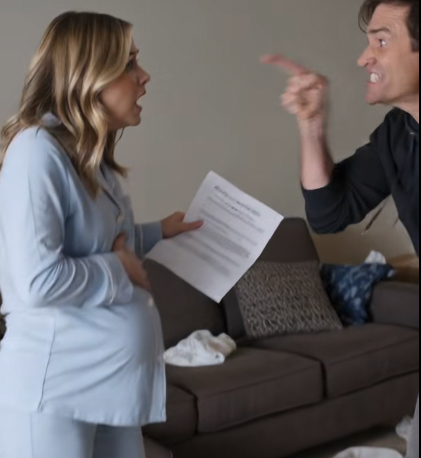
I was eight months pregnant, sitting on the floor of our living room between towers of cardboard boxes, surrounded by the remains of a life Trevor and I had spent five years building together. Our wedding photos were wrapped in newspaper. Our dishes were packed in liquor store boxes we’d begged from the corner shop. Our books were taped shut beneath labels written in my shaky handwriting.
Kitchen.
Bedroom.
Baby.
The only thing still standing was the crib.
White wood. Rounded edges. Tiny carved moons along the headboard.
Trevor had assembled it himself three months earlier, back when his hands still moved with hope instead of anger. He’d spent an entire Saturday swearing at the instructions, laughing when he put one side on backward, then standing there afterward with his hand resting on the rail like he could already see our daughter sleeping inside it.
“We’re really doing this, Leah,” he had whispered.
I had believed him.
I had believed everything.
Now the crib stood alone in the half-empty apartment like a promise neither of us knew how to keep.
The front door opened.
Trevor stepped inside carrying a stack of unpaid bills so thick it looked like evidence from a crime scene. His work boots dragged over the floor. His jacket was damp from the rain, his hair flattened against his forehead, and his face looked completely defeated.
I didn’t ask how his day was.
We were past that.
“Did you talk to Mr. Halpern?” I asked.
Trevor didn’t look at me.
He closed the door slowly behind him.
My throat tightened.
“Trevor.”
He tossed his keys into the bowl by the door, missed, and watched them hit the floor without picking them up.
That terrified me more than yelling would have.
“Did you find a way to stop the eviction?”
Still nothing.
The baby shifted inside me, slow and heavy, like she could feel the room changing.
“Answer me,” I whispered.
Trevor suddenly threw the stack of bills onto the couch. They scattered everywhere, sliding across the cushions and onto the floor.
“There,” he snapped. “There’s your answer.”
I stared at him.
Then I reached for the closest bill.
Electric. Final notice.
The amount made my stomach twist.
I picked up another.
Medical payment plan.
Another.
Past-due car loan.
Another.
Collection agency.
The numbers blurred together until I couldn’t tell where one disaster ended and the next began.
“How did it get this bad?” I asked.
Trevor laughed once, sharp and ugly.
“How do you think, Leah? Rent went up. Hours got cut. Your appointments cost money. Food costs money. Breathing costs money.”
I flinched at the mention of my appointments.
“My pregnancy isn’t what ruined us.”
“I didn’t say that.”
“You almost did.”
He rubbed both hands down his face.
“I’m tired.”
“So am I.”
“No,” he said, looking at me finally. “You’re scared. There’s a difference.”
The words hurt because they were true.
I was scared.
Scared of giving birth without a home.
Scared of bringing a baby into an apartment we might be dragged out of.
Scared of Trevor becoming a stranger right in front of me.
I pushed myself carefully to my feet, one hand braced against the wall.
“We need a plan before she comes.”
Trevor’s eyes snapped toward the crib.
“Don’t.”
“Don’t what?”
“Don’t say it like that.”
“Like what?”
“Like everything can still be fixed if we just make a little list and breathe through it.”
I swallowed hard.
“We are a family.”
His jaw tightened.
“We’re a sinking ship.”
“No,” I said. “We’re scared. We’re exhausted. But we are still a family.”
Trevor started pacing.
Back and forth.
From the couch to the kitchen doorway.
From the kitchen doorway to the crib.
Every step made the floorboards creak.
The apartment felt too small for his panic.
I watched him, trying to find the man I married beneath the anger. The man who used to leave sticky notes inside my lunch bag. The man who cried during our first ultrasound. The man who once drove forty minutes at midnight because I wanted strawberry ice cream and fries.
He was still in there.
I needed him to be.
Then I noticed the envelope.
It was sticking out from the inside pocket of his jacket.
Thick cream paper.
No logo.
No return address.
Not from the landlord.
Not from a bank.
Not from any collection agency I recognized.
“What is that?” I asked.
Trevor stopped pacing.
His hand immediately went to his pocket.
Too fast.
My stomach dropped.
“What is it, Trevor?”
“Nothing.”
“Then show me.”
“No.”
The answer came too quickly.
I took one step toward him.
“Trevor.”
He backed away.
That small movement shattered something inside me.
We had been broke before. We had been angry. We had fought over groceries, gas, doctor bills, and whose family refused to help.
But he had never hidden from me like that.
I reached for the envelope.
He twisted away.
“Stop.”
“Give it to me.”
“I said stop!”
His voice cracked through the room like a slap.
But I didn’t stop.
Maybe I should have.
Maybe if I had been less tired, less pregnant, less desperate, I would have chosen gentleness.
But fear had teeth, and it was biting me from the inside.
“What have you done?” I demanded.
Trevor’s face changed.
Panic flashed across it.
Real panic.
“Leah, please.”
“Tell me the truth.”
He looked around wildly, as if searching for an exit inside our own living room.
Then his eyes landed on the crib.
For one terrible second, I thought he was just looking at it.
Then he moved.
“Trevor, no!”
His boot slammed into the crib.
The sound was monstrous.
Wood cracked.
The crib skidded across the floor and crashed into a pile of boxes marked BABY CLOTHES. One side splintered against the corner of a moving box, and the little carved moon at the top snapped clean off.
The apartment went silent.
So silent I could hear rain ticking against the window.
My hands flew to my stomach.
The baby kicked.
Hard.
Trevor stared at the damaged crib like he didn’t recognize his own foot.
His face went pale.
“Leah…”
I couldn’t speak.
I couldn’t breathe.
That crib had been the last beautiful thing in the room.
The last untouched thing.
And he had kicked it like it meant nothing.
Like she meant nothing.
Then someone began pounding on the front door.
Not knocking.
Pounding.
A man’s voice shouted from the hallway.
“Trevor! Open this door! You need to explain why you secretly took that money!”
My blood turned cold.
Trevor closed his eyes.
The envelope slipped slightly from his jacket pocket.
I turned toward him slowly.
“What money?”
The pounding came again.
“Open up!”
Trevor whispered, “Leah, don’t.”
But I was already moving.
I crossed the room, grabbed the envelope from his pocket, and tore it open with shaking hands.
Inside was a bank withdrawal receipt.
Ten thousand dollars.
Withdrawn three days earlier.
From an account I didn’t recognize.
Underneath it was a folded contract.
My eyes caught the words first.
PRIVATE ADOPTION AGREEMENT.
For a moment, the room disappeared.
I saw only those three words.
Private.
Adoption.
Agreement.
My daughter twisted inside me as if protesting.
“What is this?” I whispered.
Trevor didn’t answer.
The pounding grew louder.
“Trevor! If you don’t open this door, I’m calling the police!”
I looked at the signature line.
Trevor’s name was there.
Not signed yet.
But typed clearly.
And below it…
A blank space for mine.
My knees nearly gave out.
“You were going to sell our baby?”
Trevor lunged forward.
“No!”
I stumbled back, clutching the papers.
“Don’t come near me.”
“No, Leah, listen to me—”
“Were you going to sell our daughter?”
His face crumpled.
“I was trying to save us.”
The sentence hit me harder than any blow could have.
“Save us?”
“I didn’t sign it!”
“But you took the money!”
He looked toward the door.
The man outside shouted again.
“The couple wants an answer, Trevor!”
The couple.
A sound escaped me that I barely recognized as a laugh.
It was broken.
Horrified.
“You found buyers.”
“No.”
“You found people to take her.”
“They said they could give her everything!” Trevor shouted.
The room shook with his voice.
Then he lowered it, trembling.
“A home. Stability. Doctors. A nursery that isn’t packed in boxes. A mother who isn’t choosing between prenatal vitamins and groceries.”
My eyes filled with tears.
“I am her mother.”
“I know.”
“No, you don’t. Because if you knew that, you would never have touched those papers.”
He looked destroyed.
“I panicked.”
“You planned.”
That silenced him.
Because it was true.
Panic was a moment.
This had taken phone calls.
Meetings.
A contract.
A withdrawal.
A secret envelope.
The pounding stopped.
Then a woman spoke through the door.
Her voice was calmer than the man’s.
“Leah? My name is Margaret Ellis. I need you to open the door.”
I stared at Trevor.
“Who is that?”
He shook his head.
“Don’t.”
I walked to the door.
“Leah, please.”
I unlocked it.
A man and woman stood in the hallway.
They looked wealthy in the quiet way rich people often do. Not flashy. Polished. Expensive coats. Careful expressions. Behind them stood Mr. Halpern, our landlord, his face red with discomfort.
The woman, Margaret, looked at my belly first.
Then at my face.
Then past me at the broken crib.
Her expression changed.
“Oh my God,” she whispered.
The man beside her stiffened.
“Trevor, what happened?”
I gripped the doorframe.
“You tell me.”
Margaret’s eyes dropped to the contract in my hand.
Then she understood.
Her face went pale.
“He didn’t tell you.”
I laughed again.
“No. He didn’t.”
Trevor stepped behind me.
“It wasn’t like that.”
Margaret’s husband looked disgusted.
“You said she agreed.”
The hallway seemed to tilt.
I turned slowly toward Trevor.
“You told them I agreed?”
His mouth opened.
Nothing came out.
Mr. Halpern removed his glasses and wiped them with trembling fingers.
“I didn’t know anything about an adoption,” he muttered. “I only came because Mr. Ellis said Trevor had money and still wasn’t paying rent.”
I looked at Margaret.
“You gave him ten thousand dollars?”
She swallowed.
“As a deposit for legal expenses. He told us you wanted a closed adoption because of your housing situation.”
Closed adoption.
A neat phrase for disappearance.
My daughter would be born, placed into someone else’s arms, and I would be expected to vanish from her life like I had never existed.
I pressed one hand against my stomach.
“She is not available.”
Margaret’s eyes filled with tears.
“I’m so sorry.”
And somehow, I believed her.
There was grief in her voice.
Not greed.
Not entitlement.
Just grief.
But grief did not make what happened acceptable.
Her husband looked furious.
“Trevor, you lied to everyone.”
Trevor snapped suddenly.
“You think I wanted this? You think I woke up excited to lose my kid?”
“Then why do it?” I screamed.
His eyes turned wet.
“Because I couldn’t watch you sleep on the floor of a shelter after giving birth!”
The hallway went quiet.
Even Mr. Halpern looked down.
Trevor’s voice broke open.
“I went to every church. Every charity. Every office downtown. I begged my boss for shifts. I sold my tools. I sold my watch. I tried, Leah.”
He pointed at the eviction notice still lying on the floor behind us.
“I tried until there was nothing left.”
My anger faltered for one dangerous second.
Not because he was right.
He wasn’t.
But because I heard the despair beneath the betrayal.
The kind that makes people do unforgivable things while telling themselves there is no other choice.
Then I looked at the broken crib.
And the softness vanished.
“You should have told me we were drowning,” I said. “Not tried to throw our baby overboard.”
Trevor covered his mouth with one hand.
Margaret stepped forward carefully.
“We don’t want to take a child from a mother who wants her.”
Her husband looked at her.
“Margaret…”
“No,” she said firmly. “Not like this.”
Something shifted then.
A small, strange quiet.
Margaret looked at me with red eyes.
“We lost our son two years ago,” she said. “He was six months old.”
The anger in my chest paused.
Not disappeared.
But paused.
“He had a heart condition,” she continued. “After that, I became obsessed with becoming a mother again. When Trevor contacted the agency’s private board, I thought…” She stopped, swallowing hard. “I thought maybe this was fate.”
Her husband placed a hand on her shoulder.
“But fate should not require a lie,” she whispered.
I didn’t know what to say.
Trevor sank onto the couch like his bones had given up.
“I’m sorry,” he whispered.
I looked at him.
For months, I had blamed the world.
The rent.
The bills.
The broken economy.
The hospital.
His boss.
My swollen feet.
But now the real enemy sat on our couch, crying into his hands.
Not poverty.
Not fear.
The lie.
The lie had become the thing that almost destroyed us.
Mr. Halpern cleared his throat awkwardly.
“I still need payment by Monday.”
Everyone turned to him.
He flushed.
“I’m sorry. I truly am. But the building was sold. New owners. They’re clearing units. My hands are tied.”
The words were so ordinary they felt cruel.
Monday.
A deadline.
As if life waited politely for business hours.
My lower back suddenly tightened.
A deep cramp wrapped around my belly.
I inhaled sharply.
Margaret noticed first.
“Leah?”
“I’m fine.”
Another wave came.
Sharper.
I grabbed the doorframe.
Trevor stood instantly.
“What’s wrong?”
“I said I’m fine.”
But my body betrayed me.
Warm liquid ran down my legs.
Everyone froze.
Margaret’s eyes widened.
“Her water broke.”
Trevor went white.
“No. No, no, no. It’s too early.”
I looked at the broken crib.
The eviction notice.
The contract.
The unpaid bills.
And suddenly I started laughing.
Not because anything was funny.
Because my daughter had apparently decided that if the whole world was going to collapse, she might as well arrive in the middle of it.
Then the pain hit.
Hard.
Trevor rushed toward me.
I slapped his hands away.
“Don’t touch me.”
His face crumpled, but he nodded.
“Okay. Okay. I won’t. Just—please—let me call 911.”
Margaret stepped in immediately.
“I’ll drive. It’ll be faster.”
Her husband nodded. “Car’s downstairs.”
Mr. Halpern grabbed the hospital bag from beside the boxes without being asked.
And just like that, the people gathered around my ruined life became a strange emergency team.
Trevor followed behind us down the stairs, keeping distance like I’d ordered, tears streaming silently down his face.
At the hospital, everything blurred.
White lights.
Cold sheets.
Nurses asking questions.
Margaret holding one hand.
A nurse holding the other.
Trevor standing in the corner like a ghost, waiting for permission to exist.
Labor swallowed me whole.
Hours passed.
Pain came in waves that tore my thoughts apart.
At some point, I screamed at Trevor.
At some point, I begged for my mother, who lived six states away and couldn’t afford the flight.
At some point, Margaret pressed a cool cloth to my forehead and whispered, “You’re stronger than you know.”
And somehow, in the middle of the worst pain of my life, I whispered back, “So are you.”
Then our daughter arrived.
Small.
Furious.
Screaming like she had been personally offended by the world.
The doctor lifted her, and the room changed.
Every terrible thing became distant for one shining second.
The eviction.
The bills.
The contract.
The broken crib.
Trevor’s betrayal.
All of it fell away beneath the sound of my daughter crying.
They placed her on my chest.
She was warm and slippery and perfect.
I looked at her tiny face and sobbed so hard I couldn’t speak.
Trevor stepped closer, trembling.
“Leah?”
I looked up at him.
He didn’t ask to hold her.
He didn’t ask for forgiveness.
He just stood there crying, hands open at his sides.
“I’m so sorry,” he whispered. “I know that doesn’t fix anything. I know it may never fix anything. But I swear to you, I will spend the rest of my life trying.”
I looked down at our daughter.
Then at him.
“You don’t get forgiveness today.”
He nodded.
“I know.”
“You get responsibility.”
His chin trembled.
“Yes.”
“You get honesty.”
“Yes.”
“You get supervised fatherhood until I decide otherwise.”
He laughed once through tears.
“Yes.”
Then I looked at Margaret.
She was standing near the doorway, crying silently.
I held my daughter closer.
“Her name is Hope,” I said.
Margaret’s face broke open.
“That’s beautiful.”
Three days later, I learned the twist that changed everything.
I was still in the hospital when a woman in a navy suit came into my room.
She introduced herself as Dana, a legal investigator hired by the Ellises.
Trevor stood beside the window, looking hollow from three days without real sleep.
Margaret and her husband had already left flowers, diapers, formula, and a handwritten note saying they would respect whatever boundaries I wanted.
Dana placed a folder on my bed tray.
“We looked into the adoption broker Trevor contacted,” she said.
My chest tightened.
“And?”
“She’s under investigation.”
Trevor turned around slowly.
“What?”
Dana opened the folder.
“The woman who arranged the agreement has been targeting financially desperate pregnant women. She presents wealthy couples as adoptive parents, collects deposits from both sides, falsifies consent documents, and sometimes disappears before the birth.”
I stared at her.
The room went cold.
“She was scamming them?”
“Not only them,” Dana said. “She planned to use Trevor’s partial signature and forge yours.”
Trevor sat down hard.
“She told me everything was legal.”
Dana’s expression softened, but only slightly.
“She tells everyone that.”
My mind raced back to the envelope.
The blank signature line.
The pressure.
The secrecy.
The timing.
The pounding on the door.
“If Margaret hadn’t come that night…”
Dana nodded grimly.
“You might have woken up to forged paperwork after delivery.”
I looked at my daughter sleeping beside me.
A chill moved through my entire body.
Trevor covered his face.
“I almost helped her.”
“Yes,” Dana said. “You did.”
He flinched.
Good.
He needed to.
Then Dana slid another document toward me.
“The Ellises recovered their money. They also asked me to give you this.”
I hesitated.
It was a certified check.
Not ten thousand dollars.
Fifty thousand.
My breath stopped.
“No,” I whispered.
Dana raised one hand.
“It is not payment. It is not connected to adoption in any way. Their attorney drafted a gift letter. No conditions. No rights. No expectations.”
I stared at the amount until it blurred.
“They said,” Dana continued softly, “that they couldn’t save their son. But maybe they could help protect someone else’s daughter.”
Tears filled my eyes.
Trevor turned away, shoulders shaking.
I could have refused out of pride.
The old me might have.
But Hope stirred in her bassinet, tiny mouth opening, fists curling against her cheeks.
Pride had no crib.
Pride did not pay rent.
Pride did not keep babies warm.
So I accepted.
Not for Trevor.
Not for myself.
For her.
The next months were not magical.
Happy endings in real life rarely arrive with music and clean lighting.
Ours came with court documents, therapy appointments, budget spreadsheets, and Trevor sleeping on the couch at his brother’s house while I stayed with Hope in a small rental the Ellises helped us secure.
The broken crib was replaced.
But I kept the carved moon Trevor had snapped off.
Not as punishment.
As memory.
A reminder that beautiful things can break when fear turns violent.
And that broken does not always mean gone.
Trevor worked two jobs.
He attended counseling.
He gave me full access to every account, every password, every paycheck.
He stopped saying “I panicked” like it was an excuse and started saying “I chose wrong” like it was the truth.
Slowly, painfully, he became someone I could speak to without shaking.
Trust did not return like a sunrise.
It returned like stitches.
One small pull at a time.
Margaret visited often, always asking first.
At first I watched her carefully.
Then I began to trust her.
She never tried to replace me.
She never crossed lines.
She became what grief had almost prevented her from becoming.
A blessing.
On Hope’s first birthday, we gathered in a small park beneath yellow leaves.
Trevor stood beside me, holding the cake box.
Margaret and her husband brought balloons.
Mr. Halpern even sent a card with a hundred-dollar gift certificate tucked inside and a note saying, “For diapers. Or wine. Your choice.”
I laughed for the first time in months.
Hope sat in the grass wearing a pink sweater, smashing cake between her fingers.
Trevor watched her like she was sunrise itself.
Then he looked at me.
“I don’t deserve this,” he said quietly.
I looked at him for a long moment.
“No,” I said. “You don’t.”
His face fell.
“But she does,” I continued. “And I deserve peace. So keep earning it.”
He nodded, tears in his eyes.
“I will.”
Margaret lifted Hope into her arms and spun her gently beneath the trees. Hope squealed with joy, reaching toward the sky like she knew nothing of eviction notices, contracts, or broken cribs.
And maybe that was the true happy ending.
Not that the past disappeared.
But that it failed to swallow her.
Later that evening, Trevor and I returned home after the party. Hope slept in her crib, one tiny hand curled beside her cheek.
A new crib.
Strong.
Safe.
Beside it, on the shelf, sat the broken wooden moon.
Trevor stood in the doorway, staring at it.
“I hate seeing that,” he whispered.
“I know.”
“Why keep it?”
I looked at our daughter.
Then at him.
“Because one day, when Hope is old enough, I want to tell her the truth.”
His eyes filled with fear.
“All of it?”
“All of it,” I said. “Not to make her hate you. To teach her something.”
“What?”
I touched the wooden moon gently.
“That love without honesty becomes danger. Fear without courage becomes cruelty. And a family isn’t saved by hiding the truth.”
Trevor nodded slowly.
Then Hope sighed in her sleep.
The smallest sound.
The softest proof that we had survived.
Trevor reached for my hand.
This time, I let him hold it.
Not because everything was forgiven.
Not because the wound was gone.
But because healing had finally entered the room.
And outside our window, the moon rose quietly over the city, whole and bright, watching over the child we almost lost before she ever opened her eyes.
Her name was Hope.
And in the end, she saved us all.
