The slap landed so loudly that the microphone on the witness stand caught it.
For one impossible second, the speakers mounted above the mock courtroom repeated the sound back to us—a sharp crack followed by a burst of static—making it feel as though Celeste Monroe had struck me twice.
My face turned to the side.
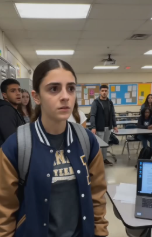
The folder I was holding slipped against my palm, but I tightened my fingers before it could fall. Around us, nearly sixty students went silent. A moment earlier, the mock courtroom had been full of restless whispering, squeaking chairs, and nervous laughter. Now even the fluorescent lights seemed to hum more loudly.
Celeste stood less than an arm’s length away, breathing hard.
Her long dark hair was still perfectly arranged over the shoulders of her navy blazer. The gold pin on her lapel—a tiny set of balanced scales—glinted beneath the ceiling lights. She had chosen it for the final round of Trenton Central High School’s statewide mock-trial showcase because she understood appearances better than anyone I had ever met.
She looked like a future attorney.
I looked like a seventeen-year-old girl who had just been slapped in front of everyone.
“You’re sick,” Celeste said.
Her voice trembled, but it was loud enough to reach every corner of the room.
“You waited until today to do this because you couldn’t stand seeing me succeed.”
A murmur moved through the benches.
I touched my cheek. It burned beneath my fingertips.
Two students in the front row were already holding up their phones. One of Celeste’s friends, Bianca Russo, stared at me with an expression that was almost triumphant, as though my humiliation had confirmed something she had always wanted to believe.
Mr. Ellison, our faculty adviser, rushed down from the judge’s platform.
“Celeste! Step away from her right now.”
“She was trying to destroy the case file,” Celeste said.
“That’s not true,” I whispered.
My throat felt closed.
I had imagined this moment dozens of times since finding the discrepancy three nights earlier. In every version, I spoke clearly. I showed the file. An adult checked the records. The error was corrected. Nobody screamed, and nobody touched me.
I had never imagined that telling the truth could feel so much like being caught doing something wrong.
Celeste pointed at the folder in my hand.
“She stole confidential material from the team drive. She’s been obsessed with proving I took her work.”
“I didn’t steal anything.”
“Then why do you have it?”
“Because it’s mine.”
The words came out louder than I expected.
The room quieted again.
Celeste’s expression changed.
It was small—a tightening beside her mouth, a flicker in her eyes—but I saw it. Beneath the polished confidence and practiced outrage, she was afraid.
That fear was the reason I did not run.
Mr. Ellison extended his hand toward the folder.
“Tamar, give me the document.”
I held it closer to my chest.
“It has to be opened in front of everyone.”
“Tamar—”
“Please.”
My voice broke on the word, but I forced myself to continue.
“If it leaves this room, someone could replace it. That’s what they tried to do last night.”
A wave of whispers rolled across the benches.
Celeste laughed, too quickly.
“Listen to her. She sounds paranoid.”
Maybe I did.
I was Tamar Gelman, the girl who worked quietly behind the scenes. I organized exhibits, corrected citations, and stayed late to make sure every witness statement matched the evidence packet. I did not give dramatic speeches. I did not know how to command a room.
Celeste did.
That was why she had been chosen as lead counsel.
And that was why, until three nights ago, almost everyone believed she had written the closing argument that had carried our team to the state showcase.
Almost everyone included me.
Mr. Ellison looked from my burning cheek to Celeste’s rigid posture.
Then he glanced at the phones recording us.
“All right,” he said quietly. “Nobody leaves. Nobody touches the computer except me.”
Celeste stepped forward.
“Mr. Ellison, this is ridiculous. The regional judges are arriving in twenty minutes.”
“And you just struck another student.”
“She provoked me.”
“No,” he said. “She spoke to you.”
Celeste went pale.
Mr. Ellison took the folder from me and walked toward the presentation computer. I followed close enough to see his hands. Inside the folder was a printed chain-of-custody sheet, a flash drive, and the original case-development log signed by every member of the team.
The paper looked ordinary.
That was the frightening thing about evidence. The truth did not always arrive dramatically. Sometimes it waited inside a plain manila folder while louder people built entire lives around the belief that nobody would open it.
Three nights earlier, I had been sitting alone in the school library when I first noticed the missing revision.
The mock-trial team had been preparing a fictional civil case involving a pharmaceutical company accused of concealing dangerous test results. I had created the central timeline, cross-referenced the witness statements, and written an argument showing that the company’s vice president had altered a report before submitting it to regulators.
The irony would not occur to me until later.
At the time, it was only schoolwork.
Our team used an internal platform called LedgerRoom, which recorded every uploaded document, every edit, and every account that accessed a file. Most students ignored the audit history. I did not. My father had taught me to keep original versions of everything after his small accounting business had once been blamed for a client’s missing records.
“People remember stories,” he always said. “Systems remember actions.”
So I saved copies.
I kept dated versions on an encrypted drive. I printed major revisions. I wrote notes beside every source. My classmates teased me for it, but they also came to me whenever something disappeared.
That Wednesday night, I opened LedgerRoom to review our closing argument and saw that my name had vanished from the authorship field.
The document now listed Celeste Monroe as the sole creator.
At first, I assumed it was a technical error.
Then I checked the revision history.
The original entry showed that I had uploaded the argument at 9:14 p.m. on February 3. A second record showed that Celeste had downloaded it six minutes later. But the visible history had been shortened. My upload was gone, replaced by a new version created under Celeste’s account.
Someone had not merely copied my work.
Someone had altered the system to make it appear that the work had always belonged to her.
I stayed in the library until closing, comparing screenshots with my printed log. By the time the librarian asked me to leave, my hands were shaking.
The next morning, I went to Mr. Ellison.
His classroom door was open, but Celeste was already inside.
She stood beside his desk holding a silver coffee tumbler and laughing at something he had said. When she saw me, the laughter stopped.
“Is everything okay?” Mr. Ellison asked.
I looked at Celeste.
She smiled.
It was not a threatening smile. That would have been easier. It was warm, almost encouraging, as though we were friends and whatever I wanted to say would be safe with her.
“I found a problem in the authorship history,” I said.
Celeste’s fingers tightened around the tumbler.
“What kind of problem?” Mr. Ellison asked.
“The closing argument was originally uploaded through my account, but the record changed.”
Mr. Ellison frowned.
Celeste did not.
She looked concerned.
“Tamar, I thought we settled this,” she said gently.
“We never discussed it.”
“You sent me notes. I incorporated them into my draft.”
“I wrote the entire argument.”
The smile remained on her face, but the warmth disappeared.
Mr. Ellison leaned back in his chair.
“Do you have proof?”
“I have my original file and a printed activity log.”
“Then bring them to me after classes.”
Celeste finally looked directly into my eyes.
“Yes,” she said. “Bring everything.”
The way she emphasized the last word made my stomach tighten.
That afternoon, I found my locker open.
Nothing had been taken. My books were still there, and my backpack had not been moved. But the zipper of the small inside pocket—where I usually kept my flash drive—was unfastened.
I had the drive with me.
That accident of timing may have saved everything.
When I returned home, an email was waiting from the school technology office. It stated that a “routine permissions update” would temporarily reset the mock-trial archive at midnight. Students were advised to download any necessary material beforehand.
The email looked official.
The sender’s address was almost correct.
Almost.
The real technology office used trentonschools.org. The message came from trentonschool.org, without the final “s.”
Someone expected me not to notice.
I forwarded the email to my father.
He called me less than a minute later.
“Do not reply,” he said.
“I wasn’t going to.”
“And do not plug that drive into any school computer until an adult is watching.”
“Dad, I think Celeste is trying to erase the record.”
There was silence on the line.
My father knew Celeste’s family. Everyone in Trenton seemed to know the Monroes. Her mother, Francesca, chaired the school foundation. Her father, Vincent Monroe, owned a legal-technology company that had donated LedgerRoom to the district.
“Tamar,” he said carefully, “are you certain about what you saw?”
“Yes.”
“Then certainty is enough to investigate. It is not enough to accuse. Protect the original. Let the record speak.”
I wanted him to come to school with me the next day.
I did not ask.
My father had spent most of the year rebuilding his business after one of his largest clients sued him over allegedly mishandled financial files. The lawsuit had been dismissed, but the accusation had spread farther than the correction. He worked late, slept little, and pretended not to notice when customers stopped calling.
I did not want my school problem to become another weight he carried.
So I printed the remaining logs, sealed them in an envelope, and brought them to the mock courtroom myself.
Now, as Mr. Ellison inserted my flash drive into the presentation computer, I felt every eye in the room pressing against my back.
The projector flickered.
A folder appeared on the large screen.
Celeste folded her arms.
“This proves nothing,” she announced. “Anyone can change the date on a personal file.”
“I know,” I said.
My cheek still throbbed, but my voice had steadied.
“That’s why the file contains the school’s cryptographic verification receipt.”
Celeste’s arms dropped.
Mr. Ellison looked at me.
“The what?”
“LedgerRoom generates an external receipt whenever a document is uploaded. The receipt contains a digital fingerprint. Even if someone changes the visible history, the fingerprint stays the same.”
A boy from the defense team leaned toward his friend.
“She’s been hiding computer-forensics skills this whole time?”
Under different circumstances, I might have laughed.
Mr. Ellison opened the receipt.
A series of numbers and letters filled the screen, followed by a timestamp, the original filename, and the uploading account.
TAMAR.GELMAN27.
9:14:08 P.M.
The room went still.
Mr. Ellison opened the closing argument currently stored in LedgerRoom and ran the verification tool.
A green banner appeared.
DOCUMENT MATCH CONFIRMED.
My original upload and Celeste’s supposed draft were the same file.
Not similar.
Not partially copied.
Identical.
Someone gasped.
Bianca lowered her phone.
Celeste stared at the screen as though she could make it disappear by refusing to blink.
Mr. Ellison’s face had lost all color.
“Celeste,” he said, “explain this.”
She did not answer.
“Why does the document listed under your name match Tamar’s verified upload?”
“I don’t know.”
“You said she only sent you notes.”
“She did.”
“The system says otherwise.”
“The system is wrong.”
“It’s your father’s system,” someone called from the benches.
A few students laughed nervously.
Celeste spun toward them.
“Shut up!”
The command cracked through the room, revealing something beneath her careful image. The girl who could smile through any accusation was gone. In her place stood someone cornered.
Then the courtroom doors opened.
Principal Warren entered with two regional judges, the district technology director, and Francesca Monroe.
Celeste’s mother wore a cream-colored suit and carried herself with the calm authority of someone accustomed to entering rooms that rearranged themselves around her. Her gaze moved from the frozen image on the screen to my reddened cheek.
“What happened?” she asked.
Nobody spoke.
Then one of the students in front raised her phone.
“Celeste slapped Tamar.”
Francesca looked at her daughter.
For the first time, Celeste appeared young.
“Mom, she’s lying about me.”
Francesca walked toward the projector screen and read the upload receipt. Her expression remained composed, but one hand tightened around the leather strap of her handbag.
“Turn that off,” she said.
Mr. Ellison hesitated.
Principal Warren stepped between them.
“No. We will preserve everything exactly as it is.”
Francesca’s eyes narrowed.
“This is a student dispute. There is no reason to turn it into a spectacle.”
“It became more than a dispute when your daughter assaulted another student.”
“Assaulted?” Francesca repeated. “That is an inflammatory word for a moment of emotional distress.”
“It is also an accurate word,” Principal Warren said.
I had never heard anyone speak to Francesca Monroe that way.
Neither, apparently, had Celeste.
Her mother crossed the remaining distance between them.
“My family has supported this school for twelve years.”
“And we are grateful for every legitimate contribution.”
The word legitimate hung in the air.
The district technology director, Ms. Patel, approached the computer.
“I need to examine the archive.”
Francesca moved in front of her.
“Not without our company’s legal department present.”
Ms. Patel stopped.
“Why would your company’s legal department need to be present for a student activity log?”
“Because LedgerRoom is proprietary software.”
“The data belongs to the district.”
“The platform belongs to us.”
“The platform’s ownership does not permit anyone to alter student records.”
Something changed in Francesca’s face.
It lasted less than a second, but I recognized it because I had seen the same thing in Celeste.
Fear.
Ms. Patel saw it too.
She turned toward Principal Warren.
“We should disconnect this computer from the network and image the drive immediately.”
Francesca’s voice sharpened.
“That is unnecessary.”
“It is standard preservation procedure.”
“You’re treating my daughter like a criminal.”
“No,” Ms. Patel replied. “I’m treating the evidence like evidence.”
The regional showcase was postponed.
Celeste was escorted to the principal’s office, while the school nurse photographed my cheek and asked whether I felt dizzy. I said no. I said I was fine so many times that the word stopped meaning anything.
My father arrived forty minutes later.
I saw him through the glass wall of the nurse’s office, still wearing the gray sweater he used at work. His hair was windblown, and he had forgotten his coat despite the February cold.
The moment he entered, all the steadiness I had forced into myself disappeared.
“I’m sorry,” I said.
He wrapped his arms around me.
“For what?”
“For making this bigger.”
He pulled back and looked at me with such confusion that I started crying.
“You didn’t make it bigger,” he said. “You refused to make yourself smaller.”
That sentence stayed with me.
It stayed with me through the meeting with Principal Warren, through the police report my father insisted on filing, and through the three days Celeste was suspended while the district investigated the altered archive.
It stayed with me when students whispered in the hall.
Some supported me. Others said I had destroyed Celeste’s future over a school assignment. Anonymous accounts posted that I was jealous, unstable, and desperate for attention. A slowed-down video of the slap circulated online with dramatic music added beneath it.
But the full recording spread too.
It showed Celeste accusing me of theft.
It showed the verified upload.
It showed her silence when Mr. Ellison asked her to explain.
By Monday, the story had reached local news.
That was when everything became stranger.
Ms. Patel called my father and me to the district office. Principal Warren was there, along with a lawyer for the school board and a detective from the county cybercrime unit.
On the conference-room table sat my flash drive inside a clear evidence bag.
Ms. Patel opened her laptop.
“We found the account used to alter the authorship record,” she said.
I gripped the edge of my chair.
“Was it Celeste?”
“No.”
My father leaned forward.
“Then who?”
“The change was made through an administrative credential issued to Monroe Legal Technologies.”
I thought of Francesca standing in front of the computer, insisting the screen be turned off.
“Her mother did it,” I said.
Ms. Patel did not answer immediately.
“The credential was assigned to Vincent Monroe.”
Celeste’s father.
I had met him twice. He was quiet, almost shy, unlike his wife and daughter. At school fundraisers, he usually stood near the back of the room, checking his phone while Francesca spoke with donors.
“Why would her father change a school assignment?” I asked.
The detective slid a printed report toward us.
“He may not have been changing only a school assignment.”
The report contained hundreds of access entries.
At first, I did not understand them. Then I recognized names—students who had received scholarships, students disciplined for academic dishonesty, students whose competition scores had been challenged and later “corrected.”
LedgerRoom did not only store mock-trial files.
The district had expanded it to debate records, scholarship recommendations, student portfolios, and disciplinary evidence.
Someone had used Monroe administrative credentials to modify those files for years.
My father’s hand froze on the page.
Near the bottom was a company name I knew.
Rosen-Gelman Accounting Services.
His business.
“What is this?” he asked.
The detective’s expression changed.
“LedgerRoom was also marketed to private firms. Your company used it for client document exchange two years ago.”
My father stared at the access history.
The lawsuit that nearly destroyed him had begun when tax records vanished from a client archive. The client accused him of negligence. He had insisted the files were present when he uploaded them, but the platform history showed otherwise.
Now the detective pointed to an administrative override performed the night before the records disappeared.
The credential belonged to Vincent Monroe.
My father slowly leaned back.
“He did this to me?”
“We don’t know yet,” the detective said. “But the evidence indicates that someone using his credentials altered your archive.”
My mind raced.
“What does this have to do with Celeste?”
“That is what we’re trying to determine.”
The answer came that afternoon.
Celeste asked to speak with me.
At first, Principal Warren refused. My father agreed with him. But Celeste’s lawyer submitted a written statement claiming she possessed information relevant to the investigation and would only provide it if I was present.
We met in the same mock courtroom where she had slapped me.
The benches were empty now. No students. No phones. No audience.
Celeste sat at the defense table beside an attorney. Her face looked smaller without makeup. The gold scales pin was gone.
I remained across the room with my father, Principal Warren, and the detective.
Celeste did not look at me until everyone was seated.
“I didn’t change the file,” she said.
“You lied about writing it,” I replied.
“Yes.”
The admission landed more quietly than the slap but carried more weight.
“Why?”
Her eyes filled with tears.
“Because my mother told me I had to win.”
“That doesn’t explain what happened.”
“No. It doesn’t.”
She folded her hands tightly on the table.
“My father created LedgerRoom. But he stopped controlling the company three years ago.”
“Your mother took over?” the detective asked.
Celeste nodded.
“She convinced him to sign voting authority to her after he got sick. He has a neurological condition. Some days he gets confused. She uses his administrative account because his name still appears on the security certificates.”
Francesca.
Not Vincent.
Celeste swallowed.
“She has been changing records for parents who donate to the foundation. Competition rankings. Scholarship files. Disciplinary reports. She says schools have always favored certain families and she is only helping the right people get what they deserve.”
“The right people?” I asked.
“People who can help her.”
“And my father?”
Celeste looked at him.
“Your company found irregularities in one of the foundation’s accounts.”
My father’s jaw tightened.
“I never audited the school foundation.”
“No. You audited a construction company owned by one of its donors. The missing money passed through shell accounts connected to my mother. Your report would have exposed it.”
My father closed his eyes.
For nearly two years, he had believed he had made some mistake he could not find. He had reread every email, every log, and every backup, trying to identify the moment his own carelessness had ruined him.
There had been no mistake.
There had been Francesca Monroe.
“She erased the documents,” he whispered.
Celeste nodded.
“She thought the lawsuit would make you lose your business before you could raise questions.”
My father’s voice hardened.
“And you knew?”
“Not then. I found out last month.”
“Why didn’t you report her?”
Celeste’s tears spilled over.
“Because she showed me what would happen to my father if the company collapsed. His medical care is paid through the business. She said employees would lose their jobs. She said families would blame me. Then she told me I had already benefited from the altered records, even when I didn’t know about them.”
“You knew about my closing argument,” I said.
“Yes.”
“Did you ask her to change the record?”
Celeste did not answer.
The silence was enough.
“I told her I needed to be selected for the statewide student advocacy program,” she finally said. “Only the lead writer could apply. She said she would handle it.”
“And then you accused me of stealing.”
“I panicked.”
“You opened my locker.”
Her head lifted.
“No.”
“The zipper on my bag—”
“That wasn’t me.”
The detective glanced toward the attorney.
“Do you know who entered Tamar’s locker?”
Celeste wiped her face.
“Bianca.”
I remembered Bianca filming the slap, her expression almost pleased.
“She told me she could make the original drive disappear,” Celeste continued. “I told her not to. I swear. But my mother had already promised Bianca’s father a place on the foundation board. Bianca thought helping me would help her family.”
The detective wrote something down.
“And the fake technology email?”
“My mother.”
The room seemed to tilt.
Celeste had lied, taken credit for my work, and struck me in public. Yet she had also been living inside a system built by her mother, where every favor became leverage and every success became evidence that she could never escape.
I did not forgive her.
Not then.
Understanding someone’s fear does not erase what they choose to do with it.
“Why tell us now?” I asked.
Celeste looked toward the judge’s bench.
“Because after the slap, my mother told me to say you threatened me. She said she could delete the video and replace the activity log. She wanted me to accuse Mr. Ellison of helping you.”
Mr. Ellison, who had trusted her.
“And you refused?”
“I said I needed time.”
“That isn’t the same as refusing.”
“No,” she whispered. “It isn’t.”
She reached into a paper evidence envelope and removed a small digital recorder.
“My father gave me this two weeks ago. He’s been pretending to be more confused than he is because he was afraid of her. He recorded conversations. He wanted me to take them to the police.”
The detective’s eyes narrowed.
“Why didn’t you?”
“Because I was a coward.”
Celeste pushed the recorder across the table.
“But Tamar wasn’t.”
The recordings ended Francesca Monroe’s control of the school before sunset.
They contained discussions of altered scholarship rankings, deleted disciplinary evidence, donor kickbacks, and the deliberate destruction of my father’s business records. In one conversation, Francesca laughed about how easy it was to ruin an honest person.
“Truth is whatever survives the cleanup,” she said.
But she had overlooked one file.
Mine.
The verified upload on my flash drive gave investigators a fresh, undeniable example of system manipulation. It allowed them to compare the visible archive with the external receipt and uncover the broader pattern.
The file I had kept from being changed became the thread that unraveled everything.
Francesca was arrested three days later.
Vincent Monroe cooperated with investigators and transferred control of the company to an independent trustee. The district removed LedgerRoom from every school system until a complete audit could be performed.
Dozens of student records were restored.
Two scholarships were awarded to the students who had originally earned them. A senior whose disciplinary report had been altered was cleared publicly. My father’s former client withdrew every accusation against him, and the company issued a written apology.
His business did not recover overnight.
Reputation returns more slowly than truth.
But old customers began calling. Then new ones did. A local newspaper published an article about the digital evidence that had cleared him, and for the first time in two years, he came home before dinner because there was nothing left to prove after midnight.
Celeste pleaded guilty in juvenile court to assault and unauthorized academic conduct. Because she cooperated with the larger investigation, she received probation, community service, and mandatory counseling rather than detention.
She was removed from the mock-trial team.
So was Bianca, who admitted entering my locker and assisting with the false email.
For weeks, I thought that was the end.
Then, on the morning of the rescheduled statewide showcase, I found an envelope on the witness stand.
Inside was the little gold scales pin Celeste had worn the day she slapped me.
There was also a handwritten note.
Tamar,
I wore this because I wanted everyone to think I believed in justice. You were the one who actually did.
I am not asking you to forgive me. I am returning something I never earned.
The closing argument should always have had your name.
—Celeste
I read the note twice.
Then I placed the pin inside my folder.
Our team had nearly withdrawn from the showcase, but the regional organizers invited us to return with a revised roster. Mr. Ellison asked me to serve as lead counsel.
My first instinct was to refuse.
I was good at research, not performance. I preferred the safety of the back row, where mistakes could be fixed before anyone saw them.
Then my father reminded me of what he had said in the nurse’s office.
You refused to make yourself smaller.
So I stood in the mock courtroom wearing a borrowed navy blazer and faced a panel of judges.
The fictional case was still about a company that altered evidence to hide the truth. That seemed almost cruelly appropriate.
When it was time for the closing argument, I carried no script to the podium.
“Members of the jury,” I began, “we often imagine that lies are powerful because they are loud. But the most dangerous lies are quiet. They hide in deleted lines, changed names, missing timestamps, and records that nobody thinks to question.”
The room was completely still.
“A lie does not become true because an important person repeats it. It does not become harmless because exposing it is inconvenient. And truth does not stop existing simply because someone with power tries to rename it.”
I glanced toward the audience.
My father sat in the second row.
Beside him was Vincent Monroe.
I had not known he would come. He looked thin and tired, but when our eyes met, he placed one hand over his heart and lowered his head.
Behind him, near the courtroom doors, stood Celeste.
She was not supposed to participate in the competition, but Principal Warren had allowed her to attend as part of her accountability plan. She looked terrified that I might see her.
I did.
For a second, the sting of the slap returned to my cheek. I remembered the laughter, the phones, and the certainty in her voice when she tried to turn the room against me.
Then I remembered her pushing the recorder across the table.
Cowardice had shaped many of her choices.
It had not been her final choice.
I faced the judges again.
“Justice begins when one person preserves what another person wants erased. Sometimes that person is a lawyer. Sometimes it is a witness. And sometimes it is simply a frightened student holding onto one file because she knows that once the original disappears, the lie will inherit its place.”
My father’s eyes shone.
“So the question before you is not whether the truth caused disruption. Truth often does. The question is who created the harm—the person who preserved the evidence, or the person who believed nobody would ever open it?”
I returned to my seat.
For several seconds, nobody moved.
Then the presiding judge removed her glasses.
“That,” she said, “is the clearest explanation of evidentiary responsibility I have heard from a student in twenty years.”
We won the showcase.
But the trophy was not the ending.
The real ending came two months later, when I was called to the school auditorium without being told why.
Students, teachers, parents, and district officials filled the seats. Onstage stood Principal Warren beside a new display case.
Inside it was my original manila folder.
The district had created an annual award called the Tamar Gelman Integrity Fellowship, funded not by the Monroe foundation but by money recovered from its fraudulent accounts. Each year, it would support a student whose work promoted transparency and fairness in public institutions.
My knees nearly gave out.
Then Principal Warren announced the first recipient.
It was not me.
It was Celeste.
The auditorium erupted in confused whispers.
Celeste froze in the aisle.
Principal Warren raised a hand.
“The fellowship is not a prize for perfection,” he explained. “It recognizes a documented act that protects the public interest despite personal cost. Tamar preserved the evidence that began this investigation. Celeste ultimately provided the evidence that completed it. Tamar requested that the first fellowship support Celeste’s continued education under strict academic-integrity conditions.”
Celeste looked at me.
She seemed unable to breathe.
I had made the request privately after learning that Francesca’s frozen assets had left Vincent struggling to cover both medical care and legal expenses. Celeste had lost her admissions offers, her friends, and the future she once assumed was guaranteed.
Some consequences were deserved.
Permanent destruction was not.
After the ceremony, she approached me near the empty stage.
“I don’t understand,” she said.
“I know.”
“You should hate me.”
“Sometimes I do.”
She flinched, but I continued.
“You hurt me. You lied about me. Helping you move forward doesn’t erase that.”
“Then why do it?”
I looked toward the display case holding the file.
“Because your mother built a system where every favor became a debt. I don’t want to become another person who uses help as a weapon.”
Celeste began to cry.
Not delicately. Not in the controlled way she had cried during the investigation. Her shoulders shook, and she covered her face with both hands.
“I’m sorry,” she said. “I know that isn’t enough.”
“It isn’t.”
She nodded.
“But it can be a beginning.”
She lowered her hands.
For the first time since I had known her, there was no performance in her expression.
“Can I ask you something?”
“What?”
“Why did you bring the file into the courtroom instead of going directly to the police?”
I thought about that morning—the folder against my chest, my stomach twisting as I searched for the safest place to ask for a correction.
“Because I still believed the truth only needed to be shown.”
“And now?”
I looked at my father, who was speaking with several former clients near the auditorium doors. I looked at Vincent Monroe, standing in the sunlight with his shoulders straighter than before. I looked at the teachers reviewing restored student records and the scholarship recipients whose futures had been returned to them.
“Now I know the truth needs someone willing to protect it after it is shown.”
Celeste glanced toward the display case.
“Do you still have my pin?”
“Yes.”
“I don’t want it back.”
“I know.”
The following autumn, I began my first semester at Rutgers University on a pre-law scholarship. My father’s business expanded, and he hired two new employees. Vincent Monroe testified against Francesca and used his remaining shares in the company to fund free digital-audit services for schools.
Celeste enrolled at Mercer County Community College.
Once a month, she volunteered with a nonprofit that helped students appeal incorrect academic records. She never used her mother’s name to open doors again.
We did not become best friends.
Life is rarely that simple.
But sometimes she sent me a record to review, and sometimes I answered. Trust returned in small, verifiable pieces.
On the first anniversary of the slap, a package arrived at my dormitory.
Inside was a new set of balanced scales.
Not a gold pin this time, but a small wooden sculpture made by students in the school workshop. A brass plate beneath it read:
TRUTH DOES NOT NEED TO BE PERFECTLY SPOKEN. IT ONLY NEEDS TO SURVIVE LONG ENOUGH TO BE HEARD.
There was no note.
There did not need to be.
I placed the sculpture beside the original flash drive on my desk.
For a long time, I had believed that keeping that file safe had saved my work.
I was wrong.
It saved my father’s name.
It restored stolen opportunities.
It exposed a system built on fear.
And, in a way neither of us could have predicted, it saved Celeste from becoming her mother.
The slap had been meant to silence me.
Instead, it became the last sound the lie ever made before the truth took the stand.
THE END
