The first thing I noticed was not the food dripping down my face.
It was the silence.
Not the normal silence that came after a teacher raised one hand, or the stiff silence before a principal spoke at an assembly. This was different. This was the kind of silence that made every breath in the room feel borrowed, the kind that arrived when people realized the story they had been enjoying might turn around and look straight at them.
My name was Arielle Cohen.
I was seventeen years old, Jewish American, and that afternoon I stood in the music department hallway of Westbridge North High with pasta salad sliding from my cheek onto my sweatshirt while half the choir program watched me like I had ruined something precious.
Five minutes earlier, they had all been saying my name.
Arielle changed the choir mix.
Arielle erased Madison’s lead.
Arielle wanted the solo for herself.
Arielle always acts quiet, but quiet girls are the sneakiest.
Nobody had checked the original record.
Nobody had opened the export log.
Nobody had compared the waveform data from the raw studio file to the edited version that had been submitted to the regional choir showcase.
They just heard Madison Sterling say I did it, and that was enough.
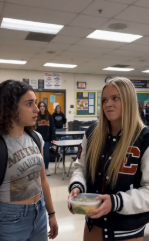
Madison stood in front of me in her custom varsity jacket, premium tailored shorts, limited-edition sneakers, and the kind of confidence that came from never being corrected in a room full of adults. She was eighteen, rich, connected, and dangerous in a way that did not always look like danger at first. With teachers, she was polished. With students, she was magnetic. With anyone weaker, quieter, poorer, or easier to isolate, she was a blade wrapped in velvet.
She had moved close enough that everyone formed a circle.
Nobody stepped between us.
That was how I knew the lie was already winning.
Then she picked up a paper bowl from the reception table and dumped the pasta salad onto my face.
A few people gasped.
A few laughed before realizing teachers were watching.
Someone whispered, “Oh my God, Madison.”
Madison’s hand trembled, but her voice did not.
“Maybe now you’ll stop pretending you’re innocent.”
I wanted to disappear.
Every part of me wanted it.
I wanted to wipe my face, run to the bathroom, lock myself in a stall, call my mother, and let the whole school swallow the lie because fighting it felt impossible. My skin burned with humiliation. Dressing stuck to my chin. A noodle clung to the sleeve of my gray cardigan. Phones were up, tiny black mirrors catching the worst moment of my life.
But behind Madison, I saw Mr. Voss standing by the music office computer.
And on that computer was the one thing she did not want opened.
The log.
So I did not run.
I did not yell.
I did not even wipe my face.
I stared past Madison and said, “Open the original file.”
The room shifted.
Madison blinked. “What?”
“The original file. The raw choir mix. The export log. Open it.”
Her smile twitched.
Only once.
But I saw it.
So did someone else.
Eli Rosen, my duet partner and the only person who had not joined the circle, stood near the water fountain with his phone lowered at his side. His eyes moved from my face to Madison’s hand to the computer screen.
“Arielle,” Mr. Voss said carefully, “go clean up first.”
“No.”
My voice sounded strange to me. Thin, but steady.
“No one checks anything after I leave. Open it now.”
Madison laughed softly, like she was embarrassed for me.
“This is so desperate.”
“No,” I said. “Desperate is dumping food on someone before the file loads.”
That made the crowd murmur.
For the first time, Madison looked around and seemed to realize the circle was not entirely hers anymore.
The choir mix was supposed to be simple.
Our school had recorded a medley for the statewide youth music showcase. Madison sang the lead vocal on the final movement, a soaring solo that everyone knew would be the centerpiece of her college arts portfolio. I was not competing with her. I was the backup alto, the one who stayed late to name files properly because Mr. Voss was brilliant with music and terrible with folders.
Two days before submission, the showcase committee received a mislabeled mix.
In that mix, Madison’s lead vocal was nearly gone.
Not muted completely. That would have been too obvious. It was lowered, blended, tucked beneath the choir until her voice sounded like part of the background. The file name had my initials attached to the last export.
AC_FINAL_REVISED.wav.
By lunch, people were saying I had sabotaged Madison because I was jealous.
By last period, Madison was crying in the choir room while her friends promised her they knew exactly who had done it.
By the time I reached the music hallway after school, the rumor had hardened into truth.
Madison did not accuse me privately.
Of course not.
She waited until there were students, teachers, parents setting up refreshments for the evening recital, and enough phones to turn shame into entertainment.
Then she said, “Why did you erase my voice?”
I asked for the file.
The log.
The receipt.
Anything that could prove what happened before the rumor became discipline.
That request made her furious.
Not loud-furious at first.
Cold-furious.
The kind that smiles.
“You always do this,” she said. “You hide behind procedure because you know people feel sorry for you.”
I felt my throat tighten. “Feel sorry for me for what?”
She tilted her head.
Her eyes flicked to the silver Star of David necklace at my collar.
Just for a second.
Long enough.
“For always acting like everyone’s against you,” she said.
The hallway went still.
Mr. Voss said, “Madison.”
But he said it too softly.
She heard the weakness in it.
So she stepped closer.
“Open the file,” I repeated.
That was when she dumped the food on me.
Now the food was there, cold and visible, and she could not take it back.
Mr. Voss looked sick. Ms. Halpern from English had appeared by the trophy case. Coach Daniels, who supervised after-school activities, was blocking the exit with one arm out like he expected someone to bolt.
“Open it,” I said again.
Mr. Voss turned to the computer.
Madison’s voice sharpened. “You’re really going to let her make this worse?”
“I’m going to verify the record,” he said.
She looked at him as if he had betrayed her personally.
The computer woke with a soft chime.
On the projector screen inside the open music room, the file directory appeared large enough for everyone in the hallway to see. Students pressed closer. Phones rose again, but differently now. Less hungry. More nervous.
Mr. Voss opened the audio project folder.
There were four main files:
RAW_SESSION_MASTER
CHOIR_MEDLEY_EDIT_1
CHOIR_MEDLEY_FINAL
AC_FINAL_REVISED
My initials sat there like a fingerprint at a crime scene.
Madison folded her arms. “See?”
“Open the metadata,” I said.
Mr. Voss hesitated.
“Please,” I added.
His hand moved over the mouse.
The metadata panel opened.
Created by: AV_Lab_Station_03.
Edited by user: guest_session.
Last export: 5:48 p.m.
Attached note: AC final revision per vocal balance request.
A ripple went through the students.
Madison’s smile returned.
“Exactly.”
But I was staring at the time.
5:48 p.m.
I had left school at 4:12 that day because my younger brother had a dentist appointment and my mother needed me to pick him up after. The attendance office had signed me out. There would be a record.
“My initials are in the file name,” I said, “not the user ID.”
Madison rolled her eyes. “You could have named it whatever you wanted.”
“I wasn’t here at 5:48.”
That landed.
Mr. Voss looked at me.
Ms. Halpern said, “Can attendance confirm that?”
Coach Daniels had already pulled out his radio.
Madison’s eyes narrowed. “She could have come back.”
“Then the door log will show it,” I said.
The door log.
That was the second thing she did not want opened.
The music wing had keycard access after 4:30 p.m. Students in performance programs could request temporary permission to enter the recording lab. Every card swipe was recorded. It was annoying. It was bureaucratic. It was, at that exact moment, the most beautiful system in the world.
Mr. Voss opened the security portal with shaking fingers.
Madison looked over her shoulder.
For the first time, I noticed her best friend, Brielle Hart, standing near the recital posters.
Brielle was usually Madison’s echo. Same sleek hair, same expensive casual clothes, same carefully bored expression. But now she looked terrified. Her face had gone colorless, and her hands were clenched around the strap of her designer bag.
Madison saw me looking at Brielle.
“Stop staring at people,” she snapped.
I looked back at the screen.
The door log loaded.
Music Lab Entry — Tuesday:
4:31 p.m. — Mr. Voss
4:44 p.m. — Madison Sterling
4:45 p.m. — Brielle Hart
5:03 p.m. — Madison Sterling
5:04 p.m. — Brielle Hart
5:47 p.m. — Madison Sterling
5:49 p.m. — Madison Sterling exit
No Arielle Cohen.
Not once.
The hallway went dead quiet.
One by one, the students who had been recording lowered their phones.
Madison stopped smiling.
“That’s not what it looks like,” she said.
Nobody answered.
Because it looked exactly like something.
Mr. Voss turned slowly. “Madison, why were you in the lab at 5:47?”
Her mouth opened.
Closed.
Opened again.
“I forgot my jacket.”
Brielle made a tiny sound.
Madison shot her a look so sharp it could have cut skin.
I wiped one noodle from my sleeve and said, “Open the waveform.”
Mr. Voss looked like he wanted to send me to the nurse, call my parents, suspend everyone, and retire in the same second. But he opened it.
The waveform filled the screen.
For most students, it probably looked like blue mountains and static. To me, after months of helping in the audio room, it looked like handwriting.
Every voice had a shape.
Madison’s lead vocal had a strong, bright waveform with clean peaks and a slight tremor at the end of sustained notes. Mine was lower, wider, softer around consonants. The final mislabeled mix showed Madison’s waveform compressed under the choir layer.
Then Mr. Voss opened RAW_SESSION_MASTER.
There she was.
Madison’s voice.
Full strength.
Unmistakable.
He opened AC_FINAL_REVISED again and isolated the change history.
A small table appeared.
Track 14: Lead Vocal — volume reduced -14 dB.
Track automation modified.
Timestamp: 5:48 p.m.
Keyboard input source: Lab Station 03.
External device mounted: STERLING_USB.
Someone gasped.
Not whispered.
Gasped.
Madison stepped back.
“That’s my practice drive,” she said quickly. “Everyone uses it.”
“No,” Eli said from the fountain.
Everyone turned.
He walked forward slowly.
His voice was calm, but his jaw was tight.
“No, they don’t. It has your name engraved on the side. Silver case. Purple charm.”
Madison looked like she might slap him.
“You don’t know anything.”
“I know I saw it plugged into Station 03 when I came back for my folder,” Eli said.
The hallway erupted.
Mr. Voss raised both hands. “Enough.”
Principal Grant arrived then, moving fast, her heels striking the floor with the kind of authority that scattered whispers. She took in the scene: me covered in pasta salad, Madison pale and furious, the waveform on the projector, the half circle of students with phones in their hands.
“What happened?” she asked.
For once, nobody rushed to answer.
That silence told her more than any speech could.
Ms. Halpern stepped forward. “A student was publicly humiliated. There is evidence that a school audio record was altered. You need to see this.”
Madison’s voice cracked. “Principal Grant, Arielle is trying to frame me.”
Principal Grant looked at my face.
Then at the food bowl on the floor.
Then at Madison’s clean hands.
“Madison,” she said, “do not speak again until I ask you a question.”
Madison froze.
She was not used to adults talking to her like that.
I should have felt relief.
Instead, my knees began to shake.
All the strength I had borrowed from the log was leaving my body now that the proof had arrived. The hallway blurred. My face felt sticky. My necklace was smeared with dressing. The smell of vinegar and mayonnaise made my stomach roll.
My mother appeared twelve minutes later.
I knew she had arrived before I saw her because the hallway changed again. People stepped back. Someone whispered, “That’s her mom.”
My mother was not tall, but she had the kind of presence that came from surviving enough rooms where people expected her to apologize for existing. She wore her work blazer, her hair pinned back, and a small hamsa bracelet my grandmother had given her. Her eyes found me, and her whole face tightened.
“Arielle,” she said softly.
That was all.
Just my name.
And I almost broke.
She crossed the hallway, took tissues from Ms. Halpern, and cleaned my cheek with careful, furious tenderness.
“Did anyone help you?” she asked.
Nobody answered.
That answer hurt more than I expected.
Principal Grant asked everyone who had recorded to submit their videos to the office before leaving campus. Parents were called. Statements were collected. Madison was escorted to the conference room, protesting that her father knew half the district board.
Brielle stayed behind.
She stood by the recital posters, crying silently.
I did not know why until she walked toward me with something in her hand.
A receipt.
Not a store receipt.
An audio export receipt.
The system printed them automatically when final files were rendered for competition submission. Most people threw them away. I saved them because I saved everything.
Brielle held the paper like it was burning her.
“I’m sorry,” she whispered.
Madison heard from the conference room doorway.
“Brielle, don’t.”
Brielle flinched.
Then she kept walking.
“I printed it Tuesday,” she said to Principal Grant. “Madison told me to. She said Arielle had already approved the balance change.”
I stared at her. “I never approved anything.”
“I know that now.”
“You knew it then,” Eli said.
Brielle’s face crumpled.
She handed the receipt to Principal Grant.
The printout showed the file path, station number, timestamp, and export note.
AC final revision per vocal balance request.
Under “operator note,” someone had typed:
Requested by A.C. after concern about lead overpowering ensemble.
A.C.
My initials.
But below that, in the system’s automatic device capture line, was the mounted drive:
STERLING_USB.
And below that:
Logged-in temporary access code: MS-4782.
Madison Sterling.
The lie had named her twice.
Principal Grant read the receipt.
Then she looked at Madison.
Madison stopped protesting.
Her face did something strange then.
It did not collapse.
It hardened.
She turned to Brielle with pure hatred.
“You promised,” she said.
Brielle whispered, “You promised it was just to make people appreciate you more.”
And there it was.
The first crack in the deeper story.
Not jealousy.
Not revenge.
Something uglier and sadder.
Madison had not lowered her own lead vocal because she hated herself. She had done it because she wanted everyone to believe someone had tried to erase her. She wanted outrage. Sympathy. Protection. A dramatic recovery story for her college application, for the showcase, for her image.
And she had chosen me as the villain because I was convenient.
Quiet.
Organized.
Different enough for people to doubt.
Visible enough to blame.
The official investigation took a week.
In that week, the school became a place of sideways glances and unfinished apologies. Madison was suspended from choir activities. Brielle gave a full statement. The export logs were preserved. The original raw files were restored.
The worst part was not that people had believed Madison.
It was how quickly they wanted me to make them feel better about it.
“I’m sorry, but you have to admit it looked bad.”
“I didn’t know what to think.”
“I was going to say something.”
“I lowered my phone when the proof came out.”
As if lowering a phone after recording someone’s humiliation was courage.
I did not yell at them.
I also did not comfort them.
My mother told me that was allowed.
“You are not required to be soft so other people can forgive themselves,” she said while helping me wash dressing from my necklace that night.
My father was quieter.
He sat at the kitchen table with the printed incident report in front of him, reading the same paragraph again and again.
Finally, he looked up and said, “When I was in school, they called me dramatic when I reported things. They said I misunderstood jokes.”
I had never heard him say that before.
His voice was calm, but his hands were not.
“I don’t want you to learn silence from us,” he said.
“I almost ran,” I admitted.
“But you didn’t.”
“I wanted to.”
“That counts too,” he said. “Wanting to run and staying anyway counts twice.”
The restored choir mix played at the regional showcase on a rainy Thursday evening.
Madison was not allowed to perform.
Her understudy, a sophomore named Tessa, sang the lead instead. Her voice was not as polished as Madison’s, but it was honest, bright, and nervous in a way that made the whole song feel alive.
I stood in the back row, alto section, hands cold, heart pounding.
When the final note ended, the audience stood.
For the first time in weeks, the applause did not feel like a trial.
Afterward, Mr. Voss found me backstage.
He looked older than he had before all this.
“I failed you,” he said.
I did not know what to do with adult honesty. It felt heavier than an excuse.
“I should have checked before your name became a rumor,” he continued. “I trusted a student’s reputation more than the record. That was wrong.”
I looked down at my shoes.
“Thank you for saying that.”
“There’s something else,” he said.
He handed me a sealed envelope.
Inside was a letter from the regional showcase committee. Because the restored file and the investigation proved the submission had been tampered with before deadline, Westbridge’s project remained eligible. More than that, the committee wanted to feature a short student statement about audio integrity and recordkeeping at the final ceremony.
They wanted me to give it.
“No,” I said immediately.
Mr. Voss nodded. “That’s completely okay.”
I read the letter again.
My name at the top looked strange.
Not like an accusation this time.
Like an invitation.
“I’ll think about it,” I said.
The final ceremony was two weeks later.
By then, Madison had withdrawn from Westbridge.
People said she transferred to a private school outside Boston. People said her father threatened legal action. People said Brielle’s family and Madison’s family were no longer speaking. People said a lot of things.
I tried not to listen.
But the day before the ceremony, a letter arrived at my house.
No return address.
My mother placed it on the kitchen table like it might bite.
I recognized the handwriting from choir sign-up sheets.
Madison.
For a long time, I did not open it.
When I finally did, I expected excuses.
I expected blame.
I expected a performance.
The letter was three pages.
The first page was bad. Defensive. Polished. Full of sentences like I was under pressure and I didn’t understand how far it would go.
I almost stopped reading.
Then I turned the page.
The handwriting changed. Messier.
She wrote:
I picked you because I thought people would believe it.
I told myself that meant you were powerful in some way, but that was a lie. I picked you because I thought people would hesitate before defending you.
I knew Brielle was afraid of losing my friendship.
I knew Mr. Voss was afraid of my parents.
I knew students would record first.
I knew you would ask for the record because you always ask for the record.
That was why I hated you.
Because you believed truth was enough.
And for a few minutes, I proved it wasn’t.
I read that sentence three times.
Then the final line:
I am sorry. You do not have to forgive me. I just wanted one record where I told the truth.
I folded the letter carefully.
My mother asked, “Are you okay?”
“No.”
She nodded and sat beside me.
We stayed there without speaking until the kitchen clock clicked into the next minute.
At the final ceremony, I wore a simple navy dress and my Star of David necklace, cleaned until it caught the light again.
When they called my name, my legs felt hollow.
The auditorium was full of students from other schools, parents, teachers, committee members, strangers who knew nothing about pasta salad or hallway silence or the way a rumor could become a weapon before anyone opened a file.
I stepped to the microphone.
For one second, I saw Madison in my mind, smiling while everyone stared at me.
Then I saw the waveform.
Blue peaks on a screen.
A voice lowered but not gone.
I unfolded my statement.
“Music is made of sound,” I began, “but trust is made of records.”
The room settled.
I continued.
“A recording can be changed. A file name can lie. A crowd can repeat the wrong story until it feels true. That is why original records matter. Not because systems are perfect, but because people are not. When we protect the original, we protect the people who might otherwise be edited out.”
My voice shook only once.
Near the end.
“When someone tried to make my name mean sabotage, the log gave my name back to me.”
I looked up.
My parents were in the third row.
My father was crying openly.
My mother was not wiping her tears at all.
She wanted me to see them.
I finished with one sentence I had written at 2 a.m. and almost deleted:
“No one should have to be humiliated before the truth is checked.”
The applause came slowly at first.
Then louder.
Then standing.
I did not smile right away.
I let myself feel the weight of it.
Not victory over Madison.
Not revenge.
Something better.
Return.
After the ceremony, a woman approached me in the lobby.
She was elegant, nervous, and holding a small program in both hands.
“I’m Brielle’s mother,” she said.
I stiffened.
She noticed and stopped a respectful distance away.
“I won’t take much of your time. I just wanted to say Brielle is in counseling now. She wanted to come, but she was afraid it would make tonight harder for you.”
I did not know what to say.
The woman’s eyes filled. “Thank you for not turning her into the whole villain.”
“She helped Madison,” I said.
“Yes,” she replied. “And Madison used her. Both things are true.”
Both things are true.
I thought about that for a long time.
That summer, the school district changed its media policy. Every performance file needed two approvals, automatic export receipts, and a protected raw backup. Students joked that I had accidentally made choir more bureaucratic than AP exams.
I did not mind.
On the first day of senior year, I walked past the music hallway and saw a new sign above the lab door:
ORIGINAL RECORDS MUST BE PRESERVED.
Below it, someone had taped a smaller handwritten note:
CHECK BEFORE YOU ACCUSE.
I laughed for the first time in that hallway.
Eli found me there.
“Legendary,” he said.
“Dramatic.”
“Also legendary.”
We walked into choir together.
Tessa waved from the front row. Brielle sat near the aisle, quieter than before, but she met my eyes.
I nodded once.
She nodded back.
Not friendship.
Not forgiveness.
But maybe a beginning made of honesty instead of fear.
Mr. Voss started class by assigning new folders and access codes. When he handed me mine, the label read:
ARI C. — ARCHIVE LEAD.
I raised an eyebrow.
He cleared his throat. “Too much?”
“Definitely.”
“Do you want me to change it?”
I looked at the label.
Then at the room.
The same room where my name had once been repeated like evidence against me.
“No,” I said. “Leave it.”
At the end of class, I stayed behind to check the backup drive.
It was ordinary work.
Quiet work.
The kind of work people only noticed when something went wrong.
As the files copied, I opened the restored choir mix one more time.
Madison’s original lead vocal still existed in the archive. Full strength. Clear. Untouched.
I did not hate hearing it anymore.
That surprised me.
Her voice was beautiful.
What she had done was ugly.
Both things were true.
I exported the new class folder, printed the receipt, and placed it in the binder. The paper slid into its plastic sleeve with a soft, final sound.
For months, I thought the twist was that the log named Madison.
But that was not the real twist.
The real twist was that she had counted on everyone seeing me as easy to erase.
Instead, her lie taught the whole school how to keep proof.
And once people learn to check the original, girls like me do not disappear so easily.
THE END
