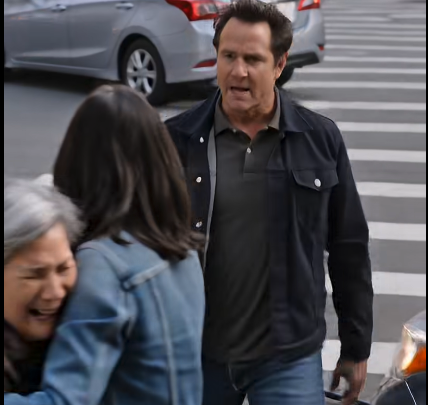
My mother screamed my name in the middle of a Seattle crosswalk, and for one terrible second, I thought the city was going to swallow her whole.
Cars shrieked to a stop. Horns blared. Rainwater sprayed beneath tires. Her thin hands reached for something that was no longer there, fingers clawing helplessly at empty air where her cane had been only a heartbeat earlier.
And my husband, standing beside her with his face twisted in rage, shouted, “If you can’t walk, stay home!”
Then the police siren exploded behind us.
Everyone froze.
Even Daniel.
Especially Daniel.
Because the officer stepping out of the patrol car had seen everything.
And from the way her face went pale when she looked at my mother, I realized this was not the first time she had seen my husband hurt someone weaker than him.
The morning had started with rain.
Not the dramatic kind that crashes against windows and announces disaster, but the soft, persistent Seattle drizzle that makes the whole world feel tired. It clung to the apartment windows in silver streaks while my mother sat at the kitchen table buttoning her blue cardigan with slow, careful fingers.
“I can go alone, Mira,” she said.
“You are not going alone.”
She smiled weakly. “Your husband does not like waiting.”
I hated how quietly she said it.
As if Daniel’s impatience was weather.
As if cruelty was something we simply dressed for.
“He’ll be fine,” I lied.
From the bedroom, Daniel slammed a drawer.
My mother flinched.
I saw it.
She pretended I didn’t.
That was what our life had become: tiny acts of pretending.
Pretending Daniel was just stressed. Pretending the pharmacy trip was simple. Pretending my mother had not started apologizing for needing help after her hip surgery last year. Pretending I had not spent three years shrinking myself to fit inside my husband’s temper.
When Daniel walked into the kitchen, he didn’t say good morning.
He looked at my mother’s cane leaning against the table and sighed loudly.
“Are we seriously doing this now? I have a client call at noon.”
“The refill is important,” I said. “Her pain medication runs out tonight.”
“Then order delivery like normal people.”
My mother lowered her eyes.
“I’m sorry, Daniel.”
Something in me cracked a little.
“She doesn’t need to apologize.”
His eyes cut toward me.
That look always came before the storm.
Cold. Controlled. Warning.
“I didn’t say she did.”
But he had.
He said it with the slammed drawers. With the sigh. With the way he grabbed his keys like he was being dragged to prison instead of driving an elderly woman to pick up medicine.
The drive downtown was silent except for the windshield wipers.
My mother sat in the back seat, clutching her purse in both hands. Every few minutes, Daniel glanced at her through the rearview mirror with open irritation.
At the pharmacy, she moved slowly down the aisle, reading labels she didn’t need, just to feel independent for a few extra seconds. I stayed beside her while Daniel stood near the entrance scrolling on his phone.
“You used to love downtown,” I told her.
She smiled faintly. “Your father brought me here on our first date. We shared one pretzel because he had only four dollars.”
I laughed despite myself.
“Dad always said it was the best four dollars he ever spent.”
Her eyes softened. “He was patient. That was his gift.”
I looked toward Daniel.
He was glaring at us.
My mother followed my gaze and gently touched my wrist.
“Mira,” she whispered, “patience is not love. But love is never without patience.”
I didn’t answer.
Because I knew exactly what she meant.
And I was not ready to hear it.
By the time we left the pharmacy, traffic had thickened. Rain slicked the pavement. The crosswalk sign blinked white, counting down seconds while pedestrians hurried across.
My mother stepped carefully from the curb.
One foot.
Then the cane.
Then the other foot.
She was halfway across when the signal began flashing red.
Daniel exploded.
“For God’s sake, move!”
“She’s trying,” I snapped.
Cars waited impatiently. Someone honked. Then another.
My mother panicked.
Her shoulders hunched. Her breath became short and uneven.
“I’m sorry,” she whispered. “I’m sorry.”
Daniel stormed toward her.
“Stop saying sorry and walk!”
“Daniel, don’t!”
He ignored me.
Then he grabbed the cane.
My mother gasped.
For one impossible second, she stood without support, her body tilting dangerously toward the wet pavement.
“Give it back!” I screamed.
But Daniel’s face had gone red with humiliation and rage.
He lifted the cane over his shoulder and hurled it into traffic.
The wooden cane spun through the rain and landed in front of a delivery truck.
Brakes screamed.
My mother cried out and collapsed to one knee.
I lunged forward, catching her before her hip struck the ground.
“You monster!” I shoved Daniel with everything in me.
He stumbled back, stunned that I had touched him.
Then came the siren.
A patrol car rolled to a sharp stop at the intersection.
The officer inside stepped out slowly.
She was tall, maybe in her late forties, with dark hair pulled into a tight bun and rain already shining on her uniform. Her hand rested near her belt, but her eyes were locked on Daniel.
Not my mother.
Not me.
Daniel.
“Sir,” she said, voice steady, “step away from them.”
Daniel immediately changed faces.
It was terrifying how fast he did it.
The rage vanished. The charming smile appeared.
“Officer, this is a misunderstanding. My mother-in-law lost her balance, and my wife is emotional.”
The officer did not blink.
“I watched you take her cane and throw it into traffic.”
The crowd murmured.
Daniel laughed awkwardly. “I was frustrated. I didn’t mean—”
“Step away.”
Something in her tone made him obey.
Another officer arrived moments later. Someone retrieved the cane from the street, its handle scraped but intact. A young woman from the crowd knelt beside my mother and offered her umbrella.
My mother was trembling so badly she could not speak.
The officer crouched in front of her.
“Ma’am, can you tell me your name?”
My mother stared at her.
And then something strange happened.
Her crying stopped.
Her lips parted.
The officer’s expression shifted too.
Recognition passed between them like lightning.
My mother whispered, “Elena?”
Daniel’s face drained of color.
The officer went completely still.
“I’m sorry,” I said, confused. “Do you two know each other?”
Officer Elena Ross slowly stood.
Her eyes moved from my mother to Daniel.
“Yes,” she said softly. “I know her.”
Then she looked directly at my husband.
“And I know him.”
Daniel stepped backward.
“No, you don’t.”
Elena’s voice hardened. “Yes, Daniel. I do.”
For the first time since I had known him, my husband looked afraid.
At the station, Daniel sat in an interview room while I remained in a separate office with my mother and Officer Ross.
My mother had wrapped both hands around a paper cup of tea. Her face looked older than it had that morning.
“Mama,” I said gently, “how do you know her?”
My mother stared into the cup.
Officer Ross answered instead.
“I was a rookie officer eighteen years ago. Your mother helped me survive the worst night of my career.”
My mother closed her eyes.
“And Daniel?” I asked.
The room grew heavy.
Officer Ross took a breath.
“His name wasn’t Daniel Reeves back then.”
My skin prickled.
“What?”
“He was Daniel Hart. He lived with his aunt two floors below your parents.”
My mother’s hands began shaking.
I turned to her. “Mama?”
She whispered, “Your father knew.”
“Knew what?”
Tears filled her eyes.
“That boy was dangerous.”
Officer Ross sat beside us.
“Eighteen years ago, an elderly man in your mother’s building was assaulted during a burglary. He later died from complications. The main suspect was a seventeen-year-old named Daniel Hart.”
My stomach turned.
“No.”
“He disappeared before charges could move forward,” Officer Ross continued. “Records were sealed because he was a juvenile. A few years later, he resurfaced under a different last name.”
I stood too quickly.
“No. I would know. I married him. I saw his background checks.”
“Elaborate lies can look very clean when someone has practiced them long enough.”
My mother began sobbing quietly.
I dropped back into my chair.
“Mama, why didn’t you tell me?”
“Because I wasn’t sure at first,” she cried. “When you brought him home, he had a different name. He looked older. Softer. And you were so happy.”
Her words cut me.
“Then why did he hate you?”
She looked at me with unbearable grief.
“Because I recognized him.”
My breath stopped.
Officer Ross opened a folder.
“Your father gave a statement before he died. He believed Daniel was responsible for several thefts in the building. But before the case could go anywhere, your father had his stroke.”
My father’s stroke.
The one that killed him two months later.
My mother covered her mouth.
“He came to visit me after your father died,” she whispered. “Daniel. He stood in the hallway and said if I ever told you, he would make sure I lost you too.”
The room tilted.
All the years Daniel called my mother dramatic.
All the sighs. The insults. The impatience.
It had never been annoyance.
It was fear.
He was punishing her for knowing who he really was.
I pressed both hands to my stomach, sick with rage.
Officer Ross leaned forward.
“Mira, I need to ask you something difficult. Has he ever hurt you?”
I almost said no.
That old reflex rose in me immediately.
No, not hurt.
Not exactly.
He grabbed my wrist once.
He punched the wall beside my head.
He locked me out on the balcony during an argument.
He called me useless, selfish, weak.
He made me apologize for things I didn’t do.
He made me afraid of footsteps in my own home.
My silence answered for me.
Officer Ross nodded gently.
“We can help you.”
Outside the office window, rain slid down the glass.
For the first time in years, the sound did not feel lonely.
Daniel was released that evening pending charges.
Officer Ross warned me before it happened.
“He’ll try to control the story. Don’t go home alone.”
So I didn’t.
My mother and I went to a small hotel near the waterfront under police guidance. I turned off my phone after twenty-seven missed calls from Daniel.
But at 11:46 p.m., a message appeared on my laptop.
He had emailed me.
Subject: You’re making a mistake.
The body contained only one sentence.
Your mother lied before, and she’s lying now.
Attached was a scanned photograph.
My mother.
Younger.
Standing beside Daniel as a teenager.
Smiling.
My hands went cold.
“Mama?”
She sat up in the hotel bed as I turned the screen toward her.
Her face collapsed.
“Oh God.”
“What is this?”
She began trembling.
“He worked at the shelter.”
“What shelter?”
“The youth shelter where I volunteered after your father’s stroke.”
I stared at her.
“You knew him more than you said.”
She nodded, crying.
“I tried to help him.”
The room seemed to close around us.
“He was angry. Lost. His aunt drank. He slept outside some nights. Your father thought he was stealing, but I thought he was just hungry.”
“Was he?”
“At first.”
Her voice broke.
“Then one night, I found your father at the bottom of the basement stairs.”
A chill crawled over my skin.
“You said Dad had a stroke.”
“He did. After he fell.”
I couldn’t breathe.
“You lied to me?”
“I was trying to protect you.”
“From what?”
She looked at me then, shattered.
“From knowing your husband killed your father.”
The world went silent.
I heard the rain. The heater. My own heartbeat.
Then from the hallway came a soft knock.
Three times.
My mother grabbed my arm.
A note slid under the door.
I picked it up with shaking fingers.
Open the door, Mira. We need to talk like a family.
Daniel.
My mother whispered, “Don’t.”
I backed away, reaching for my phone.
Before I could dial, the hotel fire alarm screamed.
Guests shouted in the hallway.
Smoke began curling beneath the door.
Daniel’s voice came from the other side.
“You should have stayed home.”
But this time, I did not freeze.
I grabbed my mother’s cane.
Not as support.
As a weapon.
When Daniel kicked the door inward, I swung with every ounce of terror and rage he had ever put inside me.
The cane cracked across his wrist.
He screamed, dropping the lighter in his hand.
My mother stood behind me, shaking but upright.
“No more,” she said.
Daniel lunged.
Then Officer Ross tackled him from the side.
The hallway flooded with police.
It had been a trap.
Officer Ross had expected him to come.
And I had finally stopped protecting him.
The truth came out piece by piece.
Daniel had followed me years ago after seeing my mother at a community event. He changed his name, rebuilt his life, and pursued me deliberately—not because he loved me, but because marrying me gave him power over the woman who knew his oldest crime.
My mother had stayed silent out of guilt, fear, and a desperate belief that maybe he had changed.
He had not.
The photograph he sent was not proof of innocence.
It was proof of proximity.
Proof my mother had once tried to save the boy who would later terrorize her daughter.
Daniel was charged with assault, arson, intimidation, identity fraud, and eventually reopened investigations tied to my father’s death.
But the biggest twist came three weeks later.
Officer Ross visited our new apartment with a small envelope.
Inside was my father’s old letter.
Written before he died.
Addressed to me.
My hands shook as I unfolded it.
My sweet Mira,
If you are reading this, it means your mother finally found the courage to give you the truth. Do not be angry with her for being afraid. Fear makes prisoners of good people.
But remember this: love should never make you smaller.
Your mother walks slowly because she has carried too much for too long. One day, she may need your hand. Give it freely. And if anyone ever makes her feel like a burden, walk away from that person and toward her.
Always toward her.
I cried so hard I could not finish reading.
My mother held me.
For once, neither of us apologized.
A year later, we returned to that same downtown crosswalk.
The city had changed nothing.
Same rain.
Same traffic.
Same impatient horns.
But my mother moved differently now.
Still slowly.
Still with her cane.
But not fearfully.
Officer Ross had become Elena to us. She joined us for coffee every Thursday. My mother laughed more. I slept better. The apartment was smaller, quieter, warmer.
Daniel was awaiting trial.
And I was free.
At the curb, my mother paused.
“Ready?” I asked.
She smiled.
“Don’t rush me.”
I laughed through sudden tears.
“Never.”
The light changed.
I held her arm.
Step.
Cane.
Step.
Rain tapped softly against our umbrellas.
Halfway across, a car honked.
My mother stiffened.
I turned my head and glared so fiercely the driver looked away.
Then my mother started laughing.
Not politely.
Not nervously.
Fully.
Brightly.
Like something trapped inside her had finally found air.
“What?” I asked.
She squeezed my arm.
“Your father would have loved that face.”
We reached the other side together.
No screaming.
No fear.
No man deciding how much space we were allowed to take up in the world.
Just my mother, walking at her own pace.
And me beside her.
Exactly where I should have been all along.
