The tow truck hooked up our car while we stood there helpless.
I was eight months pregnant and watching the only vehicle we had slowly disappear.
Brandon hadn’t made the payments in three months.
We kept hoping something would change.
Nothing did.
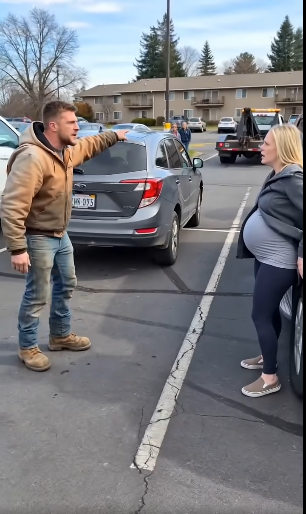
The apartment parking lot was crowded with people coming home from work.
Everyone could see what was happening.
I tried to tell Brandon it wasn’t the end of the world.
He didn’t answer.
He just stared at the tow truck driver.
The car finally rolled out of the lot.
That’s when Brandon lost control.
He started yelling about bills.
About debt.
About working nonstop and still falling behind.
I begged him to calm down.
People were staring.
He said he was tired of being humiliated.
I told him losing a car didn’t mean losing everything.
That only made him angrier.
I reminded him that our baby still needed us.
The second I mentioned the baby, he stepped closer.
His face was red.
His hands were shaking.
Then he shoved me.
I stumbled backward beside a parked car.
My hands instantly covered my stomach.
The entire parking lot went silent.
Brandon looked horrified.
For a moment, I thought he would apologize.
Then the tow truck suddenly stopped at the exit.
The driver jumped out holding an envelope.
The moment Brandon saw the logo printed on it, his face went completely white because he recognized it immediately.
The logo belonged to Hawthorne & Reed.
The law firm.
The one that had sent letters for nearly fifteen years.
The one Brandon never opened.
The one he always threw away.
The driver jogged across the parking lot.
“Brandon Mercer?” he called.
Nobody spoke.
Brandon looked as though someone had drained all the blood from his body.
The driver held out the envelope.
“You need to sign for this.”
Brandon didn’t move.
“Sir?”
Still nothing.
Finally, with trembling fingers, he grabbed the envelope.
I watched him stare at it.
His expression shifted from anger to fear.
Real fear.
The kind that comes from a ghost returning.
“What’s wrong?” I asked.
He swallowed hard.
“Nothing.”
I knew he was lying.
The driver hesitated.
Then he surprised everyone.
“Actually,” he said, pointing toward the repossessed car, “there’s one more thing.”
Brandon looked up.
“The repo order was canceled ten minutes ago.”
Silence.
The entire parking lot seemed confused.
“What?” Brandon whispered.
The driver nodded.
“Dispatch got a call while I was leaving. Debt cleared in full.”
Nobody understood.
Least of all me.
“Who paid it?” I asked.
The driver shrugged.
“No idea.”
Then he handed Brandon the keys.
And drove away.
Just like that.
The car that had been taken was suddenly ours again.
But nobody celebrated.
Because Brandon was staring at the envelope like it contained a bomb.
And because my stomach still hurt where I’d stumbled.
The crowd slowly dispersed.
People went back to their apartments.
A few lingered.
Watching.
Judging.
Whispering.
I couldn’t blame them.
My husband had shoved his pregnant wife in public.
No amount of returned car keys erased that.
“Open it,” I said quietly.
Brandon looked at me.
Then at the envelope.
Then back at me.
“I can’t.”
“Why?”
His eyes filled with tears.
“I think my father is dead.”
I had been married to Brandon for three years.
In all that time, he never talked about his father.
Not once.
The subject was buried so deeply that I eventually stopped asking.
Now, standing in a parking lot surrounded by fading daylight and scattered shame, the truth was finally clawing its way out.
We went upstairs in silence.
I didn’t let him touch me.
I didn’t let him hold my hand.
The shove replayed in my mind over and over.
Maybe it wasn’t hard.
Maybe he regretted it immediately.
But it happened.
And I couldn’t pretend otherwise.
Inside our apartment, Brandon sat at the kitchen table.
The envelope rested between us.
For several minutes neither of us moved.
Then he opened it.
His hands shook the entire time.
A thick stack of documents slid onto the table.
At the very top was a letter.
Brandon read the first line.
Then froze.
I watched tears form instantly.
“What is it?”
His voice cracked.
“He died three weeks ago.”
The room felt smaller.
Brandon stared at the page.
“He left everything to me.”
I blinked.
“What does that mean?”
He laughed bitterly.
“I don’t know.”
Then he kept reading.
Each sentence seemed to hit him harder than the last.
Finally he handed me the letter.
I scanned it.
And nearly dropped it.
According to the documents, Brandon’s father had owned thousands of acres of land.
Several commercial properties.
Investments.
Trusts.
Businesses.
The estimated estate value exceeded twenty-seven million dollars.
I looked up.
Certain I had misunderstood.
“Twenty-seven million?”
Brandon nodded slowly.
Neither of us spoke.
Our apartment suddenly felt absurd.
The peeling paint.
The broken dishwasher.
The overdue bills stacked beside the microwave.
Twenty-seven million dollars.
It didn’t seem real.
Then I reached the final page.
And found the sentence that changed everything.
Inheritance will be released upon fulfillment of the decedent’s final condition.
I frowned.
“What condition?”
Brandon took the paper.
Read it.
And went pale again.
His father had left a single requirement.
Before Brandon could receive anything, he had to spend thirty consecutive days living at Hawthorne Estate.
His father’s mansion.
The same place he had run away from at seventeen.
The same place he swore never to return.
Three days later we drove through iron gates taller than our apartment building.
The mansion looked less like a home and more like a private museum.
Stone walls.
Massive gardens.
Fountains.
Columns.
Everything screamed wealth.
Yet Brandon looked miserable.
As if every mile closer reopened an old wound.
“Tell me what happened,” I said softly.
He kept his eyes on the road.
“My father wasn’t a monster.”
That wasn’t what I expected.
“Then why leave?”
Brandon exhaled.
“Because everyone thought he was.”
The story emerged slowly.
His father, Arthur Mercer, was one of the richest men in the state.
Powerful.
Respected.
Feared.
When Brandon was sixteen, his mother became ill.
Cancer.
The family fought desperately.
Money bought treatments.
Doctors.
Specialists.
Nothing worked.
She died.
Afterward, Brandon blamed his father.
Arthur buried himself in work.
Brandon interpreted it as indifference.
Arguments escalated.
Eventually Brandon left.
He never returned.
He ignored every letter.
Every phone call.
Every attempt at reconciliation.
Until there were none left.
And now Arthur Mercer was gone.
Waiting for him inside the grave was a fortune.
Waiting for him inside the mansion was something else.
Regret.
The estate manager greeted us.
His name was Walter.
He looked seventy.
Maybe older.
He had worked for Arthur for forty years.
The moment he saw Brandon, tears filled his eyes.
“Master Brandon.”
Brandon flinched.
“Don’t call me that.”
Walter smiled sadly.
“Your father never stopped.”
Those words lingered.
Your father never stopped.
Inside the mansion, everything remained untouched.
Arthur’s favorite chair still faced the fireplace.
Books remained open where he’d left them.
Photographs lined the walls.
Thousands of memories frozen in place.
And everywhere we looked, Brandon appeared.
As a child.
As a teenager.
At birthdays.
Baseball games.
Fishing trips.
Graduations.
Arthur had preserved every moment.
Even after Brandon disappeared.
The realization hit him like a truck.
His father never stopped loving him.
He simply didn’t know how to show it.
That night Brandon cried for the first time since I’d known him.
Not quiet tears.
Not hidden tears.
The kind that come from years of buried grief exploding all at once.
I sat beside him and listened.
No judgment.
No lectures.
Just silence.
Sometimes that’s what healing sounds like.
On the fifth day we discovered the first surprise.
Walter led us to Arthur’s private study.
Inside waited a locked wooden box.
A note sat on top.
For Brandon.
Only Brandon.
He opened it carefully.
Inside were dozens of letters.
Every single one written by Arthur.
One for each birthday Brandon missed.
One for every Christmas.
Every milestone.
Every year apart.
Brandon spent hours reading.
Then days.
Letter after letter revealed the same heartbreaking truth.
Arthur never hated his son.
He blamed himself.
He thought he’d failed as a father.
He thought Brandon left because he wasn’t enough.
The letters were filled with apologies.
Love.
Memories.
Hope.
And one recurring phrase.
If you ever come home, I’ll be waiting.
By the time Brandon finished the last letter, he was shattered.
Because Arthur had waited.
Right until the end.
The next surprise arrived on Day Eleven.
A lawyer visited.
He carried another document.
Another condition.
Arthur had hidden several.
“What now?” Brandon asked.
The lawyer smiled.
“Your father enjoyed puzzles.”
Of course he did.
The condition was simple.
Or so it seemed.
Brandon had to visit one location from his childhood every day for the next week.
Photographic proof required.
That’s it.
No explanation.
No reason.
Just a list.
The old baseball field.
His elementary school.
The lake where they fished.
The diner where they ate pancakes every Saturday.
Each visit unearthed memories.
Good memories.
Memories Brandon had buried beneath anger.
By the end of the week, he wasn’t just remembering his father.
He was remembering the man before grief destroyed their relationship.
The man who taught him to ride a bike.
The man who stayed awake during thunderstorms.
The man who packed school lunches shaped like dinosaurs.
The man who loved him.
And somehow that hurt more.
Meanwhile, I couldn’t stop thinking about the shove.
Brandon had apologized dozens of times.
Every day.
Every hour.
Sometimes without words.
But trust doesn’t repair itself overnight.
Especially with a baby arriving soon.
One evening I found him sitting alone on the back porch.
Staring across the property.
“I don’t deserve any of this,” he said.
I sat beside him.
“The inheritance?”
He nodded.
“The forgiveness.”
The honesty in his voice caught me off guard.
For the first time, he wasn’t defending himself.
Wasn’t making excuses.
“I scared you.”
I didn’t answer.
“You looked at me differently afterward.”
Because I had.
“I’m terrified that’s who I am.”
The admission hung between us.
Raw.
Painful.
Real.
I finally spoke.
“Then make sure it isn’t.”
He nodded.
No arguments.
No self-pity.
Just acceptance.
And from that moment forward, something changed.
Not because of money.
Not because of guilt.
Because he chose to change.
Every day.
Deliberately.
Patiently.
One decision at a time.
Day Twenty-Eight arrived.
Only two days remained before the inheritance would transfer.
Walter requested our presence in the theater room.
Another surprise.
At this point nothing shocked us anymore.
Or so we thought.
A projector flickered to life.
Arthur appeared on screen.
Alive.
Smiling.
Recorded months before his death.
Brandon froze.
My breath caught.
Arthur looked directly into the camera.
“Hello, son.”
Brandon immediately started crying.
The video continued.
Arthur spoke for nearly an hour.
About life.
Regret.
Love.
Mistakes.
He admitted his failures.
He acknowledged the years they lost.
Then he revealed why the inheritance required thirty days.
Because money wasn’t the real inheritance.
Perspective was.
Arthur knew Brandon was struggling financially.
He could have mailed a check.
Instead, he forced his son to return home.
To remember.
To heal.
To understand.
Near the end, Arthur leaned closer.
“There’s one final surprise.”
Brandon laughed through tears.
“Of course there is.”
Arthur smiled.
“If you’re watching this, then your child will be arriving soon.”
My hand instinctively touched my stomach.
Arthur continued.
“I’ve established a trust for my grandchild.”
We exchanged stunned looks.
“A trust valued at ten million dollars.”
I nearly fell out of my chair.
But Arthur wasn’t finished.
“However, the money can never be used by the child until adulthood.”
Smart.
Very smart.
Then he smiled again.
“Because childhood should never depend on wealth.”
The screen faded.
The room remained silent.
Walter was openly crying.
So was I.
So was Brandon.
Even in death, Arthur was still teaching.
Still parenting.
Still loving.
The baby arrived the next morning.
Two weeks early.
Naturally.
Life has a sense of timing.
Labor started at dawn.
Chaos followed.
Hospital staff rushed.
Doctors moved quickly.
Brandon never left my side.
Not once.
Twelve exhausting hours later, our daughter entered the world.
Healthy.
Perfect.
Loud.
The most beautiful sound I’d ever heard.
Brandon held her with trembling hands.
Tears streamed down his face.
“She’s here.”
I nodded.
“She is.”
Then he whispered something I’ll never forget.
“I understand him now.”
I knew exactly who he meant.
Arthur.
Because the moment Brandon looked at his daughter, everything clicked.
The fear.
The love.
The desperation.
The mistakes.
The impossible desire to protect someone forever.
He finally understood his father.
Not through money.
Not through letters.
But through becoming a parent himself.
Three months later the estate transfer was finalized.
The inheritance arrived.
The media found out.
Stories spread.
Headlines appeared.
Local reporters called constantly.
Nobody knew the full truth.
They saw a poor man become wealthy overnight.
They didn’t see the years of grief behind it.
Or the lessons.
Or the pain.
Or the forgiveness.
Brandon surprised everyone again.
Including me.
He sold most of the commercial assets.
Donated millions to cancer research in his mother’s name.
Created scholarships.
Funded shelters.
Opened financial assistance programs for struggling families.
People called him generous.
But I knew the real reason.
He remembered what it felt like to stand in that parking lot.
Watching life collapse.
Feeling trapped.
Feeling hopeless.
Feeling invisible.
He wanted fewer people to experience that.
One year later we returned to our old apartment complex.
Not because we had to.
Because we wanted to.
The same parking lot.
The same spaces.
The same buildings.
The same memories.
Our daughter sat in her stroller giggling.
Brandon stopped near the spot where everything changed.
The spot where he shoved me.
The spot where the tow truck stopped.
The spot where the envelope appeared.
“I hate this place,” he admitted.
I looked around.
“Why?”
“Because it’s the worst thing I’ve ever done.”
I understood.
Then I took his hand.
“No.”
He looked confused.
I pointed toward our daughter.
“The worst thing would have been learning nothing from it.”
He stared at her.
Then smiled.
A real smile.
The kind that reaches the eyes.
At that moment an older tow truck rolled into the lot.
We both laughed.
Because stepping out of it was the same driver.
He recognized us instantly.
“Well, I’ll be damned.”
We spent twenty minutes talking.
Then he told us something neither of us knew.
Something that left us speechless.
Arthur had arranged everything.
The repossession cancellation.
The timing.
The envelope delivery.
All of it.
Months before his death.
He knew exactly when the final notice would arrive.
He instructed the law firm to wait.
To deliver the inheritance documents at the precise moment Brandon believed he had lost everything.
Not to humiliate him.
To save him.
Arthur’s final gift wasn’t money.
It was hope delivered at the darkest possible moment.
The driver left.
We stood there silently.
Watching the truck disappear.
Just like the first time.
Only now everything was different.
I glanced at Brandon.
“Your father knew you.”
He nodded.
“He really did.”
Then he looked toward our daughter.
“She’ll know me too.”
For a second I saw fear in his eyes.
Not fear of failure.
Fear of repeating old mistakes.
But then he squeezed my hand.
Because now he understood something he never understood before.
Love isn’t proven by perfection.
It’s proven by returning.
By apologizing.
By learning.
By choosing better tomorrow than you did yesterday.
The envelope had arrived on the worst day of our lives.
A day filled with debt, shame, anger, and a mistake neither of us would ever forget.
Yet hidden inside that envelope was something worth far more than twenty-seven million dollars.
A second chance.
And sometimes that’s the richest inheritance a person can ever receive.
