Part 1
I had been awake for almost twenty hours when a patient’s husband changed my life forever.
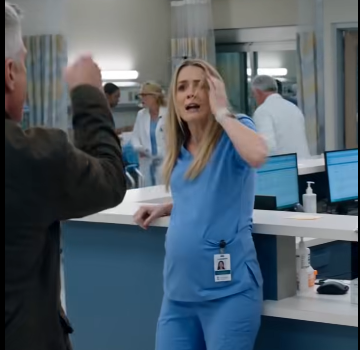
I was seven months pregnant and finishing a brutal shift in the emergency room.
Every bed was full.
Ambulances kept arriving.
Doctors were running from room to room.
The waiting area overflowed with coughing children, elderly patients wrapped in blankets, injured workers holding bloody towels to their arms, and frightened families asking the same question again and again.
“How much longer?”
I wished I had an answer for them.
My name was Claire Bennett, and I had been an ER nurse for eight years. I knew how to keep my hands steady during chaos. I knew how to comfort a mother while her child was rushed to imaging. I knew how to start an IV while alarms screamed around me.
But that night, I was exhausted in a way that reached deep into my bones.
My legs felt swollen and heavy. My lower back ached. My daughter kicked beneath my ribs like she was begging me to sit down.
“Claire, take five,” another nurse, Marisol, whispered as she passed me.
“I will,” I lied.
There was no time.
Trauma Room 2 had just received a woman named Rebecca Hale after a serious car accident. She was alive, but unstable. The doctors were working fast, and every update was uncertain.
Her husband, Grant Hale, had arrived minutes later.
He came in wearing an expensive coat, his hair disheveled, his face twisted with panic and rage.
“Where is my wife?” he demanded at the nurses’ station.
I looked up from the charting computer.
“Sir, the doctors are treating her right now.”
“I asked where she is.”
“She’s in a trauma room. You can’t go in yet.”
His jaw clenched. “I’m her husband.”
“I understand,” I said softly. “But the team needs space to work. As soon as there’s an update, someone will come speak with you.”
His eyes narrowed. “Is she dying?”
I paused.
I hated moments like that.
Families wanted certainty, but medicine did not always offer it.
“She is seriously injured,” I said carefully. “The doctors are doing everything possible.”
“That’s not an answer.”
“It’s the most honest answer I can give right now.”
He slammed his palm on the counter.
Several people in the waiting area turned.
My hand moved automatically to my stomach.
“Sir,” I said, keeping my voice calm, “I know you’re scared. But I need you to lower your voice.”
“Don’t tell me what to do.”
“I’m trying to help you.”
“No,” he snapped. “You’re hiding something.”
“I don’t have any more information yet.”
“That’s convenient.”
Behind me, Marisol reached for the phone to call security.
Grant saw her movement and pointed at her.
“Don’t you dare.”
“Sir,” I said again, “please step back.”
He leaned closer.
His breath smelled like coffee and panic.
“You people killed my brother,” he hissed.
The words froze me.
“I don’t know what you mean.”
“Of course you don’t.”
“Mr. Hale—”
“My brother came into this hospital six months ago, and he never came out.”
I swallowed.
“I’m sorry for your loss.”
His face changed.
It was as if my sympathy insulted him.
“Don’t you say that to me.”
I kept one hand on the counter and one hand near my stomach.
“Security is coming. Please sit down.”
That was the wrong thing to say.
His hand shot out before I could move.
He shoved me hard in the shoulder.
I stumbled backward.
My hip hit the chair behind me.
The entire emergency room went silent.
For one terrifying second, I felt myself losing balance.
I grabbed the counter with both hands and managed to stay upright.
A sharp pain shot through my abdomen.
My breath vanished.
Then my baby kicked.
Once.
Twice.
I gasped, half in pain and half in relief.
“Claire!” Marisol screamed.
Doctors rushed toward us.
Several visitors pulled out their phones.
Grant Hale stood frozen, staring at his own hand like he couldn’t believe what he had done.
He looked around and realized everyone had seen it.
Patients.
Nurses.
Families.
Security cameras.
Phones.
Everyone.
Then an older physician stepped out of a nearby treatment room.
Dr. Samuel Whitaker.
He had worked at the hospital longer than almost anyone. Calm, respected, careful with every word.
But the moment he saw Grant Hale, his face went pale.
The doctor froze.
Grant looked at him.
His rage disappeared.
Fear replaced it.
“Dr. Whitaker,” Grant whispered.
The room seemed to tighten around them.
Dr. Whitaker reached slowly into the inside pocket of his coat and pulled out a sealed file.
“I was coming to administration with this tonight,” he said, his voice low but clear. “I never expected to see you here.”
Grant shook his head.
“No.”
Dr. Whitaker lifted the file.
“These records finally prove the truth about your brother’s death.”
Grant’s face crumbled.
And every person in the ER waited to hear what truth had been buried for six months.
Part 2
Security arrived and moved between Grant and me.
Marisol held my arm, her eyes scanning my face.
“Claire, sit down.”
“I’m okay,” I said.
But I wasn’t.
My shoulder throbbed where Grant had shoved me. My abdomen felt tight. My heart was pounding so violently I could barely hear anything beyond the blood rushing in my ears.
Dr. Whitaker looked at me.
“Get her into an exam room,” he ordered. “Fetal monitoring now.”
“I can keep working,” I said automatically.
He gave me the kind of look only an old ER doctor could give.
“No, you cannot.”
Two nurses guided me away.
As they helped me onto a bed, I heard Grant’s voice break in the hallway.
“What do you mean the truth?”
Dr. Whitaker answered, “Your brother wasn’t killed by this hospital.”
A silence followed.
Then Grant shouted, “You’re lying.”
I couldn’t see them anymore, but I could hear every word through the half-open door.
“Your brother, Daniel Hale, came in with severe chest pain,” Dr. Whitaker said. “You accused the ER staff of ignoring him. You filed complaints. You gave interviews. You destroyed careers.”
“My brother died waiting!”
“No,” Dr. Whitaker said. “He died because someone had given him medication that caused a fatal interaction with the drugs already in his system.”
Grant’s voice dropped.
“What?”
“There were toxicology inconsistencies. The original report was incomplete. I requested an independent review.”
I stared at the ceiling as a monitor was strapped around my belly.
The nurse beside me, Aisha, adjusted the sensor.
“Baby’s heartbeat is strong,” she whispered.
Tears filled my eyes before I could stop them.
Strong.
That one word held me together.
Outside, Dr. Whitaker continued.
“The file shows your brother had a rare blood-thinning medication in his system. It was not prescribed by this hospital. It was not administered here.”
Grant sounded smaller now.
“That’s impossible.”
“It was found in pills from a bottle brought from his home.”
“I don’t understand.”
Dr. Whitaker hesitated.
When he spoke again, his voice was heavier.
“The prescription was written under your name, Mr. Hale.”
My room went still.
Even Aisha stopped moving.
Grant said nothing.
Dr. Whitaker continued, “Your brother took medication meant for you, or medication obtained by you. Whether knowingly or by mistake, that is what caused the fatal reaction.”
“No,” Grant whispered. “No, he wouldn’t.”
“The evidence is here.”
Papers rustled.
Grant’s voice cracked.
“I didn’t know. I didn’t know he took them.”
“That may be true,” Dr. Whitaker said. “But you blamed innocent people. And tonight you assaulted a pregnant nurse because you were angry at the wrong target.”
A chair scraped sharply against the floor.
Grant was either sitting down or collapsing.
I turned my face away and cried silently.
Not from pity for him.
Not exactly.
But from the weight of it all.
Six months of rage.
One dead brother.
One injured wife.
One shove that could have harmed my baby.
All of it born from grief sharpened into a weapon.
A few minutes later, my obstetrician was called. More monitoring followed. My blood pressure was high, so they kept me under observation.
Around midnight, Dr. Whitaker came into my room.
He looked older than he had an hour earlier.
“Claire,” he said gently, “how are you feeling?”
“Sore. Scared.”
He nodded. “The baby?”
“Strong heartbeat.”
“Good.”
I looked toward the hallway. “What happened to him?”
“Security is holding him until police arrive.”
“His wife?”
“Still in surgery.”
I closed my eyes.
No matter what Grant had done, Rebecca was still an injured woman fighting for her life.
Dr. Whitaker stood beside my bed.
“I’m sorry,” he said.
“You didn’t shove me.”
“No. But this hospital should have protected you faster.”
I placed a hand over my stomach.
“What was in that file?”
He was quiet for a moment.
“Proof that Daniel Hale’s death was not malpractice. Proof that several people were blamed for something they didn’t do.”
I opened my eyes.
“Who?”
Dr. Whitaker’s expression darkened with regret.
“A resident lost her position. A nurse transferred out after threats. A young doctor nearly quit medicine.”
“And Grant did all that?”
“His accusations started it,” he said. “But the truth is more complicated. The hospital administration let the staff take the damage because it was easier than fighting a grieving, powerful family.”
I felt cold.
Even under the hospital blanket.
“So why reveal it now?”
Dr. Whitaker looked down at the sealed file in his hands.
“Because I should have done it sooner.”
Part 3
Grant Hale was arrested before dawn.
The police took statements from staff, patients, and visitors. They collected security footage. They took copies of phone videos from people who had recorded the assault.
I hated the word assault.
It made the moment sound both bigger and more real.
Until someone said it, part of me had tried to shrink it.
He was scared.
He didn’t mean it.
I didn’t fall.
The baby was okay.
But when the officer asked me to describe what happened, I heard my own voice say, “He shoved me while I was seven months pregnant.”
And there it was.
The truth did not become less serious just because the worst outcome had not happened.
Rebecca Hale survived surgery.
That news reached me in the morning.
She was critical but stable.
Grant was not allowed near her room.
I was discharged that afternoon with strict instructions to rest for several days. My supervisor, Karen, drove me home because my husband, Michael, was out of town for work and trying desperately to catch the first flight back.
When I walked into my apartment, the silence broke me.
I sat on the couch and sobbed.
I cried for my baby.
For my aching body.
For the exhaustion.
For every nurse who had ever stood between fear and a family’s anger with nothing but a calm voice and a badge clipped to her scrubs.
Michael arrived late that night.
The second he stepped through the door, he dropped his suitcase and wrapped his arms around me.
“I should have been here,” he whispered.
“You didn’t know.”
“I’m sorry.”
I pressed my face into his chest.
“For a second, I thought I was going to fall.”
His arms tightened.
“But you didn’t.”
“No,” I said. “But I keep feeling it.”
Over the next week, the story spread.
A pregnant ER nurse shoved by a patient’s husband.
A respected doctor revealing hidden evidence.
A powerful family’s accusations unraveling in public.
Reporters called the hospital.
Administrators suddenly became very concerned about staff safety.
They sent emails with words like support, transparency, and zero tolerance.
The same people who had ignored years of complaints about violence in the ER now wanted to stand in front of cameras and promise change.
Marisol visited me with soup and gossip.
“They’re terrified,” she said, setting the container on my table. “Not because you got hurt. Because everyone saw it.”
I gave a tired laugh. “That sounds about right.”
Then her expression softened.
“Claire, Dr. Whitaker resigned.”
I sat up. “What?”
“He submitted his resignation this morning.”
“Why?”
“He said he failed the staff by staying silent.”
My chest tightened.
Dr. Whitaker had always seemed like part of the hospital itself. Someone permanent.
“He’s taking the file public?”
Marisol nodded.
“And the resident who lost her position? Her name was Dr. Priya Shah. He’s trying to get her reinstated.”
I remembered Priya.
Brilliant. Gentle. Always running on coffee and determination.
She had disappeared months ago after rumors spread that she had mishandled Daniel Hale’s case.
I never knew the whole story.
None of us did.
That evening, Dr. Whitaker called me.
“I wanted you to hear from me,” he said.
“Marisol told me.”
“I’m sorry.”
“Are you leaving because of what happened to me?”
“I’m leaving because what happened to you forced me to stop pretending delay was harmless.”
I sat quietly.
He continued, “I had evidence weeks ago. Not complete, but enough to push harder. I waited because I wanted the file perfect.”
“And tonight made it perfect?”
“No,” he said. “Tonight made me ashamed.”
I didn’t know what to say.
Finally, I asked, “What happens now?”
“Now the truth comes out.”
Part 4
The truth came out in pieces.
First, the hospital released a statement admitting that Daniel Hale’s death had been misrepresented in internal reviews.
Then Dr. Whitaker testified before the medical board.
Then Dr. Priya Shah’s name appeared in the news.
She had been the resident blamed for delays in Daniel’s care. According to the corrected records, there had been no fatal delay. Daniel had arrived in a condition already spiraling out of control because of the medication interaction.
Priya had done everything right.
But Grant Hale’s grief had needed a target.
The hospital had offered one.
Her.
When I saw Priya’s interview online, I cried.
She sat in front of the camera with her hands folded tightly in her lap.
“I lost my residency, my confidence, and almost my future,” she said. “But the worst part was knowing the truth was somewhere in the records and no one was brave enough to defend it.”
I replayed that sentence three times.
No one was brave enough to defend it.
A week later, I received a letter.
It came from Rebecca Hale.
Her handwriting was shaky.
Dear Claire,
I have been told what my husband did to you.
I have also seen the footage.
I do not expect you to care about my apology, but I need to give it anyway.
I am sorry.
Grant has lived inside rage since Daniel died. I begged him to get help. I begged him to stop blaming everyone. But I also stayed silent when he threatened hospital staff. I told myself grief made people temporary strangers.
That was cowardice.
You were hurt while caring for others.
You deserved protection.
Your baby deserved protection.
I hope you both heal.
Rebecca Hale.
I placed the letter on the kitchen table and stared at it for a long time.
Michael read it once.
Then he said, “How do you feel?”
“Tired.”
“Of her?”
“Of everyone apologizing after someone gets hurt.”
He nodded.
That was the thing about apologies.
They mattered.
But they always arrived after the sound of something breaking.
The next month, I was invited to speak at a hospital safety meeting.
At first, I refused.
I did not want to become a symbol.
I wanted naps, quiet, and a healthy baby.
But then Marisol called.
“Claire,” she said, “they’ll listen to you right now. They should have listened before, but they’ll listen now.”
So I went.
My belly was round and heavy beneath a navy maternity dress. Michael sat in the front row. Marisol sat beside him.
Hospital executives lined one side of the room.
Nurses, doctors, techs, and security officers filled the rest.
I stood at the podium, my hands trembling.
“I am not here because I am brave,” I began. “I am here because I was lucky.”
The room went silent.
“I was lucky I grabbed the counter. I was lucky my baby was okay. I was lucky there were witnesses. But safety cannot depend on luck.”
I looked directly at the administrators.
“We are trained to de-escalate. We are trained to stay calm. We are trained to understand fear. But we should not be trained to accept violence as part of the job.”
Someone in the back whispered, “Yes.”
I continued.
“Patients and families deserve compassion. Staff deserve protection. Those two truths do not cancel each other out.”
By the time I finished, my voice had stopped shaking.
And for the first time since that night, I felt like the counter was not the only thing holding me up.
Part 5
The hospital changed after that.
Not overnight.
Not perfectly.
But enough that people noticed.
Security was stationed inside the ER instead of two hallways away. Panic buttons were installed at the nurses’ station. Families received clearer updates during trauma cases. Staff were trained to report threats before they became physical.
Most importantly, administrators could no longer bury incidents in quiet paperwork.
There was a board now.
Names.
Dates.
Actions taken.
Visibility.
Accountability.
Marisol called it “the wall of no more pretending.”
Dr. Priya Shah was reinstated into her residency program after a formal review.
On her first day back, the ER staff lined the hallway and applauded.
She cried before she even reached the nurses’ station.
“I’m going to ruin my mascara,” she said, laughing through tears.
“You’re a doctor,” Marisol told her. “You can treat that.”
Priya hugged me carefully because my belly was enormous by then.
“You don’t know what your testimony did for me,” she whispered.
“It was Dr. Whitaker’s file.”
“It was your voice that made them unable to hide it again.”
I didn’t feel powerful.
I felt tired and swollen and scared most days.
But I understood something I hadn’t before.
Sometimes power was not a loud thing.
Sometimes it was simply refusing to let silence be convenient for someone else.
Grant Hale pleaded guilty to assault.
His lawyers tried to frame it as a moment of grief, a man overwhelmed by his wife’s accident and his brother’s death.
The judge listened.
Then she watched the footage.
In the video, I could see myself standing at the nurses’ station, pale and exhausted, one hand near my stomach.
I could see him step forward.
I could see the shove.
I could see the shock on everyone’s faces.
The judge ordered probation, mandatory counseling, community service, and a no-contact order. He was also required to make a public apology to the staff he had accused and threatened.
Some people said the sentence was too light.
Others said he had suffered enough.
I stopped trying to measure justice by other people’s opinions.
I knew only this: he was finally forced to face what his anger had done.
Rebecca recovered slowly.
She filed for separation while still in rehabilitation.
That news came from Marisol, who somehow knew everything before anyone else did.
“Good for her,” she said.
I nodded.
Then, two weeks before my due date, I went into labor.
It started at 3:12 in the morning with a cramp that made me sit upright in bed.
Michael panicked immediately.
“Is it time?”
“No,” I said.
Then another contraction hit.
I gripped his wrist.
“Maybe.”
At the hospital, I was not a nurse.
I was just a woman in pain, afraid and hopeful, holding her husband’s hand while the world narrowed to breath, heartbeat, and the promise of a first cry.
After eleven hours, my son was born.
We named him Noah.
He was small, pink, furious, and perfect.
When the nurse placed him on my chest, I whispered the first words that came to me.
“You made it.”
Michael kissed my forehead.
“So did you.”
Part 6
Maternity leave changed me.
For weeks, my world became milk, diapers, sleep in broken pieces, and the warm weight of Noah curled against my chest.
The ER felt far away.
The shouting.
The alarms.
The shove.
The sealed file.
All of it belonged to another life.
But trauma has a way of knocking softly long after the door has closed.
Sometimes, when Michael moved too quickly behind me, I flinched.
Sometimes, when Noah cried hard, my heart raced as if I were back under fluorescent lights with Grant Hale leaning over the counter.
One afternoon, I broke down while folding tiny blue onesies.
Michael found me sitting on the laundry room floor.
“I’m not okay,” I whispered.
He sat beside me without trying to fix it.
“I know.”
“I thought once the baby was born, I would feel safe again.”
He took my hand.
“Then we’ll get help until you do.”
So I did.
Therapy was not dramatic.
There were no sudden revelations.
Just slow, honest work.
I learned that surviving something was not the same as healing from it.
I learned that my body remembered the fear even when my mind wanted to move on.
And I learned that rest was not weakness.
Three months after Noah was born, I received an email from Dr. Whitaker.
He was no longer practicing emergency medicine.
Instead, he had joined a patient safety organization and was helping hospitals build better systems for transparency and staff protection.
At the bottom of his message, he wrote:
I hope Noah grows up in a world where caring for others does not require accepting harm.
I printed that sentence and kept it in my journal.
A few weeks later, Priya visited with a stuffed elephant for Noah.
She looked healthier than I remembered. Lighter somehow.
“I matched into emergency medicine again,” she said.
My eyes widened. “You still want the ER after everything?”
She smiled.
“I do. But I want to help build a better one.”
Noah yawned in her arms.
Priya looked down at him.
“You know, your mom changed a hospital.”
I laughed softly. “Your mom is mostly trying to shower before noon.”
“Both can be true.”
That became one of my favorite sentences.
Both can be true.
I could be strong and frightened.
Angry and compassionate.
A nurse and a patient.
A survivor and a mother.
A person still healing and a person still moving forward.
Part 7
One year after the assault, the hospital held a ceremony for the new emergency department safety program.
I almost didn’t go.
Ceremonies made me uncomfortable. They polished pain into speeches and plaques. They made messy stories look clean.
But Marisol insisted.
“You have to come,” she said. “They’re naming the training room after you.”
“What?”
“Relax. Not your full name. The Bennett Staff Safety Center.”
“That is my full name.”
“Then wear something nice.”
I went because the program mattered.
Not because of the plaque.
The room was full of staff, families, and reporters. Noah sat on Michael’s lap wearing a tiny sweater vest that made him look like a very serious accountant.
Dr. Whitaker was there.
So was Priya.
Even Rebecca Hale came.
She stood near the back with a cane, thinner than before, her face pale but calm.
When our eyes met, she gave a small nod.
I returned it.
Grant was not there.
I was grateful.
The hospital director gave a speech about lessons learned. It was polished, careful, and slightly too long.
Then Priya spoke.
“Systems fail when truth becomes inconvenient,” she said. “People get hurt when reputation matters more than accountability. I know because it happened to me. Claire knows because it happened to her. This center exists so it happens less often to others.”
Then Dr. Whitaker stepped up.
He looked at me.
“I carried a file in my coat pocket for too long,” he said. “Evidence does not protect anyone while it remains hidden. Truth must move.”
The room was silent.
Finally, I was asked to say a few words.
I stood at the microphone with Noah on my hip.
He immediately grabbed the microphone.
A ripple of laughter moved through the room.
I gently pulled it away.
“I don’t have a long speech,” I said. “I just want this room to remember why it exists.”
I looked at the nurses standing along the wall.
“It exists because calm voices should not be mistaken for consent to be harmed. It exists because compassion needs boundaries. It exists because the people who care for the frightened, grieving, angry, and injured are human beings too.”
Noah babbled loudly.
Everyone laughed again.
I kissed the top of his head.
“And it exists because every person who comes through those doors deserves a safer place than the one we had that night.”
After the ceremony, Rebecca approached me.
“I won’t take much of your time,” she said.
I nodded.
She looked at Noah.
“He’s beautiful.”
“Thank you.”
Her hands tightened around the handle of her cane.
“I left Grant.”
“I heard.”
“He’s in treatment. I hope he changes. But I couldn’t keep living inside his anger.”
I studied her face.
“You deserved safety too.”
Tears filled her eyes.
“So did you.”
For a moment, neither of us spoke.
Then she handed me a small envelope.
“It’s not from him,” she said quickly. “It’s from me.”
Inside was a donation receipt.
She had donated to the new safety center in Daniel Hale’s name.
I looked up.
Rebecca’s voice trembled.
“My brother-in-law’s death caused so much damage. I wanted his name attached to protection instead of blame.”
I folded the paper carefully.
“That matters.”
She nodded, crying quietly.
Then she walked away.
Part 8
Years later, people still asked about the night everything changed.
They asked about Grant Hale.
They asked about the sealed file.
They asked whether I forgave him.
I never had a simple answer.
Forgiveness was not a switch.
It was not a gift owed to anyone.
It was not the same thing as forgetting.
What I knew was this: I stopped letting that moment decide the shape of my life.
I returned to the ER when Noah was eight months old.
The first shift back, I stood outside the ambulance bay for nearly ten minutes before going in.
Marisol found me there.
“You okay?”
“No.”
She linked her arm through mine.
“Want to go in not okay?”
I laughed.
Then I cried.
Then we went in together.
The ER was still the ER.
Messy.
Loud.
Urgent.
Alive.
But it was different too.
Security stood where we could see them.
Families received updates before fear boiled into fury.
Staff reported threats without being told they were overreacting.
The Bennett Staff Safety Center trained new nurses, doctors, and techs every month.
On the wall inside hung a framed sentence from Dr. Whitaker:
TRUTH MUST MOVE.
Beside it was a photo of the old nurses’ station counter.
The place where I had caught myself before I fell.
The place where I learned that survival could become change.
One evening, near the end of a shift, a young pregnant nurse named Tessa came to me after a patient’s son yelled at her.
Her hands were shaking.
“I’m sorry,” she said. “I know I should be tougher.”
I put down my chart.
“No,” I said. “You should be protected.”
Her eyes filled with tears.
I walked with her to file the report.
Not later.
Not after it got worse.
Right then.
That was the difference.
Years before, I had grabbed a counter to keep from falling.
Now I helped someone else stand before she had to.
At home that night, Noah ran to me with sticky hands and a dinosaur pajama shirt.
“Mommy!”
I lifted him carefully, even though he was getting too big for it.
Michael smiled from the kitchen.
“Long shift?”
“Always.”
Noah pressed both hands to my cheeks.
“Did you help people?”
I kissed his forehead.
“Yes.”
“Did people help you?”
I looked at Michael.
Then I thought of Marisol, Priya, Dr. Whitaker, Rebecca, the nurses who stood beside me, and every person who refused to let the truth stay sealed in a file.
“Yes,” I said softly. “They did.”
That night, after Noah fell asleep, I opened the small box where I kept pieces of the past.
My hospital bracelet from the night he was born.
A copy of my speech.
A photo of Priya on her reinstatement day.
And one printed still from the ER security footage.
Not the shove.
Not Grant’s rage.
The frame after it.
The moment when everyone moved toward me.
Doctors.
Nurses.
Patients.
Strangers.
Proof that harm had happened, yes.
But also proof that I had not stood alone.
I closed the box and placed it back on the shelf.
The past remained there.
Contained.
Remembered.
No longer in control.
And somewhere across the city, inside a hospital that had once chosen silence, a new nurse was learning the rule that should have existed all along:
Care for the patient.
Protect the caregiver.
And never let the truth stay sealed.
