The envelope felt heavier than paper should have.
I held it against my chest with both hands, one palm over the thick cream seal, the other resting protectively beneath the curve of my pregnant belly. The baby had been restless all morning, kicking as if she could feel the storm waiting for us inside the Langford house.
Maybe she could.
Maybe children sense danger before adults admit it.
My husband, Daniel, drove beside me in silence. His jaw was tight. His black suit still smelled faintly of rain and church incense from the funeral. Every few minutes, he glanced at the envelope in my lap, not with greed, but worry.
“You don’t have to be the one to carry it in,” he said quietly.
I looked at him. “Your grandfather gave the attorney my name.”
“I know.”
“Then there must be a reason.”
Daniel exhaled, his fingers tightening on the steering wheel.
There was always a reason with Elias Langford.
Even dead, the old man seemed to move pieces across the board.
He had been Daniel’s grandfather, but to me, he had been the first person in that family who made me feel like I belonged. While my mother-in-law, Vivian, treated me like a temporary mistake Daniel would eventually regret, Elias had called me “the only honest soul in a house full of polished knives.”
I used to laugh when he said that.
Now I understood he had not been joking.
Two hours earlier, after the burial, his attorney, Mr. Whitcomb, had pulled me aside beneath the dripping branches of the cemetery oak.
He was an old man with silver eyebrows and tired eyes.
“Mrs. Langford,” he said, placing the envelope in my hands, “your grandfather-in-law left strict instructions. You are to keep this sealed until every immediate family member is gathered in the drawing room.”
“Why me?” I asked.
Mr. Whitcomb looked toward the line of black cars where Vivian stood stiffly under an umbrella, watching us like a hawk.
“Because,” he said, “Elias trusted you to do what others would not.”
Then he lowered his voice.
“No matter what happens, do not give this envelope to Vivian.”
A chill moved through me.
Now, as Daniel pulled into the circular driveway of the Langford estate, I saw Vivian waiting at the entrance.
Not grieving.
Not trembling.
Waiting.
Her black dress was immaculate, her pearls glowing against her throat, her silver-blond hair twisted into its usual perfect knot. Behind her, relatives crowded near the doorway: cousins, uncles, wives, grown grandchildren, everyone dressed in mourning and expectation.
But Vivian’s eyes were fixed only on the envelope.
Daniel parked.
Before he could come around to help me, Vivian descended the front steps.
“Give it to me,” she said.
No hello.
No condolences.
No “are you all right?”
Just the will.
I stepped out carefully, one hand braced on the car door.
“Mr. Whitcomb said it has to be opened in front of everyone.”
“I am everyone who matters.”
Daniel came around the car. “Mother.”
Vivian ignored him.
Her eyes burned into mine.
“Hand it over, Clara.”
“No.”
The word came out softer than I wanted, but it held.
A flicker of something ugly crossed her face.
“You have no idea what you’re holding.”
“I know exactly what I’m holding. Your father-in-law’s final instructions.”
“My father-in-law?” she hissed. “I took care of that man for thirty years.”
That was a lie.
Servants had cared for Elias. Nurses had cared for him. Daniel had visited every week. I had sat beside his bed, reading old detective novels while Vivian hosted charity lunches downstairs and complained about the smell of medicine.
But I said nothing.
Sometimes silence is the only dignity left in a room full of lies.
Vivian stepped closer.
“Give me the envelope.”
“No.”
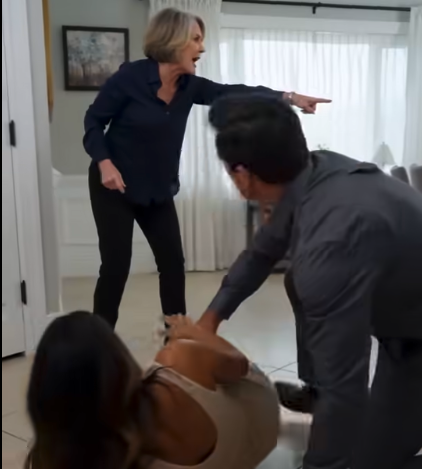
Her hand shot out.
Daniel moved, but not fast enough.
Vivian shoved me.
Hard.
The world tilted.
My heel caught on the edge of the mat. My arms flailed. The envelope slipped from my hands as I crashed backward onto the cold tile of the foyer.
Pain burst through my hip.
Someone screamed.
Daniel shouted my name.
For one terrifying second, all I could think was the baby.
My baby.
I clutched my stomach, gasping.
“Clara!” Daniel dropped to his knees beside me. “Are you hurt? Talk to me.”
“I’m okay,” I whispered, though I wasn’t sure. “I think—I think she’s moving.”
The baby kicked once beneath my palm.
Relief flooded me so sharply I nearly sobbed.
But the room had gone silent for another reason.
The envelope had landed near the foot of the staircase.
The red wax seal had cracked.
The flap had torn open.
Pages spilled across the marble like white birds shot from the sky.
Vivian lunged.
Not toward me.
Toward the papers.
That was when everyone saw her clearly.
Not a grieving widow-in-law.
Not a dignified matriarch.
A desperate woman crawling for a dead man’s words as if they could kill her.
But Aunt Margaret reached the first page before Vivian did.
Margaret Langford was Elias’s younger sister, eighty-one years old and sharp enough to make grown men regret speaking. She lifted the page with trembling fingers.
“Margaret,” Vivian said, voice low. “Give that to me.”
Aunt Margaret adjusted her glasses.
Then she began to read.
Her face changed.
The wrinkles around her mouth deepened. Her eyes widened. Her lips parted, but no sound came.
“What is it?” Daniel asked.
Aunt Margaret looked at Vivian.
For the first time in all the years I had known her, Vivian looked afraid.
Margaret read aloud.
“I, Elias Montgomery Langford, being of sound mind and final patience, hereby leave the largest portion of my estate, including Langford House, the northern vineyards, and seventy percent of the family trust, to my firstborn child, Samuel Langford.”
The foyer erupted.
“Samuel?” someone whispered.
“Who is Samuel?”
“Elias had no son named Samuel.”
Vivian staggered back as if the name itself had struck her.
Aunt Margaret’s hands shook.
Daniel looked from her to his mother. “Who is Samuel?”
Vivian’s mouth opened.
Nothing came out.
Then a voice spoke from the hallway.
“I am.”
Every head turned.
A man stood near the servants’ entrance.
He was tall, thin, wearing a simple dark coat still damp from rain. His hair was gray at the temples. His face was lined, tired, and painfully familiar.
Because he looked like Elias.
Not a little.
Not in passing.
He had Elias’s eyes.
The same storm-gray eyes that seemed to notice everything.
Mrs. Vale, the housekeeper, covered her mouth and began to cry.
Daniel slowly stood.
“Who are you?”
The man stepped forward.
“My name is Samuel Reed.”
Vivian whispered, “No.”
Aunt Margaret looked like she might collapse. “Sammy?”
The man’s eyes filled with tears.
“Hello, Aunt Maggie.”
That broke something in the room.
People started talking over one another. Cousins demanded answers. Daniel stood frozen beside me, one hand still gripping mine.
Vivian suddenly found her voice.
“He’s lying.”
Samuel looked at her.
“No, Vivian. You are.”
Her face twisted. “You don’t belong here.”
He gave a sad smile. “That is exactly what you told everyone, isn’t it?”
Mr. Whitcomb entered then, breathless, carrying his leather briefcase.
“I see the envelope has been opened.”
Vivian spun toward him. “This is invalid. She opened it early.”
“She did not,” Daniel snapped. “You shoved my pregnant wife to the floor.”
A hush followed.
For the first time, Daniel’s voice carried not hurt, not restraint, but disgust.
Vivian flinched as if her own son had slapped her.
Mr. Whitcomb calmly retrieved the remaining pages.
“The will anticipated interference,” he said.
“Anticipated?” Vivian repeated.
“Yes. Mr. Langford included a clause stating that if the seal was broken through force, coercion, theft, or intimidation, the will remained valid and the person responsible would be disqualified from receiving any personal bequest.”
Everyone looked at Vivian.
Her pearls trembled against her throat.
Mr. Whitcomb continued, “There is also a recorded statement.”
He opened his briefcase and removed a small device.
Vivian lunged.
Daniel caught her wrist.
“No,” he said.
One word.
Final.
Mr. Whitcomb pressed play.
Elias’s voice filled the foyer.
Weak.
Raspy.
Alive.
“If you are hearing this, then I am finally beyond Vivian’s reach.”
A sob escaped Aunt Margaret.
“My family deserves the truth. Samuel is my son. My firstborn. His mother, Rose Reed, was the woman I loved before duty, pride, and cowardice made me marry into expectation instead of happiness.”
Samuel lowered his head.
Elias continued.
“I searched for him too late. By the time I found Rose, she was dying. She begged me to protect our boy from the Langford name. I failed her once. I would not fail her twice.”
Vivian’s face had turned gray.
“But when Samuel was twelve, he came to this house. He stood at the kitchen door with a letter from his mother. Vivian found him first.”
Aunt Margaret whispered, “Oh, God.”
Elias’s voice cracked.
“She told him I had rejected him. She told the staff he was a thief. She burned Rose’s letter and sent him away in the rain.”
Samuel shut his eyes.
I remembered suddenly something Elias once told me while staring out the library window.
“Some doors close with a sound only children remember.”
At the time, I thought he meant regret.
Now I knew he meant Samuel.
The recording continued.
“For forty years, I believed my son had vanished because he hated me. Only recently did I learn the truth. Clara found the first thread without knowing what she had found.”
I stiffened.
Me?
Daniel looked down at me.
Elias said, “She noticed the old blue scarf in the east attic trunk. She asked why the initials R.R. were stitched beside mine. No one else had cared enough to ask. That question led me back to Rose. Then to Samuel.”
I remembered the scarf.
A faded blue thing tucked beneath moth-eaten letters. I had asked Elias about it over tea. His hand had shaken so badly the cup rattled.
He had told me, “Some memories are not dead. Only buried.”
I had not understood.
Mr. Whitcomb stopped the recording briefly.
“There is more,” he said.
Vivian whispered, “Please.”
But nobody moved to protect her.
Not even her daughters.
Not even the cousins who had lived off her approval for decades.
The recording resumed.
“To my family: if you want someone to blame, blame me first. I was weak. But blame Vivian next, because she profited from my weakness. She kept Samuel out not to protect the family, but to protect her own children’s inheritance.”
Daniel’s face hardened.
Elias’s voice softened.
“To Clara, I leave my gratitude. You were kind to an old man when kindness could earn you nothing. Because of you, the truth found its way home.”
Tears blurred my vision.
“To Daniel, my grandson, I leave the choice I should have made years ago. Stand with truth, even when it costs you comfort.”
Daniel squeezed my hand.
Then came the final sentence.
“To Vivian, I leave nothing but the mercy she denied a hungry child.”
The recording ended.
Nobody spoke.
Outside, rain tapped against the windows like impatient fingers.
Vivian stared around the foyer, searching for an ally.
Finding none.
Then she pointed at Samuel.
“He came for money.”
Samuel shook his head. “I came because Elias asked me to.”
“You want everything!”
“I wanted a father.”
The words silenced the room more completely than the will had.
Vivian looked small then.
Not innocent.
Never innocent.
But exposed.
All the power she had worn like jewelry had fallen away, and underneath was only fear.
Daniel helped me to my feet despite my protest.
“We’re going to the hospital,” he said.
“I’m fine.”
“You fell.”
“I said I’m fine.”
“And I said we’re going.”
His voice broke slightly.
That, more than anything, softened me.
He looked terrified.
Not of the will.
Not of the money.
Of losing us.
As he guided me toward the door, Samuel stepped aside.
His eyes dropped to my belly.
“Is she all right?”
“She kicked,” I said.
He smiled faintly. “Strong girl.”
Aunt Margaret crossed the foyer and touched his cheek.
“My God,” she whispered. “You have his eyes.”
Samuel tried to smile, but grief moved through him instead.
“I used to hate them.”
“Don’t,” she said. “He spent his last years trying to earn the right to look at you.”
At the hospital, the doctors confirmed the baby was safe.
Bruising, shock, elevated stress—but safe.
Daniel cried when he heard the heartbeat.
He pressed his forehead to my hand and whispered, “I should’ve stopped her.”
“You tried.”
“I should’ve stopped her years ago.”
That was the real confession.
Because Vivian had been cruel for years, and Daniel had always softened it, excused it, survived it. He had mistaken endurance for peace.
“I’m done,” he said.
“With what?”
“With pretending my mother’s love isn’t a cage.”
Three weeks later, Vivian contested the will.
She lost.
Mr. Whitcomb had prepared everything.
DNA evidence.
Rose Reed’s surviving hospital records.
Letters.
Witness statements from former staff.
Even a diary entry from a maid who had seen Vivian send a crying boy away from the kitchen entrance during a thunderstorm.
The court did not hesitate.
Samuel inherited the estate.
Vivian was removed from Langford House before spring.
But the biggest surprise came after.
Samuel did not move into the mansion.
Instead, he turned it into something Elias had secretly outlined in a final charitable trust: a home for young mothers with nowhere safe to go.
“Rose House,” Samuel named it.
After his mother.
The northern vineyards became a funding source for the charity. The old drawing room, where generations had fought over bloodlines and money, became a nursery with yellow walls and soft curtains.
Aunt Margaret moved into the west cottage and began teaching women how to balance checkbooks, write résumés, and spot men who spoke sweetly while reaching for control.
Daniel and I visited often.
At first, Samuel was polite but distant.
He had spent too long outside the family to trust warmth when it appeared.
But slowly, he changed.
He learned Daniel liked black coffee and hated small talk.
Daniel learned Samuel repaired old clocks when he couldn’t sleep.
I learned Samuel remembered every kind thing anyone had ever done for him, because there had been so few.
Two months after the will reading, I gave birth to our daughter.
We named her Rose.
When Samuel heard, he turned away quickly, but not before I saw the tears.
Daniel placed our baby in his arms.
Samuel held her like she was made of light.
“She has Elias’s eyes,” Aunt Margaret said.
Samuel smiled.
“No,” he whispered. “She has Clara’s.”
The happy ending did not arrive all at once.
It came in pieces.
In Daniel changing the locks without being asked.
In Vivian’s phone calls going unanswered.
In Samuel laughing for the first time when baby Rose grabbed his finger and refused to let go.
In the house losing its coldness room by room.
In women arriving at Rose House frightened and leaving with keys, jobs, and their names spoken with respect.
One summer evening, almost a year after Elias’s funeral, we gathered in the garden behind the estate.
Lanterns hung from the trees.
Children ran barefoot through the grass.
Baby Rose slept against my shoulder, warm and heavy and safe.
Samuel stood beside the fountain, watching the house glow gold in the sunset.
“Do you ever wish he told the truth sooner?” I asked.
Samuel was quiet for a long time.
“Yes,” he said. “Every day.”
Then he looked at Rose House.
“But if he had, maybe this place wouldn’t exist.”
I nodded.
“And maybe I wouldn’t have found all of you.”
Daniel came up behind me and wrapped one arm gently around my waist.
For the first time since I had married into the Langfords, the touch did not feel like surviving a family.
It felt like belonging to one.
Aunt Margaret lifted her glass.
“To Elias,” she said.
Samuel lifted his.
“To Rose.”
Daniel looked at me.
“To Clara,” he said softly. “Who carried the truth when the rest of us were too afraid to touch it.”
I looked down at my daughter.
Her tiny fist rested against my heart.
The envelope had felt heavy because it carried more than a will.
It carried a lost son.
A dead woman’s name.
A cruel woman’s undoing.
A family’s buried shame.
And the beginning of something better.
Vivian had shoved me to the floor to steal the future.
But she was too late.
The truth had already escaped.
And once truth enters a house built on lies, it does not knock politely.
It tears the doors open.
It lets the forgotten walk back in.
It gives the innocent somewhere safe to stand.
And sometimes, if grace is stronger than grief, it turns an inheritance into a home.
