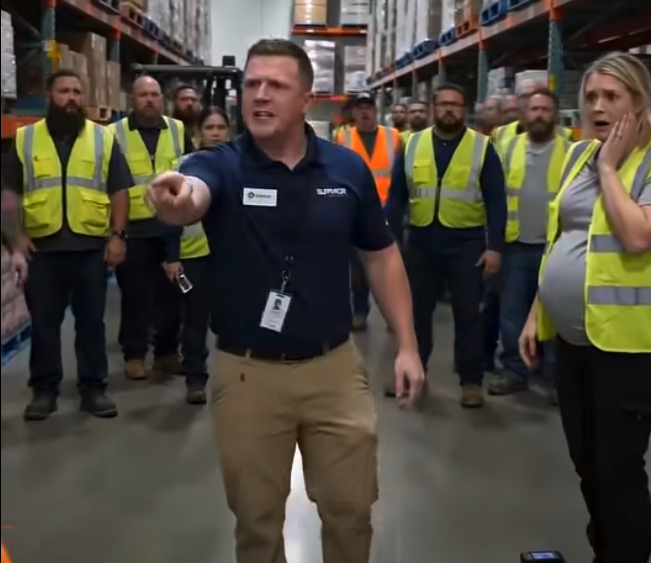
The slap echoed louder than the machines.
For one impossible second, nobody moved.
Not the packers frozen beside half-sealed boxes. Not the forklift driver with his hand still hovering over the controls. Not Kevin, whose red face twisted into a grin like he had just proven something.
And not me.
I stood there with one hand pressed to my burning cheek and the other wrapped around my seven-month pregnant stomach, trying to understand how asking for a chair had ended with my supervisor’s palm across my face.
Kevin laughed first.
“You see?” he said, turning toward the silent warehouse. “This is what happens when people think pregnancy makes them untouchable.”
My eyes stung, but I refused to cry.
I had already cried in bathroom stalls, in my car before sunrise, in the dark beside my sleeping husband after pretending the baby’s kicks were enough to keep me brave. I would not cry for Kevin.
“I asked for a chair,” I whispered.
Kevin stepped closer.
“And I said no.”
That was when a loud crash split the air.
Everyone turned.
Marcus, the forklift operator, had dropped a pallet of shrink-wrapped boxes. His face had gone pale. One hand clutched his radio.
“Kevin,” he said, voice shaking. “Corporate headquarters is on the phone because…”
Kevin snapped, “Because what?”
Marcus looked at me.
Then at Kevin.
Then at the security camera blinking above the loading dock.
“Because they saw everything.”
The warehouse went so quiet I could hear my baby move.
Kevin’s grin vanished.
“What do you mean they saw everything?”
Marcus swallowed.
“They said the live compliance feed is active today.”
Kevin froze.
That was the first time I saw fear in his eyes.
Not anger. Not arrogance. Fear.
A woman’s voice suddenly came through the wall speaker near the office door.
“This is Lydia Grant from corporate legal. Kevin Walsh, step away from employee Maya Bennett immediately.”
Every head turned toward the speaker.
Kevin stared at it like it had spoken in a foreign language.
The voice continued, colder now.
“Do not touch her again. Do not speak to her. Security is already on the way.”
My knees weakened.
A chair appeared behind me before I even understood what was happening. Rosa from packing guided me down gently, one arm firm around my shoulders.
“Sit, honey,” she whispered. “Breathe.”
Kevin pointed at me, but his hand trembled.
“She staged this,” he said. “She knew cameras were on.”
Lydia’s voice replied instantly.
“No, Mr. Walsh. You did.”
The office door opened.
Two security guards entered first.
Behind them walked a man in a dark suit I had never seen before, holding a tablet against his chest. Beside him was a silver-haired woman with sharp eyes and a calm so terrifying it made everyone straighten.
She looked at Kevin.
Then at me.
“Maya Bennett?”
I nodded.
Her expression softened.
“My name is Lydia Grant. I’m sorry we didn’t intervene sooner.”
Kevin laughed nervously.
“This is ridiculous. She’s been milking her pregnancy for weeks. Ask anyone.”
Nobody spoke.
Not one person.
Kevin scanned the room, searching for loyalty he had never earned.
“Marcus?” he barked.
Marcus looked at the floor.
“Rosa?”
Rosa’s grip tightened on my shoulder.
“She asked for a chair,” Rosa said. “That’s all.”
Kevin’s face darkened.
“You people are unbelievable.”
Lydia raised one hand, silencing him without even looking angry.
“Kevin Walsh, you are suspended pending termination and investigation.”
“You can’t do that.”
“I can.”
“I run this floor.”
“Not anymore.”
One guard stepped beside him.
Kevin jerked back.
“You’re making a mistake. Do you know who my uncle is?”
That sentence changed the air.
The man in the dark suit finally looked up from his tablet.
“Yes,” he said quietly. “We do.”
Kevin’s mouth opened, then closed.
The man continued, “That’s actually why we’re here.”
I frowned.
Lydia turned to me.
“Maya, are you able to walk?”
“I think so.”
“No,” Rosa said immediately. “She’s not walking anywhere until a medic checks her.”
For the first time all day, someone spoke about me like I mattered.
My throat tightened.
Within minutes, paramedics arrived. They checked my blood pressure, listened to the baby’s heartbeat, and told me the rhythm was strong.
Strong.
That word nearly broke me.
I closed my eyes as the small thudding sound filled the warehouse office. My son was still there, still fighting, still kicking against a world that had already shown him too much cruelty.
Lydia crouched in front of me.
“Maya, I need to ask you something. Did Kevin ever deny written accommodation requests?”
I hesitated.
Kevin, now held near the door by security, snapped, “Careful what you say.”
Lydia turned her head slowly.
“Remove him.”
The guards escorted Kevin out while he shouted that everyone would regret this.
When the door shut behind him, the warehouse exhaled.
I looked at Lydia.
“My doctor wrote a note three weeks ago,” I said. “I gave it to Kevin. He said corporate rejected it.”
Lydia’s face hardened.
“We never received it.”
My stomach dropped.
“What?”
The man in the suit tapped his tablet and turned it toward me.
“We found scans of several employee documents deleted from Kevin’s manager portal this morning. Your doctor’s note was one of them.”
Deleted.
The word hit me harder than the slap.
I thought I had been ignored by a company. But I had been trapped by one man.
Lydia exchanged a look with the suited man.
“There’s more,” she said.
I felt Rosa’s hand on my back.
The suited man introduced himself as Aaron Vale, internal investigations. He said corporate had been auditing the warehouse because several injury reports had disappeared. Complaints from pregnant workers, older workers, injured workers.
All marked resolved.
All never sent forward.
Kevin had been burying them.
And his uncle, the regional director, had been protecting him.
My pulse thudded in my ears.
I remembered women who had vanished from the schedule. Teresa, who miscarried after double shifts. Linda, who hurt her hip and was fired for “poor attitude.” Janine, who begged for lighter duty and was told to resign if she couldn’t keep up.
I had thought they were warnings.
They were evidence.
Aaron looked at me carefully.
“This morning, an anonymous employee sent corporate a packet. Videos. Screenshots. Names. Dates. The message said Kevin would hurt someone today if nobody acted.”
Rosa went still beside me.
I looked around the room.
Everyone looked away.
“Who sent it?” I asked.
Nobody answered.
Then Marcus cleared his throat.
“I did.”
My eyes widened.
Marcus, the quiet forklift operator who barely spoke except to warn people when pallets were moving.
He stared at his boots.
“My wife worked here last year,” he said. “Teresa.”
The name punched the air from my lungs.
“She lost the baby after Kevin refused her break request,” Marcus continued. “He told everyone she was careless. She blamed herself for months.”
His voice cracked.
“Then I heard him mocking you yesterday. Same words. Same tone. I couldn’t let it happen again.”
Rosa wiped her eyes.
Marcus looked at Lydia.
“I sent everything I had. But I didn’t know the live feed would be on today.”
Lydia’s gaze sharpened.
“It wasn’t supposed to be.”
Aaron’s tablet chimed.
He read something, and his face changed.
“What is it?” Lydia asked.
Aaron looked at me.
“The live feed was manually activated from headquarters.”
“By who?” I asked.
Before Aaron could answer, my phone vibrated in my pocket.
I pulled it out with shaking hands.
It was my husband, Daniel.
He was supposed to be three states away on a construction job.
I answered.
“Maya?” His voice broke. “Are you safe?”
I burst into tears then.
Not loud. Not dramatic. Just one sharp crack inside me.
“Daniel?”
“I’m downstairs.”
I looked toward the window.
A black car had pulled up outside.
Seconds later, Daniel burst through the office door, still wearing his work boots, dust on his jeans, panic carved into his face.
He crossed the room and dropped to his knees in front of me.
“Did he hit you?” he whispered.
I nodded.
Daniel closed his eyes like the answer physically hurt him. Then he pressed his forehead to my stomach.
“I’m sorry,” he said. “I’m so sorry.”
I held his head, confused and overwhelmed.
“Why are you here?”
He looked up.
“Because I’m the one who called corporate this morning.”
The room tilted.
“What?”
Daniel took my hands.
“You kept saying it was fine. That you could handle it. But last night, you fell asleep at the kitchen table with your shoes still on, and your hands were swollen, and you whispered in your sleep, ‘I only need a chair.’”
A sob escaped me.
“So I checked the papers you kept in the drawer,” he said. “Your doctor’s note. The copy Kevin signed. I scanned everything and sent it to the company’s ethics line.”
Lydia nodded.
“Your husband’s report matched Marcus’s packet. That triggered the emergency review.”
Daniel swallowed.
“I asked them to watch today. I was afraid he’d retaliate.”
I stared at him.
“You activated the live feed?”
“No.” He looked at Aaron. “I don’t have that power.”
Aaron’s tablet chimed again.
Then another sound came from the warehouse entrance.
High heels on concrete.
Every person turned.
A tall woman walked in wearing a navy coat, her hair pulled back, her expression unreadable. Two executives followed behind her like nervous shadows.
Lydia straightened immediately.
“Ms. Harlow.”
The woman ignored everyone else and looked directly at me.
“Maya Bennett?”
“Yes.”
She walked closer.
“I’m Evelyn Harlow.”
The name meant nothing to me at first.
Then Rosa gasped.
Daniel stood slowly.
Aaron whispered, “The CEO.”
My heart stumbled.
The CEO of Harlow Distribution was standing in the warehouse office looking at my swollen cheek.
Evelyn’s eyes flicked to my stomach.
Then to the chair beneath me.
Her expression changed in a way I couldn’t read.
“I’m sorry,” she said. “Not as a corporate statement. As a person.”
Nobody breathed.
She turned to Lydia.
“Is Kevin Walsh removed?”
“Yes.”
“His uncle?”
“Being contacted.”
Evelyn’s jaw tightened.
“Terminate them both after legal review. Preserve every record.”
Then she looked back at me.
“Maya, there is something you deserve to know before rumors turn it ugly.”
I gripped Daniel’s hand.
Evelyn took a slow breath.
“I activated the live feed.”
The office went silent again.
“Why?” I asked.
Her eyes softened.
“Because twenty-seven years ago, I was you.”
No one spoke.
Evelyn looked past us, out toward the warehouse floor.
“I was pregnant. Broke. Terrified. I asked my supervisor for a stool at an assembly line. He laughed. Then he made me stand twelve hours. I collapsed before the shift ended.”
Her voice trembled once, barely.
“My daughter was born too early. She lived for only nine days.”
Rosa covered her mouth.
I felt Daniel’s hand tighten around mine.
Evelyn continued, “I built this company years later with one promise: no worker would be punished for needing basic dignity. Somewhere along the way, people like Kevin buried that promise under reports and numbers.”
She looked at me.
“When I read your husband’s complaint and Marcus’s evidence this morning, I knew the language. I knew the pattern. I turned on the feed myself.”
I stared at her, stunned.
The chair beneath me suddenly felt like more than metal and plastic.
It felt like a witness.
Then Evelyn’s assistant stepped forward with a folder.
Evelyn took it but didn’t open it.
“There’s another reason this case stood out,” she said.
My chest tightened.
“What reason?”
Evelyn’s eyes moved to Daniel, then back to me.
“Your employee file included an emergency contact named Ruth Bennett.”
My mother.
I blinked.
“She died when I was thirteen.”
“I know,” Evelyn said softly.
My breath caught.
Daniel looked at me.
“Maya?”
Evelyn opened the folder.
Inside was an old photograph.
She handed it to me.
The edges were faded. Three young women stood outside a factory gate. One was unmistakably my mother, laughing with her head tilted back.
Beside her stood a much younger Evelyn.
And between them stood another pregnant woman, smiling shyly with one hand on her belly.
Evelyn pointed to her.
“That was my sister, Claire.”
My hand shook.
“What does this have to do with me?”
Evelyn’s voice dropped.
“Claire died in childbirth. Her baby survived. A baby girl.”
My skin went cold.
“No.”
“My family was unstable then,” Evelyn said. “My parents wanted the baby placed quietly. Your mother, Ruth, was Claire’s best friend. She took the baby in.”
The photo blurred.
I heard Daniel say my name, but it sounded far away.
Evelyn knelt in front of me, the CEO of a national company kneeling on a warehouse floor.
“Maya,” she whispered, “Ruth Bennett raised you. But Claire Harlow gave birth to you.”
The world stopped.
For years, I had believed my mother’s silence about my father, my birth, and her old life came from grief. I remembered her telling me, over and over, that family was not blood.
Family was who stayed.
At thirteen, when she died, I had clung to that sentence without understanding why.
Now I did.
I looked at Evelyn.
“You’re my aunt?”
Tears filled her eyes.
“Yes.”
The word broke something open in me.
Not because I suddenly had money or power or a famous last name.
Because there had been someone left.
Someone who had been searching.
Evelyn wiped her cheek quickly.
“I didn’t know where Ruth took you. By the time I had resources to look, the records were gone. I searched for years.”
“Why didn’t my mother tell me?”
“I think she was afraid my parents would take you. And back then, they might have tried.”
I pressed the photograph to my chest.
My baby kicked.
A tiny, fierce movement.
Evelyn laughed through tears.
I laughed too.
For the first time in months, the sound didn’t hurt.
Kevin thought the chair was special treatment.
He never knew it was sitting at the center of a story that began before I was even born.
Two weeks later, the warehouse looked different.
Not because the walls had changed.
Because the fear had.
Kevin was gone. So was his uncle. Investigators uncovered years of deleted complaints, falsified reports, and illegal retaliation. Workers came forward one by one, their voices shaking at first, then growing stronger.
Teresa returned with Marcus on the day corporate held the listening session.
She hugged me carefully, both of us crying before either of us spoke.
“I’m sorry,” I whispered.
She shook her head.
“No. You survived loud enough for the rest of us.”
Evelyn created a new policy named after her sister Claire and my mother Ruth.
Every warehouse received seated-work options, pregnancy accommodations, anonymous reporting protections, and direct legal oversight.
But the first chair arrived at our warehouse.
It was simple. Black. Adjustable. Ordinary.
Rosa tied a ribbon around it.
Marcus rolled his eyes and said that was dramatic.
Then he cried when Teresa sat in it.
Months later, my son was born on a rainy Tuesday morning.
Healthy.
Furious.
Perfect.
Daniel cried harder than the baby did.
Evelyn stood outside the hospital room holding flowers, afraid to come in until I waved her forward.
When she held him, her face folded with a grief so old and a joy so new that I understood both without asking.
“What’s his name?” she whispered.
I looked at Daniel.
Then at the photo of my mother on the bedside table.
“Jonah Ruth Vale Bennett,” I said.
Evelyn blinked.
“You gave him Ruth’s name?”
“She stayed,” I said.
Evelyn nodded, tears spilling freely.
“Yes,” she whispered. “She did.”
Three months later, I returned to the warehouse.
Not to work a ten-hour shift.
Not to beg for a chair.
I came back as the new employee welfare coordinator, a role Evelyn insisted should be held by someone who understood the floor, not just spreadsheets.
The workers applauded when I walked in carrying Jonah against my chest.
Rosa shouted, “Careful, everyone, the boss is here!”
Jonah sneezed.
Everyone laughed.
Then I saw it.
Near the scanner station, beneath the same camera that had witnessed Kevin’s cruelty, sat the chair.
A small brass plaque had been fixed to the back.
I stepped closer and read it.
For every worker who was told dignity was too much to ask. Sit down. Stand up. Be heard.
My eyes burned.
Daniel slipped his arm around me.
“You okay?”
I looked across the warehouse.
At Marcus teaching a new worker safety checks.
At Teresa smiling beside him.
At Rosa barking instructions like a queen.
At Evelyn standing near the doorway, watching not like an owner, but like someone finally keeping a promise.
Then I looked at my son.
His tiny fist rested over my heart.
“Yes,” I said.
And this time, I meant it.
