By midnight, the royal arena of Eldrath no longer resembled a place built for celebration.
It looked like judgment.
Rain poured endlessly across the shattered stone walls while thunder rolled above the castle towers overlooking the arena. Burning torches struggled against violent wind sweeping through the open battleground. Thousands of nobles, soldiers, priests, and frightened villagers crowded beneath the storm beneath black banners soaked dark with water and ash.
At the center of the arena stood the execution platform.
And beside it waited death itself.
The royal execution warrior towered above everyone around him, wrapped in black steel armor scarred by decades of war. His enormous war axe rested against one shoulder, its heavy blade still stained dark from earlier executions. Rainwater streamed down the metal plates covering his body while chains rattled softly behind him where prisoners knelt in rows beneath the storm.
Some prayed quietly.
Others simply stared into the mud.
Because hope rarely survives long inside execution arenas.
Above the battlefield, nobles watched from covered stone balconies carved high into the arena walls. Wine cups rested beside velvet chairs while servants held dark umbrellas over jeweled lords who came to witness punishment like theater.
The kingdom was starving beyond the castle gates.
But death still entertained the wealthy.
Near the front row of chained prisoners knelt an old woman clutching trembling fingers together beneath rusted iron restraints. Beside her sat a wounded blacksmith missing two fingers after refusing to forge weapons for royal purges in the northern villages.
Their crime was not rebellion.
It was remembering mercy in a kingdom teaching itself to fear compassion.
Thunder exploded violently above the arena.
The royal herald stepped onto the platform holding a soaked parchment.
“By decree of the High Council of Eldrath,” he announced loudly, “all traitors guilty of harboring rebellion, concealing royal enemies, or spreading false bloodline claims shall face death before dawn.”
Several villagers lowered their heads immediately.
Not because they respected the decree.
Because public fear had become law years ago.
The execution warrior slowly lifted his axe.
The crowd fell silent.
Then the arena gates opened.
The sound echoed through the stone walls louder than thunder itself.
Every soldier turned.
A small orphan boy walked alone into the arena through the freezing rain.
He could not have been older than thirteen.
Mud covered his torn dark cloak. Bruises darkened the skin beneath exhausted eyes while ash mixed with rainwater across his pale face. At his side rested a cracked sword hanging from worn leather straps nearly falling apart.
The child looked thin enough for the storm itself to break him.
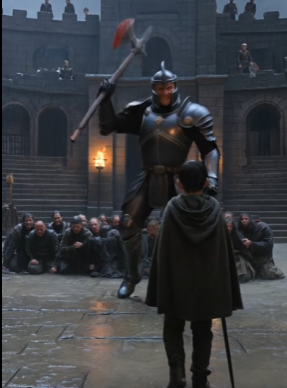
But he kept walking.
Straight toward the execution platform.
Several guards laughed quietly.
“The child came to die.”
Another soldier smirked beneath his helmet.
“Perhaps he got lost searching for his mother.”
Nearby nobles chuckled softly from the balconies.
Cruelty becomes easier when practiced publicly long enough.
But the boy never looked toward them.
His eyes remained fixed only on the chained prisoners kneeling beneath the rain.
And one prisoner suddenly recognized him.
The old woman near the front inhaled sharply.
“No…”
Tears instantly filled her eyes.
Not fear.
Recognition.
“You shouldn’t be here,” she whispered weakly.
The child stopped only a few feet from the execution platform.
Rain poured down around him while thousands watched silently beneath the storm.
The execution warrior slowly stepped forward.
Each armored footstep echoed heavily across the stone arena floor.
The giant man stopped directly before the child.
Towering over him.
His scarred face remained mostly hidden behind a black iron half-mask, but pale eyes stared downward without emotion.
“State your name before your death.”
The voice sounded less human than the thunder surrounding them.
The child struggled to breathe.
Nearby villagers lowered their heads.
Chains rattled softly in the wind.
And suddenly memories flooded through the boy’s mind beneath the storm.
A hidden cabin deep within frozen forests.
A dying fire struggling against winter wind.
A man kneeling beside him with blood soaking through royal armor hidden beneath peasant clothing.
His father’s hands trembled as he pressed a silver ring into the child’s palm.
“You must never speak your name,” the man whispered painfully.
The little boy cried openly.
“Why?”
His father looked toward the snow-covered windows as distant riders searched the forest outside.
“Because kingdoms fear surviving children more than enemy armies.”
The child gripped his father’s cloak desperately.
“Will they find us?”
The man closed his eyes briefly.
“Eventually.”
Then he touched the boy’s face gently.
“But when the time comes…”
His voice nearly disappeared.
“Make them remember who they murdered.”
Back in the arena, thunder cracked violently overhead.
The memory vanished.
Rainwater streamed across the orphan’s bruised face.
The execution warrior lifted the axe slightly higher.
“Your name.”
The child slowly raised his eyes.
And whispered quietly:
“Aren Vareth…”
The orchestral tension surrounding the arena collapsed instantly into silence.
“…son of King Aldric.”
For one impossible second, even the storm seemed to stop breathing.
The execution warrior froze completely.
Rain rolled across the scars visible beneath his half-mask while his pale eyes widened in horror.
Above the arena, several nobles stood up abruptly from their seats.
One elderly knight near the eastern balcony turned deathly pale.
“That bloodline was erased fifteen years ago.”
Nearby soldiers exchanged frightened glances.
Because everyone knew the story of King Aldric’s fall.
Or at least the version officially permitted.
The royal records claimed the king and his entire family died during the Crimson Rebellion after attempting to massacre noble houses opposing new taxation laws.
But older soldiers remembered darker rumors whispered quietly beneath tavern candles.
That the rebellion was staged.
That Aldric refused to authorize mass executions during famine riots.
That the High Council betrayed him from inside the throne room itself.
And afterward, every surviving child connected to the royal bloodline disappeared.
The execution warrior stared at the boy as if witnessing a ghost.
Rainwater slid across trembling hands gripping the enormous axe handle.
“No…”
His voice cracked slightly.
“That’s impossible.”
The child said nothing.
But beneath his torn cloak hung the silver ring his father once carried.
The old royal crest.
Half-hidden.
Still visible.
The elderly knight noticed it first.
And terror flooded his face instantly.
“He’s telling the truth.”
The surrounding nobles erupted into panic.
“Seize him!”
“Kill the child!”
“End this immediately!”
But nobody moved.
Because something inside the arena had already shifted.
The execution warrior’s breathing grew visibly uneven.
Slowly, almost unconsciously, his fingers loosened around the axe handle.
The enormous weapon slipped from his hands.
And crashed against the stone floor with a deafening metallic impact.
The sound echoed through the entire arena like judgment itself.
Nearby soldiers stepped backward in confusion.
The giant warrior stared down at the orphan child beneath the storm.
And for the first time in decades, fear entered his eyes.
Not fear of battle.
Recognition.
The child looked impossibly familiar now.
Not only the eyes.
The expression.
The same expression King Aldric carried during the Night Tribunal years earlier when nobles demanded executions for starving villagers who stole grain from royal storage houses.
The king refused.
The High Council never forgave him for it.
The execution warrior remembered that night perfectly.
Because he was there.
Not as executioner.
As royal protector.
His real name was Darius Vane.
And once, long ago, he swore loyalty directly to King Aldric before the kingdom buried truth beneath blood and propaganda.
Rain poured harder across the arena.
Darius stared at the boy.
Then slowly dropped to one knee.
Gasps spread instantly through the crowd.
Several soldiers lowered their weapons automatically in shock.
The old knight near the balcony whispered weakly:
“Gods preserve us…”
The execution warrior bowed his head beneath the storm.
“My prince.”
Absolute silence consumed the arena.
The nobles looked horrified.
Because fear controls kingdoms only while lies remain intact.
And now the dead king’s blood stood alive before thousands of witnesses.
Lord Carrow — eldest member of the High Council — suddenly stepped forward from the royal balcony.
“Kill the boy!” he screamed.
His voice cracked with panic.
“He’s an imposter!”
But nobody obeyed immediately.
The chained prisoners stared openly now.
Villagers exchanged terrified whispers.
Soldiers looked uncertain beneath raised spears.
Because powerful men always sound less convincing once frightened.
The orphan child looked toward Darius slowly.
“You knew my father.”
The execution warrior’s head remained lowered.
“Yes.”
The boy swallowed painfully.
“Did he deserve to die?”
Rainwater streamed across Darius’ scarred face.
“No.”
The answer echoed through the arena louder than thunder.
Several nobles immediately began retreating from the balconies.
Because once truth enters public spaces, fear spreads upward faster than downward.
Lord Carrow pointed furiously toward the soldiers.
“Arrest everyone who kneels!”
But movement had already begun across the arena.
One older guard slowly lowered his spear.
Then another.
Then several more.
Not rebellion.
Conscience.
The old knight removed his helmet and stepped forward trembling beneath the rain.
“I stood beside King Aldric during the northern plagues,” he whispered. “He sold royal jewels to feed starving villages while the council protected their estates.”
His eyes filled with shame.
“And we let them call him a tyrant afterward.”
The crowd erupted into whispers instantly.
Because ordinary people already suspected the kingdom lied.
They were simply waiting for someone brave enough to confirm it publicly.
The little boy stood trembling in the center of the arena while thousands stared at him.
Not as an orphan anymore.
As surviving evidence.
Darius slowly rose to his feet again beside the child.
The execution warrior turned toward the chained prisoners behind him.
Then toward the terrified nobles above.
For years he carried out executions believing survival required obedience.
Now he understood the truth.
Survival without honor slowly transforms men into weapons pointed at innocent people.
Lord Carrow screamed again:
“Do your duty!”
Darius looked toward the frightened child standing beside him.
Then toward the old woman in chains.
Finally toward the storm swallowing the arena walls.
“No,” the execution warrior said quietly.
“The kingdom already asked too much.”
And with one enormous swing, Darius buried the execution axe directly into the wooden scaffold.
The platform shattered apart instantly.
Chains rattled violently as prisoners cried openly in shock.
Several guards rushed forward instinctively.
Then stopped.
Because Darius Vane still stood between the child and the kingdom.
And nobody inside the arena truly believed they could move him.
The storm raged harder above Eldrath.
But something inside the royal arena had already broken more permanently than stone.
Fear.
By sunrise, news spread across the capital that the dead king’s son had walked openly into the execution grounds and survived.
Several noble houses fled before morning bells finished ringing.
Others burned royal records attempting to erase old crimes before soldiers seized them.
And throughout Eldrath, ordinary people repeated the same story beside market fires and cathedral steps.
Not about rebellion.
Not about war.
About a terrified orphan child standing alone in the storm speaking a forbidden name loudly enough to make an entire kingdom remember its shame.
