Part 1
I thought I was going to pass out.
I was eight months pregnant and packing orders during the holiday shipping rush.
The warehouse felt endless.
Boxes were moving down every conveyor.
Supervisors were shouting production numbers over the speakers.
I had been on my feet for ten straight hours.
My chest felt tight.
I stepped away from my station for less than a minute.
I leaned against a pallet and tried to catch my breath.
That’s when my supervisor spotted me.
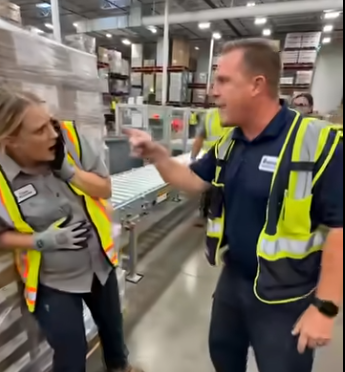
He marched across the aisle demanding to know why I wasn’t working.
I told him I felt dizzy.
He said everyone was tired.
I asked for sixty seconds.
He refused.
Workers nearby started watching.
I went back to my station and picked up another box.
He kept yelling.
I told him I was doing the best I could.
That made him furious.
He stepped directly in front of me and accused me of slowing down the entire shift.
I tried to walk around him.
Then his hand cracked across my face.
The box slipped from my hands.
The warehouse fell silent.
I stumbled backward into a stack of packages and grabbed my stomach.
Several workers shouted at him.
Then a voice suddenly came over the supervisor’s radio saying, “Don’t let him leave. Corporate just reviewed the camera footage.”
For one second, nobody moved.
My supervisor’s face changed.
All the color drained from it.
He looked down at the radio clipped to his vest like it had betrayed him.
Then he looked at me.
The same man who had been screaming a moment earlier suddenly lowered his voice.
“Don’t make this worse,” he said.
I stared at him, one hand on my cheek, the other on my stomach.
My baby kicked hard.
A sharp, terrifying pain ran across my lower back.
One of the women from my line, Denise, rushed toward me.
“She needs medical help,” Denise shouted. “Somebody call 911!”
My supervisor snapped, “Nobody is calling anyone until I speak to HR.”
That was when another worker stepped forward.
His name was Marcus.
He was usually quiet.
He never got involved in warehouse drama.
But that night, he pulled out his phone and said, “Too late. I’m calling now.”
The supervisor lunged toward him.
“Put that phone away.”
Marcus stepped back and raised it higher.
“You slapped a pregnant woman on camera,” he said. “You don’t get to give orders anymore.”
The radio crackled again.
This time the voice was colder.
“Security is on the way. Supervisor Keller is to remain on site.”
Everyone heard it.
Supervisor Keller turned toward the exit.
But before he could take two steps, two security guards appeared at the end of the aisle.
Behind them was a woman in a black coat, walking fast with a tablet in her hand.
I had never seen her before.
But every manager in the warehouse seemed to know exactly who she was.
Because when she entered the packing floor, even the machines felt quieter.
She stopped in front of Keller.
Then she looked at me.
Her expression hardened.
“My name is Allison Grant,” she said. “I’m the regional operations director.”
Keller immediately started talking.
“Allison, this is being exaggerated. She was refusing to work. She became disruptive—”
“Stop,” Allison said.
One word.
He froze.
She turned the tablet toward him.
On the screen was the security footage.
Clear as day.
Me stepping away.
Him yelling.
Me returning to work.
Him blocking me.
His hand striking my face.
Allison watched him watch himself.
Then she said, “You’re done here.”
Keller swallowed.
“You can’t fire me on the floor.”
“I just did.”
The warehouse erupted in whispers.
But I barely heard them.
The lights above me started to blur.
Denise grabbed my arm.
“She’s going down!”
The last thing I saw before everything faded was Allison running toward me.
And the last thing I heard was her yelling, “Get medical in here now!”
Part 2
When I opened my eyes, I was lying on the warehouse floor.
A folded jacket was under my head.
Denise was kneeling beside me, holding my hand.
Marcus stood nearby, speaking to the 911 operator.
Allison Grant was crouched beside me, her polished coat spread across the dusty concrete.
“Stay with us,” she said gently. “The ambulance is almost here.”
I tried to sit up.
She stopped me.
“No. Don’t move.”
“My baby,” I whispered.
Denise squeezed my hand. “You felt movement after you fell?”
I nodded weakly.
Another kick came.
Small, firm, alive.
Tears slid down my temples.
“She’s moving,” I said.
Denise exhaled like she had been holding her breath for years.
Keller was standing between two security guards near the time clock.
He looked angry now.
Not sorry.
Not scared for me.
Angry that he had been caught.
“I want my phone call,” he kept saying. “I know the district VP. This is a misunderstanding.”
Allison stood up slowly.
“There is no misunderstanding,” she said. “There is video.”
Then she turned to security.
“Escort him to the conference room. Do not allow him near the floor, the footage, or any employee.”
Keller pointed at me.
“She was costing us numbers!”
Allison’s voice sharpened.
“She is a human being. Not a production number.”
The entire warehouse went still again.
The paramedics arrived minutes later.
They checked my blood pressure.
It was dangerously high.
One of them asked how far along I was.
“Thirty-four weeks,” I said.
His face tightened.
“We’re taking you in.”
As they lifted me onto the stretcher, workers from every station lined the aisle.
Some of them had tears in their eyes.
Some looked furious.
Some just looked ashamed.
Because everyone knew Keller had been cruel before.
Maybe not like this.
But close.
He had denied bathroom breaks.
Mocked injuries.
Threatened people’s schedules.
Told single parents they were “replaceable.”
For months, people had whispered that someone should report him.
For months, everyone had been afraid.
And now I was being wheeled out with a swollen cheek and shaking hands.
Just before the ambulance doors closed, Allison stepped beside me.
“I’m coming to the hospital,” she said.
I blinked at her.
“You don’t have to.”
“Yes,” she said. “I do.”
At the hospital, the nurses moved quickly.
Monitors were placed around my belly.
A fetal heartbeat filled the room.
Fast.
Steady.
Beautiful.
I started crying.
My husband, Daniel, arrived twenty minutes later, still in his work boots.
He ran into the room looking wild with fear.
When he saw the mark on my face, he stopped breathing.
“Who did this?”
I couldn’t answer.
His jaw clenched.
“Who touched my wife?”
Allison stood near the door.
She stepped forward.
“One of our supervisors,” she said. “He has been removed from the facility. The police have been contacted.”
Daniel turned to her.
“Removed? He assaulted my pregnant wife.”
“Yes,” Allison said. “And we are treating it as exactly that.”
A nurse came in and told us they needed to keep me overnight.
My blood pressure was too high.
They were worried the stress had triggered complications.
Daniel sat beside me and pressed his forehead to my hand.
“I told you not to keep pushing yourself,” he whispered.
“I needed the hours,” I said.
“I needed you safe.”
I closed my eyes.
Because that was the truth I had been avoiding.
We needed rent.
We needed diapers.
We needed health insurance.
And I had convinced myself I could survive anything for just a few more weeks.
The next morning, Allison returned.
But she wasn’t alone.
A woman from legal was with her.
So was someone from HR.
And a police officer.
Allison placed a folder on the table beside my bed.
“We reviewed more footage last night,” she said.
My stomach tightened.
“More footage?”
She nodded.
“This wasn’t the first time Keller targeted you.”
Daniel stood up.
“What does that mean?”
Allison opened the folder.
“There are recordings of him denying your accommodation requests. There are recordings of him assigning you heavier stations after you submitted medical restrictions. There are recordings of him laughing about it with another supervisor.”
The room felt cold.
I stared at the folder.
All those moments I had thought maybe I was being too sensitive.
All those times I thought I just had to be tougher.
They were real.
Someone had seen them.
Someone had recorded them.
Then Allison said something I didn’t expect.
“And there’s one more thing you need to know.”
Part 3
Allison took a breath before continuing.
“Keller was already under internal review.”
My husband’s eyes narrowed.
“Then why was he still supervising people?”
The HR representative lowered her gaze.
Allison answered instead.
“Because the first complaints were not handled properly.”
The room went silent.
That sentence sat heavy between all of us.
Not handled properly.
It sounded clean.
Corporate.
Careful.
But I knew what it meant.
People had spoken up.
And somebody had buried it.
Allison looked directly at me.
“I am not going to pretend this company protected you the way it should have.”
The HR woman shifted uncomfortably.
Allison didn’t look away.
“Keller had three previous complaints in six months. One from a worker recovering from surgery. One from a woman who requested nursing breaks. One from an employee with a documented back injury.”
Daniel’s hands curled into fists.
“And nothing happened?”
“Warnings happened,” Allison said. “Paperwork happened. Nothing effective happened.”
The police officer asked me to describe what happened.
I told him everything.
My voice shook at first.
Then it got steadier.
I told him about the dizziness.
The yelling.
The slap.
The pain.
The way Keller tried to stop someone from calling 911.
The officer wrote it down.
Then he said, “We’ll be speaking with witnesses and collecting the footage.”
Allison nodded. “It is already preserved.”
After they left, Daniel sat beside me again.
“I don’t want you going back there,” he said.
“I don’t either,” I admitted.
But fear came immediately after.
Rent.
Bills.
Insurance.
The baby.
Allison seemed to read my face.
“Your job is protected,” she said. “You will be placed on paid leave effective immediately.”
I looked at her.
“Paid leave?”
“Yes.”
“For how long?”
“Through delivery and recovery. And we are reviewing additional compensation.”
The HR representative quickly added, “Pending formal process.”
Allison’s eyes flicked toward her.
“Formal process will not be used to delay care.”
The woman closed her mouth.
For the first time since the slap, I felt like someone powerful was standing on the right side of the room.
Two days later, I was discharged from the hospital.
My baby was stable.
I was ordered to rest.
When Daniel drove me home, there were three bags of groceries on our porch.
A pack of newborn diapers.
A box of wipes.
And an envelope.
Inside was a card signed by dozens of warehouse workers.
Denise had written the message at the top.
You are not alone.
I cried so hard Daniel had to help me inside.
That night, my phone started buzzing.
A video had been leaked.
Not the slap itself.
But the aftermath.
The silent warehouse.
Keller being blocked by security.
Allison saying, “She is a human being. Not a production number.”
Someone had posted it online.
By morning, it had spread everywhere.
People were furious.
Former employees began commenting.
“He did the same thing to me.”
“I reported him twice.”
“That warehouse has been toxic for years.”
“They only care now because there’s video.”
Then a local news station called.
Then another.
Then my sister called and said, “You’re on TV.”
I sat on the couch, wrapped in a blanket, watching a reporter stand outside the warehouse gates.
Behind her, workers were gathering.
Not for a shift.
For a protest.
They held signs made from broken-down cardboard boxes.
PREGNANT WORKERS ARE NOT MACHINES.
WE REPORTED HIM.
HUMANS OVER NUMBERS.
Then I saw Denise.
She was standing in front of the cameras.
And she was holding up her phone.
“I have the whole video,” she said.
My heart stopped.
Daniel turned to me.
“The whole video?”
I whispered, “She recorded it?”
On the television, Denise looked straight into the camera.
And then she said, “Corporate has the footage. The police have the footage. But the public needs to know this didn’t start with one slap.”
Part 4
The full story came out faster than anyone expected.
Denise had started recording before Keller hit me.
She said she had seen him walking toward me and knew he was about to start another scene.
Her video captured everything from a different angle.
My breathing.
My hand on the pallet.
Keller towering over me.
My quiet request for sixty seconds.
His refusal.
His voice getting louder.
Me returning to work.
Him blocking my path.
And then the slap.
The sound was worse than I remembered.
Sharp.
Cruel.
Final.
The video cut off with Denise screaming, “Are you insane?”
By noon, the company released a public statement.
By evening, Keller was arrested.
His mugshot appeared on every local page.
He looked smaller without the vest.
Smaller without the radio.
Smaller without people afraid of him.
But the story didn’t stop with him.
The other complaints surfaced.
Workers began naming managers who ignored reports.
A former HR assistant posted that complaints about Keller had been “redirected” to avoid slowing operations during peak season.
A leaked email showed a senior manager writing:
“We cannot afford leadership disruption during holiday fulfillment. Coach him after Q4.”
Coach him after Q4.
Those four words enraged people more than anything.
Because it meant they knew.
They knew he was dangerous.
They knew people were being harmed.
But packages had to move.
Numbers had to climb.
Customers had to receive gifts on time.
So they waited.
They waited until his hand hit my face.
They waited until my baby was at risk.
They waited until the camera made silence impossible.
Three days later, Allison called me.
“I need to be honest,” she said.
My stomach tightened.
“About what?”
“The company is going to try to settle quietly.”
Daniel, sitting beside me, leaned closer.
Allison continued.
“They will offer money. They will want confidentiality. They will want this story gone.”
I stared at the phone.
“And what do you want?”
There was a pause.
Then she said, “I want the truth documented so thoroughly that nobody can bury it again.”
“Why are you helping me?” I asked.
For the first time, her voice cracked.
“Because my sister lost a pregnancy fifteen years ago after being denied medical accommodation at work.”
I covered my mouth.
“She tried to report it,” Allison said. “They called her unreliable. Emotional. Difficult. I promised myself if I ever had enough authority to stop something like that, I would.”
For a moment, neither of us spoke.
Then she said, “You need your own lawyer. Not the company’s process. Not HR. Your own lawyer.”
The next morning, Daniel and I met with an employment attorney named Rachel Meyers.
She had silver hair, a calm voice, and the kind of eyes that missed nothing.
She reviewed my notes.
The hospital records.
The video.
The old emails Allison had legally preserved through internal compliance.
Then Rachel closed the folder and said, “This is not just assault. This is systemic negligence.”
Daniel asked, “Can we win?”
Rachel looked at me.
“With evidence like this? The question is not whether they’re liable. The question is how much they’re willing to expose before they admit it.”
Two weeks later, just as I started to feel safe again, a letter arrived.
It was from Keller’s attorney.
He claimed I had exaggerated my condition.
He claimed I provoked him.
He claimed I was part of a coordinated attempt to destroy his career.
I read the letter twice.
Then my hands began shaking.
Daniel took it from me and cursed under his breath.
That night, I barely slept.
At 3:00 a.m., I sat in the nursery we had barely finished.
A secondhand crib.
A soft yellow blanket.
A tiny onesie that said Hello, World.
My daughter kicked under my ribs.
I whispered, “I’m sorry.”
Then my phone lit up.
A message from an unknown number.
You don’t know me. My name is Laura. Keller was my supervisor before you. I have something you need to see.
Attached was a video.
When I opened it, I felt my blood turn cold.
Part 5
The video showed Keller in the warehouse break room.
Not yelling.
Not angry.
Laughing.
He was sitting at a table with two other supervisors.
One of them asked, “What are you gonna do if she keeps asking for breaks?”
Keller smirked.
“Push her until she quits. Pregnant workers are a liability anyway.”
The room spun around me.
Then he added, “If she falls behind enough, I can write her up before maternity leave. Saves us the headache.”
I pressed pause.
My hand went to my stomach.
This had never been about performance.
It had been a plan.
A deliberate plan.
Daniel found me sitting in the nursery with the phone in my lap.
When he watched the video, his face changed in a way I had never seen before.
Quiet rage.
Controlled.
Terrifying.
“Send it to Rachel,” he said.
By 8:00 a.m., Rachel called.
“Where did this come from?”
“A former employee.”
“Do you trust her?”
“I don’t know.”
“I’m going to verify it.”
She did.
The timestamp matched.
The location matched.
The other supervisors were identified.
One of them still worked there.
By the end of the day, Rachel filed an emergency preservation demand requiring the company to protect all break room footage, internal messages, disciplinary records, and complaint files related to Keller.
The company’s tone changed overnight.
Their settlement offer arrived two days later.
It was more money than Daniel and I had ever seen in our lives.
Enough to pay medical bills.
Enough to cover rent.
Enough to breathe.
But it came with a condition.
Silence.
I sat at the kitchen table staring at the number.
Daniel stood behind me.
“We could use it,” he said softly.
“I know.”
“You don’t have to become the face of this.”
“I know.”
“You and the baby matter more than fighting them.”
I turned to him.
“What happens to Denise? Marcus? Laura? The next pregnant woman?”
He closed his eyes.
Because he knew.
The money would help us.
But silence would help them.
That evening, Rachel came to our apartment.
She sat across from me and said, “There is no shame in accepting. You have a family to protect.”
“I don’t want shame,” I said. “I want safety.”
Rachel nodded slowly.
“Then we reject confidentiality.”
The company responded by increasing the offer.
Rachel rejected it again.
Then they tried a different tactic.
A public relations firm contacted reporters, suggesting I had “performance issues.”
Anonymous comments appeared online saying I was lazy.
That I wanted a payday.
That Keller had only “tapped” me.
That pregnancy was not an excuse to stop working.
For the first time, I understood why so many people stay quiet.
Because the slap was one moment.
But the punishment for speaking lasted days.
Weeks.
Maybe longer.
Then Denise posted another video.
This one showed my station numbers.
I had been exceeding quota for months.
Even while pregnant.
Even while denied breaks.
Even while assigned heavier work.
The comments flipped instantly.
People began asking why the company was attacking a worker whose numbers were above average.
Then Marcus posted his statement.
Then Laura.
Then the woman who had requested nursing breaks.
Then the man with the back injury.
One by one, people stepped out of fear.
And the company that had once seemed enormous started looking very small.
Three weeks after the incident, I woke before dawn with a deep, rolling pain across my abdomen.
At first, I thought it was stress.
Then it came again.
Stronger.
Daniel sat up beside me.
“What’s wrong?”
I gripped the sheets.
“I think she’s coming.”
Part 6
Our daughter was born six weeks early.
Tiny.
Fierce.
Furious at the world.
She came out screaming, and that sound became the most beautiful thing I had ever heard.
The nurses placed her against my chest for only a few seconds before taking her to the NICU.
I reached for her.
“Wait—please—”
“She needs support,” the doctor said gently. “We’re going to take care of her.”
Daniel kissed my forehead, then followed them.
I lay there shaking, empty and terrified.
For the first time since the warehouse, I stopped thinking about cameras, lawsuits, statements, and evidence.
There was only her.
My daughter.
Maya.
Four pounds, twelve ounces.
A head full of dark hair.
Hands so small they wrapped around one fingertip.
For the next several days, the NICU became our world.
Beeping machines.
Plastic tubes.
Soft blankets.
Whispered prayers.
Daniel and I slept in chairs.
We learned the language of oxygen levels and feeding goals.
I blamed myself every time a monitor beeped.
Every time Maya cried.
Every time a nurse said, “She just needs more time.”
One afternoon, Allison visited.
She stood outside the NICU glass with a small stuffed elephant in her hands.
“She’s beautiful,” she said.
I nodded.
“She’s early.”
Allison looked at me.
“She’s here.”
That sentence broke something open in me.
I cried into my hands.
Allison didn’t touch me.
She just stood there, letting me fall apart without making me feel weak for it.
A week later, Rachel came to the hospital with news.
“The company’s board has opened an independent investigation.”
Daniel frowned.
“Because they care?”
“Because the evidence is spreading faster than they can control it,” Rachel said.
She placed a document on the table.
“Keller is claiming upper management pressured supervisors to meet impossible numbers. He says the culture made him act that way.”
I almost laughed.
“Now he wants to blame them?”
“Yes,” Rachel said. “And they want to blame him.”
Daniel looked between us.
“So they’re turning on each other.”
“Exactly.”
Rachel’s eyes sharpened.
“That’s good for us.”
The independent investigation moved fast.
Managers were suspended.
Two HR employees were placed on leave.
The senior manager who wrote “Coach him after Q4” resigned before he could be fired.
But Keller still refused to accept responsibility.
Through his lawyer, he claimed the slap was “accidental contact.”
Then the police released part of the footage to the prosecutor.
The “accidental contact” defense died immediately.
At the preliminary hearing, I sat in the courtroom with Daniel beside me.
Maya was still in the NICU, and leaving her felt like ripping out part of my heart.
Keller walked in wearing a suit that didn’t fit.
He didn’t look at me.
His lawyer argued that Keller was under extreme workplace pressure.
Rachel leaned toward me and whispered, “Pressure doesn’t move your hand across someone’s face.”
The judge watched the video.
The courtroom went silent.
Again.
That same silence from the warehouse.
When the slap sounded through the speakers, a woman in the back gasped.
Keller finally looked down.
The judge set conditions.
No contact with me.
No contact with witnesses.
No entering the warehouse.
No contacting former employees involved in the investigation.
As we left court, reporters shouted questions.
I didn’t answer.
I wasn’t ready.
Then one reporter asked, “What do you want people to know?”
I stopped.
Daniel looked at me.
Rachel didn’t say anything.
I turned toward the cameras.
My voice shook, but I spoke anyway.
“I want people to know that needing a paycheck should not mean giving up your dignity, your health, or your safety.”
Then I walked away.
That night, the clip played everywhere.
But I didn’t watch it.
I was in the NICU, holding Maya against my chest, feeling her tiny breaths against my skin.
For once, the world could talk without me listening.
Part 7
Maya came home after sixteen days.
The apartment changed overnight.
Tiny bottles by the sink.
Diapers stacked beside the couch.
Burp cloths over every chair.
Daniel walked around like a bodyguard protecting royalty.
Every little sound from Maya made him sprint across the room.
“She sneezed,” he announced once, terrified.
“She’s allowed,” I said.
For a few days, life felt almost normal.
Almost peaceful.
Then Rachel called.
“They want mediation.”
I held Maya closer.
“Another settlement?”
“Yes. But this time, no confidentiality requirement.”
I looked at Daniel.
He nodded slowly.
At the mediation table, the company’s lawyers looked exhausted.
Their polished confidence was gone.
Across from them sat Rachel, calm as ever.
Allison was there too, representing the company’s internal investigation findings.
The company offered money.
Real money.
But Rachel asked for more than compensation.
She asked for written policy changes.
Independent reporting channels.
Mandatory pregnancy accommodation training.
Supervisor discipline transparency.
Paid emergency medical leave after workplace incidents.
A public apology.
And reinstatement offers or compensation reviews for workers previously harmed under Keller.
The company lawyers resisted.
Rachel opened her folder.
Inside were signed statements from twenty-seven employees.
Videos.
Emails.
Medical records.
Complaint logs.
She said, “We are fully prepared to file.”
The room went quiet.
One lawyer asked for a break.
When they returned, the offer had changed.
Not perfect.
But different.
Stronger.
Public.
Documented.
Binding.
I signed only after Rachel read every line.
Afterward, Allison found me in the hallway.
“I resigned this morning,” she said.
I stared at her.
“What?”
“The board wanted someone visible to remain and rebuild trust. But I ignored red flags too. Not the way others did, but enough.”
“You helped me,” I said.
“After you were hurt.”
Her face was tired.
“I should have looked harder before.”
I didn’t know what to say.
She handed me a card.
“I’m starting a workplace safety consulting firm. For people who don’t want to wait until something terrible happens.”
For the first time in weeks, I smiled a little.
“That sounds like you.”
Keller’s criminal case ended months later.
He took a plea.
No dramatic trial.
No grand speech.
Just a man standing before a judge, forced to say out loud that he assaulted me.
He lost his job.
His license to work in warehouse management became useless.
The other supervisors in the break room video were fired.
The HR manager who buried complaints was fired too.
The senior manager who delayed action lost his next job after the leaked email followed him.
But the strangest part was returning to the warehouse.
Not to work.
To speak.
The company held a mandatory safety meeting after the settlement.
Rachel told me I didn’t have to attend.
Daniel didn’t want me to.
But Denise asked me to come.
So I did.
I walked through the same doors with Maya sleeping against my chest in a carrier.
The same concrete floor.
The same conveyors.
The same fluorescent lights.
But Keller wasn’t there.
His office had been cleared out.
His nameplate was gone.
The workers stood in rows.
Denise hugged me first.
Marcus hugged Daniel.
People stared at Maya like she was proof of something.
Proof that the worst night had not taken everything.
When I stepped up to speak, my hands trembled.
Then Maya made a tiny noise against my chest.
And somehow, I found my voice.
Part 8
“I don’t have a long speech,” I said.
The warehouse was silent.
Not the shocked silence from the night Keller slapped me.
This was different.
This silence was listening.
“I used to think keeping my head down would protect me,” I continued. “I thought if I worked harder, stayed quiet, and didn’t make trouble, I could get through it.”
I looked at the packing stations.
At the conveyors.
At the place where I had stood for ten hours, pretending I was fine.
“But silence protected the wrong people.”
Denise wiped her eyes.
Marcus folded his arms, jaw tight.
I touched Maya’s back gently.
“She was born early. She spent sixteen days in the NICU. I will never know how much of that was caused by what happened here, but I know this: no job should ever make a person choose between a paycheck and their body.”
A few workers nodded.
Some looked down.
I turned toward the new management team standing near the front.
“And no company should wait for a video before believing its workers.”
That line traveled through the room like electricity.
After the meeting, workers came up to me one by one.
Some thanked me.
Some apologized for not speaking sooner.
Some told me stories I wished they had never lived through.
One young woman, barely twenty, whispered, “I reported him once. They told me I misunderstood his tone.”
I hugged her.
“You didn’t.”
Outside, snow had started falling.
Soft flakes drifted over the parking lot, covering the same pavement where the ambulance had waited months earlier.
Daniel buckled Maya into her car seat.
Denise stood beside me.
“You know people are calling you brave,” she said.
I shook my head.
“I was scared the whole time.”
“That’s what brave usually is.”
I looked back at the warehouse.
The building still looked huge.
But it didn’t feel endless anymore.
Not like it had that night.
A year later, I no longer worked there.
The settlement gave us enough stability for me to take time with Maya and start over.
Daniel and I moved into a slightly bigger apartment with sunlight in the living room.
Maya grew strong.
Loud.
Stubborn.
Perfect.
Every time she grabbed my finger, I remembered the first kick I felt after the slap.
The one that told me she was still there.
Still fighting.
Denise became a floor lead under the new management structure.
Marcus joined the employee safety committee.
Laura testified during the internal investigation and finally received the apology she had been denied for years.
Allison’s consulting firm took off faster than anyone expected.
And me?
I began speaking at worker safety events.
Not because I wanted attention.
Not because I wanted to relive it.
But because every time I told the story, someone came up afterward and said, “Something like that happened to me too.”
So I kept telling it.
I told them about the dizziness.
The slap.
The radio.
The footage.
The workers who refused to look away.
The woman from corporate who finally said enough.
And the baby who came into the world early but fighting.
People always asked me what happened to Keller.
The answer was simple.
He thought power meant making people afraid.
But the moment everyone stopped being afraid of him, he had nothing left.
No vest.
No radio.
No office.
No control.
Just a video he could never erase.
And a warehouse full of people who finally understood one thing:
A production number can be replaced.
A person cannot.
