Part 1
I knew the customer was angry before I even reached the front door.
Rain hammered the street so hard it bounced off the pavement like shattered glass. My coat was soaked through. My shoes squelched with every step. At seven months pregnant, every breath felt heavier than the last, but I kept one hand under my belly and the other wrapped around the delivery bag, trying to keep the food warm.
The house sat at the end of a quiet suburban street, all sharp angles and expensive lights glowing behind rain-streaked windows.
I had already apologized twice through the app.
Traffic was backed up everywhere. Several roads were flooded. One intersection had been blocked by emergency crews. I had sent updates, taken a longer route, and driven slowly because the streets were slick and dangerous.
I thought the customer would understand.
I was wrong.
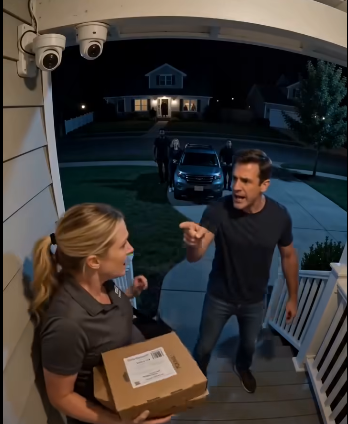
The moment I reached the porch, the front door flew open.
A tall man in a gray sweater stood there, his face twisted with anger.
“Finally,” he snapped. “Do you have any idea how late you are?”
“I’m so sorry,” I said, lifting the bag carefully. “The storm delayed everyone tonight. I sent updates through the app.”
“I don’t care about your excuses.”
His voice was so loud that I glanced instinctively toward the neighboring houses. A curtain moved across the street. Someone was watching.
I handed him the order.
“My dinner is probably ruined,” he said. “You people are unbelievable.”
My hands shook from cold, exhaustion, and the weight of the day. I had been working since morning, taking every order I could before my baby arrived. Rent was due soon. The nursery still needed a crib. I could not afford to stop.
“I really did my best,” I said quietly.
He stepped closer.
His eyes moved briefly to my stomach, then back to my face.
“Your best isn’t good enough.”
I swallowed hard.
“Please,” I said. “There’s no need to yell.”
That made him angrier.
“No need to yell?” he repeated. “You ruined my evening. You made me wait like I don’t matter.”
A neighbor’s porch light turned on.
Then another.
I could feel people watching, but no one stepped outside.
“I’m going to leave now,” I said.
I turned carefully, holding the railing as I stepped down from the porch.
Then he lashed out.
The entire street seemed to freeze.
His words cut through the rain, cruel and sharp enough to make several neighbors gasp.
“You’re incompetent,” he shouted. “Maybe if you had your life together, you wouldn’t be waddling around in a storm begging for tips.”
My breath caught.
For a second, I could not move.
My delivery bag slipped from my hand, but I caught it before it hit the porch steps.
A woman across the street opened her front door.
Someone whispered, “Oh my God.”
Then I noticed the small black security camera mounted above his porch.
So did he.
The customer’s face changed instantly.
His anger disappeared, replaced by something colder.
Fear.
Before either of us could speak, headlights swept across the wet street.
A black SUV pulled up to the curb.
The driver’s door opened.
A woman stepped out, holding a tablet against her chest. She wore a dark coat, her hair pulled back neatly, her expression calm but firm.
The customer went pale the second he saw her.
She walked through the rain toward the porch like she had been expecting this moment.
“Mr. Whitaker,” she said.
His jaw tightened.
“What are you doing here?” he asked.
The woman looked at me, then at him.
“I’ve reviewed footage from multiple incidents,” she said. “And tonight’s recording finally confirms what several drivers, neighbors, and service workers have reported.”
The rain kept falling.
No one moved.
The man opened his mouth, but no words came out.
The woman lifted the tablet.
“And this time,” she said, “you won’t be able to explain it away.”
Part 2
My name is Emma Carter.
Until that night, I thought I was invisible.
Just another delivery driver with tired eyes, swollen feet, and a smile I used even when I wanted to cry.
But the woman in the dark coat looked at me like I mattered.
“Are you hurt?” she asked.
I shook my head, though my heart was pounding.
“I’m okay,” I whispered.
“You don’t look okay.”
The customer, Mr. Whitaker, stepped forward.
“This is ridiculous,” he said. “She was late. I complained. That’s all.”
The woman turned her tablet toward him.
“That is not all.”
His eyes flicked to the screen.
Even from where I stood, I could see the frozen image: me on the porch, rain pouring behind me, him leaning forward with his mouth open in rage.
“This is private property,” he said quickly. “You can’t just—”
“The camera is part of your homeowners’ association security system,” she interrupted. “You signed the disclosure agreement. Footage from exterior cameras may be reviewed in cases involving complaints, threats, harassment, or public safety concerns.”
His face darkened.
“This is harassment.”
“No,” she said. “This is accountability.”
A few neighbors had stepped outside despite the storm. Some stood under umbrellas. Others watched from porches, silent and tense.
The woman looked around at them.
“My name is Rachel Monroe,” she said. “I represent the neighborhood board and the property management company. Over the past six months, we’ve received repeated complaints about Mr. Whitaker’s behavior toward delivery drivers, contractors, cleaners, and even neighbors.”
A man from across the street called out, “He screamed at my teenage son for parking near his driveway.”
Another neighbor said, “He made our housekeeper cry last month.”
Mr. Whitaker spun around.
“Stay out of this!”
Rachel did not flinch.
“That is exactly the problem,” she said.
The storm seemed to grow quieter around her voice.
I stood there with rain dripping from my sleeves, unsure whether to leave or stay. My body was exhausted, but something inside me would not let me move.
For once, someone was saying the things people like me rarely heard.
That what happened was not normal.
That being tired, late, poor, pregnant, or working did not make me less human.
Rachel touched the screen of her tablet.
“This is footage from February,” she said.
The tablet played a video of a plumber standing on the same porch while Mr. Whitaker shouted inches from his face.
“This is March.”
A grocery delivery woman was shown backing away while Mr. Whitaker threw a bag onto the ground.
“This is April.”
A young landscaper stood silently as Mr. Whitaker berated him over a patch of grass.
“And this,” Rachel said, tapping the tablet again, “is tonight.”
My own voice came from the speaker.
“I really did my best.”
Then his voice.
“Your best isn’t good enough.”
My stomach tightened.
Hearing it again hurt worse than I expected.
Mr. Whitaker looked around at the neighbors.
“You’re all enjoying this, aren’t you?” he snapped.
No one answered.
Rachel lowered the tablet.
“Mr. Whitaker, due to repeated violations of the community conduct agreement, the board is issuing an emergency review of your residency privileges and access to shared services.”
His expression cracked.
“You can’t do that.”
“We can,” Rachel said. “And we are.”
Then she looked at me.
“Emma, would you be willing to provide a statement?”
I stared at her.
No one had called me by my name all night.
Not the customer.
Not the app.
Not the people watching.
Only her.
I nodded slowly.
“Yes,” I said. “I would.”
Part 3
Rachel helped me into the back seat of the black SUV while the neighbors remained gathered outside.
The heater was running.
For the first time in hours, warmth touched my hands.
Rachel handed me a bottle of water and a clean towel.
“Take your time,” she said.
I looked down at my muddy shoes, embarrassed.
“I’m getting your seat wet.”
“That’s what seats are for.”
I almost laughed, but my throat tightened instead.
Mr. Whitaker was still on the porch, arguing into his phone now. His face had gone red again, but the confidence was gone. He kept looking at the camera above his door like it had betrayed him.
Rachel sat beside me, tablet resting on her lap.
“I need to ask a few questions,” she said gently. “But only what you’re comfortable answering.”
I nodded.
She recorded my statement.
I told her about the delay, the flooded roads, the updates I sent through the app, and how I apologized before he started yelling. I told her what he said about me, about my pregnancy, about my job.
When I finished, Rachel’s face was still calm, but her eyes had hardened.
“This was not your fault,” she said.
I looked out the window.
“I know,” I said, but my voice betrayed me.
Because part of me did not know.
Part of me had spent months absorbing people’s impatience, their insults, their slammed doors, their missing tips, their complaints over things I could not control.
Rachel seemed to understand.
“Do you have anyone waiting for you at home?” she asked.
“My sister,” I said. “She worries.”
“Call her.”
I pulled out my phone with trembling fingers.
My sister Lily answered on the second ring.
“Emma? Are you okay?”
That was all it took.
I started crying.
Not loud.
Not dramatic.
Just silent tears running down my cold face while the rain blurred the windows.
“I’m okay,” I said. “Something happened on a delivery.”
Lily’s voice changed instantly.
“Where are you?”
I gave her the address.
“I’m coming.”
Before I could argue, she hung up.
Rachel gave me space. She stepped outside and spoke to two neighbors, then to a police officer who had arrived after someone called in a disturbance.
A few minutes later, the officer approached the SUV.
“Ma’am,” he said, “we reviewed the initial footage. We’re documenting this as harassment and verbal intimidation. Since there was no physical contact, charges may be limited, but the record will be filed.”
I nodded.
It was not everything.
But it was something.
Then another car came speeding carefully down the street and stopped behind the SUV.
My sister jumped out before the engine was even off.
Lily was five years older than me and twice as fierce. She ran toward me in a raincoat, her eyes flashing.
“Where is he?”
“Lily,” I said.
“Where is the man who screamed at my pregnant sister in a storm?”
Rachel stepped between her and the porch.
“I understand,” she said. “But tonight, the best thing you can do is help Emma.”
Lily looked at me.
Her anger broke into concern.
She opened the SUV door and wrapped me in her arms.
I leaned into her and finally let myself shake.
Across the street, Mr. Whitaker watched from his porch.
For the first time that night, he was the one surrounded by eyes.
And he hated it.
Part 4
The video spread faster than any of us expected.
Not the full security footage.
Not at first.
But one neighbor had recorded part of the confrontation from her doorway. Another posted about what had happened in the neighborhood group. By morning, people were talking.
By noon, Mr. Whitaker’s name was everywhere in town.
By evening, the delivery company contacted me.
At first, I ignored the call.
I assumed they were going to ask why the order had gone wrong.
Instead, a supervisor named Daniel left a message.
“Emma, we reviewed your delivery route, your app messages, the weather alerts, and the report from the neighborhood. You did everything correctly. Please call us back.”
I sat at my kitchen table, staring at the phone.
Lily stood at the stove making soup.
“Call him,” she said.
“I don’t want more trouble.”
“You didn’t make trouble. Trouble opened its front door and screamed at you.”
So I called.
Daniel apologized.
Not the quick, empty kind of apology people give when they want you to move on.
A real one.
He told me my account would not be penalized. He told me the customer had been permanently banned from the platform. Then he told me the company wanted to pay me for the rest of the week so I could take time off.
I pressed my hand to my mouth.
“I can’t afford time off,” I whispered.
“That’s why it’s paid,” he said.
I closed my eyes.
After the call, Lily set a bowl of soup in front of me.
“You’re crying again,” she said.
“I’m pregnant. I’m allowed.”
She smiled softly.
The next day, Rachel called.
“The board held an emergency meeting,” she said. “Mr. Whitaker has been fined for multiple violations. His lease agreement is also under formal review.”
“He rents that house?” I asked.
“Yes,” Rachel said. “And apparently his landlord has received complaints before.”
That surprised me. The house looked like it belonged to someone powerful.
Maybe that was part of the illusion.
Some people built their whole personality around doors they could slam, porches they could stand on, and people they could make feel small.
But Mr. Whitaker’s door no longer protected him.
That afternoon, three neighbors showed up at my apartment.
At first, I panicked when Lily opened the door.
But they were holding bags.
One had diapers.
Another had baby blankets.
The third carried a small envelope.
“We’re from Oakridge Lane,” one woman said. “We saw what happened. We should have stepped in sooner.”
I did not know what to say.
The woman’s eyes filled with regret.
“I watched from my window,” she admitted. “I heard him. I froze. I’m sorry.”
Her apology felt heavier than the gifts.
I accepted both.
Inside the envelope was a card.
For you and your baby. From neighbors who should have spoken sooner.
There was also money.
Not a fortune.
But enough to buy the crib.
I sat down slowly, overwhelmed.
For months, I had felt like I was racing against life with no one beside me.
Now strangers were standing in my living room, proving that sometimes people noticed.
Sometimes they were late.
But sometimes they still came.
Part 5
Mr. Whitaker did not disappear quietly.
People like him rarely do.
Two days after the incident, he posted a long statement online claiming he was the victim. He said the video had been taken out of context. He said he was under stress. He said delivery drivers had become careless and entitled.
Then the full footage was released by the neighborhood board’s attorney.
Not publicly at first.
Only to the landlord, the delivery company, and the investigating officer.
But enough people saw it.
And enough people knew.
His excuses collapsed one by one.
The footage showed me arriving with the food still sealed in the insulated bag.
It showed me apologizing.
It showed him stepping closer.
It showed his insults.
It showed the neighbors reacting.
It showed the moment he realized the camera had caught him.
That moment became the detail everyone remembered.
Not his yelling.
Not his cruelty.
His fear.
Because it revealed he knew exactly what he had done.
A week later, Rachel invited me to the community center.
“I understand if you don’t want to come,” she said. “But some residents want to apologize in person.”
I almost said no.
Standing in front of people sounded terrible.
But Lily said, “You don’t have to protect people from their own guilt.”
So I went.
The room was filled with Oakridge residents. People in nice coats. People holding coffee cups. People who looked uncomfortable because they were not used to being part of an ugly story.
Rachel introduced me simply.
“This is Emma Carter.”
Everyone turned.
I rested one hand on my belly.
For a moment, I felt the old instinct rise inside me.
Smile.
Make them comfortable.
Say it was okay.
But it was not okay.
So I told the truth.
“I’m not here because I want attention,” I said. “I’m here because I don’t think people understand what service workers deal with. We drive through storms. We carry groceries up stairs. We bring food to doors when people don’t want to leave their homes. Most people are kind. Some aren’t. And when they aren’t, it stays with us.”
The room was silent.
I looked at the faces watching me.
“I’m seven months pregnant. I was tired. I was scared. And I still apologized to someone who was treating me like I wasn’t a person.”
A woman in the front row wiped her eyes.
“I’m not asking anyone to feel sorry for me,” I continued. “I’m asking you to pay attention sooner next time.”
That was all.
I sat down.
For a second, no one moved.
Then an older man stood.
“I heard him yelling that night,” he said. “I didn’t open my door. I’m ashamed of that.”
Another neighbor stood.
“So did I.”
Then another.
One by one, people admitted what they had ignored.
Rachel watched quietly from the side of the room.
By the time the meeting ended, the neighborhood had voted to create a new conduct policy for all residents and guests, including protections for delivery workers, contractors, cleaners, caregivers, and anyone providing service in the community.
It would not fix everything.
But it was a start.
And sometimes a start is the first crack in a wall that should have fallen long ago.
Part 6
Three weeks later, I received a letter.
It came in a clean white envelope with my name typed across the front.
Inside was a formal apology from Mr. Whitaker’s landlord.
He wrote that he had ignored warning signs. He wrote that other complaints had seemed minor when viewed separately. He wrote that seeing the full pattern changed everything.
At the bottom, in bold print, was the sentence that made Lily shout from the kitchen.
Mr. Whitaker’s lease will not be renewed, and he has been issued notice to vacate the property.
I read it three times.
Lily grabbed the letter and read it out loud.
Then she grinned.
“Looks like the porch king lost his castle.”
I laughed so hard the baby kicked.
Life did not magically become easy after that.
I still had bills.
I still got tired.
I still woke up some mornings afraid I was not ready to be a mother.
But something had shifted.
The delivery company offered me a temporary remote support position until after the baby was born. Instead of driving through storms, I helped other drivers handle difficult customers, unsafe routes, and emergencies.
The first night I worked from home, I sat at the same kitchen table where I had once counted coins for gas.
My headset felt strange.
My belly pressed against the edge of the table.
Then a driver called in from across town.
A customer was screaming at him over a missing sauce packet.
I listened.
I documented everything.
Then I said, “You’re allowed to leave if you feel unsafe.”
There was a pause.
“Really?” the driver asked.
“Yes,” I said. “No order is worth being threatened.”
I wished someone had said that to me sooner.
So I kept saying it to others.
Meanwhile, the Oakridge neighborhood changed in small ways.
Signs went up near delivery areas asking residents to treat workers respectfully.
The community board created a reporting system.
Rachel emailed me updates sometimes.
And the neighbors who had come to my apartment kept checking in. One woman, Mrs. Alvarez, brought homemade meals every Sunday. Another neighbor dropped off a rocking chair her daughter no longer needed.
I tried to refuse.
They refused harder.
“You’re part of our story now,” Mrs. Alvarez said.
I did not know what that meant at first.
Then one rainy afternoon, I understood.
I was folding baby clothes when my phone buzzed.
It was a message from Rachel.
Thought you should know. He moved out today.
Attached was a photo taken from across the street.
Mr. Whitaker stood beside a moving truck, shoulders hunched, rain falling around him. No neighbors came to help. No one waved goodbye.
The house behind him looked empty.
The porch camera watched silently above the door.
For once, he had nothing to say.
Part 7
My daughter was born on a clear morning in May.
After months of storms, the sky outside the hospital window was bright blue.
I named her Grace.
She arrived tiny, loud, and furious, with fists clenched like she was ready to argue with the world.
Lily cried harder than I did.
“She has your attitude,” she said.
“She’s two hours old.”
“I stand by it.”
Rachel sent flowers.
Mrs. Alvarez brought a knitted blanket.
Daniel from the delivery company sent a card signed by half the support team.
Even some Oakridge residents sent gifts.
I kept every card in a shoebox beneath Grace’s crib.
There was one envelope with no return address.
Inside was a cashier’s check and a note.
For the crib, the diapers, the quiet days, and the loud ones. You reminded us to open the door.
I never found out who sent it.
Maybe that was better.
Not every kindness needed a name.
A month after Grace was born, Rachel visited my apartment.
She held Grace awkwardly at first, like the baby was made of glass.
Grace stared up at her with serious dark eyes.
“She looks like she’s judging me,” Rachel said.
“She judges everyone,” I replied.
Rachel smiled.
Then her expression turned thoughtful.
“I have something to ask you.”
I sat straighter.
“The property management company is expanding the worker safety program,” she said. “We’re creating training materials for neighborhoods and residential communities. We want to include real experiences from drivers and service workers. Not just policies. Human stories.”
I looked down at Grace.
“You want mine?”
“Only with your permission,” Rachel said. “And only in the way you choose to tell it.”
For a long moment, I said nothing.
The old version of me might have wanted to hide from that night forever.
But I was not that version anymore.
That night had started with humiliation.
But it had not ended there.
It had become a record.
A warning.
A reason for people to change their rules, their habits, and maybe even their courage.
“Yes,” I said. “Use it.”
Rachel nodded.
“And Emma?”
“Yeah?”
“You did more than survive a bad night.”
I looked at my daughter, asleep against her shoulder.
Maybe she was right.
Maybe survival was not always quiet.
Sometimes it had a voice.
Sometimes it stood in a community center with shaking hands and told the truth.
Sometimes it answered the phone and told another driver, “You are allowed to leave.”
Sometimes it named a baby Grace because even after everything, you still believed something gentle could grow.
Part 8
One year later, I returned to Oakridge Lane.
Not as a delivery driver.
Not in soaked shoes.
Not with shaking hands.
I came as a speaker for the neighborhood’s first annual service worker appreciation event.
It sounded too formal to me, but Rachel insisted.
“You started this,” she said.
“I got yelled at on a porch.”
“And then you spoke up.”
The old house at the end of the street had new tenants now. A young couple lived there with two rescue dogs and a habit of leaving snacks out for delivery drivers during bad weather.
The porch camera was still there.
But it felt different now.
Not like a witness waiting for damage.
Like a guard making sure the truth had somewhere to live.
I stood near the community center entrance with Grace on my hip. She was nearly one, round-cheeked and curious, grabbing at my necklace while people greeted us.
Mrs. Alvarez kissed Grace’s forehead.
Lily stood beside me, proud as ever.
“You nervous?” she asked.
“A little.”
“Good. Means you’re about to do something important.”
When it was time, Rachel introduced me.
I walked to the front of the room.
This time, my hands did not shake.
I looked out at the crowd: residents, drivers, cleaners, landscapers, contractors, store clerks, caregivers. People who kept life moving in ways most others only noticed when something went wrong.
I took a breath.
“A year ago,” I began, “I came to this neighborhood during a storm.”
The room quieted.
“I was tired. I was pregnant. I was late because the roads were flooded. And when I reached the door, someone decided my job made me an easy target.”
Grace babbled softly against Lily’s shoulder.
A few people smiled.
I continued.
“For a long time, I thought strength meant staying calm while people mistreated me. I thought it meant apologizing even when I had done nothing wrong. I thought it meant swallowing every insult because I needed the money.”
I paused.
“But strength can also mean telling the truth after your voice has been ignored.”
Rachel watched from the side with tears in her eyes.
“That night changed my life,” I said. “Not because someone was cruel. Cruelty is common. It changed my life because other people finally stopped pretending they didn’t see it.”
I looked toward the windows, where sunlight touched the floor.
“So when you see something wrong, open the door. Say something. Record if you must. Report it. Stand beside the person being targeted. Don’t wait for someone else to be brave first.”
The applause came slowly at first.
Then louder.
Then everyone stood.
I saw delivery drivers clapping with tired smiles. I saw neighbors wiping their eyes. I saw Lily holding Grace high enough so she could see the room.
And for the first time, I thought about that storm without feeling small.
After the event, I walked alone to the old porch.
The house looked peaceful.
The street was dry.
No angry voice waited behind the door.
Rachel joined me quietly.
“Do you ever think about him?” she asked.
“Sometimes,” I admitted.
“And?”
I looked up at the camera above the porch.
“I hope he remembers exactly what he said.”
Rachel nodded.
I adjusted my coat and looked down the street where the black SUV had once pulled up through the rain.
That night, I had arrived as a tired pregnant woman carrying someone else’s dinner.
I left as a person whose story could no longer be erased.
And somewhere behind me, my daughter laughed.
The sound floated through the quiet street, bright and fearless.
For once, the whole neighborhood heard it.
