The repair estimate was sitting between us when everything fell apart.
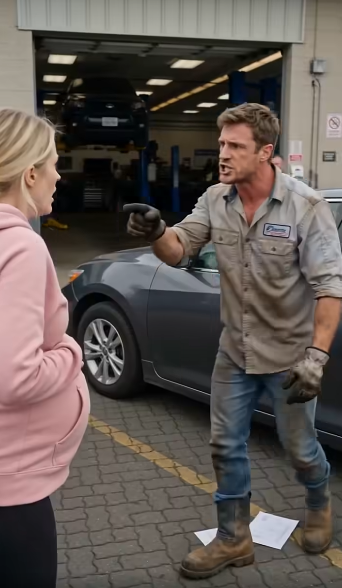
I was seven months pregnant and standing beside our car in the auto shop parking lot.
The mechanic had just handed Brian a quote we couldn’t afford.
The transmission was failing.
The total was more than we had in savings.
Brian stared at the paper without saying a word.
His hands were still covered in grease from trying to fix the car himself.
I told him we would figure something out.
He didn’t respond.
I suggested a payment plan.
Still nothing.
Then I mentioned borrowing money from my parents.
That was a mistake.
Brian crumpled the estimate in his fist.
He said he was tired of feeling helpless.
I told him needing help didn’t make him weak.
That only made him angrier.
Customers walking through the parking lot started glancing our way.
I begged him to lower his voice.
He accused me of treating him like a failure.
I told him I was trying to save our family.
The second I said that, he shoved me.
I stumbled backward into the side of the car.
My hands instantly covered my stomach.
The parking lot went silent.
Brian looked horrified.
For a second, I thought he would apologize.
Then the repair shop door burst open.
A mechanic came running outside holding another piece of paper.
The moment Brian saw the shop manager behind him, his face turned white because he recognized what was in the manager’s hand.
It wasn’t another repair estimate.
It was a photograph.
And it was a photograph of him.
My stomach dropped.
The manager pointed at Brian.
“That’s him.”
The mechanic stopped running.
Everyone in the parking lot froze.
“What are you talking about?” I asked.
The manager looked from Brian to me and immediately softened.
“Ma’am,” he said carefully, “I think you need to sit down.”
Brian’s eyes darted toward the street.
Toward the road.
Toward escape.
I’d never seen that look on his face before.
Fear.
Real fear.
“Brian?” I whispered.
He wouldn’t look at me.
The manager stepped closer.
“Three years ago, our shop was robbed.”
My heart started pounding.
“What?”
The manager held up the photograph.
Security camera footage.
Grainy.
Blurry.
But unmistakable.
A younger Brian stood inside the shop after hours.
Holding a crowbar.
Standing beside an open safe.
The world tilted.
“No,” I said.
“No, that’s not possible.”
Brian finally spoke.
His voice barely existed.
“I can explain.”
The manager laughed bitterly.
“Good. Because the police would love an explanation.”
Customers began backing away.
Someone pulled out a phone.
Someone else quietly walked inside.
I looked at Brian.
My husband.
The father of my unborn child.
The man I’d known for five years.
And suddenly I realized there was an entire chapter of his life I’d never heard.
The manager continued.
“We never caught the guy. Insurance covered most of it, but not all. Last week we upgraded our computer system and recovered archived security files. This morning I finally got around to reviewing them.”
He tapped the photograph.
“Then this guy walks into my shop.”
Brian closed his eyes.
I felt cold despite the summer heat.
“Tell me he’s wrong,” I said.
Brian didn’t answer.
“Tell me.”
His silence shattered something inside me.
A police siren echoed in the distance.
Someone had already called.
The manager hadn’t even needed to.
Brian looked at me then.
Really looked at me.
His eyes filled with tears.
“I’m sorry.”
I took a step back.
Not because of the photograph.
Not because of the robbery.
Because those two words told me everything.
He wasn’t denying it.
The sirens grew louder.
Then Brian did something nobody expected.
He handed the manager the crumpled repair estimate.
The manager frowned.
“What?”
Brian swallowed.
“Turn it over.”
The manager unfolded the paper.
On the back was handwriting.
Dozens of lines.
Dates.
Dollar amounts.
Notes.
The manager’s expression changed.
“What is this?”
Brian looked exhausted.
Like he’d been carrying a mountain on his shoulders.
“My repayments.”
The parking lot fell silent again.
The manager blinked.
“Repayments?”
Brian nodded.
“Every dollar I stole. Plus interest.”
Nobody spoke.
The manager stared at the list.
Then at Brian.
Then back at the list.
I moved closer.
The handwriting covered both sides.
Hundreds of entries.
Years of entries.
Small payments.
Twenty dollars.
Fifty dollars.
Thirty-five dollars.
Every spare cent.
Every month.
Every year.
“What is this?” I asked softly.
Brian finally faced me.
And for the first time since I’d met him, he told me the truth.
When he was twenty-one, his younger brother had needed emergency surgery.
No insurance.
No money.
No options.
Their mother had already passed away.
Their father had disappeared years earlier.
The hospital demanded payment.
Brian had panicked.
Desperate people make terrible decisions.
One night he broke into the repair shop.
He stole just over eleven thousand dollars.
Enough to save his brother.
Nothing more.
His brother survived.
But guilt never left.
Not for a single day.
So Brian got a second job.
Then a third.
He lived in tiny apartments.
Drove broken cars.
Skipped vacations.
Bought nothing for himself.
And slowly, secretly, he began repaying every dollar.
Anonymously.
Cash deposits.
Money orders.
Untraceable payments sent to the company’s account.
Over three years.
Then four.
Then five.
Until the amount he had repaid exceeded what he stole.
The manager stared at the list.
His hands shook.
“I never knew.”
“You weren’t supposed to.”
The police cars arrived.
Blue lights flashed across the parking lot.
Two officers stepped out.
The manager raised a hand.
“Wait.”
The officers paused.
The manager looked at the photograph.
Then at the repayment record.
Then at Brian.
“Did you really pay it all back?”
Brian nodded.
“And more.”
The older officer approached.
“What’s going on here?”
The manager handed him the photograph.
Then the repayment log.
The officer spent several minutes reviewing both.
Finally he looked at Brian.
“Is it true?”
“Yes.”
The officer sighed.
“You understand there’s still a crime involved.”
“I know.”
Brian held out his wrists.
As if expecting handcuffs.
My chest tightened.
Part of me was furious.
Part of me felt betrayed.
Part of me wanted to scream.
And another part saw something else.
A broken young man who had spent years trying to make something right.
The manager rubbed his forehead.
Then said something that shocked everyone.
“I don’t want to press charges.”
The officer frowned.
“You sure?”
The manager nodded.
“He made a terrible decision.”
Brian stared at him.
“But he spent years fixing it.”
The manager folded the photograph.
“The money came back.”
He looked at Brian.
“Most thieves don’t spend half a decade paying restitution nobody asked for.”
The officer remained silent.
The manager continued.
“If he’d walked away and never looked back, I’d feel differently.”
He held up the repayment log.
“But this? This matters.”
For a long moment nobody spoke.
Finally the officer lowered his notebook.
“That’s your decision.”
The manager nodded.
“It is.”
The officer turned to Brian.
“You’re a lucky man.”
“No,” Brian said quietly.
“I’m not.”
He looked at me.
And I knew exactly what he meant.
Because I wasn’t looking at him the same way anymore.
The police left.
The crowd dispersed.
The manager returned inside.
The mechanic awkwardly followed.
Within minutes the parking lot was nearly empty.
Just me.
And Brian.
Standing beside a broken car.
Holding a broken marriage together with threads.
“I was going to tell you.”
I laughed bitterly.
“When?”
He couldn’t answer.
“When our daughter was born?”
Silence.
“Ten years from now?”
More silence.
I shook my head.
“You shoved me.”
His face crumpled.
“I know.”
“No.”
My voice cracked.
“You don’t.”
Tears blurred my vision.
“I trusted you.”
“I know.”
“You could have hurt her.”
His eyes instantly filled.
The realization hit him harder than anything else had.
Harder than the police.
Harder than the photograph.
Harder than exposure.
His knees buckled.
Right there in the parking lot.
My husband sank onto the asphalt and cried.
Not polite tears.
Not movie tears.
The kind that come from somewhere deep and ugly.
The kind a person can’t stop.
“I know,” he whispered.
“Oh God.”
He covered his face.
“I know.”
For the first time since the shove, I believed him.
Not because excuses existed.
There weren’t any.
But because he understood exactly what he’d done.
The next few months were the hardest of our lives.
I moved in with my parents temporarily.
Not because I wanted revenge.
Because trust needed space.
Brian started therapy.
Anger management.
Individual counseling.
Anything recommended.
He never complained.
Never argued.
Never blamed me.
Every appointment.
Every session.
Every week.
He showed up.
When our daughter, Lily, was born two months later, Brian wasn’t in the delivery room at first.
That had been my choice.
A consequence.
A boundary.
A painful one.
He waited outside.
For twelve hours.
Without leaving.
Without sleeping.
Without eating.
Just waiting.
When Lily finally arrived healthy and screaming, a nurse asked if I wanted him to come in.
I stared at my daughter.
Tiny fingers.
Tiny nose.
Tiny heartbeat.
Then I said yes.
Brian entered the room looking terrified.
The moment he saw Lily, he froze.
Then he started crying.
Again.
He took one look at her and completely fell apart.
The nurse placed Lily into his arms.
And something happened.
Not dramatic.
Not magical.
Just real.
A man looked at his child and understood exactly who he wanted to become.
And exactly who he never wanted to be again.
Years passed.
Slowly.
Painfully.
Trust returned one brick at a time.
Not because we ignored what happened.
Because we confronted it.
Repeatedly.
Honestly.
Some marriages collapse after betrayal.
Some survive.
Ours nearly didn’t.
But survival required work from both of us.
The shove was never forgotten.
Neither was the lie.
Neither was the robbery.
Those scars remained.
But scars aren’t the same as wounds.
Five years later, Lily started kindergarten.
One afternoon she came home carrying a sheet of paper.
A class assignment.
Draw your hero.
I expected a firefighter.
A doctor.
A superhero.
Instead she handed me a crayon drawing.
A stick figure man.
Brown hair.
Blue shirt.
Holding a little girl’s hand.
“Who’s this?” I asked.
She smiled.
“Daddy.”
I looked toward the kitchen.
Brian was helping prepare dinner.
Laughing because he’d accidentally dropped spaghetti on the floor.
Again.
Lily climbed onto my lap.
“My teacher said heroes help people.”
“They do.”
She pointed at the drawing.
“Daddy helps everybody.”
My throat tightened.
Children don’t care about who you used to be.
They care about who you are.
That night, after Lily fell asleep, I found Brian sitting on the porch.
Watching the stars.
I sat beside him.
Neither of us spoke for a while.
Then I handed him the drawing.
He stared at it.
His eyes glistened.
“Hero, huh?”
“Looks like it.”
He laughed softly.
“If she knew everything…”
I squeezed his hand.
“One day she will.”
He looked at me.
“And then?”
I thought about the parking lot.
The photograph.
The lies.
The therapy.
The years.
The work.
The growth.
Everything.
Then I smiled.
“Then she’ll learn the most important lesson of all.”
“What’s that?”
I leaned against his shoulder.
“That being a hero doesn’t mean you’ve never failed.”
He looked down at the drawing again.
The little stick figure holding her father’s hand.
The picture seemed ridiculously simple.
Yet somehow it contained an entire lifetime.
“It means,” I continued, “you chose to become better after you did.”
For a long time he didn’t speak.
Then he folded the paper carefully.
Like something precious.
Like something fragile.
Like a second chance.
And under the quiet glow of the porch light, the man who once believed his worst mistake would define him forever finally understood something unexpected.
The photograph had not destroyed his life.
The truth had saved it.
