I couldn’t believe what was happening.
One moment I was carrying a tray of iced tea and coffee through the crowded diner.
The next, I was sprawled across the floor.
My vision swam.
My ears rang.
The baby kicked hard inside my stomach.
People rushed toward me.
Someone offered water.
Another customer asked if they should call an ambulance.
Then Brian appeared.
My manager.
The man who constantly reminded everyone that “business comes first.”
He didn’t ask if I was hurt.
He didn’t ask if the baby was okay.
Instead, he started yelling.
“Get up!”
The entire restaurant froze.
Customers stared.
Servers exchanged horrified looks.
I tried pushing myself upright.
“I’m dizzy,” I whispered.
Brian rolled his eyes.
“You’re always complaining.”
Humiliation washed over me.
I had worked at Riverside Diner for almost four years.
I had covered shifts.
Worked holidays.
Stayed late.
Came in sick.
And now, at eight months pregnant, after collapsing in front of dozens of people, this was how I was being treated.
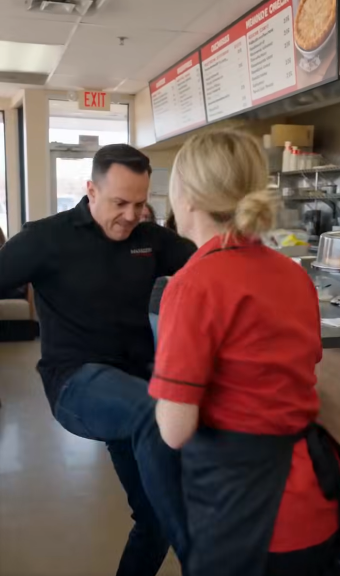
Then came the kick.
Not hard enough to cause major injury.
But hard enough.
His shoe slammed into my calf.
The shock hurt more than the impact itself.
A collective gasp swept through the dining room.
Someone shouted, “What the hell is wrong with you?”
Brian pointed at me.
“You’re fired.”
The words echoed through the restaurant.
“Effective immediately.”
Nobody moved.
Nobody spoke.
Then a chair scraped against the floor.
An elderly man slowly stood up from a corner booth.
Until that moment, I hadn’t paid much attention to him.
He looked to be in his seventies.
Gray hair.
Simple sweater.
Wire-rimmed glasses.
The kind of customer who quietly drank coffee while reading the newspaper.
But there was something about the way he stood.
Something confident.
Commanding.
The entire room seemed to notice.
He calmly folded his newspaper.
Placed it on the table.
Then looked directly at Brian.
“Young man,” he said quietly.
Brian turned.
“What?”
The elderly customer reached into his jacket pocket.
Pulled out a leather wallet.
And displayed an identification card.
The color instantly drained from Brian’s face.
The man spoke clearly.
“My name is Arthur Whitmore.”
Nobody reacted.
The name meant nothing to most of us.
Then Arthur added:
“I own this restaurant.”
The silence was deafening.
Brian blinked.
“What?”
Arthur slipped the identification card back into his pocket.
“I own this diner.”
A customer near the counter nearly dropped her coffee.
One of the cooks actually whispered, “Oh my God.”
I stared from the floor, completely confused.
Brian laughed nervously.
“No, you don’t.”
Arthur’s expression never changed.
“Actually, I do.”
The manager’s confidence evaporated.
Because deep down, he already knew.
Everyone who worked for Riverside Diner knew the owner’s name.
Few had ever met him.
The company owned multiple locations throughout the state.
Arthur Whitmore rarely appeared in public.
Most employees had only seen photographs.
And the older man standing in front of us looked exactly like those photographs.
Brian suddenly looked terrified.
“Mr. Whitmore…”
Arthur raised a hand.
“Stop.”
Brian immediately obeyed.
The room remained completely silent.
Arthur walked toward me.
Then, to everyone’s surprise, he knelt beside me.
“Are you hurt?”
The kindness in his voice nearly made me cry.
“I don’t know.”
“Has anyone called an ambulance?”
Several customers shook their heads.
Arthur turned.
“Call one now.”
Three phones appeared instantly.
Brian stood frozen.
Arthur looked at him.
“I assume you knew she was eight months pregnant.”
“Yes, sir.”
“And she informed you she wasn’t feeling well.”
Brian swallowed.
“Yes.”
“You ignored her concerns.”
No response.
“You screamed at her in front of customers.”
Silence.
“You kicked her.”
The entire diner watched.
Brian’s mouth opened.
Closed.
Opened again.
Finally he whispered:
“It wasn’t like that.”
Arthur’s eyes hardened.
“Interesting.”
He pointed toward the woman holding her phone.
“Would you happen to have recorded any of this?”
The woman nodded.
“I recorded everything.”
Brian looked like he might faint.
Arthur nodded.
“Thank you.”
Then he pointed toward another customer.
“And you?”
“Same.”
A third hand rose.
“So did I.”
A fourth.
A fifth.
The entire dining room seemed to have footage.
The realization hit Brian like a freight train.
There were witnesses everywhere.
No excuses.
No alternative version.
Just evidence.
Lots of it.
Arthur stood.
“Brian.”
“Yes, sir?”
“You’re terminated.”
The words landed like a bomb.
“Effective immediately.”
The irony wasn’t lost on anyone.
Brian’s face went white.
“Please—”
“No.”
“But I—”
“No.”
Arthur’s voice remained calm.
Almost gentle.
Which somehow made it worse.
“You assaulted an employee.”
Brian tried speaking again.
Arthur cut him off.
“You assaulted a pregnant employee.”
Nobody had ever seen Brian speechless before.
Now he couldn’t form a sentence.
Security arrived ten minutes later.
Not because Arthur called them.
Because corporate headquarters had.
Apparently someone inside the restaurant had already alerted them.
Brian was escorted out in front of everyone.
Customers actually applauded.
I watched through blurry eyes as he disappeared through the front doors.
Then the ambulance arrived.
The hospital visit lasted nearly six hours.
Thankfully, the baby was fine.
I was dehydrated.
Exhausted.
Overworked.
The doctor wasn’t happy.
“You should not be working double shifts.”
I laughed weakly.
“Tell that to my bills.”
His expression softened.
“I understand. But if you keep pushing this hard, you’re risking your health.”
I knew he was right.
The problem was that being right didn’t pay rent.
I expected that to be the end of the story.
I was wrong.
The next morning, my phone rang.
It was Arthur.
The owner.
I nearly didn’t answer because I assumed it was spam.
When I realized who it was, I almost dropped the phone.
“Hello?”
“Good morning, Samantha.”
I sat upright.
“Mr. Whitmore?”
“Please call me Arthur.”
I wasn’t sure I could.
The man owned twenty-seven restaurants.
People like him didn’t call people like me.
Yet here he was.
“I wanted to check on you.”
The simple concern caught me off guard.
We talked for nearly twenty minutes.
At the end of the conversation, he asked a question.
“Would you be willing to meet me?”
Three days later, I sat across from Arthur in a quiet office above one of his restaurants.
I was nervous.
Very nervous.
Arthur smiled.
“Relax.”
Easy for him to say.
He slid a folder across the desk.
I opened it.
Inside were employee evaluations.
Mine.
Every review from the previous four years.
Attendance records.
Customer feedback.
Performance reports.
I frowned.
“What is this?”
Arthur leaned back.
“I spent two days reviewing your employment history.”
My stomach tightened.
Had I done something wrong?
Then he continued.
“You have the highest customer satisfaction scores in the company.”
I blinked.
“What?”
“You’ve received more positive customer comments than any server we employ.”
I stared.
Surely he had the wrong file.
Arthur smiled.
“You also covered more shifts than anyone else.”
I didn’t know what to say.
Nobody had ever noticed.
At least, not publicly.
Arthur tapped the folder.
“Do you know why I was in that diner?”
I shook my head.
“I visit one location every month anonymously.”
I remembered the newspaper.
The coffee.
The corner booth.
He’d been observing.
Watching.
Listening.
Learning how employees and customers were treated.
Then he sighed.
“Unfortunately, what I saw that day wasn’t the first complaint involving Brian.”
A cold feeling settled in my stomach.
“People reported him?”
Arthur nodded.
“Many times.”
I felt sick.
“Then why was he still there?”
Arthur’s face darkened.
“Because someone higher up ignored those reports.”
The next month became chaos.
Corporate investigations began.
Human resources files were reviewed.
Managers were interviewed.
Former employees were contacted.
The deeper they dug, the uglier things became.
Brian wasn’t the only problem.
Several supervisors had hidden complaints.
Falsified reports.
Ignored safety concerns.
Retaliated against employees.
By the time the investigation ended, seven people had lost their jobs.
News outlets started calling.
Videos from the diner had gone viral.
Millions of views.
Thousands of comments.
People were furious.
The story spread across social media.
Suddenly everyone knew about the pregnant waitress who collapsed at work.
I hated the attention.
But it forced the company to change.
And Arthur seemed determined to make sure those changes lasted.
Six weeks later, I gave birth to a healthy baby girl.
I named her Emma.
The moment I held her, every fear melted away.
She had tiny fingers.
Tiny toes.
And a cry powerful enough to wake an entire city.
She was perfect.
Two days after we came home from the hospital, there was a knock at the door.
Outside stood Arthur.
Holding a gift basket.
I was speechless.
Inside were diapers.
Baby clothes.
Formula.
Books.
Gift cards.
Enough supplies to help for months.
But there was also an envelope.
Inside was a handwritten note.
And a check.
I stared at the number.
Ten thousand dollars.
My hands started shaking.
I called Arthur immediately.
“There must be a mistake.”
“There isn’t.”
“I can’t accept this.”
“Yes, you can.”
I nearly cried.
“Why?”
His answer stayed with me forever.
“Because sometimes people need a hand when life gets heavy.”
A year passed.
Then another.
Emma grew.
Life stabilized.
For the first time in years, I wasn’t constantly terrified about money.
Partly because of something Arthur did six months after Emma’s birth.
He offered me a new position.
Not as a server.
As a regional training coordinator.
The salary was nearly double what I’d earned before.
Benefits.
Paid vacation.
Flexible scheduling.
I thought he was joking.
He wasn’t.
“You understand people,” he told me.
“That’s harder to teach than management.”
I accepted.
It changed everything.
Three years later, Arthur called again.
By then we had become friends.
Unlikely friends.
The billionaire restaurant owner and the former waitress.
He invited me to lunch.
I almost declined because of work.
Thank goodness I didn’t.
Halfway through the meal, Arthur slid another folder across the table.
I laughed.
“You really love folders.”
He smiled.
“Open it.”
Inside were business documents.
Legal papers.
Ownership agreements.
I stared.
Completely confused.
“What am I looking at?”
Arthur folded his hands.
“A proposal.”
“For what?”
He smiled.
“For your future.”
My heart raced.
I kept reading.
Then stopped.
Then read it again.
I genuinely thought I was misunderstanding.
The papers offered me partial ownership in three restaurant locations.
Not management.
Ownership.
Actual equity.
A percentage of profits.
A stake in the business.
I looked up.
Speechless.
Arthur nodded.
“I’ve spent years looking for people who care about employees.”
Tears filled my eyes.
“Arthur…”
“You earned this.”
I couldn’t speak.
For nearly a minute.
Then I finally whispered:
“Why me?”
The old man smiled.
“Because when I first met you, you were lying on a diner floor worried more about finishing your shift than yourself.”
I laughed through tears.
“That sounds ridiculous now.”
“Maybe.”
He leaned back.
“But character reveals itself during difficult moments.”
Five years after the day I collapsed, I stood inside the same diner.
Only now things looked very different.
The restaurant had been renovated.
Employees received better benefits.
Pregnant workers had flexible schedules.
Mandatory management training had been implemented company-wide.
Staff turnover had dropped dramatically.
Morale had never been higher.
Near the entrance hung a framed photograph.
Customers often asked about it.
The picture showed a young waitress holding a newborn baby.
Standing beside an elderly man with silver hair.
Beneath it was a small plaque:
Treat people like they matter. Because they do.
Every time I saw it, I smiled.
Because it reminded me how quickly life can change.
I thought collapsing that afternoon was the worst thing that could happen.
I thought getting fired would destroy me.
Instead, it exposed everything that needed to be exposed.
And the elderly customer quietly drinking coffee in the corner booth turned out to be exactly the person who could change everything.
Not because he owned the restaurant.
Not because he had money.
But because when everyone else looked away, he chose to stand up.
And that single decision changed my life forever.
