I learned that a house could be full of people and still feel like the loneliest place on earth.
I was twelve years old the night my stepmother made me eat on the floor.
It was my father’s birthday, and our house looked more beautiful than I had ever seen it. Golden balloons floated near the ceiling. White flowers filled crystal vases. Music poured from the living room speakers while relatives laughed over trays of roasted chicken, glazed ham, buttered rolls, and expensive desserts my stepmother had ordered from a bakery two towns away.
Everyone looked happy.
Everyone except me.
My name was Lily Parker, and for three years after my mother died, I had tried very hard to be invisible.
Not because I wanted to disappear.
Because disappearing was safer.
My stepmother, Diane, hated noise when I made it. She hated questions when I asked them. She hated seeing my mother’s photograph on the mantel, hated when my father mentioned old memories, hated when anyone said I looked like Mom.
At first, she had hidden it.
She smiled when guests visited.
She called me sweetheart in public.
She bought me dresses before school events.
But the moment the doors closed, her sweetness vanished.
“Don’t look at me like that, Lily.”
“Don’t touch those plates, Lily.”
“Don’t sit there, Lily.”
“That chair is for family.”
That last sentence was one I had heard often.
Family.
A word she used like a locked door.
That night, I came downstairs wearing a pale blue dress my mother had bought me before she got sick. It was a little tight at the shoulders, but I loved it because the hem had tiny embroidered stars.
My father saw me from across the living room and smiled.
“There’s my girl,” he said.
For one second, warmth filled my chest.
Then Diane appeared beside him.
Her smile was perfect.
Her eyes were cold.
“Lily,” she said softly, “go help in the kitchen.”
I looked at the dining room.
Every chair had a name card.
Grandma Ruth.
Uncle Martin.
Cousin Elena.
My father.
Diane.
Even my stepbrother, Caleb.
I searched for my name.
It wasn’t there.
“Where should I sit?” I asked.
Diane tilted her head, as if I had asked something foolish.
Then she pointed toward the kitchen doorway.
There was an empty space on the floor beside the trash bin.
“You can sit there.”
I thought she was joking.
A nervous little laugh escaped me.
But Diane did not laugh.
Her expression sharpened.
“Children like you don’t belong at the family table.”
The room did not go silent all at once.
It happened slowly.
A few relatives heard her.
Then a few more turned.
Someone coughed.
Someone looked down.
No one spoke.
I glanced toward the backyard, where my father was greeting late guests. He couldn’t see me. He couldn’t hear me.
Diane knew that.
She always knew exactly when to hurt me.
“Take your plate,” she said. “And don’t make a scene.”
So I did.
I took a paper plate.
I put two rolls on it because my hands were shaking too badly to scoop anything else.
Then I sat on the floor.
The tile was cold beneath my legs.
People walked past me carrying real plates.
China plates.
Heavy silver forks.
Glasses filled with lemonade and wine.
I stared at my food until the rolls blurred.
Caleb sat in my usual chair.
He was fourteen, tall for his age, and always smirking like life had told him a joke nobody else understood.
He looked at me, lifted his fork, and whispered, “Good dog.”
A few cousins heard him.
They laughed.
I tried not to cry.
That was the hardest part.
Not the floor.
Not the hunger.
Not even Diane’s smile when she saw me sitting there.
The hardest part was holding tears inside my body while everyone pretended I wasn’t breaking.
Then the front door opened.
The laughter changed.
Not stopped.
Changed.
Like wind shifting before a storm.
A man stepped into the house.
He was older, with silver hair, a dark suit, and eyes that seemed to notice everything at once. He did not enter loudly. He did not smile too much. But every adult in the room straightened.
My father hurried in from the backyard.
“Mr. Whitmore,” he said, almost breathless. “You came.”
Diane rushed forward, suddenly warm and glowing.
“Arthur, what an honor. We weren’t sure you’d make it.”
Arthur Whitmore.
I had heard that name before.
My father had spoken it quietly on the phone for weeks.
A family friend, Diane had said.
A very important one.
The man shook my father’s hand, then Diane’s.
Relatives gathered around him, smiling too widely.
But Arthur Whitmore’s eyes moved past them.
Across the room.
To me.
Sitting on the floor beside the kitchen door.
Holding a paper plate in my lap.
His smile disappeared.
He walked toward me.
Every conversation died.
I wanted to shrink into the wall.
He stopped in front of me and lowered himself slightly, not enough to embarrass me, but enough so he wasn’t towering over me.
“What is your name?” he asked.
My throat felt tight.
“Lily.”
His eyes softened.
“Lily Parker?”
I nodded.
Something painful crossed his face.
Then he looked at the table.
“At whose birthday party is this?”
“My dad’s,” I whispered.
“And why,” he asked, his voice calm but suddenly dangerous, “is his daughter eating on the floor?”
No one answered.
My father stepped forward, confused.
“What?”
Diane laughed quickly.
“Oh, Arthur, please don’t misunderstand. Lily wanted to sit there. She gets overwhelmed around crowds.”
Mr. Whitmore did not look away from me.
“Is that true?”
My fingers tightened around the plate.
Diane’s stare burned into the side of my face.
I knew what would happen later if I told the truth.
The slammed cabinet doors.
The cold dinner.
The whispered threats.
But something about Mr. Whitmore’s voice made me feel like I was standing near a door I had never dared open.
So I whispered, “No.”
The room froze.
My father’s face turned pale.
Diane’s smile twitched.
“Lily,” she said sweetly, “don’t start telling stories.”
I looked at my father.
For once, I wanted him to see me.
Really see me.
“She told me children like me don’t belong at the family table,” I said.
A sound moved through the room.
A shocked breath.
A mutter.
A chair scraping.
My father looked at Diane.
“Is that true?”
Diane touched her necklace.
“Of course not. She’s upset. Children exaggerate.”
Mr. Whitmore slowly reached into his jacket.
He removed a folded document.
The moment my father saw it, all the color left his face.
Diane saw his reaction and stiffened.
“What is that?” she asked.
Mr. Whitmore unfolded the paper.
His voice was quiet.
“This is the final amendment to Margaret Parker’s trust.”
My mother’s name struck the room like thunder.
My father whispered, “Arthur…”
Mr. Whitmore ignored him.
He looked directly at Diane.
“Before I read it, I have one question.”
Diane swallowed.
“What question?”
His eyes hardened.
“Did you force Margaret Parker’s only daughter to eat on the floor in the very house Margaret left for her?”
Nobody moved.
Even the music seemed to vanish.
Diane nearly dropped her glass.
My father grabbed the back of a chair.
“What did you just say?”
Mr. Whitmore turned to him.
“Your wife didn’t leave this house to you, Daniel.”
My father looked as if the room had tilted beneath him.
“She left it to Lily.”
Diane’s face changed.
Not shocked.
Exposed.
That was the difference.
And Mr. Whitmore saw it.
“So you knew,” he said.
She opened her mouth.
Nothing came out.
Mr. Whitmore looked around the room.
“Margaret Parker was my younger sister.”
A gasp swept through the guests.
My heart stopped.
My mother had told me she had no close family left.
Or maybe that was what I had been told after she died.
Mr. Whitmore’s voice trembled for the first time.
“I was overseas when she passed. By the time I returned, Daniel had already moved, changed numbers, and stopped answering every letter from my attorneys.”
My father closed his eyes.
“Arthur, I can explain.”
“No,” Mr. Whitmore said. “You can’t.”
He looked at me again, and his expression softened with grief.
“I spent years searching for you, Lily. Your mother made me trustee over everything she left behind. Her house. Her savings. Her insurance. Her personal letters. All of it was meant to protect you.”
My paper plate slipped from my lap.
The rolls fell onto the tile.
I barely noticed.
Mr. Whitmore continued.
“But someone had been submitting yearly guardianship statements claiming you were happy, cared for, privately educated, and treated as the cherished heir of Margaret Parker.”
He turned back to Diane.
“The signatures were yours.”
Diane’s lips parted.
My father stared at her.
“Diane?”
She shook her head quickly.
“I only did what was necessary. We had bills. Daniel was drowning after Margaret died. Lily was a child. She didn’t need all that money.”
Mr. Whitmore’s voice sharpened.
“She needed food at the table.”
My father flinched.
For the first time that night, I saw shame on his face.
Real shame.
Not embarrassment because guests were watching.
Shame because he had finally understood.
He looked at me sitting on the floor.
Really looked.
And something inside him broke.
“Lily,” he whispered.
I wanted to run to him.
But my body didn’t move.
Because love does not erase neglect in one second.
And fathers do not become heroes just because truth arrives wearing a suit.
Diane’s panic turned into anger.
“She is dramatic,” she snapped. “You have no idea what it’s like raising another woman’s spoiled child.”
Mr. Whitmore folded the document carefully.
“You’re right,” he said. “I don’t.”
Then he removed a second paper.
“But I do know what fraud is.”
Diane went silent.
“And I know what child cruelty looks like when I see it.”
Caleb pushed back his chair.
“Mom?”
Diane turned on him.
“Sit down.”
But Caleb did not sit.
For once, his smirk was gone.
Mr. Whitmore looked at my father.
“Daniel, I came tonight to finalize a private review of the trust. I hoped I was mistaken. I hoped Lily was safe.”
His eyes moved to the floor beneath me.
“I was not mistaken.”
My father covered his mouth.
“I didn’t know.”
I expected Mr. Whitmore to comfort him.
He didn’t.
“You chose not to know.”
Those five words changed my father more than all the shouting could have.
His shoulders collapsed.
He walked toward me slowly and knelt on the floor in his birthday suit, in front of everyone.
“Lily,” he said, his voice breaking, “I failed you.”
I stared at him.
The room blurred again.
“I kept waiting for you to notice,” I whispered.
He bowed his head.
“I’m so sorry.”
Diane laughed bitterly.
“Oh, please. Are we all performing now? She sat on the floor for ten minutes.”
Mr. Whitmore turned toward the hallway.
“Mrs. Hale, you can come in now.”
The front door opened again.
An elderly woman entered.
She wore a navy coat and carried a small leather bag.
My father whispered, “Judge Hale?”
Diane’s face went white.
Mr. Whitmore said, “Retired Judge Evelyn Hale is the independent protector named in Margaret’s trust. She has heard enough.”
Judge Hale’s gaze swept the room.
Then settled on me.
“Child,” she said gently, “would you like to sit at the table?”
I nodded.
My father stood immediately and pulled out his own chair.
“No,” Mr. Whitmore said.
Everyone looked at him.
He walked to the head of the table.
Diane’s seat.
He pulled it back.
“This is Lily’s house,” he said. “She sits there.”
No one breathed.
I stood on trembling legs.
Every step toward that chair felt impossible.
Diane watched me with hatred in her eyes.
But for the first time, her hatred could not reach me.
I sat at the head of the table.
My mother’s table.
My chair.
Judge Hale placed a hand on my shoulder.
Mr. Whitmore set the trust document beside my plate.
Then he reached into his jacket one last time and removed an envelope.
It was old.
Soft at the edges.
My name was written across the front.
Lily, when you are old enough to feel alone.
The handwriting was my mother’s.
I covered my mouth.
Mr. Whitmore’s voice became quiet.
“She wrote this before she died.”
With shaking fingers, I opened it.
Inside was a letter.
My darling Lily,
If you are reading this, then life has been unfair to you in ways I prayed it never would be.
But listen to me.
You were never unwanted.
You were never a burden.
You were never someone who belonged on the floor.
This house is yours because I wanted you to always have a place where no one could make you feel small.
And if anyone ever tries, remember this:
A chair is not given to you by cruel people.
A chair is something you claim because you were born worthy of sitting in it.
I love you beyond every star on your blue dress.
Mom.
By the time I finished, I was crying.
Not quietly.
Not politely.
I cried like a child who had spent too long pretending she was fine.
My father cried too.
Even some relatives wiped their eyes.
Caleb stared at the table, ashamed.
Diane stood alone near the wall, her perfect party falling apart around her.
Judge Hale spoke first.
“Diane Parker, pending a full review, you are removed from all access to trust funds. Mr. Parker, your guardianship will be evaluated immediately. Mr. Whitmore will remain trustee, and Lily’s welfare will be supervised.”
Diane exploded.
“You can’t just walk into my home and humiliate me!”
Mr. Whitmore looked at her calmly.
“This is not your home.”
That was the moment Diane understood.
She had not just lost control of me.
She had lost everything she thought she had stolen.
The weeks that followed were not easy.
Happy endings rarely arrive clean.
They arrive with paperwork.
With apologies.
With therapy.
With boxes packed in silence.
Diane left first.
She tried to fight.
Then Mr. Whitmore’s lawyers uncovered forged reports, missing money, and emails proving she had hidden letters from my mother’s side of the family.
My father was not forgiven overnight.
He didn’t deserve to be.
But he changed.
Not with speeches.
With actions.
He fired the staff Diane had used to monitor me.
He put my mother’s photograph back above the fireplace.
He attended counseling with me every Thursday.
He learned to cook my favorite soup badly, then better.
And every night, before dinner, he pulled out my chair.
Not because I needed it.
Because he needed to remember.
Caleb apologized months later.
Awkwardly.
Honestly.
He admitted Diane had taught him to see me as competition.
We were never close like siblings in storybooks.
But we became something quieter.
Kinder.
Real.
As for Arthur Whitmore, he did not disappear again.
He became Uncle Arthur.
He took me to visit my mother’s childhood home.
He showed me photographs.
Told me stories.
He said my mother used to climb trees in Sunday dresses and argue with teachers who underestimated her.
“She would have been proud of you,” he told me once.
I shook my head.
“I didn’t do anything brave.”
He smiled.
“You told the truth while sitting on the floor. That is braver than most adults ever become.”
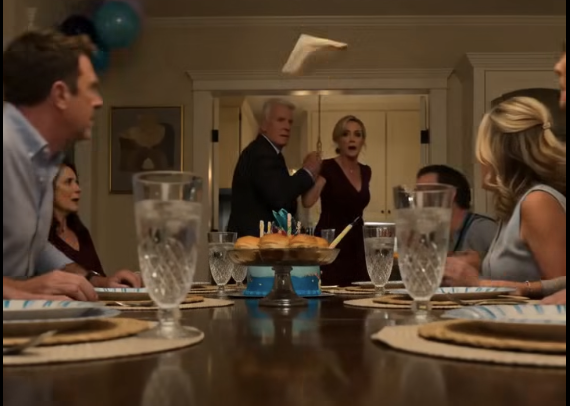
Years later, on my eighteenth birthday, I hosted dinner in that same house.
The table was long.
The chairs were full.
My father sat on one side.
Uncle Arthur sat on the other.
Judge Hale, now retired for real, came with flowers.
Caleb brought dessert.
At the head of the table was an empty chair.
My mother’s chair.
I placed her letter beside it.
Then I looked around at the people who had stayed, changed, and earned their places.
For a moment, I saw myself again at twelve years old, sitting on cold tile with a paper plate in my lap, believing nobody would ever choose me.
I wished I could reach back through time and take that little girl’s hand.
I would tell her:
Stand up.
The floor was never yours.
The house was.
And somewhere beyond grief, beyond cruelty, beyond all the years stolen by silence, love was still coming through the door.
Wearing a dark suit.
Carrying the truth.
And ready to call you home.
