PART 2
The silence inside the exhibition hall felt heavier than stone.
I could still feel the sting on my cheek where Savannah Blake had slapped me.
But nobody was looking at me anymore.
Every eye was fixed on the open Stitch Log.
The event coordinator, Mrs. Hargrove, stared down at the final entry.
Her expression changed.
First confusion.
Then disbelief.
Then anger.
A slow murmur spread through the room.
“What does it say?”
“Read it.”
“Who wrote that?”
Savannah’s perfect posture suddenly collapsed.
“That’s private,” she said sharply.
Mrs. Hargrove looked up.
“No,” she replied. “Not anymore.”
The coordinator turned the log toward the audience.
“The entry was made at 8:12 this morning.”
My heart hammered.
The page contained a digital authorization note.
Someone had attempted to remove my name from the project records.
Someone had tried to transfer credit for the central quilt to the Blake Foundation.
The entire room gasped.
Then Mrs. Hargrove read the authorization account used to make the change.
It belonged to Savannah’s mother.
For a second nobody moved.
Not even Savannah.
Her face had become completely colorless.
Then dozens of phones tilted upward again.
This time they weren’t recording me.
They were recording her.
The spotlight she wanted had finally arrived.
Only it wasn’t shining the way she expected.
PART 3
The Blake family had sponsored nearly every major event in the county for years.
People admired them.
Respected them.
Feared upsetting them.
Now whispers spread across the room like wildfire.
“I knew something felt off.”
“Anya was always working.”
“Savannah never touched a needle.”
“I saw her taking photos while Anya stayed after school.”
Every word hit harder than the slap.
Because they were true.
For eight months I had spent afternoons repairing damaged squares, matching fabric patterns, documenting histories, and stitching hundreds of memory pieces together.
Most students had helped occasionally.
I had practically lived in the textile room.
Savannah had mostly attended photo opportunities.
The coordinator looked toward Savannah.
“Do you deny this?”
Savannah swallowed.
Her confidence was gone.
“It was a misunderstanding.”
The room erupted.
“A misunderstanding?”
“You tried stealing her work!”
“You slapped her!”
A local reporter stepped forward.
“What exactly was misunderstood?”
Savannah’s eyes darted toward her parents.
For the first time in her life, nobody seemed able to rescue her.
Then something unexpected happened.
Her father stood up.
Everyone assumed he would defend her.
Instead he looked horrified.
“What did you do?”
Savannah froze.
“Dad…”
“What did you do?”
The room fell silent again.
He wasn’t acting.
He genuinely hadn’t known.
The realization shocked everyone.
Including Savannah.
Including me.
That was when Mrs. Hargrove revealed another detail.
The authorization request hadn’t only removed my name.
It had also altered scholarship recommendations connected to the project.
My stomach dropped.
Scholarship recommendations.
The quilt exhibition wasn’t just an event.
It was connected to several arts programs.
Including one I desperately hoped to attend.
Someone hadn’t merely tried to embarrass me.
They had tried to erase my future.
The realization hurt far more than the slap.
I felt tears threatening.
But I refused to cry.
Not here.
Not now.
Not in front of her.
Savannah finally spoke.
“You don’t understand.”
Her voice shook.
Nobody answered.
“You don’t know what it’s like.”
The room stared.
“My entire life I’ve been expected to be perfect.”
People exchanged confused looks.
She laughed bitterly.
“Perfect grades. Perfect appearances. Perfect interviews. Perfect photographs.”
For the first time, she sounded less arrogant than exhausted.
“But Anya kept getting praised.”
I blinked.
“What?”
She looked directly at me.
“You weren’t supposed to matter.”
The words hit harder than anything else.
Not because they were cruel.
Because they were honest.
She had never hated me.
She hated the idea that someone invisible could be valued.
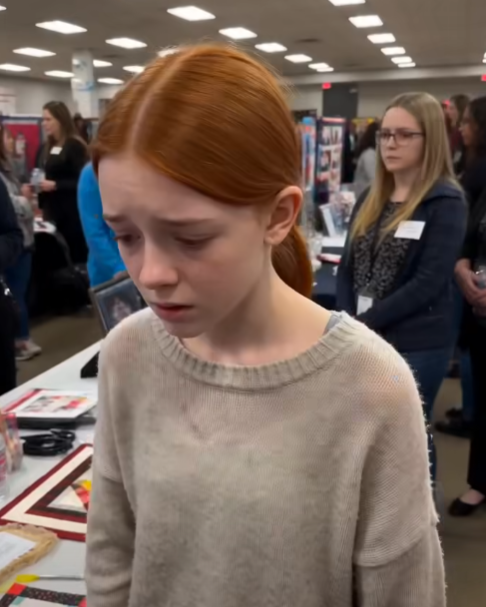
PART 4
The exhibition should have ended there.
But fate wasn’t finished.
A volunteer rushed into the hall carrying a storage box.
“Mrs. Hargrove!”
The coordinator frowned.
“What is it?”
“We found another package in the archive room.”
The box looked old.
Dusty.
Unmarked.
Mrs. Hargrove carefully opened it.
Inside were dozens of handwritten letters.
Attached to fabric samples.
Historical photographs.
And one yellow envelope.
A note was attached.
FOR THE STUDENT WHO FINISHES THE MEMORY QUILT.
The entire hall went quiet.
Mrs. Hargrove opened the envelope.
Her eyes widened.
“What is it?” someone asked.
She slowly handed it to me.
My hands trembled as I unfolded the paper.
The letter was dated thirty-two years earlier.
Written by the founder of the Community Quilt Project.
A woman named Eleanor Reed.
I had studied her work countless times.
To me, she was a legend.
The letter read:
If you are reading this, then you completed the work that others abandoned. The final quilt always reveals character more than talent. Whoever finished this project deserves more than recognition. They deserve opportunity.
My throat tightened.
The letter continued.
Eleanor had created a private educational trust decades earlier.
Every few years, the trust funded one student who demonstrated dedication, service, and craftsmanship.
The scholarship had been forgotten.
Lost in storage.
Never awarded.
Until now.
The room collectively inhaled.
Then Mrs. Hargrove looked directly at me.
“Anya…”
Her voice cracked.
“I think this belongs to you.”
PART 5
I couldn’t process what was happening.
Not after everything.
Not after years of feeling invisible.
Not after growing up watching other students receive opportunities I couldn’t afford.
My mother worked double shifts.
My father had died when I was eleven.
Every application fee mattered.
Every bus ticket mattered.
Every textbook mattered.
I wasn’t looking for miracles anymore.
Life had trained me not to expect them.
Yet somehow one sat in my trembling hands.
The forgotten scholarship was worth nearly forty thousand dollars.
The room exploded into applause.
People stood.
Teachers cried.
Students cheered.
I stared at the paper, unable to breathe.
For one impossible moment, the entire world felt different.
Not easier.
Not perfect.
Just different.
Like a door had opened somewhere.
A door I never thought existed.
Then I noticed movement.
Savannah was leaving.
No cameras followed her now.
No admirers.
No applause.
Just silence.
For a second I considered letting her go.
Then something inside me said no.
I walked after her.
The crowd parted.
She stopped near the exit.
Without turning around she asked,
“Why are you here?”
I looked at her back.
Because suddenly I understood something.
She looked defeated.
Not evil.
Not victorious.
Just broken.
“I wanted to ask why.”
She laughed softly.
“You already know.”
“No.”
She turned.
Tears had ruined her makeup.
“I was scared.”
The answer surprised me.
“Scared of what?”
She stared at the floor.
“Being ordinary.”
The confession seemed to cost her everything.
“My family built their entire reputation around success.”
She wiped her eyes.
“Then you came along.”
“I never competed with you.”
“I know.”
That hurt even more.
Because she knew.
She had always known.
PART 6
Three days later the story spread across Ohio.
News outlets covered the exhibition.
Videos circulated online.
People debated responsibility.
Some defended Savannah.
Most didn’t.
The Blake Foundation launched an internal review.
Her mother resigned from several community boards.
The consequences were real.
Far bigger than anyone expected.
But the strangest development happened a week later.
I received a handwritten letter.
From Savannah.
Not a text.
Not an email.
A letter.
Inside was a single paragraph.
I don’t expect forgiveness. I only wanted to tell you that the person I became that day isn’t who I want to remain. Thank you for not humiliating me when you had every chance.
I read it three times.
Then set it aside.
I didn’t know how to respond.
Maybe some wounds needed time.
Maybe some people did too.
The scholarship interviews began later that summer.
For the first time, I traveled beyond my hometown.
I visited universities.
Textile museums.
Design programs.
Art preservation centers.
The world felt enormous.
And every place taught me the same lesson.
Talent mattered.
Hard work mattered.
But persistence mattered most.
Again and again professionals asked about the quilt.
About the records.
About the hours.
About why I kept working when nobody noticed.
My answer never changed.
“Because the work still needed to be done.”
One professor smiled when I said it.
Years later I would remember that smile.
Because it changed everything.
PART 7
Two years passed.
Then three.
Then five.
Life moved forward.
I attended university.
Graduated.
Built a career preserving historical textiles and community artwork.
The forgotten scholarship became the foundation of everything.
Meanwhile, the memory quilt toured exhibitions across multiple states.
Thousands of people saw it.
Many never learned my name.
And strangely, that no longer bothered me.
The work mattered.
That was enough.
Or so I thought.
One autumn afternoon I received an invitation.
The Community Quilt Exhibition was celebrating its fiftieth anniversary.
They wanted me as keynote speaker.
The request made me laugh.
Seventeen-year-old Anya would never have believed it.
I accepted immediately.
The anniversary event filled the same hall where everything had happened years earlier.
Walking inside felt surreal.
The display tables remained.
The stage remained.
Even the lighting looked familiar.
But I wasn’t the same girl.
I no longer wore worn boots.
I no longer apologized for existing.
And I no longer measured my worth through other people’s approval.
As guests arrived, I noticed a familiar face.
Standing quietly near the back.
Savannah Blake.
My heart skipped.
She looked completely different.
Her blonde hair was shorter.
Her clothes were simple.
No diamonds.
No entourage.
No cameras.
When our eyes met, she smiled nervously.
I walked over.
For a second neither of us spoke.
Then she said,
“Hi, Anya.”
“Hi.”
Awkward silence followed.
Then she laughed.
“Still terrifying.”
I laughed too.
The tension shattered instantly.
Over coffee she told me what happened after the scandal.
Therapy.
Volunteer work.
Distance from public attention.
Years spent rebuilding relationships.
“I deserved the consequences,” she admitted.
“But they forced me to become honest.”
For the first time, I believed her completely.
People rarely change overnight.
But years can transform someone.
And years had transformed her.
Then she handed me a small box.
“What’s this?”
“Open it.”
Inside lay a silver needle.
Beautifully crafted.
Its handle contained tiny engraved stitches.
I looked up.
Confused.
Savannah smiled.
“I funded a new scholarship.”
I blinked.
“What?”
She nodded.
“For students who do the work nobody notices.”
My throat tightened.
“There will be one awarded every year.”
I couldn’t speak.
Because suddenly the room looked blurry.
And I realized I was crying.
Again.
But for a completely different reason.
PART 8 (THE END)
That evening I stepped onto the stage.
The same stage where humiliation had nearly destroyed me.
The same stage where truth had saved me.
Hundreds of guests filled the hall.
Students.
Teachers.
Families.
Sponsors.
Artists.
Dreamers.
People searching for their place.
Just like I once had.
Behind me hung the memory quilt.
Still beautiful.
Still imperfect.
Still strong.
Every square contained a story.
Every stitch represented effort.
Every flaw represented humanity.
Looking at it felt like looking at life itself.
I began my speech.
Not with the scandal.
Not with Savannah.
Not with the scholarship.
Instead I told them about stitching.
About how thousands of tiny stitches create something larger than themselves.
How most important work happens quietly.
How recognition often arrives long after effort.
Or never arrives at all.
Yet the work still matters.
Because character is built in unseen moments.
The audience listened carefully.
Then I shared one final lesson.
“The day I was slapped on this stage,” I said, “I believed my worst moment had arrived.”
Silence filled the hall.
“But life has a strange sense of humor.”
People smiled.
“Sometimes the moment that seems like the end is actually the beginning.”
I looked toward the back of the room.
Savannah sat there.
Applauding.
Not as a rival.
Not as an enemy.
As someone who had learned her own difficult lessons.
Then I noticed something unexpected.
Near the display area stood a group of students examining the original Stitch Log.
One girl looked exactly the way I once felt.
Quiet.
Nervous.
Invisible.
She carefully studied every page.
Every recorded hour.
Every signature.
Every piece of proof.
As though she needed reassurance that effort mattered.
After the ceremony she approached me.
“Ms. Petrov?”
“Yes?”
She hesitated.
Then asked the question.
The same question I had once carried in my own heart.
“What if nobody notices?”
I smiled.
Then pointed toward the quilt.
Toward the log.
Toward the crowded room.
Toward everything that existed because someone refused to quit.
And I answered honestly.
“Keep stitching anyway.”
The girl smiled.
A real smile.
The kind that changes futures.
Years later people would remember the famous quilt.
Some would remember the scholarship.
Some would remember the scandal.
But those weren’t the most important things.
The most important thing was simpler.
A tired seventeen-year-old girl once believed she was invisible.
Yet every stitch she made left a mark.
And when the truth finally surfaced, it didn’t merely protect her name.
It transformed lives.
Including the life of the girl who tried to erase her.
Because in the end, the greatest surprise hidden inside the Stitch Log wasn’t the evidence.
It wasn’t the scholarship.
It wasn’t the exposure.
It was the proof that kindness can survive humiliation, truth can outlast power, and the quiet people the world overlooks are often the ones holding everything together.
And that was the happiest ending nobody could have predicted.
THE END
