PART 2 — THE NAME THAT SHOCKED THE ENTIRE BALLROOM
The chief judge paused.
The giant screen glowed behind him.
Hundreds of eyes remained fixed on the rankings.
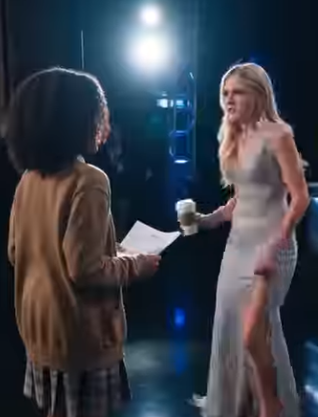
I stood frozen near the stage entrance, coffee still dripping from my cardigan.
My notes were scattered across the floor.
Audrey Harrington stared at the screen.
Her breathing seemed uneven.
For years she had been treated as the future queen of journalism.
Tonight was supposed to be her coronation.
Instead, uncertainty had begun creeping across her face.
The chief judge adjusted his glasses.
Then he spoke.
“The student currently holding the number one journalism ranking in the United States is…”
The ballroom became completely silent.
Even the cameras stopped moving.
“…Sophia Martinez.”
The room exploded.
Gasps.
Applause.
Disbelief.
Several professors immediately stood.
Students turned toward me.
Media executives exchanged shocked looks.
I couldn’t move.
I couldn’t breathe.
I simply stared at the screen.
There it was.
My name.
At the top.
National Rank #1.
Below it appeared pages of evaluations.
Investigative reporting.
Interview performance.
Ethics.
Broadcast communication.
Community impact.
Every category carried exceptional scores.
The chief judge continued.
“Miss Martinez received the highest combined evaluation score in festival history.”
The audience erupted again.
Audrey looked as though someone had physically struck her.
“No,” she whispered.
The microphone accidentally picked it up.
Several reporters turned toward her immediately.
“No. That’s impossible.”
But the rankings remained on the screen.
Unchanged.
Unquestionable.
Official.
For the first time all evening, the spotlight wasn’t obeying wealth.
It was obeying merit.
And Audrey hated every second of it.
PART 3 — THE REPORT THAT NOBODY WAS SUPPOSED TO SEE
The rankings should have ended the controversy.
But the chief judge wasn’t finished.
He raised a second folder.
The room gradually quieted again.
“Since tonight’s selection has been challenged publicly,” he said, glancing toward Audrey, “the judging committee has authorized the release of additional findings.”
The audience exchanged confused looks.
Additional findings?
Audrey’s father, William Harrington, immediately stood from the sponsors’ table.
His expression tightened.
“That’s unnecessary.”
The chief judge ignored him.
A technical assistant uploaded another file.
The giant screen changed.
A title appeared.
PROFESSIONAL PERFORMANCE REVIEW
Whispers spread through the ballroom.
Then the report opened.
The first section highlighted my work.
Audio clips played.
Interviews with veterans.
Community volunteers.
Families affected by housing shortages.
Teachers.
Emergency responders.
The audience listened carefully.
Then another number appeared.
More than two hundred volunteer reporting assignments completed over three years.
The room murmured.
People hadn’t known.
Most had only seen me reading local announcements.
They had never seen the thousands of hours behind them.
Then came the second section.
The section nobody expected.
The screen displayed Audrey’s evaluation record.
Her face instantly drained of color.
The audience leaned forward.
Several judges looked uncomfortable.
Then the first red flag appeared.
Missed assignments.
The second appeared.
Unverified sources.
The third appeared.
Multiple submissions completed by assistants.
The ballroom erupted.
“What?”
“Assistants?”
“Are you serious?”
The chief judge’s expression darkened.
“Our committee discovered evidence that several projects submitted under Miss Harrington’s name were primarily produced by paid professionals employed by her family’s company.”
The room exploded into chaos.
Reporters immediately started taking notes.
Camera flashes lit up the ballroom.
Audrey looked horrified.
William Harrington looked furious.
And suddenly everyone realized something terrifying.
The perfect image wasn’t cracking.
It was collapsing.
PART 4 — THE SECRET INSIDE THE MEDIA EMPIRE
William Harrington marched toward the stage.
His expensive suit couldn’t hide his anger.
“This is ridiculous,” he snapped.
“Those records are confidential.”
The chief judge remained calm.
“No.”
He opened another document.
“They became relevant the moment your daughter publicly challenged the integrity of this competition.”
The audience applauded.
William didn’t.
The screen changed again.
Several internal emails appeared.
The ballroom gasped.
The messages had been sent between executives at Harrington Media Group.
One line immediately drew attention.
“Make sure Audrey receives priority placement regardless of evaluation scores.”
A second email appeared.
“Sponsors expect her to remain the face of youth journalism.”
Then a third.
The room became silent.
“Sophia Martinez’s community reporting is outperforming Audrey’s metrics. Find a way to reduce exposure.”
I stared at the screen in disbelief.
My stomach dropped.
The room suddenly felt smaller.
The executives seated near William Harrington looked terrified.
One professor slowly stood.
“Are these authentic?”
The chief judge nodded.
“Our forensic team verified every document.”
The audience erupted again.
Reporters practically sprinted toward their phones.
Breaking news alerts began appearing instantly.
The media empire that had shaped public narratives for decades was now becoming the story itself.
And the story was ugly.
Very ugly.
PART 5 — THE BROADCAST THAT CHANGED EVERYTHING
The festival director approached me.
“Sophia.”
I looked at him nervously.
“Yes?”
He smiled.
“The broadcast begins in ten minutes.”
I looked down at my coffee-stained cardigan.
The stain covered nearly half the front.
Embarrassment washed over me.
“I can’t go on television looking like this.”
Several people overheard.
Before I could say anything else, a woman stepped forward from the front row.
She was elegant.
Confident.
Professional.
One of the most respected television anchors in America.
She removed her blazer.
Then handed it to me.
The crowd gasped.
“I think this belongs on the national broadcast tonight.”
I stared at her.
“You don’t have to do that.”
She smiled warmly.
“I know.”
The room erupted into applause.
My eyes filled with tears.
The anchor leaned closer.
“Journalism belongs to people who earn trust.”
She glanced toward the rankings.
“You’ve earned it.”
Ten minutes later I walked onto the broadcast stage wearing her blazer.
The countdown began.
Five.
Four.
Three.
Two.
One.
The red light illuminated.
Millions of viewers across the country tuned in.
My hands trembled.
Then years of radio experience took over.
My voice steadied.
The fear disappeared.
And for the next ninety minutes, I delivered the best broadcast of my life.
When the program ended, the control room erupted.
Producers cheered.
Professors applauded.
Even veteran reporters looked impressed.
One executive quietly said something nobody expected.
“That was better than most professional hosts.”
PART 6 — THE NATIONAL INVESTIGATION
The morning after the festival felt unreal.
My phone wouldn’t stop vibrating.
Messages arrived nonstop.
Interview requests.
Scholarship offers.
Internship opportunities.
Congratulations from people I had never met.
But the biggest story wasn’t my broadcast.
It was the Harrington investigation.
The leaked emails spread across every major news outlet.
Former employees started speaking publicly.
Then more came forward.
Then more.
A pattern emerged.
Promotions influenced by family connections.
Stories manipulated to protect sponsors.
Young journalists pushed aside.
The allegations multiplied daily.
Within weeks, federal regulators began reviewing multiple business practices connected to the company.
William Harrington appeared on television trying to defend himself.
The strategy failed.
Public trust evaporated.
Stock values dropped.
Sponsors fled.
The empire built on image suddenly faced something it couldn’t control.
Truth.
Ironically, the very thing journalism was supposed to protect.
Meanwhile, another surprise arrived.
The National Journalism Foundation announced a special award.
An award they had never created before.
The citation read:
“For extraordinary commitment to ethical reporting, public service, and journalistic integrity.”
The recipient?
Me.
I cried when I read it.
Not because of the recognition.
But because of what it represented.
Years of invisible work had finally been seen.
PART 7 — AUDREY’S CONFESSION
Six months later, I received an unexpected email.
The sender shocked me.
Audrey Harrington.
I stared at the screen for several minutes.
Eventually, curiosity won.
I opened it.
The message was simple.
Could we meet?
I almost declined.
Then I remembered something journalism had taught me.
People are often more complicated than their worst moment.
A week later we met at a quiet café.
No reporters.
No cameras.
No audience.
Just two young women whose lives had collided publicly.
Audrey looked different.
The confidence was gone.
So was the arrogance.
She seemed exhausted.
For several moments neither of us spoke.
Finally she looked down.
“I’m sorry.”
The words sounded genuine.
Not rehearsed.
Not strategic.
Real.
“I spent my entire life being told I had to be extraordinary.”
Her voice trembled.
“And every time someone achieved something on their own, I felt threatened.”
I listened quietly.
“My parents built an image around me.”
A tear rolled down her cheek.
“After a while, I started believing the image mattered more than reality.”
The honesty surprised me.
Then she said something even more shocking.
“I never hated you.”
I frowned.
“Then why did you do it?”
Her answer broke my heart.
“Because you proved I wasn’t who everyone thought I was.”
The silence lingered.
Then she handed me a small notebook.
Inside were pages of handwritten reporting notes.
Community interviews.
Local investigations.
Volunteer stories.
Real journalism.
“I’ve started over,” she said quietly.
“For the first time, the work is actually mine.”
I smiled.
And for the first time, she smiled too.
Not the polished smile of a media heiress.
The uncertain smile of someone trying to become better.
PART 8 — THE END: THE RANKING THAT CHANGED A NATION
One year later, I returned to New York.
The same ballroom.
The same festival.
The same stage.
But everything felt different.
This time I wasn’t standing near the spotlight.
I was opening the event.
Thousands attended.
Millions watched online.
The festival director stepped to the microphone.
“We have one final announcement.”
The audience quieted.
A massive banner descended from the ceiling.
I assumed it would display sponsorship information.
Instead, three words appeared.
THE SOPHIA STANDARD
Confused whispers filled the room.
The director smiled.
“This new national benchmark will evaluate journalism students based on ethics, community impact, transparency, and public service.”
Applause erupted.
He continued.
“The standard was inspired by a student who reminded this profession what journalism is supposed to be.”
My eyes immediately filled with tears.
The crowd stood.
Every single person.
Professors.
Students.
Executives.
Reporters.
Judges.
Then something caught my attention.
Near the middle rows sat Audrey.
She stood and applauded with everyone else.
Not because she had to.
Because she wanted to.
And in that moment I understood something extraordinary.
The ranking had never really been about who was number one.
It wasn’t about scores.
Or trophies.
Or television appearances.
The ranking mattered because it exposed the difference between reputation and character.
One can be purchased.
The other must be earned.
The giant screen behind me illuminated one final message.
TRUTH OUTLASTS IMAGE.
The audience erupted.
The applause thundered through the ballroom.
And as I looked across the crowd, I realized the most shocking part of the entire story.
The coffee stain Audrey had thrown at me that night had disappeared long ago.
But the truth it revealed changed countless lives forever.
And that was a story worth telling.
