Part 2: The Number Nobody Wanted Revealed
The ballroom became so quiet that the soft hum of the stage lights sounded loud.
Charlotte Kensington stared at the giant screen.
The charity director adjusted his glasses and turned another page.
“Let’s review the complete contribution records.”
Rows of numbers appeared.
Donation totals.
Volunteer hours.
Supply purchases.
Fundraising events.
The audience leaned forward.
Several reporters began taking photographs.
Month after month, one name remained at the top.
Lucy Carter.
My name.
Charlotte’s expression tightened.
The director continued.
“Over the last three years, Lucy Carter contributed more than five thousand volunteer hours.”
A murmur spread through the room.
He turned another page.
“She personally funded school-supply drives.”
Another page.
“She organized winter food collections.”
Another page.
“She purchased emergency hygiene kits using her own earnings.”
Guests exchanged stunned looks.
I felt my face burning.
I never expected any of this to become public.
Then the director reached the final summary.
His voice became firm.
“The student who contributed the highest combined value of donations, supplies, fundraising revenue, and volunteer labor is Lucy Carter.”
The room erupted into applause.
Charlotte looked like she had been struck.
Then she pointed at the screen.
“Those numbers can’t be right.”
The applause stopped.
The director slowly looked at her.
“Actually, Charlotte, they are.”
Then he revealed a document nobody knew existed.
A donor verification report.
And the signature at the bottom changed everything.
Part 3: The Signature That Destroyed Her Argument
The verification report filled the giant screen.
Charlotte’s eyes widened immediately.
She recognized it.
So did her father.
At the bottom sat a signature.
Charlotte Kensington.
The room fell silent.
The charity director folded his arms.
“Last year, all major contributors reviewed and approved these records.”
A reporter gasped.
Because Charlotte herself had signed the report confirming its accuracy.
The director pointed toward the date.
Six months earlier.
Long before the gala.
Long before tonight’s confrontation.
Charlotte struggled to speak.
“I didn’t read all of it.”
A few guests exchanged uncomfortable glances.
The excuse sounded weak.
The director calmly replied, “Nevertheless, you approved it.”
The reporters loved every second.
Cameras flashed nonstop.
Then one of the foundation auditors stood from the front row.
His expression looked troubled.
“I think everyone should see another report.”
The room instantly quieted.
The auditor approached the stage carrying a folder.
Unlike the donor records, this one was marked confidential.
And whatever was inside made the charity director’s face darken immediately.
Part 4: The Missing Funds Nobody Could Explain
The auditor opened the folder.
Financial spreadsheets appeared on the giant screen.
At first they looked ordinary.
Then several highlighted entries caught everyone’s attention.
Missing funds.
Repeated withdrawals.
Unexplained transfers.
The ballroom grew tense.
The auditor pointed toward the transactions.
“Over the last two years, nearly two hundred thousand dollars disappeared from several fundraising campaigns.”
Gasps echoed across the room.
Charlotte’s father stood abruptly.
Richard Kensington was one of the charity’s largest sponsors.
“What are you implying?”
The auditor met his gaze.
“I’m not implying anything.”
He pointed toward the records.
“I’m showing documented facts.”
The audience stared.
Every suspicious transaction led to the same corporate account.
Kensington Community Partnerships.
The room exploded with whispers.
Richard’s face turned pale.
Charlotte looked horrified.
For the first time that evening, she seemed genuinely frightened.
Then the auditor revealed something even worse.
The missing money came from programs supporting struggling families.
The exact families the charity claimed to protect.
And suddenly the gala was no longer about a spoiled heiress.
It was about a financial scandal.
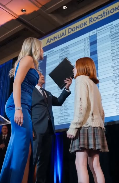
Part 5: The Volunteer Who Noticed The Pattern
News of the investigation spread across Atlanta within hours.
The gala footage appeared everywhere.
The video of Charlotte pulling my hair went viral.
But investigators focused on something else.
The missing funds.
The suspicious transfers.
The unexplained accounting gaps.
Three days later, I received a call from the charity director.
“Lucy, we need your help.”
I arrived at headquarters that afternoon.
Several investigators sat around a conference table.
Documents covered every surface.
One investigator smiled when I entered.
“You noticed something months ago.”
I nodded slowly.
During donation drives, I often helped inventory supplies.
Some shipments never arrived.
Some purchase orders looked strange.
I reported the discrepancies.
Nobody thought much of it at the time.
Now those reports were being reexamined.
The investigators discovered a pattern.
The missing shipments matched the missing funds.
Every trail led back toward a network of shell companies.
Companies connected to Kensington business interests.
The room grew silent.
Because what began as questionable accounting was starting to look deliberate.
Then investigators uncovered an old archive.
And the scandal suddenly became much bigger than anyone imagined.
Part 6: The Secret Hidden For Twenty Years
The archive contained charity records dating back two decades.
Boxes of documents filled a storage room.
Auditors reviewed everything.
What they found shocked them.
The financial irregularities weren’t new.
They stretched back nearly twenty years.
Generation after generation.
Different names.
Different executives.
Same pattern.
Small amounts disappearing repeatedly.
Enough to avoid attention.
Enough to accumulate fortunes.
The lead investigator stared at the evidence in disbelief.
“This wasn’t an accident.”
The room fell silent.
Because the scheme appeared systematic.
Carefully maintained.
Hidden beneath thousands of legitimate transactions.
The deeper they searched, the worse it became.
Millions of dollars had quietly vanished from programs meant to help vulnerable families.
Then investigators discovered something unexpected.
Richard Kensington wasn’t the architect.
He inherited the system from executives who came before him.
That didn’t excuse anything.
But it changed the story.
The corruption had become tradition.
And now it was finally being exposed.
Then Richard requested a public hearing.
Nobody knew what he planned to say.
Part 7: Charlotte’s Confession Before The Cameras
The hearing drew enormous attention.
Community leaders attended.
Journalists packed the room.
Former beneficiaries of the charity filled every seat.
Charlotte sat beside her father.
She looked exhausted.
Gone were the designer dresses.
Gone was the confidence.
When her turn came to speak, she approached the microphone slowly.
The room became silent.
She looked directly at me.
Then lowered her head.
“I’m sorry.”
The words stunned everyone.
Charlotte took a shaky breath.
“I spent my whole life believing recognition belonged to wealth.”
No one interrupted.
No one moved.
“I thought people like Lucy existed to help people like me succeed.”
Tears appeared in her eyes.
“But she cared more about this charity than I ever did.”
The room remained silent.
“I attacked her because I couldn’t stand seeing her earn what I wanted.”
Several audience members wiped away tears.
Then Charlotte revealed something unexpected.
She had spent weeks helping investigators.
Providing records.
Emails.
Internal documents.
Evidence.
The information helped expose the entire financial scheme.
The hearing lasted hours.
When it ended, reforms were approved unanimously.
But one final announcement still remained.
Part 8: The Building That Carried Her Name
Six months later, the charity held another gala.
This time it felt completely different.
Families filled the hall.
Volunteers stood proudly near the stage.
Children played in activity areas funded by newly recovered donations.
The atmosphere felt hopeful.
The director invited me forward.
I assumed I was helping present another gift box.
Instead, a curtain rose behind the stage.
The audience gasped.
A brand-new community center appeared on the giant screen.
Food assistance programs.
Educational services.
Emergency family support.
Volunteer training facilities.
Everything funded through recovered resources and new donations.
Then the final image appeared.
A bronze plaque above the entrance.
I stopped breathing.
THE LUCY CARTER COMMUNITY RESOURCE CENTER
The crowd rose to its feet.
Applause thundered through the hall.
I couldn’t speak.
The director smiled.
“For years, one volunteer quietly gave more than anyone realized.”
Tears filled my eyes.
Then he handed me the very first donation box I had ever packed.
It was worn.
Slightly faded.
Saved all these years.
Inside sat hundreds of handwritten notes from families the charity had helped.
Messages of gratitude.
Stories of hope.
Lives changed.
As I read them, I realized the greatest gift wasn’t the building carrying my name.
It was knowing that every family those missing funds should have helped would finally receive the support they deserved, and that the quiet work nobody noticed had become the reason an entire community could begin again.
