Part 2: The Page He Read Into The Microphone
The director’s hand trembled just enough to make the paper flicker under the lights.
I was still on the floor.
My knees burned. My palms were scraped from catching myself. One of the leather flats I had worn since sophomore year had slipped halfway off my heel, and I hated that I noticed that. I hated that part of me still wanted to look presentable while everyone stared.
Yvette Kingswell stood beside the display table, chin lifted, eyes bright with panic she was trying to disguise as anger.
The event director, Mr. Roland Voss, leaned into the microphone.
“This maintenance record was submitted over four weeks,” he said, his voice cutting through the humming equipment. “It shows daily cleaning, lens checks, weatherproofing, and data-card replacements on the bird-nest camera box.”
Yvette laughed once. Too sharp. Too loud.
“That could have been anyone,” she snapped.
Mr. Voss looked at her, then at me.
Then he said the line that made the room inhale.
“The footage shows Mina Al-Khatib doing every one of those tasks.”
A reporter’s camera clicked.
Then another.
Then ten.
My throat tightened so hard I could barely swallow.
Yvette’s friends, the same girls who had lifted their phones to catch my humiliation, lowered them slowly as if the devices had become evidence against them.
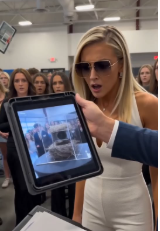
Mr. Voss placed the paper down and opened a tablet from the folder.
The projector behind the stage blinked.
For half a second, the screen showed nothing but blue light.
Then the footage appeared.
There I was.
Not polished. Not smiling. Not posed.
Just me, standing beneath gray morning light with my sleeves rolled up, carefully removing the camera box cover while cold wind pushed my hair loose around my face. The timestamp glowed in the corner.
March 12. 6:43 a.m.
A murmur moved through the room.
The video changed.
March 18. 7:02 a.m.
There I was again, wiping mud from the lower hinge, checking the nest lens with a cloth, and writing something on a clipboard.
Then another clip.
Then another.
A month of me.
A month of quiet work nobody had seen.
My chest hurt.
I had always imagined proof would feel powerful. Instead, it felt like someone had opened the most private part of my life and shown everyone how hard I had been trying not to disappear.
Yvette took one step backward.
Her boot struck the table leg.
The nest monitor shook.
Her father, Conrad Kingswell, stood from the sponsor row. He was tall, silver-haired, wearing a navy suit with a pin shaped like his company logo.
“Roland,” he said, smiling like a man warning a servant, “perhaps we should discuss this privately.”
Mr. Voss did not move away from the microphone.
“This ceremony is public,” he said. “The accusation was public.”
A stunned little sound left someone in the front row.
Yvette’s face changed.
The fear vanished.
Something colder replaced it.
She turned toward me, still on the floor, and hissed, “You planned this.”
I pushed myself upright. My legs shook, but I stood.
“No,” I said. “You did.”
The words were quiet, but the microphone near the table caught them.
They spread through the speakers.
Yvette’s mouth opened.
Nothing came out.
Then the projector flickered again.
A new clip appeared.
This one was not of me.
It showed Yvette near the camera box two days before the ceremony, standing with one of her friends behind the storage shed. She was holding a glossy sponsor decal.
The room went dead silent.
On the footage, Yvette looked directly at her friend and said, clear enough for every speaker to carry it:
“Once my family logo is on the box, nobody will remember that maintenance girl.”
My breath stopped.
Yvette lunged toward the tablet.
Mr. Voss stepped back.
Her father’s smile disappeared.
And then the screen showed Yvette reaching for the camera box latch with a screwdriver in her hand.
Part 3: The Sponsor’s Smile Finally Cracked
Nobody moved until the sound played.
Metal against metal.
A small, ugly scrape.
On the projector, Yvette Kingswell twisted the screwdriver into the latch of the bird-nest camera box, trying to force the sponsor decal plate over the school’s project label.
One of the younger students in the back whispered, “She was tampering with it.”
Yvette spun around.
“I was improving it,” she shouted. “That box looked cheap.”
The word cheap landed harder than the shove.
Not because it was clever.
Because everyone knew she meant me too.
Mr. Voss paused the video. Yvette froze on-screen with one hand on the latch, expensive sunglasses pushed into her hair, her mouth curled in disgust.
The image behind her looked enormous.
Unforgiving.
Conrad Kingswell walked into the aisle.
“This has gone far enough,” he said.
His voice was polished, trained, the kind of voice that expected doors to open.
He did not look at me.
He looked at the cameras.
“My daughter is passionate. She may have acted impulsively, but this event exists because families like ours fund opportunities for students like—”
He stopped before finishing.
But everyone heard the missing words.
Students like me.
Mr. Voss turned slowly.
“Families like yours funded the banners,” he said. “Mina kept the nest camera alive.”
A sound moved through the room, not applause yet, but something close to courage waking up.
Yvette’s mother, Celeste, rose from her chair. Her diamond bracelet flashed under the lights.
“Roland,” she said, “you are making a terrible mistake.”
Mr. Voss looked tired suddenly. Older.
“No,” he said. “I made the mistake weeks ago when I let donor pressure decide who got interviewed.”
I looked at him.
He would not meet my eyes.
The cameras swung from Yvette to him.
A reporter near the aisle raised her hand. “Are you saying Mina’s work was intentionally hidden from the press materials?”
Mr. Voss closed the folder.
Then opened it again.
His jaw tightened.
“Yes.”
The room erupted.
Yvette shouted something at her father. Her father grabbed her wrist, not roughly, but urgently. Celeste stepped toward the press, smiling too hard.
“This is a misunderstanding,” she said. “Our family has always supported deserving students.”
A girl from my environmental science class stood up.
Her name was Elise.
She was usually so quiet that teachers forgot to call on her. But now her chair scraped loud across the floor.
“Mina cleaned that camera box when it snowed,” she said. “I saw her. We all did.”
Another student stood.
“She missed lunch to check the lens.”
Then another.
“She fixed the cable after the storm.”
My hands covered my mouth before I could stop them.
I had thought nobody noticed.
I had been wrong.
Yvette stared at the students as if betrayal had crawled out of the walls.
“You’re all ridiculous,” she said. “She’s making herself a victim because she knows how this looks.”
“This is how it looks,” Elise replied. “You shoved her.”
For the first time, Yvette had no answer.
Then a security officer entered from the side door.
Behind him came a woman with a city badge, gray coat, and a folder tucked under one arm.
Mr. Voss stiffened.
The woman walked straight to the front.
“My name is Inspector Helen Markham,” she said. “I’m with the municipal wildlife compliance office.”
Conrad Kingswell’s face changed so slightly most people might have missed it.
I did not.
The inspector looked at the paused footage.
Then at Yvette.
Then at the damaged latch visible on the display table.
“I need everyone to step away from the camera box,” she said.
Yvette swallowed.
Inspector Markham’s next words dropped like ice.
“This is no longer just a school ceremony.”
Part 4: The Box Held More Than Footage
The room emptied in pieces.
Not fully. Not calmly.
Guests were moved back from the display aisle. Reporters were told to remain behind a taped line. Students clustered near the chairs, whispering into sleeves and phones.
I stood near the stage with Elise’s arm around my shoulder.
I did not remember her stepping beside me.
I only knew she was there, solid and warm, while my knees throbbed beneath my frayed pants.
Inspector Markham put on gloves before touching the bird-nest camera box.
Yvette watched her with a face so pale even her lipstick looked harsh.
“It’s a student project,” Yvette said. “You’re acting like someone broke into a bank.”
Inspector Markham did not look up.
“It is a monitored wildlife structure installed under city permit,” she said. “Tampering with it can disturb protected nesting behavior.”
Yvette blinked.
Protected.
The word moved through the sponsors like a match in dry paper.
Conrad Kingswell stepped forward.
“My daughter did not disturb wildlife.”
The inspector lifted the latch.
It came loose too easily.
A small screw fell onto the table and rolled in a slow circle.
Everyone watched it stop.
Inspector Markham held up the loosened latch.
“This was compromised.”
Yvette’s father inhaled through his nose.
“Can we discuss this without theatrics?”
“No,” Inspector Markham said.
It was the smallest word.
It crushed him.
Mr. Voss opened another envelope from beneath the table. I recognized it instantly. Brown paper. Red seal. The backup data packet.
He looked at me.
“Mina,” he said softly, “you submitted a note last week about interrupted recordings.”
My stomach turned.
“Yes.”
Yvette’s head snapped toward me.
I remembered that day too clearly: the strange gap in the feed, the tiny smear of white adhesive near the box, the wire bent at an angle I had not left it in.
I had written it down because I wrote everything down.
Not because I expected anyone to believe me.
Mr. Voss handed the packet to Inspector Markham.
She inserted the data card into a laptop.
The projector changed again.
The new footage was grainier. Nighttime. The camera angle came from the internal backup lens, one I had installed after the first weather issue.
Yvette did not know it existed.
My pulse hammered.
On the screen, shadows moved near the box.
A hand appeared.
Then Yvette’s face, lit by phone glow.
Her friend whispered, “Hurry up.”
Yvette answered, “I just need the feed to fail during the ceremony. Then Dad’s team can replace it.”
The silence that followed was not ordinary silence.
It had weight.
It pressed on every shoulder in the room.
Yvette turned to her father. “Dad—”
But Conrad Kingswell was staring at the screen with a look that was not shock.
It was calculation.
Inspector Markham paused the clip.
“Mr. Kingswell,” she said, “did your company have a replacement unit prepared?”
He did not answer.
Celeste whispered, “Conrad.”
A reporter called out, “Was Kingswell Systems planning to take over the project after a staged failure?”
That was when Conrad made his mistake.
He looked at Yvette, not with concern, but with fury.
“You were supposed to remove the backup card.”
The entire room heard him.
Even the security officer froze.
Yvette’s lips parted.
For one awful second, she looked exactly eighteen. Not powerful. Not polished. Just trapped by the man whose approval she had mistaken for love.
Inspector Markham closed the laptop slowly.
Mr. Voss stepped back from Conrad.
And I realized with a chill that Yvette had not acted alone.
She had been sent.
Part 5: The Apology That Was Actually A Threat
They moved us into a smaller conference room behind the ceremony hall.
The walls were covered with student posters of birds, migration routes, nesting seasons, careful sketches made in colored pencil. On any other day, I would have loved that room.
That day, it felt like a waiting room before someone decided whose truth was expensive enough to matter.
I sat with a paper cup of water between my hands.
Elise sat beside me.
Mr. Voss stood near the door, speaking quietly with Inspector Markham and two city officials. Through the glass panel, I could see reporters waiting outside.
Yvette entered with her parents.
Her sunglasses were gone.
Without them, her eyes looked red around the edges.
Conrad Kingswell shut the door behind him.
“Everyone is upset,” he said.
Nobody answered.
He turned to me at last.
For the first time all morning, he looked directly at my face.
“Mina,” he said, almost gently, “my daughter owes you an apology.”
Yvette’s shoulders tightened.
Her mother touched her elbow.
Yvette stared at the floor.
“I’m sorry,” she said.
The words were flat.
Empty.
Dragged out like something dead.
I looked at her.
“For what?”
Her head lifted.
“What?”
I held the paper cup so tightly the rim bent.
“You’re sorry for what?”
Color crept into her cheeks.
“For what happened.”
“What happened?”
Elise shifted beside me, but she did not interrupt.
Yvette’s mouth trembled with anger. “I pushed you.”
“And?”
Her father’s expression hardened.
Yvette looked at him, then at me.
“And I said things I shouldn’t have.”
“And?”
Her nostrils flared.
“And I tried to make the ceremony about my family.”
Inspector Markham wrote something down.
Conrad noticed.
His voice cooled.
“That is enough.”
I stood.
My knees protested, but I stood anyway.
“No,” I said. “It isn’t.”
The room sharpened around me.
All the fear I had carried for years sat inside my ribs like a bird beating its wings. Fear of being too poor. Too visible. Too easy to dismiss. Fear of adults with soft voices and hard power.
I looked at Yvette.
“You didn’t just push me,” I said. “You tried to erase me.”
She blinked fast.
Then her face twisted.
“You think I wanted this?” she whispered.
Conrad snapped, “Yvette.”
But she kept looking at me.
“My father told me the project had to fail,” she said. “He said if the school embarrassed his company by using student equipment instead of his system, we would look weak.”
Celeste closed her eyes.
Conrad’s hand curled at his side.
Yvette’s voice cracked, but not with regret. With something uglier. Something old.
“He said I had one job. Make sure everyone saw his brand, not yours.”
Inspector Markham looked up.
“Yvette,” Conrad warned.
She laughed suddenly, wet and bitter.
“There it is,” she said. “That voice.”
Then she turned to me.
“I hated you because you were the only one here who actually belonged to this project.”
The words struck me harder than her hands had.
For one second, I almost felt sorry for her.
Then Conrad Kingswell stepped close to the table and placed both palms on it.
“This conversation is over,” he said. “Mina, you will receive a private scholarship donation. Your family will be taken care of. In exchange, you will tell the press this was a misunderstanding.”
The room went still.
My bent paper cup collapsed in my hand.
Water spilled across the table.
Conrad smiled.
“That is the kindest offer you will ever receive.”
Part 6: The Girl Who Refused To Be Bought
I looked at the water spreading across the table.
It slipped around the paper cup, reached the edge, and fell in clear drops onto the floor.
One.
Two.
Three.
Everyone waited for my answer.
Conrad Kingswell’s smile did not move, but his eyes had gone flat.
He thought he had found the number attached to my silence.
That hurt more than the shove.
My family had counted coins in grocery aisles. I had worn shoes until the soles thinned. I had pretended not to notice when classmates discussed vacations like weather. Money was not a small thing to me.
That was why his offer was so cruel.
He knew exactly where to aim.
Mr. Voss said, “Mina, you do not have to answer him.”
But I did.
“No.”
The word came out quiet.
Conrad tilted his head.
“I’m sorry?”
I lifted my chin.
“No.”
Elise smiled beside me, just barely.
Conrad’s face darkened.
Celeste whispered, “Conrad, don’t.”
He ignored her.
“You are seventeen,” he said. “You have no idea what you are refusing.”
“I know exactly what I’m refusing.”
“A future?”
“A lie.”
Yvette stared at me as if she had never seen anyone do that before.
Refuse him.
Conrad leaned closer.
“Careful, Mina. Schools depend on donors. Recommendations disappear. Opportunities become complicated.”
Inspector Markham closed her notebook.
“Mr. Kingswell,” she said, “that sounded like witness intimidation.”
He straightened immediately.
“I am advising a child.”
“No,” I said. “You’re threatening one.”
The door opened.
A woman stepped in with a camera hanging from her neck and a press badge against her coat. She must have been waiting outside, but her recorder was already on.
“Did I hear that correctly?” she asked.
Conrad’s face drained.
Mr. Voss looked at the open door, then at the hallway beyond it, where half the press group stood close enough to hear everything.
The reporter looked at me.
“Do you want to make a statement?”
My mouth went dry.
Every adult in the room seemed suddenly far away.
I thought of the first morning I cleaned the box, when my fingers had gone numb and nobody had known I was there. I thought of the bird feed flickering back to life after I fixed the cable. I thought of Yvette’s hands hitting my shoulder, her voice declaring I did not belong.
I stepped toward the door.
Conrad said, “Do not be foolish.”
Yvette whispered, “Mina.”
I looked back.
Her face was pale, stripped of its armor. For the first time, she looked less like my enemy and more like someone standing in the wreckage of a life built for her by someone else.
But the truth still mattered.
Especially then.
I faced the reporter.
“My name is Mina Al-Khatib,” I said. “I cleaned the bird-nest camera box because I cared about the project. I kept records because I knew work like mine gets ignored. Today, Yvette Kingswell shoved me and accused me of stealing a place I earned.”
The hallway went silent.
I kept going.
“The footage proves the truth. And Mr. Kingswell just offered me money to call it a misunderstanding.”
A camera flashed.
Conrad shouted, “That is defamatory!”
Inspector Markham stepped beside me.
“No,” she said. “It is evidence.”
Then Mr. Voss did something I never expected.
He walked to the ceremony hall doors and opened them wide.
The crowd turned.
The microphones lifted.
And Mr. Voss announced, “The ceremony will continue with Mina Al-Khatib at the monitor.”
Part 7: The Monitor Showed The Secret Nest
The applause did not come all at once.
It started with Elise.
Two hands, steady and clear.
Then one student joined.
Then another.
Soon the sound filled the hall, awkward at first, then fierce enough to make the sponsor banners tremble against their stands.
I walked back into the ceremony aisle with every camera pointed at me.
Not at Yvette.
Not at her father.
Me.
My old flats whispered against the floor. My knees ached with every step. My shirt sleeve was dusty from the fall.
I did not hide any of it.
Yvette stood near the side wall with her mother. Conrad had been pulled into a corner by city officials and a security officer. His voice rose once, then disappeared under the applause.
Mr. Voss handed me the small activation remote.
His eyes were wet.
“I should have said your name earlier,” he whispered.
I looked down at the remote.
“Yes,” I said.
He flinched.
Then nodded.
“You’re right.”
That mattered.
Not enough to erase what happened.
But enough to start.
The main screen switched from evidence footage to the live nest feed.
The audience leaned forward.
I raised the remote.
For a heartbeat, I saw myself reflected in the black monitor: a tired seventeen-year-old girl with scraped palms and shaking fingers.
Then I pressed the button.
The nest camera came alive.
At first, the screen showed twigs, pale grass, the curved edge of the nesting platform.
Then movement.
A small bird shifted in the nest.
The room softened.
Someone whispered, “Oh.”
The bird lifted its head, alert but calm, untouched by the human chaos below.
Then the camera angle adjusted automatically, revealing something tucked beneath the nest lining.
A strip of white plastic.
A logo.
Kingswell Systems.
My stomach dropped.
Inspector Markham stepped forward.
The camera zoomed slightly as the system stabilized.
The plastic was not a decal.
It was part of a thin electronic tag.
Mr. Voss whispered, “What is that?”
Conrad Kingswell stopped arguing across the hall.
He saw the screen.
And his face told everyone the answer before he said a word.
Inspector Markham moved closer to the monitor.
“That is not part of the approved student equipment.”
The bird shifted again. The tag glinted.
A technician from the school rushed to the control laptop and pulled up the device scan.
Numbers filled the screen.
Signal detected.
Hidden transmitter active.
The room erupted.
Reporters shouted questions.
City officials surrounded Conrad.
Celeste covered her mouth.
Yvette stared at the screen as if the nest itself had betrayed her family.
Inspector Markham’s voice cut through the noise.
“Mr. Kingswell, did your company install an unauthorized tracking device in a protected nest structure?”
Conrad said nothing.
Yvette began shaking her head.
“No,” she whispered. “No, he wouldn’t—”
But her mother grabbed her arm and said, “Yvette, be quiet.”
That confirmed more than any confession.
I looked at the bird on the screen.
The whole project had been about watching without harming. Learning without taking. Protecting something small because it mattered.
And Conrad had used even that as a place to hide his ambition.
Then Yvette stepped away from her mother.
Her face looked shattered.
She walked toward the microphone.
Conrad barked, “Yvette, stop.”
For once, she did not obey.
She gripped the microphone stand with both hands.
“I know where the other devices are,” she said.
The hall went silent again.
Her eyes found mine.
Then she said the sentence that changed everything.
“And Mina’s records are the only reason we can prove it.”
Part 8: The Name They Could Not Erase
The investigation lasted three months.
By then, the ceremony video had been watched so many times that strangers recognized my old sand-colored shirt before they recognized my face.
I did not enjoy that part.
People wanted me to be a symbol.
Brave girl. Poor girl. Shoved girl. Camera-box girl.
But I was still just Mina.
I still had homework. Still had sore knees for two weeks. Still avoided the hallway where Yvette’s friends had once laughed. Still woke some mornings with the feeling of hands hitting my shoulders.
The difference was that now people moved aside when I walked into rooms.
Not because they feared me.
Because they finally saw me.
Kingswell Systems collapsed faster than anyone expected. The hidden transmitters were found in four wildlife projects across two states. Conrad Kingswell resigned before the official charges were announced, but resignation did not save him. His company lost the city contract, then the university partnership, then the private donors who had once treated him like a king.
Celeste disappeared from public view.
Yvette did not.
That was the surprising part.
She testified.
Not perfectly. Not prettily. Sometimes defensively. Sometimes crying. Sometimes still sounding like a girl who had spent her life confusing wealth with oxygen.
But she testified.
She admitted her role in the staged failure. She admitted her father had pressured her. She admitted she had shoved me because she wanted the room to see me as unstable before the truth could be shown.
The day she returned to school, everyone stared.
She walked without sunglasses.
No custom white jumpsuit.
No friends flanking her like guards.
Just Yvette Kingswell in a plain gray coat, holding a folder against her chest.
She found me outside the science lab.
I stiffened when I saw her.
She stopped several feet away.
Good.
“I’m not asking you to forgive me,” she said.
I said nothing.
Her fingers tightened around the folder.
“I brought something.”
“If it’s money, keep it.”
She swallowed.
“No. It’s worse.”
That almost made me laugh.
She opened the folder and handed me a printed document.
At the top was the original press plan for the ceremony.
My name was nowhere.
Not once.
The student spotlight had been assigned to “Sponsor Representative: Yvette Kingswell.”
Below that, in a smaller note, someone had written:
Maintenance student may assist offstage if needed.
My eyes burned.
Even after everything, seeing it hurt.
Yvette’s voice was quiet.
“I thought taking your place meant I was winning,” she said. “But there was never a place for either of us. My father wrote one role for himself and made me fight you for the shadow.”
I folded the page carefully.
“Why give me this?”
“Because the school board still has people pretending they didn’t know.”
She looked toward the lab door.
“You keep records,” she said. “So I thought you should have one more.”
That document changed the final hearing.
Mr. Voss admitted donor pressure had shaped the ceremony. Two board members resigned. The wildlife program was placed under student and city oversight. No sponsor could rename, rebrand, or alter student conservation work without public approval again.
And the bird-nest camera box?
It stayed.
Repaired latch. Clean lens. No hidden devices.
At the spring assembly, they unveiled a small bronze plaque beneath the monitor.
I stood in the back because I did not want another stage.
Elise stood beside me, grinning like she had personally forced the sun to rise.
Mr. Voss read the plaque aloud.
Maintained, protected, and defended by Mina Al-Khatib, whose records saved the project and the truth.
Everyone clapped.
This time, nobody interrupted.
Then the live feed flickered on behind him.
The nest was full of movement.
Three tiny hatchlings lifted their heads into the light, alive in the box everyone had fought over, watched by a camera that still worked because I had refused to let it fail.
Yvette stood near the side exit.
She did not clap loudly.
But she clapped.
When our eyes met, she nodded once.
Not friendship.
Not forgiveness.
Something rarer.
A witness.
I looked back at the screen, at the fragile lives moving inside the nest, and for the first time all year, I let myself smile without checking who wanted to take it from me.
They had tried to make me invisible, but the smallest camera in the room had remembered everything.
