Part 2: The Question That Froze The Heiress
Brooke Sinclair’s face went so still it looked carved.
The organizer, Mr. Elias Moreau, held the pronunciation practice recording folder against his chest while the microphone beside him carried every word into the hall.
“Why did your daughter try to erase the official record?”
The question did not land softly.
It struck the room like glass breaking.
Brooke’s family representative, a tall woman in a cream blazer with a gold academy pin, lowered her hand slowly. Her name was Vivian Sinclair, Brooke’s aunt, and everyone knew she handled the family’s donations, sponsorships, and quiet threats.
“I think,” Vivian said, smiling without warmth, “you should be very careful with accusations.”
Mr. Moreau did not step back.
“I am asking about a signed request submitted this morning,” he said. “It asked for Kemi Adeyemi’s name to be removed from the student contribution list.”
The crowd shifted.
My leg throbbed where Brooke had kicked me. I could still feel the shock of losing my balance, the awful moment when I almost fell in front of everyone. My safety shoes gripped the floor, but my whole body shook.
Brooke looked at me like I had caused the question.
Like my existence had betrayed her.
“That record is wrong,” she snapped. “She sorted cards. That is all she did.”
Mr. Moreau opened the folder.
“No,” he said. “She held free pronunciation practice sessions every Tuesday and Thursday for six weeks.”
A student near the front lifted his hand.
“She helped me with the French round,” he said. “I couldn’t say half the passage before she worked with me.”
Another student stood.
“She stayed late for the Spanish dialogue group.”
Then another.
“She recorded drills for us when the official academy coach stopped showing up.”
The official academy coach.
Everyone heard that part.
Vivian Sinclair’s expression tightened.
Brooke’s luxury watch flashed as she clenched her fist.
“She was not authorized,” Brooke said. “My family’s academy is the approved partner.”
I finally found my voice.
“Your academy canceled three sessions.”
The microphone near the ceremony marker caught me.
The room turned toward me.
My throat burned, but I kept going.
“They said there wasn’t enough budget for extra coaching. So I used the old pronunciation room after school. I sorted the vocabulary cards first. Then students started asking for help.”
Brooke laughed, but it came out thin.
“You helped them? With what authority?”
“With the words they were afraid to say wrong.”
That made the room silent again.
Not because it was dramatic.
Because everyone knew exactly what I meant.
Mr. Moreau removed a small digital recorder from the folder.
Brooke’s aunt went pale.
“What is that?” Vivian asked.
Mr. Moreau looked at her.
“The practice recording.”
Brooke stepped forward. “You cannot play that.”
“Why not?” he asked.
Brooke’s lips parted.
No answer came.
He pressed play.
At first, all anyone heard was static.
Then my voice filled the hall, younger and tired but clear.
“Again, not faster. Softer first. Let your mouth learn before your fear interrupts.”
A few students smiled through tears.
Then another voice played.
Brooke’s.
Sharp. Mocking. Close to the recorder.
“Let her keep practicing them. When they win, we will say Sinclair Academy trained them.”
Part 3: The Voice Brooke Could Not Deny
The recording kept playing.
No one breathed loudly enough to cover it.
Brooke’s voice came again, careless and cruel in a way she had never meant the public to hear.
“She is just the room helper. Nobody will believe she coached anyone.”
My stomach twisted.
I remembered that day.
I had been kneeling beside a box of old vocabulary cards, sorting them by language and level while Brooke and two academy staff members walked through the hallway. I had kept my head down because girls like Brooke noticed you only when they wanted to remind you of your place.
I had not known the recorder was still running.
Mr. Moreau paused the audio.
Brooke’s face was no longer superior.
It was frightened.
Vivian Sinclair turned toward her niece, whispering through clenched teeth. “What did you do?”
Brooke’s eyes flashed.
“What I was supposed to do.”
The microphone caught that too.
Vivian froze.
The reporters moved closer.
Mr. Moreau’s voice was low. “Supposed to do by whom?”
Brooke swallowed.
No answer.
Then a man rose from the sponsor section.
He was older, silver-haired, and elegant, wearing a dark suit with a Sinclair Academy crest on the lapel. Arthur Sinclair. Brooke’s father. The man whose name appeared on the event banners, the student certificates, and the scholarship display behind the stage.
“This has gone far enough,” he said.
People moved aside without meaning to.
Power had a way of making space for itself.
Arthur walked toward the ceremony marker and looked at me for the first time all afternoon.
Not at my face.
At my old reflective vest.
At my dusty pants.
At my safety shoes.
As if he were calculating how little it would cost to make me disappear.
“Kemi,” he said smoothly, “I am sorry this became uncomfortable for you.”
Uncomfortable.
The word made my leg ache harder.
Brooke had kicked me in front of an entire room. She had called me a fraud. Her family had tried to erase my name.
And he called it uncomfortable.
Mr. Moreau said, “Mr. Sinclair, the record shows your academy attempted to take credit for student-led practice sessions.”
Arthur smiled.
“Our academy sponsored this program. Students benefited from our resources.”
A boy in the back called out, “We benefited from Kemi.”
Brooke spun toward him. “You don’t know anything.”
“I know who stayed,” he said.
That silenced her.
Arthur’s smile faded slightly.
Mr. Moreau lifted another page.
“This is the official recognition list from last night,” he said. “Kemi Adeyemi was listed as opening reader and pronunciation support lead.”
He lifted a second page.
“This is the altered list submitted this morning.”
My name was gone.
In its place: Sinclair Academy Student Ambassador, Brooke Sinclair.
A low sound moved through the room.
Arthur’s eyes hardened.
“That list was corrected.”
“No,” Mr. Moreau said. “It was falsified.”
Vivian whispered, “Arthur, stop.”
He ignored her.
Then Mr. Moreau looked at the recorder again.
“There is more audio.”
Brooke took a step back.
Her father’s face changed.
He knew.
Mr. Moreau pressed play.
Arthur Sinclair’s voice filled the hall.
“Remove the Adeyemi girl before the ceremony. Make it clean.”
Part 4: The Clean Removal Was Never Clean
The words stayed in the air after the recording stopped.
Make it clean.
I had never heard anything so ugly said so calmly.
Brooke looked at her father, and for one quick second, she did not look like an heiress. She looked like a daughter realizing the person she feared had been exposed with her.
Arthur Sinclair did not flinch.
“That recording is out of context,” he said.
Mr. Moreau closed his hand around the device.
“Then explain the context.”
Arthur’s jaw tightened.
“I will not be interrogated in a student ceremony.”
“No,” I said quietly. “You wanted me humiliated in one.”
Every camera turned toward me again.
My voice trembled, but I did not stop.
“You did not remove me cleanly. She kicked me. She lied about me. She tried to make everyone look at my clothes instead of my work.”
Brooke’s eyes flickered down to my vest.
Shame crossed her face so quickly I almost missed it.
Almost.
Arthur looked irritated, not ashamed.
“Miss Adeyemi, you are young. You do not understand how institutions function.”
“I understand how theft sounds when it is recorded.”
Someone gasped.
Vivian Sinclair stepped between her brother and the microphone.
“This event should pause,” she said. “All parties need privacy.”
Mr. Moreau shook his head.
“Kemi was attacked publicly. Her work was denied publicly. The correction will be public.”
Brooke suddenly laughed.
It was a broken sound.
“You all act like she is some saint. She practiced with them because she wanted attention.”
I looked at her.
“I practiced with them because I know what it feels like to be afraid of opening your mouth.”
The hall softened.
I had not meant to say that much.
But it was true.
All my life, people had corrected my name before learning it. Teachers had praised me when I made myself smaller. Students had laughed when my voice caught on unfamiliar syllables. I knew the heat of getting a sound wrong while everyone waited for you to fail.
So I stayed after school.
I listened.
I repeated.
I helped.
And Brooke had turned that kindness into something dirty.
Mr. Moreau opened another envelope.
“This was found with the altered recognition list,” he said.
Inside was a printed email.
He read it aloud.
“From Arthur Sinclair to Vivian Sinclair. Subject: Ceremony optics.”
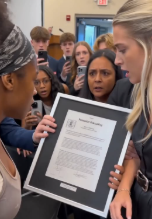
Vivian closed her eyes.
Arthur said, “Do not.”
Mr. Moreau continued.
“‘The girl in the work clothes cannot represent the language program on camera. Replace her with Brooke. If questioned, say the academy provided the training.’”
The room erupted.
Teachers shouted. Students stood. Reporters spoke into microphones at once.
My face burned.
Not from embarrassment this time.
From fury.
The girl in the work clothes.
Not Kemi.
Not the student who stayed late.
Not the voice on the recordings.
Just the girl in the work clothes.
Brooke stared at the email, then at her father.
“You said it was because I deserved the role,” she whispered.
Arthur snapped, “You do deserve it.”
“No,” she said, voice cracking. “You said she was trying to take something from me.”
He leaned close to her.
“She was.”
I looked at him.
“No,” I said. “I was only standing where my name already was.”
Then the back door opened.
An elderly woman entered with a cane, a school badge, and a cardboard box in her arms.
The room quieted.
Mr. Moreau turned.
“Mrs. Leclerc?”
She lifted the box.
“I have the old pronunciation room tapes,” she said. “And one of them explains why Sinclair Academy stopped showing up.”
Part 5: The Tape From The Forgotten Room
Mrs. Leclerc moved slowly, but everyone parted for her.
She had retired the year before, but I remembered her from the library desk. Soft gray hair. Careful hands. A voice that could quiet a room without raising itself.
She set the cardboard box on the display table.
Dust lifted from it in a pale cloud.
“These should have been archived,” she said, looking at Mr. Moreau. “But when I heard what was happening, I checked the storage cabinet.”
Arthur Sinclair’s face had gone dangerously still.
Brooke whispered, “Dad, what is she talking about?”
He did not answer.
Mrs. Leclerc removed a labeled tape recorder and a stack of sign-in sheets.
“The pronunciation room used to record all official coaching sessions,” she said. “For quality review. Then Sinclair Academy requested the policy be discontinued.”
Vivian Sinclair pressed her fingers to her mouth.
Mr. Moreau asked, “When?”
“Two days after their coach stopped attending.”
The city education officer in the front row stood.
“I would like those records preserved.”
Arthur snapped, “They are outdated materials.”
Mrs. Leclerc looked at him over her glasses.
“Truth does not expire because it is inconvenient.”
A few students clapped.
This time, they did not stop.
Mrs. Leclerc inserted a tape into the old player.
The machine clicked.
For a moment, there was only room noise from weeks ago.
Then a man’s voice spoke.
Not Arthur’s.
A Sinclair Academy coach.
“I am not staying late for unpaid practice. Tell the sponsor office the scholarship kids can manage with cards.”
A second voice answered.
Vivian’s.
“Arthur wants the room active on paper. Not necessarily in person.”
My stomach sank.
Active on paper.
That was what I had been to them too.
Useful on paper until my name became inconvenient.
The tape continued.
The coach laughed.
“Then let the Adeyemi girl sort the room. She’s always here.”
Brooke’s face turned pale.
I did not look at her.
I looked at the floor because suddenly I remembered every evening I thought I was just helping a forgotten program survive. I had not known they were counting on my unpaid work while pretending their academy was still serving the students.
Mrs. Leclerc stopped the tape.
Mr. Moreau looked shaken.
“The school paid Sinclair Academy for those sessions,” he said.
The education officer’s voice hardened. “And the academy may have billed for services not provided.”
Arthur’s polished mask finally cracked.
“You cannot prove that from one tape.”
Mrs. Leclerc reached back into the box.
“No,” she said. “That is why I brought the attendance sheets.”
She placed them beside the practice recording.
Date after date.
Students’ names.
My initials.
No academy coach signature.
A reporter spoke clearly into her camera.
“Sinclair Academy is now facing questions over whether it accepted sponsorship and school funds for language sessions led by an unpaid student.”
Arthur turned toward me.
His eyes were cold enough to make my hands curl.
“You should have stayed quiet.”
My heart pounded.
Brooke whispered, “Dad.”
He ignored her.
“You think this makes you powerful?” he said to me. “This makes you difficult.”
I stepped closer to the microphone.
“No,” I said. “It makes me heard.”
Then the old tape player clicked again by itself.
Mrs. Leclerc frowned.
A final recording began.
This time, Brooke’s voice filled the hall, much younger and trembling.
“Dad, I cannot pronounce the opening line. What if they laugh at me?”
Part 6: The Heiress Had Been Afraid Too
Brooke’s face collapsed.
“Turn it off,” she whispered.
Nobody moved at first.
The tape kept playing.
Arthur’s voice followed hers, sharp and impatient.
“Then make sure no one better gets the chance.”
Brooke covered her mouth.
The room changed.
Not in her favor.
Not exactly.
But something complicated passed through the students. A strange, painful understanding.
Brooke had not been born cruel in front of us.
She had been trained there.
On the recording, younger Brooke sniffed.
“What if I mess up?”
Arthur said, “Sinclairs do not mess up. Other people mess up. You stand in front of them and let them.”
Mrs. Leclerc stopped the tape.
The silence after it was different from every silence before.
Brooke’s eyes shone with tears she refused to let fall.
I thought I would feel satisfied hearing her humiliated by her own fear.
I did not.
I felt tired.
Because her fear had not softened her when she looked at me. It had made her kick me harder.
Arthur turned on Mrs. Leclerc. “You had no right to play that.”
She said, “You had no right to build a school program on a child’s fear and another child’s labor.”
Vivian Sinclair stepped away from her brother.
That small movement seemed to shock him more than the tapes.
“Vivian,” he said.
She shook her head.
“I signed what you told me to sign,” she said quietly. “I defended what you told me to defend. But I will not stand here while you threaten an eighteen-year-old girl you exploited.”
Arthur’s mouth tightened.
Brooke looked at her aunt like the floor had shifted.
Mr. Moreau turned to me. “Kemi, the opening ceremony is still yours if you want it.”
If I wanted it.
After soup-stained stories I had read online, I used to imagine truth arriving like applause. Bright. Clean. Final.
But standing there, with my leg aching and my heart pounding, truth felt heavy.
The opening line waited on the podium.
A simple sentence in four languages, meant to celebrate courage in speech.
I had practiced it alone after sweeping the pronunciation room.
I had practiced it with students who were afraid of rolling an r, softening a vowel, lifting their voice.
I had practiced it until the words stopped feeling like performance and started feeling like promise.
Brooke suddenly spoke.
“Kemi.”
I turned.
She stood with her hands at her sides, no longer pointing, no longer smirking.
“I did try to erase your name,” she said.
The cameras caught every word.
“I knew the recognition list was changed. I knew you had done the practice sessions. I told myself it did not matter because my family paid for everything.”
Her voice broke.
“And I kicked you because I was afraid that if you read better than me, everyone would know I was never the best. Just the most protected.”
Arthur barked, “Brooke!”
She flinched, then looked at him.
“No.”
One word.
Small, but real.
Then she faced me again.
“I am sorry,” she said. “Not because I got caught. Because I heard the tape and realized I became his voice.”
I did not forgive her.
Not there.
Not for the cameras.
But I believed she had finally told the truth.
I walked to the podium.
My hands shook as I picked up the paper.
Arthur Sinclair moved toward the exit.
The education officer blocked him.
And I read the opening line.
Not perfectly. Powerfully.
Part 7: The Line Everyone Repeated After Her
My voice filled the hall in English first.
Then French.
Then Spanish.
Then Italian.
Each language carried its own shape through my mouth, each sound steadier than the one before. I felt the room listening—not waiting for me to fail, not studying my clothes, not measuring whether I belonged.
Listening.
When I finished, nobody clapped at first.
They repeated the line.
One student began.
Then another.
Then an entire row.
The words moved through the hall in uneven accents and trembling voices, imperfect and alive.
That was the most beautiful sound I had ever heard.
Mr. Moreau wiped his eyes.
Mrs. Leclerc held the box of tapes like it was something sacred.
Brooke stood by the sponsor seats, crying silently now, mascara dark under her lashes. Vivian had one hand on her shoulder. Arthur Sinclair was speaking furiously to the education officer, but no one seemed afraid of him anymore.
That was new.
Power leaving a room makes almost no sound.
It simply stops being obeyed.
After the ceremony, the official language round results were shown on the screen. The school team had won by three points.
Three points.
A pronunciation correction here. A confidence drill there. A late bus missed. A dinner skipped. A stack of vocabulary cards sorted until my fingers cramped.
Three points.
My name appeared beside the student practice sessions.
Kemi Adeyemi — Volunteer Pronunciation Lead.
Mr. Moreau stepped to the microphone.
“That title is incomplete,” he said.
He looked toward the education officer, who nodded.
Mr. Moreau turned back to the crowd.
“Effective today, the school is suspending its contract with Sinclair Academy pending investigation. The pronunciation room will become a student-led language lab, and Kemi Adeyemi will be offered a paid coordinator position through graduation.”
I gripped the podium.
Paid.
The word nearly knocked the breath out of me.
Not because it was everything.
Because it meant someone had finally admitted the work had value.
Brooke looked at me across the room.
Her expression was unreadable.
Then she did something I did not expect.
She removed the Sinclair Academy pin from her jumpsuit.
Her father saw.
“Put that back on,” he ordered.
She looked at the pin in her palm.
Then she dropped it into the trash beside the stage.
The room gasped.
Arthur’s face turned red.
Brooke’s voice shook, but it carried.
“I will testify about the altered lists and the unpaid sessions.”
Vivian closed her eyes in relief.
Arthur stared at his daughter as if she had become a stranger.
Maybe she had.
Maybe truth always makes strangers out of people who only knew how to lie.
A reporter asked me how I felt.
I looked at the old pronunciation room door behind the ceremony hall. The paint was chipped near the handle. The window was cloudy. Inside were boxes of vocabulary cards nobody had cared about until they became evidence.
“I feel,” I said slowly, “like the room was never empty after all.”
Then Mrs. Leclerc touched my arm.
“There is one more thing in the box,” she whispered.
She handed me a small envelope with my name written on it.
The handwriting was my mother’s.
Part 8: The Room Remembered Every Voice
I did not open the envelope until the hall had emptied.
The reporters were gone. The sponsors had vanished. The banners with Sinclair Academy’s crest had been taken down and stacked against the wall like discarded costumes.
Only the pronunciation room remained.
Small. Dusty. Familiar.
I sat at the old practice table where I had sorted cards for weeks, where students had leaned over vowel charts and whispered words they were afraid to say aloud.
Mr. Moreau, Mrs. Leclerc, and my mother stood nearby.
My mother had arrived late from work, still in her uniform, her face tight with the guilt of every parent who wanted to be everywhere and could not.
“I asked Mrs. Leclerc to keep it,” she said softly. “Just in case you ever needed proof of why you started.”
My fingers opened the envelope.
Inside was a note I had written years ago, when I was twelve.
The paper was creased. The spelling was messy. At the top, I had written:
Things I Wish Teachers Knew.
My throat closed.
I read the first line.
Please do not skip my name because you are scared to say it wrong.
The room blurred.
I had forgotten writing it.
Mrs. Leclerc had not.
My mother touched my shoulder.
“You came home crying that day,” she said. “You said maybe names like ours were too hard for school.”
I covered my mouth.
All those weeks in the pronunciation room, I thought I was helping other students win a competition.
But maybe I had been answering my younger self.
Maybe every card I sorted, every sound I repeated, every nervous student I encouraged, had been my way of saying: no voice should be treated like a problem.
Weeks passed.
Arthur Sinclair’s academy lost its school contracts. Investigators found altered attendance reports, false billing records, and several recognition lists rewritten to favor sponsor families. Vivian testified. Brooke testified too.
She did not return to school as a hero.
She returned quietly, without the watch, without the pin, without the group of girls who once trailed behind her like a warning.
One afternoon, she came to the pronunciation room while I was labeling new shelves.
“I’m not here to ask for forgiveness,” she said.
“Good,” I answered.
She nodded, accepting that.
Then she placed a stack of blank practice cards on the table.
“I thought the lab might need these.”
I looked at them.
No logo.
No Sinclair crest.
Just plain cards.
Useful.
“Leave them there,” I said.
She did.
By spring, the student-led language lab was full every afternoon. Nobody had to pay. Nobody had to prove they belonged before asking for help. We recorded practice lines, not to catch mistakes, but to show progress.
On the final day of school, Mr. Moreau unveiled a small sign outside the room.
The Adeyemi Language Lab.
I laughed because I thought he was joking.
He was not.
Beneath the name, in smaller letters, it read:
Every voice deserves the patience to become brave.
My mother cried first.
Then I did.
Not loudly.
Just enough to let the old hurt leave.
I unlocked the door with my new key and stepped inside. Sunlight fell across the table, the shelves, the boxes of cards, the recorder that had once exposed a lie and saved my name.
For the first time, the room did not feel like a place where forgotten work was hidden.
It felt like a place where voices came back to themselves.
I picked up the first blank card and wrote my name across it slowly, clearly, without shrinking a single letter.
They tried to erase my voice from the ceremony, but the room had been recording my courage all along.
