Part 2: The Page Brielle Could Not Explain
The organizer held the ledger open like it weighed more than paper.
For a second, the entire workshop seemed to stop breathing.
The silk-screen frame stood ready on the table, the fresh uniform fabric stretched beneath it, the ink tray shining under the ceremony lights. My leg still ached where Brielle had kicked me, and my fingers pressed into the table edge because I refused to let myself fall.
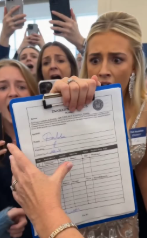
Mrs. Evelyn Hart, the ceremony organizer, looked from the ledger to Brielle Winslow.
“Why,” she repeated, her voice shaking with anger, “did your daughter try to erase the official record?”
The microphone carried every word.
Brielle’s diamond bracelet flashed as her hand tightened around her designer clutch.
Her father’s representative, Mr. Alden Pierce, stepped forward with a smooth smile.
“This is clearly a misunderstanding,” he said. “The Winslow family has supported this workshop for years.”
Mrs. Hart pulled the ledger closer to her chest.
“Support does not give anyone the right to remove a student’s name.”
My throat tightened.
My name.
For weeks, I had written it beside late orders, emergency uniform repairs, and quiet notes like no payment collected or donated print. Not because I wanted praise. Because the students who came to me embarrassed, clutching torn shirts or old sweaters, deserved to receive uniforms without feeling exposed.
Brielle laughed once.
It was sharp enough to cut the silence.
“She aligned screens,” she said. “That is not charity. That is not leadership. That is shop labor.”
The words hit exactly where she aimed.
Shop labor.
Like the work mattered only when someone rich could put a logo on it.
Mrs. Hart turned the ledger toward the crowd.
“This entry is from February 9th,” she said. “Talia Cohen printed two gym uniforms for students whose family could not afford replacements. No charge. February 16th, three polos. February 22nd, four jackets. March 4th, emergency batch before regional competition.”
Students began whispering.
A boy near the back stood up.
“She printed mine,” he said quietly. “I told everyone my parents bought it. They didn’t.”
Then a girl rose beside him.
“She fixed my sister’s uniform before picture day.”
Another voice followed. “She stayed late for the debate team.”
My hands started shaking.
I had thought nobody would ever say it out loud.
Brielle’s face hardened with every testimony.
“That proves nothing,” she snapped. “My family donated the materials.”
Mrs. Hart turned another page.
“No,” she said. “The ledger shows Talia sourced leftover fabric, cleaned the frame herself, and used rejected ink batches your company marked as unusable.”
Mr. Pierce’s smile thinned.
“Evelyn, you should not be reading internal workshop notes publicly.”
“You should not have tried to alter them privately.”
A reporter lifted her camera higher.
Brielle’s mother stood in the sponsor row, pale beneath perfect makeup. “This ceremony is being hijacked.”
I looked at Brielle.
“No,” I said. “It was already hijacked before I got here.”
The microphone caught me.
Brielle’s eyes flared.
Then Mrs. Hart turned to the final page clipped inside the ledger.
Her expression changed.
Not just anger now.
Shock.
“There is an authorization slip,” she whispered.
Mr. Pierce reached for it again.
Mrs. Hart stepped back.
She read the line aloud.
“Request to remove Talia Cohen from first-print honors and replace with Winslow Apparel Legacy Representative.”
Everyone knew what that meant.
Brielle.
Mrs. Hart looked at the signature at the bottom.
Then she lifted her eyes.
“This was signed by Brielle Winslow herself.”
Part 3: The Sponsor Table Went Silent First
Brielle’s mouth opened, but no sound came out.
For the first time since she entered the workshop, the room did not belong to her.
The sponsor table went silent first. Then the teachers. Then the students with phones held halfway between recording and lowering them out of shame. The hum of the heat press sounded suddenly enormous.
Mr. Pierce spoke before Brielle could.
“An eighteen-year-old student may sign a ceremonial preference form without understanding administrative consequences.”
Mrs. Hart stared at him.
“This was not a preference form.”
He smiled tightly. “Then perhaps the staff mislabeled it.”
A soft voice came from the second row.
“No, they didn’t.”
Everyone turned.
It was Maren Doyle, the workshop assistant who usually cleaned screens after events and never spoke unless spoken to. She stepped forward with ink stains on her fingers and a folded apron tucked under one arm.
“I saw Brielle in the office this morning,” Maren said. “She told the receptionist the Winslow name needed to be the only name reporters heard.”
Brielle spun toward her.
“You’re lying.”
Maren’s face went pale, but she kept standing.
“You said Talia was making the brand look cheap.”
The room reacted like someone had struck a match.
Cheap.
There it was.
The word behind every stare at my faded sweater, every glance at my worn shoes, every whisper about why someone like me had been chosen for a ceremony with donors and cameras.
Brielle’s father rose from the front row.
Graham Winslow was tall, silver-haired, and polished in a way that made every room adjust itself around him. His suit looked more expensive than the entire workshop. His eyes did not go to me, or Mrs. Hart, or even his daughter.
They went to the cameras.
“This is a student misunderstanding being inflated for spectacle,” he said. “My daughter is passionate about our family’s commitment to school uniforms and accessibility.”
A teacher muttered, “Accessibility?”
Mrs. Hart lifted the ledger higher.
“Then why try to erase the only student actually providing it?”
Graham Winslow’s smile cooled.
“Careful.”
The word was quiet.
Everyone heard it.
My heart beat hard against my ribs.
Mrs. Hart did not move.
A city education liaison near the stage stepped forward. “Mr. Winslow, was your company aware of the altered honor list?”
His smile returned too quickly.
“Our company does not involve itself in student recognition decisions.”
Maren swallowed.
“That is not true.”
Brielle looked furious now. “Stop talking.”
Maren flinched.
I recognized that flinch.
It was the movement of someone who had learned that rich people did not need to shout to hurt you.
Mrs. Hart asked, “Maren, what do you mean?”
Maren looked at me, then at the ledger.
“There were invoices,” she said.
Mr. Pierce’s face changed.
Graham’s did not, but his hand tightened on the back of his chair.
“What invoices?” the liaison asked.
Maren reached into her apron and pulled out a folded packet.
“I copied them because the amounts looked wrong.”
Graham Winslow took one step forward.
“Maren,” he said softly, “you should think about your future.”
That was his mistake.
Because the microphone near the print table caught him too.
The education liaison turned fully toward him.
“Was that a threat?”
Graham smiled, but his jaw had hardened.
Maren unfolded the packet with trembling hands.
Then she placed it beside the order ledger.
The first invoice carried my free uniform orders under Winslow Apparel’s billable services.
Part 4: The Free Uniforms Were Never Free
I stared at the invoice until the numbers blurred.
The uniforms I printed after school, the ones I had quietly made for students who could not pay, were listed in neat columns under Winslow Apparel outreach services.
Each one had a price.
Not small prices either.
My hands went cold.
“They charged for them,” I whispered.
Mrs. Hart looked like she might be sick.
Maren nodded. “The school fund was billed every month.”
A boy in the front row said, “But Talia told me it was free.”
“It was free,” I said.
My voice cracked.
I hated that.
I wanted to sound strong, but the truth had come too fast. The students I had tried to protect were now watching their dignity become evidence.
Graham Winslow spoke with practiced patience.
“Administrative billing is complex. Donated labor and sponsored resources are often categorized—”
“No,” Mrs. Hart interrupted. “These orders were marked as completed by Winslow staff.”
She flipped through the pages.
“Operator initials: B.W.”
Brielle’s initials.
Every head turned toward her.
Brielle stepped back so quickly her heel struck the table leg. The ink tray rattled.
“I didn’t do the billing,” she said.
“But you signed the recognition removal,” Mrs. Hart replied.
“I was told to!”
The words burst out before she could stop them.
Her father’s expression sharpened.
“Brielle.”
She froze.
The room froze with her.
For a moment, she looked younger than eighteen. Not innocent. Not helpless. Just caught between the lie she had performed and the person who had taught her the script.
The education liaison asked carefully, “Who told you?”
Brielle’s throat moved.
She looked at her father.
He stared back without blinking.
Mr. Pierce stepped in. “No further questions should be answered without counsel.”
A reporter near the aisle asked, “Is Winslow Apparel accused of billing the school for student volunteer labor?”
Graham turned toward the cameras.
“Absolutely not.”
Maren pointed to the invoice.
“Then why does the billing date match Talia’s free order entries?”
The room grew louder. Teachers whispered. Students compared photos of the ledger and invoices. Cameras shifted between Graham, Brielle, and me.
I wanted to disappear behind the printing racks.
Instead, I stepped closer to the ledger.
“These students came to me because they were embarrassed,” I said. “They asked me not to tell anyone. I wrote the orders in the ledger so the workshop inventory stayed honest, but I never wrote their names publicly.”
Mrs. Hart’s hand covered mine for one second.
A small kindness.
Enough to keep me upright.
Graham’s voice lowered. “Miss Cohen, you may not understand how sponsorship programs work.”
I looked at him.
“I understand how stealing works.”
The room gasped.
Brielle’s eyes widened.
Graham’s smile disappeared.
Then the workshop door opened.
An older man entered wearing a gray maintenance coat, carrying a metal cash box and a stack of carbon-copy receipts.
Mrs. Hart turned.
“Mr. Bell?”
He nodded once.
“I kept the old workshop duplicates,” he said. “And you need to see the receipts Winslow Apparel asked me to destroy.”
Part 5: The Receipts Hidden Beneath The Press
Mr. Bell set the metal cash box on the printing table.
The clang sounded final.
He was the kind of man most people forgot immediately after asking him to unlock a storage room. Quiet. Stooped. Always carrying keys. But now every camera in the workshop followed his hands as he opened the box.
Inside were yellowed carbon receipts, inventory slips, and scraps of paper bound with rubber bands.
Graham Winslow’s voice sharpened.
“Harold, those are company materials.”
Mr. Bell did not look at him.
“No,” he said. “They are school workshop records.”
Mr. Pierce moved forward. “You are not authorized to release documents.”
The education liaison stepped between them.
“He is now.”
Mr. Bell placed the first receipt beside Maren’s invoice.
Same date.
Same order number.
Different truth.
The original receipt showed donated scrap fabric, student labor, zero charge.
The Winslow invoice showed premium fabric, professional labor, full charge.
A murmur spread through the room like fire under a door.
Mrs. Hart whispered, “How long?”
Mr. Bell’s face tightened.
“At least two years.”
Two years.
I had only been in the workshop one semester.
That meant there had been others before me.
Other students staying late. Other free repairs. Other quiet acts turned into profit by people with their names on banners.
Mr. Bell opened another stack.
“These were from last year. Different student initials. Same billing pattern.”
The education liaison’s face went dark.
Graham Winslow reached for his phone.
“Do not leave,” the liaison said.
He gave her a cold look.
“I am calling my attorney.”
“Good. Tell them the district is preserving all records.”
Brielle stared at the receipts like they belonged to a stranger.
“You said the outreach program lost money,” she whispered to her father.
Graham did not answer.
“You said we paid for poor students to have uniforms.”
His eyes cut to her. “Do not say another word.”
Her face changed.
Not into remorse yet.
Into realization.
A horrible, slow understanding that the throne she had stood on was made from people she had been taught to look down on.
I wanted that to be enough.
It was not.
Because my leg still hurt.
Because she had still kicked me.
Because she had still pointed at my sweater and my shoes without pointing at them at all.
Mrs. Hart turned to me. “Talia, did you ever receive payment for the free orders?”
I shook my head.
“No.”
“Credit?”
“No.”
“Training hours?”
“No.”
My cheeks burned.
“I was just told the workshop needed to stay open late, and if I wanted to use it for school credit, I should make myself useful.”
Maren looked down.
“I’m sorry,” she whispered.
Graham laughed softly.
“You are turning ordinary student volunteer work into a scandal.”
Mr. Bell reached into the cash box one last time.
“No,” he said. “The scandal is this.”
He lifted a sealed envelope.
On the front was written: First Print Ceremony Media Plan.
Mrs. Hart opened it.
Her face drained of color.
Inside was a prepared press release.
The headline read:
WINSLOW HEIRESS LAUNCHES FREE UNIFORM INITIATIVE FOR STRUGGLING STUDENTS.
Part 6: The Press Release That Stole My Life
The headline felt like a hand around my throat.
Brielle Winslow’s name was printed in bold.
Her photograph was placed beneath it.
Perfect hair. Perfect smile. Perfect diamonds.
Below that, in polished language, the release described “her compassionate leadership,” “her commitment to dignity,” and “her innovative after-school uniform access program.”
My work.
My evenings.
My sore hands.
My silence.
All rewritten as Brielle’s kindness.
I heard a sound and realized it had come from me.
Not a sob.
Something smaller.
Mrs. Hart turned the page.
There was a quote prepared for Brielle.
“I believe every student deserves to walk into school feeling equal.”
The room went still.
The students whose uniforms I had printed looked at the floor.
They knew those words were supposed to be built on their private need.
Their hardship had been packaged into her image.
Brielle covered her mouth.
For once, she looked ashamed.
But shame after exposure still had to face what came before it.
I looked at her.
“Were you going to read that?”
She did not answer.
“Were you going to stand here after kicking me and tell everyone you helped students like me?”
Her eyes filled.
“I didn’t write it.”
“But you were going to read it.”
Her silence answered.
Graham Winslow stepped forward.
“My daughter is not responsible for communications prepared by staff.”
Mr. Bell placed another document down.
“This version has her handwritten notes.”
The cameras clicked wildly.
Brielle whispered, “No.”
Mrs. Hart lifted the marked-up draft.
In the margin, Brielle had written: Make this more emotional. Mention students who cannot afford basics.
My stomach turned.
She had not just accepted the lie.
She had decorated it.
Brielle shook her head. “I thought it was marketing.”
A student near the back said, “We are not marketing.”
That sentence broke something open.
Applause started, angry and scattered, then grew.
Graham shouted over it, “Enough!”
The room quieted, but not because he controlled it.
Because everyone wanted to hear what desperate power sounded like.
He pointed at the ledger.
“You think anyone cares who pulled a screen in a school workshop? My company gave this program prestige. Without us, nobody would look twice at any of you.”
I stepped toward him before fear could stop me.
“That was the problem,” I said. “You only looked when there was something to take.”
His face reddened.
Mr. Pierce grabbed his arm. “Graham.”
The education liaison signaled to security.
Graham looked around and finally saw what had changed.
No one was moving aside for him.
Brielle suddenly took the press release from Mrs. Hart’s hand.
Her fingers shook.
“I knew Talia’s name was removed,” she said, voice breaking. “I knew the honor should have been hers.”
Her father barked, “Brielle!”
She flinched, but kept going.
“I told myself it was fine because Dad said poor students don’t know how to represent a brand.”
The words landed like stones.
Then she faced me.
“And I kicked you because I needed everyone to see you as unstable before they saw you as honest.”
The hall went silent.
I looked at her for a long time.
“Thank you for telling the truth,” I said.
Hope flickered in her eyes.
Then I added, “But that does not undo what you did.”
Part 7: The First Print Finally Came Back To Me
Security escorted Graham Winslow to the side office with the education liaison and district officials.
He did not go quietly.
He spoke about lawyers, contracts, reputations, donors. But each word sounded thinner than the last. Mr. Pierce followed him, already typing furiously into his phone.
Brielle remained near the print table.
Without her father beside her, she seemed stripped of size. The diamonds were still there, but now they looked like costume pieces under the harsh workshop lights.
Mrs. Hart turned to me.
“Talia,” she said softly, “the first print is still yours, if you want it.”
If I wanted it.
I looked at the silk-screen frame.
The design waited beneath the mesh: the school crest, clean lines, the new uniform emblem that was supposed to mark the start of a fair-access program.
Fair access.
The phrase almost made me laugh.
My leg throbbed. My sweater smelled faintly of ink and dust. I could feel every camera waiting for me to become inspirational in a neat, convenient way.
But I was not neat.
I was angry.
I was hurt.
I was seventeen years old, and adults had let a powerful family turn my work into a stage prop.
“I’ll do it,” I said. “But not for their press release.”
Mrs. Hart nodded. “For what, then?”
I looked at the students.
At the boy who had admitted his family could not buy the gym uniform.
At the girl whose sister made picture day because of a repaired shirt.
At Maren, who had copied invoices even though she was scared.
At Mr. Bell, who kept receipts beneath a press because he knew someone might need the truth.
“For the students who were never supposed to be named,” I said.
Mrs. Hart stepped back.
The workshop became quiet in a different way.
Not cold.
Ready.
I took the squeegee.
My hands knew what to do.
Flood the screen. Set the angle. Press evenly. Pull with one steady motion.
The ink moved across the mesh in a smooth dark wave.
For once, nobody interrupted.
I lifted the frame.
The first print lay beneath it, perfect.
A sound moved through the room, soft at first, then swelling into applause.
My eyes stung.
I pressed my palm against the table to steady myself.
Mrs. Hart walked to the microphone.
“This first print,” she announced, “will not be displayed under any sponsor name. It will hang in the workshop with the order ledger beside it.”
She looked directly at the cameras.
“And the district will open an investigation into all billing connected to Winslow Apparel.”
Brielle wiped her cheek.
Then she removed her diamond bracelet.
Everyone watched.
She placed it on the table beside the press release.
“I don’t want to wear what this paid for,” she whispered.
No one clapped.
Some moments did not deserve applause.
They deserved witnesses.
Then Mr. Bell touched my shoulder gently.
“There is one more ledger,” he said.
I turned.
He nodded toward the old storage cabinet.
“The one before yours. The one with the first student who started printing for free.”
Part 8: The Ledger Before Mine Changed Everything
The old ledger was smaller than mine.
Its cover was cracked, its corners softened by years of hands, and the label had faded until the words were almost unreadable.
Workshop Orders: Year One.
Mr. Bell placed it on the table with surprising tenderness.
“I should have shown someone sooner,” he said.
Mrs. Hart opened it carefully.
The handwriting inside was different from mine.
Rounder.
Younger.
But the entries felt familiar.
Two shirts, no charge.
Emergency jacket repair.
Leftover fabric used.
Student requested privacy.
My chest tightened.
Someone had done this before me.
Someone had stood in the same workshop, pulled the same screens, protected the same quiet dignity, and disappeared into the record.
Mrs. Hart turned to the inside cover.
A name was written there.
Leah Cohen.
My breath stopped.
“That’s my mother,” I whispered.
The room faded at the edges.
My mother had told me she worked after school when she was young. She had told me she knew what it meant to make things last. But she had never told me about this workshop.
Mr. Bell nodded.
“Leah started the free uniform orders fifteen years ago. Winslow Apparel turned it into a sponsored program after she graduated.”
My hands covered my mouth.
All this time, I thought I had been inventing a small kindness in a forgotten room.
I had been continuing one.
Mrs. Hart found a folded note tucked between the pages.
The paper had yellowed with age.
She handed it to me.
My mother’s handwriting looked younger, but unmistakable.
If anyone ever questions why these orders matter, remind them that a uniform can either hide shame or protect a child from it.
I broke then.
Quietly.
No dramatic collapse. No performance for the cameras.
Just tears running down my face while the first print dried beside my mother’s old ledger.
Brielle looked away, and for the first time, I was grateful she did.
Weeks later, the investigation spread beyond the ceremony. Winslow Apparel lost its district contract. Reimbursement funds were returned. The “free initiative” was rebuilt as a student-run workshop account with public records, paid student labor, and anonymous access for any family who needed help.
Brielle testified.
Not beautifully.
Not heroically.
But honestly enough to damage the empire that had taught her to confuse attention with worth.
She did not become my friend.
That would have been too easy.
But on her last day before transferring schools, she left a plain envelope on the workshop table.
Inside was a signed statement confirming every altered list, every staged accusation, every instruction from her father.
No apology note.
No dramatic plea.
Just evidence.
I respected that more.
On the final day of the semester, my mother came to the workshop.
She stood in front of the framed first print and the two ledgers displayed beneath it: hers and mine.
For a long time, she said nothing.
Then she touched her old signature through the glass.
“I hoped you would never have to learn how hard it is to be seen,” she whispered.
I took her hand.
“I did learn,” I said. “But I wasn’t alone.”
The workshop changed after that.
Students came in without shame. Some paid. Some did not. Some learned to print. Some learned to mend. Every order went into the ledger, not as exposure, but as proof that care had passed through human hands.
The last entry I wrote before summer was simple.
First student volunteer trained. Program continues.
Then I added one more line beneath it.
Started by Leah Cohen. Protected by Talia Cohen. Belonging to everyone.
I closed the ledger and looked at the drying racks, the ink, the old press, the room that had remembered what powerful people tried to bury.
They tried to erase my name from the first print, but my mother’s hands had signed the truth years before mine.
