Part 2: The Mother Who Walked Toward the Microphone
Scarlett’s mother did not rush to her daughter.
That was the first thing everyone noticed.
Lady Vivienne Winthrop moved slowly, one gloved hand resting against the edge of the honor table as if the entire room in Zurich had tilted beneath her heels. Her diamonds flashed under the chandelier, but her face had gone flat and pale, almost carved.
Scarlett whispered, “Mother, don’t.”
The emcee’s hand froze around the microphone.
I stood there with my cheek burning and my fingers pressed so tightly into the linen tablecloth that I could feel the embroidery cutting little half-moons into my skin. The trays of canapés beside me smelled of butter, thyme, and smoked trout. I had spent three nights helping Chef Laurent repair that menu after the caterer’s refrigeration mistake nearly ruined the whole launch.
Nobody had cared then.
Now everybody was staring.
Lady Vivienne looked at the committee chair. “Read it.”
Scarlett’s head snapped toward her. “You cannot be serious.”
The committee chair unfolded the kitchen note with hands that trembled only once.
“Chef Laurent Besson wrote this at 1:14 in the morning,” he said. “It states that Lucia Morgan discovered the spoiled shipment, reorganized the service plan, contacted the replacement supplier in Lausanne, and prepared the honorary appetizer course that allowed tonight’s ceremony to proceed.”
A sound passed through the room, not quite a gasp, not quite a whisper.
Scarlett laughed sharply. “She carried plates. That’s not saving anything.”
Chef Laurent stepped out from behind the side curtain in his white jacket, his face red with fury. “No,” he said, voice low. “She saved my name. She saved this event. And she saved your mother’s foundation from public embarrassment.”
Lady Vivienne closed her eyes for half a second.
Then she turned to me.
Not to Scarlett.
To me.
“I owe you an apology,” she said.
Those six words did something strange to the room. They made it smaller, tighter, impossible to escape. Scarlett’s perfect smile cracked.
“Mother,” she hissed, “everyone is filming.”
Lady Vivienne’s gaze did not move. “Good.”
The emcee lifted the microphone again, but Scarlett lunged forward and grabbed the note from the chair’s hand. Paper tore down the center with a sound that made my whole body flinch.
For one breath, nobody moved.
Then Scarlett held up the torn halves and said, “There. No document.”
Chef Laurent reached into his jacket pocket.
His voice was quiet.
“There is always a second copy in a professional kitchen.”
Part 3: The Chef’s Copy Changed Every Face
The second copy was not paper.
It was a photograph.
Chef Laurent placed his phone on the honor table and turned the screen toward the guests. The image showed the note pinned to a steel kitchen board, signed, dated, and stamped with the foundation’s own seal.
Scarlett stared at it like it had bitten her.
The chair cleared his throat. “There is more.”
Lady Vivienne’s jaw tightened. “How much more?”
He looked at me once, almost apologetically, then tapped the folder against the microphone stand. “The kitchen notes were only the beginning. There are payment records, delivery logs, and volunteer hour sheets. Lucia’s name appears across all of them.”
My throat went dry.
I had not known anyone kept those.
I had done the work because someone had to. Because the kitchen had smelled sour that night and Chef Laurent had looked close to tears. Because the scholarship committee had told me that opportunities came to girls who proved they could stand in hard rooms without asking to be rescued.
I never imagined those hours had become evidence.
Scarlett stepped backward into a photographer, knocking his camera against his chest.
“This is absurd,” she said. “She wants attention. Look at her.”
Every eye slid to my old black dress, the one I had altered myself with a borrowed needle in a hostel room near the river. My shoes were polished but worn. My hair had been pinned carefully, though a few curls had loosened when she hit me.
I felt the familiar shame rise in me.
Then Chef Laurent moved beside me and placed one firm hand on the table between us.
“Look at her,” he said. “Yes. Look properly.”
The room obeyed.
For the first time that night, they did not look through me.
The chair opened another page. “The honorary appetizer was supposed to be named for the Winthrop family.”
Scarlett’s lips parted.
He continued. “But according to Chef Laurent’s submission, the dish was redesigned by Lucia. He formally requested the name be changed before tonight.”
The emcee leaned toward the page. “Changed to what?”
Chef Laurent looked at me, and his angry face softened.
“The Morgan Course,” he said. “Because she earned the table everyone else was born standing beside.”
My eyes stung so suddenly I had to look down.
Scarlett whispered, “No.”
Lady Vivienne turned to her daughter at last. “What did you do?”
Scarlett’s face twisted. “I protected our name.”
Lady Vivienne’s voice cut through the chandeliers.
“No, Scarlett. You exposed it.”
Part 4: The Diary Hidden Beneath the Silver Tray
Security moved closer, but Lady Vivienne lifted one finger and stopped them.
“No one touches my daughter yet,” she said.
Yet.
That word landed harder than the slap.
Scarlett heard it too. Her eyes darted toward the doors, then to the photographers, then to me. I knew that look. It was the look of someone searching for the weakest wall.
She pointed at me. “Ask her why she was in the private pantry.”
The room shifted again.
The private pantry.
My stomach clenched.
That was the one place I had not told anyone about. Not because I had stolen anything, but because I had been embarrassed. I had gone there to cry the night the first supplier refused to speak to me like I was staff worth hearing. I had sat on an overturned crate, wiping my face with a napkin, before calling three more suppliers from my cracked phone.
Scarlett smiled because she saw my silence.
“There,” she said. “She has no answer.”
But Lady Vivienne’s expression changed.
Not suspicion.
Fear.
She looked toward a silver serving tray near the end of the table. Beneath it sat a small navy diary with a ribbon around it.
I had noticed it earlier and assumed it belonged to the foundation archive display.
Lady Vivienne picked it up with both hands.
“Lucia,” she said quietly, “did you open this?”
“No,” I whispered.
“I did,” Chef Laurent said.
Scarlett spun toward him. “You had no right.”
“It was in my kitchen,” he replied. “Hidden beneath a tray marked for tonight’s honorary service.”
Lady Vivienne untied the ribbon.
The room was so silent I heard the tiny scrape of silk over paper.
She opened to a marked page and read one line. Her face seemed to age ten years before she reached the period.
Then she looked at Scarlett.
“This is your handwriting.”
Scarlett said nothing.
Lady Vivienne read aloud, “Delay the first course. Blame Lucia. Let Mother see the foundation cannot survive without Winthrop control.”
The air vanished from my lungs.
The slap had not been a burst of anger.
It had been part of a plan.
The chair took a step back. “Scarlett, you sabotaged the kitchen?”
Scarlett’s mouth trembled, but her voice came out cold. “I was fixing what she ruined by existing here.”
Lady Vivienne closed the diary.
Then she said the words that made Scarlett’s face collapse.
“You are no longer speaking for this family tonight. Lucia is.”
Part 5: The Speech I Was Never Meant to Give
The microphone felt too heavy.
The emcee placed it in my hand like it was made of glass, but my fingers still shook around it. Across the room, Scarlett stood trapped between security and her mother’s silence, her chin lifted even though tears shone angrily in her eyes.
I had never spoken in front of people like that.
People in silk and velvet. People who said “opportunity” while guarding doors with their elbows. People who loved stories about hardworking girls as long as those girls stayed grateful and small.
Lady Vivienne stepped beside me. “You do not have to defend yourself.”
But I knew I did.
Not to them.
To the version of me who had almost walked out after the slap.
I lifted the microphone.
At first, my voice barely crossed the table. “I was not supposed to be in this room.”
Someone coughed near the back.
I kept going.
“I was supposed to be in the kitchen until the trays were cleared. I was supposed to smile when no one remembered my name. I was supposed to be thankful for being close to something important, even if I was never allowed to touch it.”
Chef Laurent’s eyes shone.
Scarlett looked away.
“But the first night I worked here, I saw Chef Laurent standing alone beside ruined crates of food. Nobody was clapping. Nobody was taking pictures. There was just a problem that would have embarrassed everyone in this room.”
I swallowed.
“So I helped. Not because I wanted Scarlett’s place. Not because I wanted a family name. I helped because the people serving from the side doors are usually the ones holding the whole room together.”
A murmur moved through the guests.
Then I turned toward Scarlett.
My cheek still burned.
“You slapped me because you thought shame would make me quiet.”
My hand stopped shaking.
“But shame belongs to the person who uses power to hurt someone who cannot hit back.”
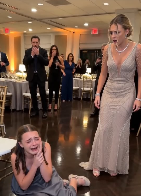
Someone began clapping.
One pair of hands.
Then another.
Then the sound widened until the chandeliers seemed to tremble.
Scarlett shouted over it, “You think they love you? They love the drama!”
Lady Vivienne looked at her daughter and said, “Enough.”
But Scarlett smiled through her tears.
“You still don’t know what she really came here for.”
Then she pointed at my necklace.
“That locket is not hers.”
Part 6: The Locket Opened a Buried Family Secret
My hand flew to my throat.
The locket was small, oval, and scratched near the hinge. I had worn it since I was twelve, after my grandmother pressed it into my palm in a hospital room in Milan and told me never to let anyone make me feel like I came from nowhere.
Scarlett’s smile sharpened.
“Ask her where she got it.”
Lady Vivienne turned slowly toward me.
For the first time, she looked frightened of me.
Not angry. Not suspicious.
Frightened.
I could barely speak. “It was my grandmother’s.”
“Her name?” Lady Vivienne asked.
“Elena Moreau.”
The room seemed to drop beneath us.
Lady Vivienne whispered, “No.”
Chef Laurent looked between us. “Vivienne?”
Lady Vivienne reached for the locket, then stopped herself before touching it. “May I?”
I opened the clasp with numb fingers.
Inside were two tiny photographs. One was my grandmother as a young woman, dark-haired and unsmiling. The other was a baby wrapped in a cream blanket.
Lady Vivienne covered her mouth.
Scarlett frowned. “What is happening?”
Lady Vivienne did not answer her.
She took the microphone from my hand, but when she spoke, her voice broke on the first word.
“My sister had a daughter.”
Every photographer lifted a camera.
Lady Vivienne shut her eyes, then forced herself on. “My younger sister, Amalia, disappeared from our family estate near Lucerne when she was nineteen. My father said she had disgraced us. He told us her child died. He forbade her name inside our house.”
The locket pulsed warm against my palm.
Lady Vivienne looked at me.
“But Amalia wore that locket.”
I could not breathe.
“No,” Scarlett said. “No, that’s impossible.”
Lady Vivienne’s tears finally fell. “Elena Moreau was the nurse who helped Amalia leave Switzerland. If Lucia has that locket, then—”
“Stop,” Scarlett snapped. “You are embarrassing yourself.”
Lady Vivienne’s face hardened.
“No, Scarlett. I am finally telling the truth.”
She turned to the committee chair.
“The foundation was not created by my father. It was created from Amalia’s inheritance after he erased her.”
The guests went utterly still.
Lady Vivienne looked at me with a grief so old it felt like dust rising from a locked room.
“Lucia is not an outsider to this ceremony. She may be the reason it exists.”
Part 7: Scarlett’s Last Lie Shattered the Room
Scarlett laughed, but it sounded wrong.
Too high.
Too sharp.
“You’re all insane,” she said. “A cheap locket and a sad story do not make her family.”
Lady Vivienne’s lips trembled. “No. But the archive does.”
The committee chair had gone pale. “Vivienne, are you certain you want this discussed publicly?”
“It became public when my daughter used public cruelty as a weapon.”
Scarlett stepped toward her. “I am your daughter.”
Lady Vivienne looked at her for a long moment.
“And that is why this hurts.”
The chair opened the final section of the folder. His hands were no longer trembling. “The foundation archive includes a sealed clause written by Amalia Winthrop before her disappearance.”
Scarlett froze.
Lady Vivienne whispered, “I never saw that.”
“It was restricted until the anniversary launch,” he said. “Tonight.”
The emcee lowered the microphone toward the page.
The chair read, “If my child or any descendant of my child is found, the foundation is to transfer guardianship of its youth programs to that descendant upon legal verification, provided they have served the work directly and not merely inherited its name.”
The words struck the room like a bell.
Scarlett’s face drained of color.
I gripped the locket so hard the hinge bit my palm. “I don’t want anyone’s fortune.”
Lady Vivienne turned to me. “It is not fortune. It is responsibility.”
Scarlett lunged for the folder.
This time security stopped her.
She screamed, “She planned this! She came here wearing that thing because she knew!”
I shook my head, unable to find words.
Chef Laurent stepped between us. “She came here to work.”
Scarlett fought against the guard’s hold, pearls shaking at her throat. “You’ll regret this. All of you.”
Then Lady Vivienne did something no one expected.
She walked to Scarlett and took off the diamond foundation pin from her daughter’s gown.
Scarlett went still.
“Mother,” she whispered.
Lady Vivienne’s hand shook, but she did not stop.
“Until you learn the difference between legacy and ownership, you will not wear Amalia’s symbol.”
Scarlett’s tears spilled over then, real and furious and terrified.
But before anyone could speak, an elderly man rose from the back table.
“I can verify the girl,” he said.
Lady Vivienne turned white.
Because the man was her father.
Part 8: The Man Who Had Buried Her Name
The old man leaned on a black cane, but his voice carried like a door slamming shut.
“I said I can verify her.”
Lady Vivienne looked as if she might fall. “Father.”
Scarlett stopped struggling.
The guests turned toward him with the awful hunger of people watching a family history split open in public.
Lord Matthias Winthrop walked slowly down the center aisle. He was smaller than his portraits, thinner than his reputation, but the room still parted for him. His eyes found the locket in my hand and stayed there.
“I gave that to Amalia on her sixteenth birthday,” he said.
My chest ached.
Lady Vivienne whispered, “You told us her baby died.”
“I lied.”
Two words.
A whole life destroyed inside them.
No one clapped. No one whispered. Even Scarlett looked stunned.
Lord Matthias reached the honor table and rested both hands on his cane. “Amalia wanted the foundation to feed children, train them, give them doors our family never opened unless it benefited us. I called her foolish. When she left, I buried her name so no one would know she had more courage than I did.”
Lady Vivienne’s voice cracked. “You let me mourn her child.”
His eyes filled, but he did not look away. “Yes.”
Then he turned to me.
“I had investigators search for years after regret became louder than pride. They found Elena Moreau, but by then she had hidden you well. She refused my money. She said a Winthrop apology arriving with lawyers was not an apology.”
A broken laugh escaped me, because that sounded exactly like my grandmother.
Lord Matthias reached into his coat and removed a sealed envelope.
“I came tonight to announce the correction privately. Scarlett’s cruelty made privacy impossible.”
Scarlett whispered, “Grandfather…”
He looked at her sadly. “You inherited my worst lesson.”
She flinched harder than when security touched her.
He placed the envelope before me. “This gives you nothing you have not earned. It only returns Amalia’s name to the work she started.”
My hands hovered over it.
“I don’t know how to be part of a family like this,” I said.
Lady Vivienne stepped closer, tears shining openly now. “Then we will learn how to become one worth joining.”
Across the room, Chef Laurent lifted the tray of appetizers I had helped create. Not the Winthrop Course. Not a rich family’s ornament.
The Morgan Course.
The emcee’s voice softened. “Ladies and gentlemen, tonight’s honorary service will begin with Lucia.”
I looked at Scarlett. She was crying silently now, the diamond pin gone, the cameras no longer loving her. For the first time, she looked less like a villain and more like a girl standing in the ruins of what she had been taught to worship.
I picked up the first silver tray.
Then I offered the first piece to Lady Vivienne.
She did not take it like charity.
She took it like forgiveness had weight.
And when the applause rose, I finally understood the shocking truth my grandmother had protected all along: I had not come to their ceremony as a guest or a servant, but as the missing heir to the kindness they tried to bury.
