Part 2: The Video That Made Everyone Stop Breathing
The screen behind the podium flickered once, and the entire ballroom in Vienna went still.
Not quiet. Still.
Even the waiters stopped moving with their silver trays balanced in both hands. The violinist in the corner lowered her bow. The chandeliers above us threw hard white light across every face, catching every twitch of discomfort, every nervous swallow, every rich guest suddenly wishing they had chosen a different side of the room.
Victoria Pemberton turned toward the screen as if she could command it to go black by glaring.
It did not.
The video opened on the storage corridor behind the ballroom. A timestamp blinked in the corner from three nights earlier. The camera angle was high and grainy, but clear enough to show the covered centerpiece table, the rolled sketches, the packing crates, and Victoria herself stepping into view in a pale coat with her hair pinned low.
A murmur moved through the room.
Victoria’s mother whispered, “No.”
On screen, Victoria looked over both shoulders, then lifted the cloth from the centerpiece model.
My throat closed.
That model was mine.
Not the one her family had unveiled in their glossy donor brochure. Not the polished final version with their crest stamped on the base. This was the first rough model I had built in the volunteer studio from wire, paper, and borrowed copper paint. The one I had stayed late to finish after cleaning flower buckets and carrying donation boxes until my shoulders burned.
The screen showed Victoria pulling a phone from her coat pocket.
Then came her voice, thin through the speakers but unmistakable.
“Papa, it’s exactly what we need. Noemi’s version looks better than the one our designer sent.”
Her father, standing beside the front row, went completely red.
The camera had caught the call on speaker.
Victoria’s voice continued, casual and cruel. “Nobody will believe she made it. She folds napkins here. We’ll say the family archive inspired it.”
A woman near the press wall gasped so sharply it sounded like glass cracking.
Victoria lunged toward the director. “Turn it off.”
The director, Anton Weiss, did not move. His finger rested beside the laptop, but his eyes stayed on her.
“No,” he said softly. “I think everyone should see what your family submitted to the foundation.”
Victoria’s father took one hard step forward. “Anton, you will regret this.”
Anton looked at him then, and something in his face changed. The polite mask slipped. Under it was exhaustion, anger, and a grief I did not understand.
“I already do,” he said.
The video jumped forward.
Now Victoria was joined by a man in a dark suit. He was older, broad-shouldered, with a silver watch flashing at his wrist. He unrolled my sketches on the table and took photographs one by one.
“Use the girl’s signature page?” he asked.
Victoria laughed.
I felt that laugh under my skin.
“No,” she said. “Burn that part.”
My hands went cold.
The archivist beside the podium, Marta Feld, turned another signed page for the audience to see. My name sat at the bottom in blue ink. Noemi Parker. Date. Volunteer design proposal. Approval initials.
Victoria stared at that page as if it had bitten her.
Then the video showed the man in the suit reaching into the crate, lifting a folder, and pausing.
He did not take only my design.
He took another file from beneath it.
A file marked with a red archive tag.
The moment it appeared on screen, Anton stiffened.
Marta’s fingers tightened around the stack of papers.
Victoria’s father stopped breathing.
I saw it happen. His chest just froze.
The video zoomed badly as the man turned, but the label was visible for one terrible second.
Pemberton Foundation: Private Adoption Ledger, 2008.
A hush swallowed the ballroom.
Victoria’s face drained of color so fast she looked painted.
Her mother gripped the back of a chair.
I did not understand why that file mattered. Not yet. I only knew the atmosphere had changed again. The theft of my design had shocked them. This had frightened them.
Anton closed the laptop.
“No,” Victoria’s father snapped. “Play no more.”
This time, Anton smiled without warmth.
“That is the first honest thing you have said tonight.”
Then Marta turned toward me, and her voice was careful.
“Noemi,” she said, “there is something in the second file that was never supposed to be found.”
Victoria whispered, “Don’t.”
But her whisper was not aimed at Marta.
It was aimed at me.
Part 3: The Ledger With My Name Inside
Marta did not open the ledger immediately.
That was what made it worse.
She held it against her chest like it was heavy enough to break bone. The red archive tag trembled against her sleeve. Around us, people who had spent the evening pretending not to see me were suddenly staring as if I had become the only real thing in the room.
I wanted to step back.
I wanted to leave the orchids, the cameras, the shining floor, the stolen centerpiece, the rich family with their marble smiles. I wanted the narrow volunteer kitchen where I knew where everything belonged. I wanted air that did not taste like perfume and panic.
Anton must have seen it in my face, because he moved closer without touching me.
“You do not have to hear this in public,” he said.
Victoria laughed once, a tiny desperate sound. “How noble. Now you care about privacy?”
Anton turned on her. “You lost the right to speak about privacy when you tried to destroy hers.”
Her mouth shut.
My voice came out smaller than I wanted. “What is in the file?”
Marta looked toward the front row.
Victoria’s mother, Celia Pemberton, had gone rigid. She was an elegant woman in pearl earrings and a silver dress, but all that elegance seemed useless now. Her fingers were pressed to her lips. Her eyes were not on the ledger.
They were on me.
“I knew your face,” she whispered.
The words moved through me slowly.
My face.
Marta opened the ledger.
The paper inside was old, not ancient, but handled too many times by people who had no right to touch it. There were printed forms, handwritten notes, receipts, signatures, and a small photograph clipped to the top corner.
A baby photograph.
I stared at it.
The room blurred.
The baby had dark curls, round cheeks, and a tiny knitted yellow cardigan. On the back, visible through the plastic sleeve, someone had written one name.
Noemi.
My knees weakened.
Anton reached for a chair, but I did not sit.
Marta’s voice shook. “Seventeen years ago, the Pemberton Foundation sponsored a private infant placement program through clinics in Prague, Vienna, and Milan. Several records were later sealed after accusations of illegal transfers.”
Victoria’s father exploded. “Careful.”
Marta did not look at him. “This file lists one infant transferred from a temporary care home in Prague to a private household in England. The receiving family name is Parker.”
Every sound in the room dropped away.
Parker.
My adoptive parents had told me the truth as kindly as they could. That I had been adopted as a baby. That my birth records were incomplete. That the agency had closed. That they loved me before they knew me, and that was the only part that mattered.
I had believed the missing pages were just missing.
Not hidden.
Not stolen.
Celia Pemberton made a broken sound.
Victoria grabbed her arm. “Mother. Don’t.”
Celia shook her off.
For the first time all evening, Victoria looked truly scared.
Celia stepped into the aisle, pearls trembling against her throat. “I had a daughter,” she said. “Before Victoria. Before all of this. I was told she died.”
Victoria’s father turned on her. “Celia.”
She flinched, but kept walking.
“I was twenty-three,” she said, and now she was speaking only to me. “I had complications after birth. I woke up in a clinic in Prague, and my husband told me the baby had not survived. He said there was no body because the clinic handled everything quickly. He said grief would ruin me if I asked questions.”
Her eyes filled.
“I asked anyway.”
The room seemed to tilt.
Victoria’s father said, “This is absurd.”
Celia looked back at him with something colder than hatred.
“You made me mourn a living child.”
The words struck the ballroom like thunder.
Victoria staggered backward as if the sentence had hit her too.
I looked from Celia to Marta, then to the baby photograph. My hands rose, but I could not make myself touch it.
“That baby is me?” I asked.
Marta’s eyes shone. “The dates, transfer signatures, and attached documents suggest that, yes.”
Suggest.
That word should have protected me. It did not. Something inside me had already recognized the photograph, the name, the shape of Celia’s mouth when she tried not to cry.
Victoria’s father reached for the ledger.
Anton stepped in front of him.
“Do not,” Anton said.
The old man’s face twisted. “You have no idea what you are doing.”
Anton’s answer was quiet and devastating.
“I know exactly what you did, Lord Pemberton.”
The title rippled through the guests.
Lord Pemberton.
Not just a donor. Not just a foundation chairman. A man whose name sat on museums, scholarships, hospital wings, orphan programs, and tonight’s entire gala.
And he was staring at me like I was a locked door he had failed to keep shut.
Then Victoria whispered, “She cannot be.”
Nobody moved.
Victoria looked at me, and beneath her cruelty, beneath the diamonds and fury, I saw something raw and terrified.
“She cannot be my sister.”
Part 4: The Sister Who Wanted Me Erased
The word sister did not soften her.
It sharpened her.
Victoria’s eyes filled, but not with tenderness. With panic. With insult. With the horror of someone discovering that the person she had tried to humiliate was not beneath her, but tied to her by blood she could not polish away.
Celia took another step toward me. “Noemi—”
I stepped back.
The hurt that crossed her face nearly broke me, but I could not let a stranger’s grief become my responsibility in front of two hundred people.
“No,” I said, and my voice finally held. “Do not come closer.”
She stopped at once.
That mattered.
Lord Pemberton did not stop.
He pushed past Anton and spoke loudly, choosing the audience instead of me. “This is a disgusting stunt. A forged ledger, a bitter archivist, and a volunteer girl eager for attention.”
Volunteer girl.
After everything, that was still all he could call me.
The guests shifted. Some looked ashamed. Some looked hungry for scandal. Cameras near the press wall blinked red. Someone was already recording.
Victoria saw the phones too.
Her chin lifted.
“There,” she said quickly. “That is what this is. She wanted a moment. She copied old files, copied our design history, and now she wants to attach herself to my family.”
I stared at her.
“You threw wine at me.”
Her mouth tightened. “You were standing where you did not belong.”
“I was standing where the director asked me to stand.”
“You were standing in my place.”
“No,” I said. “I was standing in mine.”
The sentence landed harder than I expected.
Victoria’s face changed.
For a second, I thought she might slap me. Her hand twitched. Celia noticed and stepped between us, not dramatically, not for show. Like a mother blocking a door.
Victoria saw it.
That tiny movement broke something in her.
“Oh,” she said, laughing through tears now. “Of course. Of course, you protect her. You met her five minutes ago, and suddenly I’m the monster.”
Celia whispered, “Victoria, please.”
“No.” Victoria’s voice rose. “You cried over a dead baby my entire life. Every birthday, every Christmas, every charity speech about lost children and second chances, she was there. A ghost at the table. And now she walks in wearing a cheap dress and everyone looks at her like she is the miracle.”
I felt the words hit, but not the way she meant them to.
Because for the first time, I saw the shape of her cruelty.
It had been fed.
It had been dressed in silk and taught to smile.
Lord Pemberton seized the moment. “You see? This is what you are doing to my daughter.”
Anton turned back to the laptop. “No. We have not yet shown what you did to both of them.”
Marta placed another paper on the podium camera. The image appeared on the screen.
A letter.
Typed, unsigned, but stamped by the Pemberton Foundation.
Marta read it aloud.
“To the Parker household: the child’s prior identity is to remain sealed permanently. Any attempt to contact maternal relatives will result in termination of support funds and legal action.”
My stomach twisted.
Support funds.
My parents had struggled for years. I remembered my father repairing shoes with glue, my mother selling her wedding bracelet when rent went up, both of them pretending not to be hungry so I would finish dinner.
“What support funds?” I asked.
Marta closed her eyes.
Anton answered. “Payments were issued in your name for sixteen years. Education, housing, medical care. They were never sent to your parents.”
I looked at Lord Pemberton.
He did not deny it.
Celia swayed.
“You stole from her too?” she whispered.
Lord Pemberton’s face hardened into something almost bored. “I protected this family.”
“No,” Anton said. “You protected your inheritance.”
Then he opened a second video.
This one was not from the gala.
It showed a law office. A younger Lord Pemberton. A lawyer. A document across a desk.
The lawyer’s voice came through clearly. “If the first child survives, she remains first in line to the Marceau trust through Lady Celia’s mother.”
Lord Pemberton’s younger voice answered, “Then she must not survive on paper.”
Celia made a sound I never wanted to hear again.
Victoria froze.
The truth unfolded in front of us with no mercy.
I had not been hidden because I was unwanted.
I had been hidden because I inherited something they wanted.
Part 5: The Trust That Changed Every Lie
Nobody clapped. Nobody whispered. Even the cameras seemed indecent now.
The ballroom had become something harsher than a crime scene because the flowers were still beautiful, the champagne still chilled, the centerpiece still waiting beneath a silk cloth as if ceremony could survive rot.
Celia gripped the back of a chair. “My mother’s trust?”
Anton nodded. “The Marceau trust was created in Lyon by your mother before her death. Its primary beneficiary was your first living daughter.”
Victoria looked at me as if the floor had split between us.
“I did not know,” she said.
It was not an apology. Not yet. More like a reflex, the first defense of someone standing too close to a fire.
I believed her.
That made everything worse.
Lord Pemberton adjusted his cufflinks. The movement was smooth, practiced, obscene. “This is not a court.”
“No,” Marta said. “But the police outside may be interested.”
The room breathed again, all at once.
Lord Pemberton’s eyes darted toward the doors.
For the first time, he looked less like a lord and more like a man counting exits.
A pair of uniformed officers entered from the side hall with a woman in a dark navy suit. She was not police. Her face was calm, sharp, and completely unimpressed by wealth.
“Clara Voss,” she said. “Financial crimes division, Vienna.”
Lord Pemberton smiled with old arrogance. “You are interrupting a private charity event.”
Clara held up a folder. “No. We are interrupting a fraud investigation.”
Flashbulbs burst.
Victoria flinched.
Celia moved closer to me again but stopped herself before crossing the distance I had asked her not to cross. That restraint did something painful to my chest.
Clara approached the podium. “Anton Weiss provided evidence three weeks ago. Marta Feld provided corroborating archives. Tonight’s public unveiling was allowed to proceed because we needed Lord Pemberton to confirm control of the stolen design submission and foundation documents in front of witnesses.”
I turned to Anton. “You knew before tonight?”
His face tightened. “Not everything. I knew your design had been stolen. I suspected the ledger mattered. I did not know you were Celia’s daughter until Marta finished matching the files this afternoon.”
“This afternoon?”
Marta’s eyes filled. “I wanted to tell you privately. Anton said Lord Pemberton had already ordered the archive room emptied tomorrow morning. If we waited, the rest could disappear.”
My anger had nowhere to go. It moved through me hot and directionless.
“So I was bait?”
Anton looked wounded because the word was true.
“You were the only person he underestimated enough to expose himself around,” he said. “And I am sorry.”
That apology did not fix it. But it did not insult me either.
Lord Pemberton laughed. “This is sentimental nonsense. Even if some paperwork exists, no court will hand a Marceau fortune to a girl who cannot prove blood.”
Clara Voss turned a page.
“Actually, my lord, Lady Celia voluntarily submitted a DNA sample two weeks ago.”
The room snapped toward Celia.
Victoria’s face went white again. “You did what?”
Celia’s voice was quiet. “I never stopped looking.”
Victoria stepped back as if her mother had struck her.
Celia reached for her, but Victoria recoiled.
“You looked for a dead child,” Victoria said. “Not for me.”
Celia’s face crumpled. “Victoria, I looked because something in me knew I had been lied to. That does not mean I loved you less.”
Victoria’s laugh was broken. “It always meant that.”
For one impossible moment, I forgot Lord Pemberton. I forgot the money, the stolen design, the cameras. I saw only a daughter who had grown up beside an empty chair and decided the ghost was her enemy.
Then Lord Pemberton moved.
He did it so quickly no one reacted at first.
He snatched the ledger from the podium and shoved Marta hard enough that she stumbled against the floral stand. Papers flew. The baby photograph slid across the marble floor.
I lunged for it.
Victoria lunged too.
Our hands met over the photograph.
We both froze, crouched in the wreckage of the gala, her diamond bracelet pressed against my wrist, my cheap sleeve damp with wine.
Her fingers trembled.
On the tiny photograph, baby me stared up between us.
Victoria whispered, almost inaudibly, “I hated a baby.”
Then her father reached the side door with the ledger under his arm.
And Victoria stood.
“Papa, stop.”
Part 6: The Heiress Who Chose The Truth
Lord Pemberton did not stop for the police.
He stopped for Victoria.
Maybe arrogance made him believe she was calling him back to protect him. Maybe habit made him turn because she had always been his daughter when it was useful and his weapon when it was convenient.
He looked almost relieved.
“Victoria,” he said. “Come here.”
She did not move.
The room waited.
Her face was wet now, but she did not wipe it. Mascara had gathered beneath her eyes. The perfect heiress from the glossy foundation posters was gone. In her place stood a young woman in a ruined silver gown, holding herself together with nothing but rage and shame.
“Did you know?” she asked.
He frowned. “This is not the time.”
“Did you know she was alive when you told Mother she died?”
Celia covered her mouth.
Lord Pemberton’s jaw shifted. “I did what was necessary.”
Victoria closed her eyes.
That was the confession.
Not legal, maybe. Not enough for court alone. But enough to destroy the last lie she had been clinging to.
When she opened her eyes, she looked older.
“You made me compete with a grave,” she said. “Then you made me attack a person.”
He snapped, “I made you strong.”
“No,” Victoria said. “You made me cruel.”
The words shook as they left her, but they did not break.
Clara Voss signaled to the officers. They approached Lord Pemberton.
He tightened his grip on the ledger. “You think she will thank you?” he spat at Victoria. “You think your new sister will love you because you had one decent minute in a ballroom? She will take everything. The trust. The foundation. Your mother’s pity. Your name.”
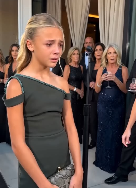
Victoria looked at me.
Everyone looked at me.
I hated that they expected me to become judge, victim, miracle, and heir all in one breath.
So I stood.
My knees were still weak, but my voice was not.
“I do not want her name,” I said.
Lord Pemberton smiled. “Listen to that performance.”
“I have a name.” I picked up the baby photograph and held it carefully. “The Parkers gave it to me every day. They stayed when things were hard. They loved me without a trust fund attached. You do not get to make that sound small.”
Celia cried silently now.
Victoria stared at the floor.
I turned to her. “And I do not know if I can forgive you.”
Her chin trembled.
“I know,” she whispered.
“But if you are about to tell the truth,” I said, “tell all of it.”
The challenge hit her like cold water.
She looked around at the donors, the cameras, the officers, her mother, me. Then she walked to the podium.
Her father shouted, “Victoria!”
She ignored him.
Anton moved aside.
Victoria took the microphone with both hands. The speakers crackled.
“My name is Victoria Elise Pemberton,” she said, voice shaking. “Three nights ago, I entered the archive storage corridor and photographed Noemi Parker’s design proposal. I sent those photographs to my father and to the foundation’s private designer.”
Lord Pemberton struggled as officers reached him.
Victoria continued louder.
“I knew it was hers. I knew she had worked for it. I told myself it did not matter because girls like her always disappear after the gala.”
Her eyes found mine.
“I was wrong.”
The ballroom held its breath.
“I humiliated her tonight because I was afraid people would see what I had stolen. And because my father taught me that shame was easier to use than honesty.”
Lord Pemberton roared, “Enough!”
The officers took the ledger from him.
He fought, not wildly, but with the offended fury of a man who had never believed consequences applied to him. One officer pulled his hands behind his back. The click of cuffs sounded too small for the damage he had done.
Celia turned away, shaking.
Victoria saw it and nearly folded.
But she stayed at the microphone.
“There is more,” she said.
Clara Voss lifted her head.
Victoria swallowed.
“The centerpiece design was not the only thing we planned to claim tonight.”
Anton’s face changed. “Victoria?”
She looked at the covered centerpiece in the middle of the stage.
“My father hid something inside it before the gala.”
A cold ripple moved through me.
Clara stepped forward. “What?”
Victoria pointed at the silk-covered structure.
“The original Marceau trust seal.”
Part 7: The Centerpiece That Hid A Fortune
For a second, nobody understood.
Then Marta gasped.
“The seal disappeared from the Lyon archive twenty years ago,” she said. “Without it, several amendments to the trust could never be authenticated.”
Lord Pemberton’s face twisted. “Victoria, you stupid girl.”
She flinched, but did not take it back.
Clara Voss ordered the officers to hold him by the doors. Anton walked toward the centerpiece like he was approaching a bomb.
The silk cloth shimmered under the stage lights.
My design had been inspired by old European winter gardens, by glasshouses and ironwork, by the idea of fragile things surviving because someone built a structure around them. I had shaped the centerpiece as a copper tree rising from a mirrored base, its branches holding small glass lanterns meant to be lit one by one by former scholarship students.
A symbol of care.
They had turned it into a hiding place.
Anton looked at me. “May I?”
It was strange, absurdly strange, that he asked permission in that moment.
I nodded.
He lifted the cloth.
Gasps broke across the ballroom.
The centerpiece stood there, beautiful and stolen. My copper branches curved upward beneath crystal lights. Tiny glass lanterns caught the chandelier glow. Around the base, the Pemberton crest had been added without my permission, stamped over the pattern I had drawn by hand.
Anton crouched at the mirrored base.
Victoria stepped closer. “The left panel,” she said. “He told the installer never to open it unless he gave the order.”
Clara knelt beside Anton, gloved hands ready.
The panel resisted at first. Anton pressed beneath the rim, and a hidden latch clicked.
The mirrored side opened.
Inside was a velvet pouch.
Marta whispered something in German.
Clara removed the pouch and tipped it gently onto a clean cloth on the podium.
A round metal seal rolled into view, dark with age, engraved with the Marceau family mark: a small greenhouse beneath a crescent moon.
Celia sobbed once.
“That was my mother’s,” she said. “I remember it on her desk.”
Lord Pemberton stopped fighting.
His silence was worse than his shouting.
Clara lifted another folded paper from the hidden compartment. “There is a document.”
Marta leaned over it, reading fast. Her face changed.
“What is it?” I asked.
She looked at Celia first.
Then at me.
“It is an amendment,” Marta said. “Signed by your grandmother before her death. It says the trust was never meant to belong only to one child.”
Victoria’s lips parted.
Marta continued, voice thick with disbelief. “It names Celia’s first living daughter as custodian, not owner. The funds were to be used to create an independent arts and education foundation for abandoned and displaced girls across Europe.”
The words entered me slowly.
Not mine.
Not Victoria’s.
Not his.
A foundation.
A real one.
Celia pressed her hand to her heart. “My mother always said wealth should move, not sit.”
Marta’s eyes filled as she read the final line.
“She wrote, ‘Let the child who was nearly erased become the hand that opens the door for others.’”
I could not speak.
The ballroom, which had feasted on humiliation all night, now stood inside something too intimate for applause.
Victoria looked at the seal, then at me, and her face crumpled.
“He knew,” she said. “He knew it was not supposed to be ours.”
Lord Pemberton smiled bitterly. “Your grandmother was sentimental and reckless. I preserved what generations built.”
“You buried a baby to do it,” Celia said.
He looked at her then, and for the first time, I saw no charm, no polish, no lordship.
Only emptiness wearing a tailored suit.
“I gave you a life,” he said.
Celia’s answer was barely above a whisper.
“You stole the person who would have made it real.”
Police led him out through the side doors. Cameras followed, but I did not. I watched the doors close behind him and felt no triumph. Only a strange aching space where fear had been.
Then a small hand slipped into mine.
Victoria’s.
I looked down.
She pulled away quickly, ashamed. “Sorry.”
But her fingers had been freezing.
Celia stood between us without touching either of us. Three women linked by lies, standing around a stolen centerpiece that had accidentally revealed the truth.
Then Anton checked his phone, and his face went pale.
“Noemi,” he said.
I turned.
He held the screen toward me.
A message from the hospital in London, sent through the emergency contact listed in my volunteer file.
My adoptive father had collapsed.
Part 8: The Door My Grandmother Left Open
The private jet offer came from three donors at once.
I refused all three.
I flew commercial to London before dawn with my wine-stained dress folded in a paper garment bag and the baby photograph tucked inside my coat. Celia came too, but only after asking me at the airport, “May I sit near you, or would that be too much?”
That question did what all her crying had not.
It made me trust her a little.
Victoria came without luggage.
She stood at the gate in last night’s dress beneath a borrowed wool coat, looking like a girl who had run out of a life and had not yet found another one. I did not ask her to come. I did not tell her to leave.
On the plane, she sat across the aisle and stared at her hands for nearly two hours.
Finally she said, “I do not expect anything.”
I looked out at the clouds.
“Good.”
She nodded as if she deserved that.
Then she whispered, “But I am going to testify. Against him. About the design, the files, everything I remember.”
I turned back.
Her eyes were red but steady.
“Even if it ruins you?”
A faint, humorless smile crossed her face. “I think I was already ruined. This might be the first useful thing I ever do.”
At St. Thomas’ Hospital, my mother was in the corridor wearing yesterday’s cardigan, her hair coming loose, her face gray with fear. When she saw me, she folded me into her arms so tightly that the baby photograph bent in my pocket.
“Dad?” I whispered.
“Awake,” she said. “Angry that they will not let him make tea.”
I laughed and cried at the same time.
That was when my mother saw Celia.
The corridor seemed to narrow.
Celia stepped forward, then stopped, honoring the invisible line.
“Mrs. Parker,” she said, voice breaking. “I owe you more than I can say.”
My mother looked at her for a long time.
This woman had lost a baby.
My mother had raised one.
There was no simple fairness that could hold both truths.
Finally, my mother said, “She is not a parcel to be returned.”
Celia flinched. “I know.”
“She is our daughter.”
“Yes,” Celia whispered. “She is.”
My mother’s eyes filled then, not with softness exactly, but with recognition.
“And yours too, I suppose.”
Celia covered her mouth.
I leaned against the wall because the corridor had started to blur.
Inside the room, my father looked smaller than I had ever seen him, wires taped to his chest, white blanket pulled to his waist. But when I walked in, his eyes lit with the same fierce love that had carried me through every rented flat, every secondhand coat, every school fee paid late.
“There’s my girl,” he rasped.
I took his hand.
“Dad, there is something I have to tell you.”
He listened to all of it.
Not once did he interrupt. Not when I said Celia’s name. Not when I described the ledger. Not when I told him about the trust.
When I finished, he squeezed my fingers.
“So,” he said hoarsely, “your grandmother was sensible.”
I laughed through tears. “That is what you got from this?”
“She left money to help girls, not to spoil useless men.” He glanced toward the hallway, where Victoria stood half-hidden behind the doorframe. “Very sensible.”
Victoria looked startled to be noticed.
My father lifted one weak hand. “Come in, then. No lurking. Hospitals have enough ghosts.”
She entered like she was approaching judgment.
My father studied her. “You hurt my daughter?”
Victoria swallowed. “Yes.”
“Badly?”
“Yes.”
“Going to do it again?”
“No.” Her voice cracked. “Never.”
He nodded. “Good. Then bring me water.”
My mother made a scandalized sound. “Martin.”
But Victoria went at once.
That was the first time I saw her do something without being watched by cameras.
Three months later, the story had become international news. Lord Pemberton faced charges in Austria, France, and the United Kingdom. The stolen foundation accounts were frozen. The Marceau seal authenticated the amendment. The trust did not pass into my hands as treasure.
It passed through them as work.
The first office of the Marceau Door Foundation opened in Lyon in a narrow old building with blue shutters and uneven stairs. Not glamorous. Not gala-worthy. Perfect.
My parents sat in the front row. Celia sat beside them, not replacing anyone, not begging for a title, just present. Victoria stood at the back in a plain black dress, holding a clipboard, checking names of the first scholarship girls as they arrived.
No cameras were allowed inside the room.
That was my rule.
Anton unveiled the original centerpiece, restored without the Pemberton crest. The copper tree stood in the morning light, its glass lanterns empty.
One by one, the girls came forward to place notes inside them. Not donor pledges. Not press statements. Wishes. Plans. Names of schools. Names of mothers. Names they had chosen for themselves.
When the final lantern was filled, Victoria approached me.
“I found one more thing,” she said.
She handed me a small envelope, yellowed with age.
Celia recognized the handwriting and began to cry before I opened it.
Inside was a note from my grandmother, written before I was born.
For the child they may try to use, hide, or name for themselves: you owe your bloodline nothing. Build the door. Give others the key.
I read it twice.
Then I looked at Victoria.
Her face was open now, frightened but honest.
“You should light the first lantern,” she said.
I shook my head.
“No,” I told her. “We both should.”
Together, we lifted the taper.
The flame caught inside the first glass lantern, small and gold and stubborn. Then another. Then another. Soon the copper tree glowed from within, not like wealth, not like victory, but like shelter.
Celia took my mother’s hand.
My father pretended not to cry and failed.
And beside me, the sister who had once tried to erase me whispered, “Thank you for not becoming what he made us.”
I looked at the open doors, at the girls walking in from the cold Lyon morning, and understood at last that my grandmother had not left me a fortune.
She had left me a way to turn pain into an entrance.
