Part 2: The Donor Pointed At The Wrong Screen
The donor’s question cut through the ballroom harder than the violin music ever had.
“Why,” Lord Matthias Adler asked, still pointing at the tablet screen, “would Camille Vanderbilt bury proof that Nora Weiss saved the birds?”
My name sounded strange under the chandeliers.
Not small. Not accidental. Not something people could step over.
I stood at the red-carpet entrance of the old glass conservatory in Vienna, one hand gripping the torn hem of my turquoise dress, the other pressed against my ribs because I could still feel the shock of almost falling. My flats had skidded on the marble. My ankle throbbed. My face burned so badly I could barely look up.
Camille stood ten feet away in her pearl-white designer gown, her smile still trying to pretend nothing had happened.
“That log is being misunderstood,” she said, laughing lightly. “Nora changed birdseed. That doesn’t make her important.”
A few guests glanced toward the ceremonial bird-cage gate at the front of the room. Behind it, the foundation’s rescued golden canaries shifted on their perches, soft yellow bodies glowing beneath warm lights.
The event director, Elias Brandt, took the tablet from the staff member.
“She did not just change birdseed,” he said.
He connected the tablet to the huge screen above the stage. My animal-care log appeared, page after page, timestamp after timestamp.
Feed ratios. Hydration notes. Wing checks. Temperature warnings. Emergency messages.
Elias’s voice lowered. “Nora noticed that the birds were refusing the imported feed delivered this week. She replaced it with the safe reserve mixture, called the veterinarian, and documented symptoms in time.”
Camille rolled her eyes. “They are birds.”
A woman near the donor table gasped.
Lord Matthias turned to Camille. “Those birds are the symbol of the sanctuary your family is trying to control.”
Camille’s father, Victor Vanderbilt, rose slowly from the honor table. He was elegant, silver-haired, and terrifyingly calm.
“Control is a dramatic word,” he said. “We are patrons.”
Elias did not look away from the screen.
“There is more.”
Camille’s face changed.
Only for a second.
But I saw it.
Elias tapped the tablet again. A new folder opened beneath my log.
Emergency Feed Contamination Report.
The ballroom went silent.
Camille whispered, “Close that.”
Nobody moved.
Part 3: The Feed Was Poisoned Before The Gala
The words stayed on the screen like something alive.
Emergency Feed Contamination Report.
For one long second, all I could hear was the faint flutter of wings inside the ceremonial cage. The canaries did not know about donors, gowns, family names, or cruelty polished until it looked like etiquette.
They only knew when something was wrong.
So had I.
Elias opened the report.
“The veterinarian’s preliminary test found traces of a sedative compound in the imported feed,” he said. “Enough to weaken the birds during tonight’s ceremony.”
A wave of horror moved through the room.
Camille’s mother, Beatrice Vanderbilt, stood so quickly her chair scraped the marble.
“A sedative?” she asked.
Victor placed one hand on her arm. “Beatrice, do not react to incomplete information.”
She pulled away from him.
I looked toward the bird-cage gate. The smallest canary tucked its head under one wing, trembling slightly.
My throat tightened.
I had thought they were sick from stress. From travel. From lights. From too much noise. I had stayed all night in the care room, grinding safe seed, cleaning water dishes, whispering nonsense to them because no one else seemed to hear how weak their chirps had become.
Camille stepped forward. “This is disgusting. Nora is trying to blame my family because she wants attention.”
I finally found my voice.
“I wanted the birds to survive.”
The sentence was quiet.
It still reached the cameras.
Camille’s eyes flashed. “You wanted my place.”
“No,” I said. “I wanted you to stop pretending a photo mattered more than living creatures.”
The room shifted.
Victor looked at me as if I had become an insect on his sleeve.
“Miss Weiss,” he said smoothly, “young volunteers often become emotionally attached. That does not make them reliable.”
Elias scrolled lower.
A delivery receipt appeared.
The contaminated feed had been signed into the conservatory by someone with Vanderbilt clearance.
Then Elias opened the security still.
Camille stood outside the bird-care room two nights earlier, holding the feed crate.
Her face went pale.
“That proves nothing,” she said.
Lord Matthias looked closer. “Who is standing behind her?”
Everyone leaned toward the screen.
A man in a dark suit stood half-hidden near the service door, one hand resting on the crate.
Beatrice whispered, “Otto.”
Victor’s private estate manager.
Then the service doors opened, and Otto Keller walked in with two security guards behind him.
In his hand was the missing veterinary file.
Part 4: The Estate Manager Brought The Missing File
Otto Keller looked like a man dragged out of a secret.
His tie was loose, his face damp with sweat, and one sleeve had been torn near the cuff. The two security guards did not touch him, but they stood close enough to make running impossible.
Camille backed away.
“Otto,” she whispered. “Don’t.”
That single word made the room colder.
Beatrice turned toward her daughter. “Camille?”
Otto lifted the file with shaking hands.
“I was told to destroy this,” he said.
Victor’s voice became ice. “You were told to protect private family correspondence.”
Otto laughed once, bitter and broken. “No, sir. I was told to remove proof that the birds were deliberately weakened.”
A donor near the front murmured, “My God.”
Elias took the file and opened it beneath the document camera. Veterinary notes appeared on-screen.
The report was detailed. Feed sample results. Symptom charts. A warning marked urgent.
But the last page made my stomach drop.
It was not about the birds.
It was about me.
If volunteer Nora Weiss interferes, describe her as unstable and overly attached to animals.
My fingers went cold.
There it was.
The trap.
The same room that had laughed when Camille kicked my dress had already been prepared to believe I was the problem.
Camille shook her head. “I didn’t write that.”
“No,” Otto said quietly. “Your father did.”
Beatrice turned to Victor slowly.
He did not deny it.
He only sighed, as if everyone had become disappointingly difficult.
“The ceremony needed to fail,” he said. “Temporarily. The sanctuary board had grown too independent. A public welfare concern would have justified emergency Vanderbilt oversight.”
The words took a moment to make sense.
Then they did.
“You were going to make the birds sick,” I said, “so your family could take over the sanctuary.”
Victor’s expression did not change.
“I was going to protect an institution my family funded.”
“No,” Lord Matthias said sharply. “You were going to manufacture a crisis.”
Camille looked at the floor.
My anger shifted toward her.
“You knew.”
She swallowed. “I knew the birds would seem weak. I didn’t know the feed was dangerous.”
“That was enough,” I said.
Her mouth trembled.
Before she could answer, the lights above the cage flickered.
The smallest canary fell from its perch.
Part 5: The Fallen Canary Changed The Whole Room
The sound was tiny.
Barely more than a soft thud against the cage floor.
But every person in that room heard it.
I ran.
My torn dress snagged under one flat. I nearly stumbled again, but this time nobody laughed. Elias opened the ceremonial bird-cage gate with the emergency key, and I reached inside with both hands shaking.
The little canary lay on its side, chest fluttering too fast.
“Get Doctor Lehner,” I said.
A staff member sprinted toward the side corridor.
Camille stood frozen by the buffet, one hand over her mouth.
I lifted the bird gently into a warmed cloth from the care table. Its body weighed almost nothing. That made it worse. Something so small had been dragged into a family’s power game because rich people wanted a reason to look heroic.
I checked its breathing, then touched a dropper to its beak.
“Come on,” I whispered. “Stay with me.”
The ballroom had become utterly silent.
No violin. No champagne laughter. No whispers pretending not to be cruel.
Just the fragile rhythm of a bird fighting to breathe.
Doctor Lehner arrived with her medical case and crouched beside me.
“Good,” she murmured after one quick look. “You switched the feed in time. It’s weak, not lost.”
My eyes burned.
She administered medicine, then glanced at the log on the tablet beside me.
“These notes saved them,” she said loudly enough for the room to hear. “Without the reserve mixture, we might have lost the whole flock.”
Camille flinched.
Victor did not.
He looked annoyed.
That was when Beatrice saw him clearly.
Not as her husband.
Not as a patron.
As a man who could watch a creature collapse and calculate optics.
She stepped away from him.
“Victor,” she said, voice trembling, “what else did you do?”
He turned on her. “Do not embarrass this family.”
She laughed once, but it broke in the middle.
“Embarrass it? You drugged sanctuary birds.”
“I managed risk.”
“You created it.”
The smallest canary stirred in my palm.
A weak chirp rose from the cloth.
The room exhaled.
Then Otto spoke again.
“There is another reason he wanted the sanctuary.”
Victor’s head snapped toward him.
Otto looked at me.
“And Nora’s name is in that file too.”
Part 6: My Name Was Hidden In The Old Papers
Elias took the second folder from Otto with visible caution, like it might burn through his hands.
Victor stepped forward. “Those are confidential estate documents.”
Lord Matthias blocked him.
“So was the plan to frame a seventeen-year-old volunteer,” he said. “We seem to be past courtesy.”
Elias opened the folder on the document camera.
Old scanned papers appeared. Black-and-white photographs. Land surveys. Letters written in careful German. A faded map of the sanctuary grounds before the glass conservatory had ever been built.
I was still kneeling beside Doctor Lehner, the recovered canary warm in the cloth between us, when my surname appeared on the screen.
Weiss.
My chest tightened.
Elias read slowly. “Original Aviary Trust, founded by Magdalena Weiss and Henriette Vogel, 1954.”
My grandmother’s name.
I had never seen it printed in a legal document before.
I knew only the stories my mother told in our little flat in Salzburg: that my grandmother had loved birds, that she had worked in gardens, that she had once lost something important to people with lawyers.
The screen changed to a photograph.
A young woman stood in front of the first sanctuary aviary, smiling shyly beside a wooden cage. She had my mother’s eyes.
Magdalena Weiss.
My grandmother.
Beatrice whispered, “Victor, why is Nora’s family in our documents?”
Victor’s jaw tightened.
Otto answered for him. “Because the Vanderbilt family never founded this sanctuary. They absorbed it.”
The room erupted.
Elias lifted a hand for silence and read from the next page.
“The trust states that if Vanderbilt management endangers sanctuary animals or attempts private sale of protected grounds, control reverts to the Weiss family line and an independent animal-care board.”
My hand tightened around the cloth.
Private sale.
Doctor Lehner looked up sharply. “Protected grounds?”
Otto nodded. “Mr. Vanderbilt has a buyer. A luxury hotel group in Zürich. The birds were supposed to appear unmanageable, the sanctuary unstable, and the emergency takeover would clear the land transfer.”
Camille stared at her father.
“You said it was just board politics,” she whispered.
Victor’s patience snapped.
“You wanted the ribbon. You wanted the cameras. I gave you a role.”
“A role?” Beatrice said. “You used our daughter to poison a sanctuary.”
Victor’s eyes hardened. “I used what I had.”
Camille made a sound like the words had hit her in the ribs.
Then Elias opened the final page.
A letter from Magdalena Weiss.
At the bottom, one sentence was underlined.
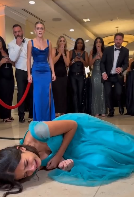
If the birds stop singing, trust the girl who kept feeding them anyway.
Part 7: Camille Finally Opened Her Father’s Drawer
Camille began to cry without making a sound.
It should have made her look softer.
It did not erase what she had done.
I looked at the little canary now standing shakily in the recovery box Doctor Lehner had prepared. Its feathers were ruffled, but its eyes were open.
Alive.
That mattered more than Camille’s tears.
Victor reached for the old trust papers.
Security stopped him.
“This is theft,” he said.
“No,” Beatrice said, stepping between him and the podium. “This is what theft looks like when the records come back.”
The room went quiet again.
Camille wiped her face with the back of her hand, smearing mascara across one cheek.
“There’s a drawer,” she said.
Victor froze.
Beatrice turned. “What drawer?”
Camille looked at me, then at the cameras, then at the floor.
“In Father’s private office upstairs. He keeps duplicate contracts there. I saw a land sale agreement last week. I thought…” Her voice cracked. “I thought he was selling old storage land. Not the sanctuary.”
Victor’s voice lowered. “Camille.”
She flinched.
And I hated that I recognized the movement.
A girl trained to hurt downward because she was terrified of the person above her.
Still, fear did not make her innocent.
Camille lifted her chin.
“No.”
That one word cut through the room.
Beatrice nodded to security. “Open the office.”
Victor lunged toward the stairs.
Two guards caught him before he reached the first step.
Camille handed Beatrice a small gold key from her clutch. Her hands shook so badly the metal rattled.
Minutes later, security returned with a black leather binder.
Elias opened it.
The sale agreement appeared on-screen.
The buyer. The price. The demolition schedule. The plan to relocate only “marketable birds” to a decorative aviary at the resort entrance.
Doctor Lehner swore under her breath.
Then Elias found an attachment.
A media strategy.
At the top, in bold letters:
Blame Animal-Care Failure On Volunteer Nora Weiss.
My name again.
Prepared. Packaged. Disposable.
Camille covered her mouth.
“I didn’t know they would blame you.”
I stood slowly, my dress torn, my ankle aching, my hands smelling like seed and medicine.
“But you helped them make me look easy to blame.”
She nodded through tears.
“Yes.”
For once, no excuse followed.
Then the recovered canary chirped.
Soft at first.
Then louder.
And from the cage, every other bird answered.
Part 8: The Birds Sang Before The Gate Opened
The sound filled the conservatory like sunlight breaking through glass.
One canary.
Then five.
Then the whole trembling flock.
Their song rose above the chandeliers, above the donors, above Victor Vanderbilt shouting that every document was privileged and every witness would regret speaking.
Nobody listened to him anymore.
People listened to the birds.
Doctor Lehner smiled through tears. “They’re stabilizing.”
I closed my eyes for half a second.
All night, I had wanted not to fall apart.
Now I only wanted them to keep singing.
The police arrived fifteen minutes later. Victor tried to greet them like guests. He spoke of misunderstandings, business urgency, family reputation, and hysterical volunteers.
Elias handed over the animal-care log.
Otto handed over the veterinary file.
Beatrice handed over the land sale binder.
Camille stood beside her mother and said, “I gave him the key to the drawer. I will give a statement.”
Victor stared at his daughter like she had betrayed him.
Maybe she had.
But not soon enough to be heroic.
Soon enough to matter.
After the police escorted him out, the ceremony did not continue as planned. No Vanderbilt speech. No family photograph. No staged moment where Camille smiled beside a cage her father had tried to turn into evidence.
Instead, Elias placed the ceremonial key in my hand.
My fingers closed around it carefully.
“This was always yours to open,” he said.
I walked toward the bird-cage gate.
The turquoise dress dragged slightly where Camille’s heel had torn it. I left it that way. Let the cameras see the damage. Let them understand that proof did not have to arrive clean.
Before I unlocked the gate, I turned to the room.
“My grandmother built a sanctuary because she believed care was not decoration,” I said. “Care is work. It is early mornings, clean water, noticing who has stopped eating, and staying when applause has gone somewhere else.”
Camille bowed her head.
I put the key into the lock.
The gate opened with a soft golden click.
The birds did not fly out. They were not supposed to. The ceremonial gate opened into a larger protected flight space, filled with branches, warmed lamps, and fresh water.
One by one, the canaries moved through.
The smallest one hesitated.
Then it hopped forward.
The applause began quietly.
This time, it did not feel like charity.
It felt like witness.
Months later, the sanctuary was restored under the Magdalena Weiss Aviary Trust. The land sale collapsed. Victor Vanderbilt faced charges for fraud, animal endangerment, and attempted trust violation. Beatrice resigned from every decorative board and helped create an independent care council led by veterinarians, not donors.
Camille testified.
Not perfectly. Not prettily. But truthfully.
She admitted she kicked my dress because she wanted the room to see me as beneath her. She admitted she helped hide the log. She admitted her father had taught her to call cruelty leadership when it protected their name.
I did not forgive her in front of cameras.
Forgiveness was not another ceremony for rich people to watch.
A year later, the conservatory reopened without orchids flown in for show. Instead, local schoolchildren planted herbs for the birds. Doctor Lehner taught them how to read feed charts. Elias displayed my original animal-care log beside my grandmother’s trust letter.
At the entrance, beneath the restored bird-cage gate, a brass plaque caught the morning light.
MAGDALENA AND NORA WEISS — THEY KEPT THE BIRDS ALIVE WHEN POWER TRIED TO SILENCE THEM.
The smallest canary sang above my head, clear and stubborn, and I finally understood that some gates open only after the truth learns to sing.
