Part 2: The Question That Froze Her Family
Brooke’s family representative stopped reaching for the pages.
Not because the organizer looked strong enough to stop him.
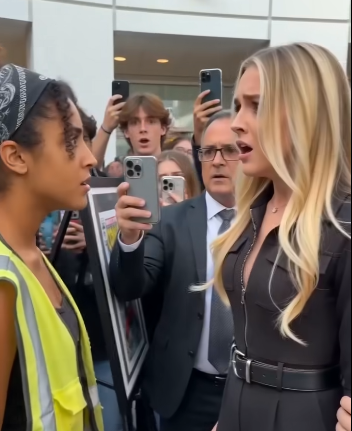
Because every phone in the exhibition hall was already lifted, recording the way his hand hovered over my name.
The microphone squealed softly.
“Why,” Ms. Elena Marceau repeated, her voice shaking but clear, “did your daughter try to erase the official record?”
Brooke Sinclair’s face went flat.
A second ago, she had been standing over me with that polished smile, acting like the floor itself belonged to her family. Now her eyes darted from the draft to the cameras to the representative in the navy suit.
My leg throbbed where she had kicked me.
I kept one hand on the display rope so nobody could see how badly I was trembling.
“I didn’t erase anything,” Brooke snapped. “That drawing is obviously copied.”
Ms. Marceau lifted the draft higher.
The paper was creased at the corners, smudged with pencil dust, and marked with my initials beside the first sketch of the mascot: a fierce little girl in a cape made from torn comic pages, one boot patched, one fist raised.
My character.
My late-night drawing.
The one I had made after mounting frames until my fingers ached.
Brooke’s father, Mr. Adrian Sinclair, pushed forward from the sponsor row. His face had gone pale beneath the gallery lights.
“Brooke,” he said quietly, “tell me you did not touch the archive file.”
She laughed, but it cracked halfway through.
“Dad, this is ridiculous. She works maintenance.”
The word hit me harder than the kick.
Maintenance.
As if the work that held the room together made me less worthy of standing inside it.
A boy from the student press table whispered, “She drew it. I saw her sketchbook.”
Brooke spun toward him. “Shut up.”
The room gasped.
Ms. Marceau turned another page in the file. “There is more.”
Brooke’s family representative stepped in again. “This is private foundation property.”
“No,” Ms. Marceau said. “This is student work submitted under school protection.”
Then she unfolded a second sheet.
A printed email appeared on the projector screen behind her.
REQUEST: REMOVE LENA VOSS FROM CREDIT LINE. REASSIGN MASCOT CONCEPT TO SINCLAIR YOUTH COMMITTEE.
Every breath in the room seemed to stop at once.
My name sat there in black letters.
Lena Voss.
The girl Brooke said had faked everything.
The girl whose old safety shoes were still dusty from hanging the frames everyone had praised.
Brooke whispered, “That was not supposed to be shown.”
The microphone caught it.
And that was the moment her perfect image began to burn.
Part 3: The Email Hidden Inside The Archive
Mr. Sinclair turned toward his daughter so slowly it felt like watching a door close.
“Brooke,” he said, “who sent that email?”
Her mouth opened.
Nothing came out.
The representative, Mr. Clarke, tried to smile at the audience. “This is clearly a formatting mistake from the office. These events involve many moving pieces.”
Ms. Marceau did not blink. “Then you will not mind if I show the sender.”
His smile vanished.
She tapped the laptop.
The projector refreshed.
FROM: BROOKE SINCLAIR
TO: SINCLAIR PUBLISHING EDUCATION OFFICE
SUBJECT: URGENT CREDIT FIX
The sound that moved through the hall was not a gasp anymore.
It was disgust.
Brooke’s eyes filled instantly, but even her tears looked angry, like she was furious her body had betrayed her.
“I didn’t mean it like that,” she said.
I swallowed. “Then how did you mean it?”
She looked at me as if she could not believe I had spoken.
My voice was thin, but it did not break.
“How do you accidentally remove someone’s name?”
Nobody rescued her.
Not the teachers. Not the sponsors. Not the students who had laughed at her jokes ten minutes earlier.
Mr. Sinclair stepped closer to the projector. His luxury watch caught the light. “Brooke, why would you send this?”
“Because it was embarrassing!” she burst out.
The room went colder.
Her father stared at her. “What was embarrassing?”
Brooke pointed at me.
“Her. That outfit. Those shoes. She looked like she came to fix the lights, not open a ceremony sponsored by our family.”
My throat tightened.
Somewhere near the front, a teacher whispered, “Enough.”
But Brooke was already too far gone.
“My family built this event,” she said, voice rising. “Do you know how humiliating it is to have her stand there while everyone photographs her name beside our mascot?”
Our mascot.
I felt something sharp and hot open inside my chest.
“It was never yours,” I said.
Brooke laughed through her tears. “Nobody would have cared about it if Sinclair Publishing had not paid for the banners.”
A quiet voice came from the side of the room.
“That is not true.”
Everyone turned.
A small elderly man stood near the comic exhibition entrance, leaning on a black cane. He wore a brown coat, round glasses, and a badge that read Henrik Bauer — Guest Artist.
I recognized him immediately.
Everyone did.
Henrik Bauer had drawn one of the most famous European comic heroines of the last forty years.
He looked at Brooke, then at me.
“I cared,” he said. “Because I chose the mascot myself.”
Brooke’s face changed.
Mr. Sinclair whispered, “Henrik?”
Mr. Bauer reached into his coat pocket and pulled out a folded copy of my original draft.
Then he said the sentence that made Brooke stumble backward.
“Your office sent me a stolen version, but Lena’s first drawing had already reached my desk.”
Part 4: The Artist Who Recognized My Line
The hall erupted.
Students whispered. Parents shifted. Reporters near the exhibition wall began speaking into their phones. The honorary comic cover remained closed on its stand, forgotten beneath the lights.
Mr. Bauer walked toward me with slow, careful steps.
I wanted to straighten my vest. Hide the dust on my pants. Wipe my eyes. Become someone presentable before a legend saw me up close.
But he stopped in front of me and smiled like none of that mattered.
“You have a brave line,” he said.
I did not know what to do with praise that gentle.
“My line?”
He nodded. “Most young artists draw what they think people will approve. You drew someone who had already survived disapproval.”
My hands went to my scarf.
Brooke made a choking sound. “This is theater.”
Mr. Bauer turned sharply.
“No,” he said. “Theater is pretending a sponsor’s daughter drew what she did not understand.”
Brooke’s father closed his eyes.
Mr. Clarke, the representative, moved toward the exit.
Ms. Marceau saw him.
“Stop him.”
Two security guards blocked the door.
Mr. Clarke lifted both hands. “I have a call to make.”
“You can make it here,” Ms. Marceau said.
Mr. Bauer unfolded the page he had carried.
“This arrived in my studio three weeks ago,” he said. “A polished digital copy from Sinclair Publishing, claiming Brooke Sinclair had created the event mascot.”
The screen showed the copied version.
It was cleaner, brighter, more expensive-looking.
But wrong.
My patched boot had been turned into a glossy superhero shoe. The torn-paper cape had become a perfect satin cloak. The character’s fierce, tired eyes had been softened into something pretty and empty.
Mr. Bauer held up my draft beside it.
“This is the original,” he said. “This has the soul.”
The words landed somewhere so deep inside me that I almost cried again.
Brooke folded her arms tightly. “Artists copy each other all the time.”
Mr. Bauer’s eyes hardened.
“Not like this.”
He pointed to a tiny mark near the character’s left sleeve.
A crooked little star.
“When I was young,” he said, “my mentor taught me that artists hide truths in corners. Lena did that here.”
My breath caught.
Nobody had ever noticed.
Not my teachers. Not the committee. Not even me, fully.
Mr. Bauer looked at me. “What does the star mean?”
I whispered, “It was for my mother.”
The room softened around me.
“She used to draw stars on my lunch bags,” I said. “Before she got sick.”
Brooke looked away.
But her father did not.
He stared at the small star on the page like it had become the most important thing in the room.
Then Ms. Marceau clicked open one final document.
Her voice dropped.
“There is also a payment record.”
Mr. Sinclair turned.
“What payment?”
The projector changed.
And Mr. Clarke’s name appeared beside a transfer marked:
ARCHIVE CORRECTION FEE.
Part 5: The Price Of Erasing A Name
Mr. Clarke stopped trying to leave.
For the first time, he looked truly afraid.
Mr. Sinclair turned on him. “What is this?”
The representative tugged at his collar. “Administrative language. Nothing more.”
Ms. Marceau’s voice sharpened. “It was paid two days after Lena’s submission was moved from finalist records into rejected student files.”
My stomach twisted.
Rejected student files.
All those days when I thought the committee had forgotten me.
All those nights when I kept working after school because I told myself being useful was still better than being seen.
They had not forgotten me.
They had buried me.
Mr. Bauer looked at the screen with quiet fury. “Who authorized it?”
Mr. Clarke did not answer.
Brooke whispered, “Don’t.”
Her father heard her.
Everyone heard her.
Mr. Sinclair turned slowly. “Brooke. What did you do?”
She shook her head. “I just wanted one thing that was mine.”
His expression cracked.
“One thing?” he said. “You have had every door opened for you.”
“Opened?” Brooke’s voice broke. “You mean watched. Measured. Compared. Every time I draw something, people ask if you helped. Every time I win something, they say it is because of the name.”
For one breath, she sounded less like a villain and more like a girl drowning in a pool she had pretended was a throne.
Then she looked at me, and whatever pity I might have felt disappeared.
“So yes,” she said. “I took one chance to be seen.”
I stared at her.
“You took mine.”
That silenced her.
Mr. Sinclair pressed both hands to his face. When he lowered them, he looked older.
“Clarke,” he said, “did you alter the archive?”
Mr. Clarke’s jaw tightened.
“I acted in the family’s interest.”
Brooke gasped. “You said it would be easy.”
Her father closed his eyes.
Ms. Marceau whispered, “So you admit it.”
Brooke realized too late what she had done.
Phones lifted higher.
Mr. Clarke snapped, “She was panicking. I protected the sponsor relationship.”
Mr. Bauer struck his cane against the floor.
“You protected theft.”
The word rang through the exhibition room.
The honorary comic cover still waited beneath its black cloth. My drawing was printed there, I knew that now. My character. My mother’s star. My survival line.
But the ceremony felt poisoned.
I looked at Ms. Marceau.
“I don’t want to open it.”
Her face softened. “Lena—”
“Not like this.”
The crowd murmured.
Brooke laughed bitterly. “So dramatic.”
I turned toward her.
“No,” I said. “For once, I want my work to be opened in a room that is not lying.”
Mr. Bauer smiled faintly.
Then a loud crack sounded from the display wall behind us.
Everyone turned.
One of the mounted comic frames tilted forward.
Then another.
My heart dropped.
Because I knew that wall.
I had mounted it myself.
And someone had loosened the supports.
Part 6: The Wall That Started To Fall
The first frame slipped slowly, almost politely, before gravity caught it.
Glass shattered across the floor.
Then the second frame lurched.
A group of younger students stood directly beneath the display wall, still holding their phones, too shocked to move.
“Get back!” I shouted.
My voice tore through the room.
A teacher grabbed two children by the shoulders and pulled them away just as the third frame swung outward.
I ran toward the wall.
Pain shot through my kicked leg, but I did not stop.
Ms. Marceau yelled my name. Mr. Bauer shouted for security. Chairs scraped. People surged backward.
I knew the pattern of the mounts because I had installed them after hours, alone with a toolbox and a ladder while the organizing committee debated floral arrangements.
The upper rail had not failed naturally.
The locking clips were open.
All of them.
Someone had done this.
I grabbed the ladder near the side curtain and shoved it under the center rail.
“Hold this!” I screamed.
A student named Felix rushed forward, then another girl, Marta, joined him. Together, they braced the ladder while I climbed high enough to reach the main support.
My hands shook.
Below me, Brooke stood frozen, staring at the loosened wall.
She knew.
That was obvious.
But this fear was different from before.
Not fear of being exposed.
Fear of what her own anger had almost caused.
“Lena!” Felix yelled. “The left side!”
The rail bent.
Three more frames slid.
I hooked my arm over the top rung and slammed the first locking clip back into place.
Then the second.
The third was jammed.
My fingers scraped against metal. My leg throbbed so badly my vision blurred.
“Come down!” someone shouted.
Not yet.
The last frame on the left began to fall.
Right beneath it, a little boy from the junior class had frozen near the velvet rope.
Brooke moved first.
She lunged forward, grabbed the child, and shoved him back toward a teacher.
The frame crashed where he had been standing.
Glass burst across the floor.
Brooke stared at it, white-faced.
I forced the jammed clip until it snapped shut.
The rail held.
Silence swallowed the hall.
Then Felix looked down at the open clips and said what everyone else was thinking.
“These didn’t open by themselves.”
Brooke sank onto the edge of the stage.
Mr. Sinclair looked at his daughter.
“Brooke,” he whispered, “please tell me you did not touch that wall.”
She covered her mouth.
But she did not say no.
Part 7: The Confession Beneath The Unopened Cover
Brooke started crying before anyone accused her.
Not the sharp, angry tears from earlier.
These were uglier. Younger. Real.
“I didn’t think it would fall,” she said.
The hall went utterly still.
Mr. Sinclair stepped back as if she had become someone he did not recognize.
Brooke looked at the shattered glass, then at the little boy clinging to his teacher.
“I only opened a few clips,” she whispered. “I thought the frames would look crooked. I thought they would delay the ceremony and everyone would blame her installation.”
Her eyes found mine.
“I didn’t think anyone would get hurt.”
My scraped hands curled around the ladder rail.
“You kicked me,” I said. “You called me fake. You stole my drawing. And when that wasn’t enough, you tried to make my work look dangerous.”
She sobbed. “I know.”
“No,” I said. “You don’t.”
The words came out harder than I expected, but I did not take them back.
“You don’t know what it is like to have every mistake follow you because people already decided you do not belong. If that wall had fallen, nobody would have called it an accident. They would have called it proof.”
Brooke folded in on herself.
Mr. Clarke spoke quickly. “Miss Sinclair is distressed. This statement should not be treated as formal—”
“Enough,” Mr. Sinclair said.
His voice was quiet.
That made it terrifying.
Mr. Clarke shut his mouth.
Mr. Sinclair faced the crowd. “The Sinclair family will cooperate with the school’s investigation. Mr. Clarke is dismissed from representing us immediately.”
Mr. Clarke went red. “Adrian—”
“Leave.”
Security escorted him toward the door.
Brooke wiped her face. “Dad, please.”
He looked at her with grief so deep it seemed to hollow him out.
“You needed help,” he said. “And I gave you praise instead.”
That sentence hit the room differently.
Brooke cried harder.
Mr. Bauer turned to me. “Lena, the cover is still unopened.”
I looked at the black cloth on the ceremony stand.
The whole room waited.
My drawing was under there. My mother’s star. My name.
But so was everything that had happened.
The kick. The theft. The falling wall. The proof that the room had only believed me after disaster forced it to.
I stepped down from the ladder, limping.
Then I walked to the microphone.
“My character was supposed to be brave,” I said. “But not because she never got hurt.”
My voice shook.
I let it.
“She was brave because she kept her name.”
I turned to Brooke.
“I’m opening it. Not because you apologized. You haven’t earned that. I’m opening it because I did.”
Then I pulled the cloth.
Part 8: The Mascot With The Hidden Star
The honorary comic cover gleamed beneath the lights.
For one second, nobody clapped.
They just looked.
My character stood at the center of the poster, one patched boot on a pile of torn pages, her paper cape flying behind her like a flag made from every story that had tried to throw her away. Her curls were wild. Her chin was lifted. Her fist was not raised to strike.
It was raised to hold a pencil.
And beside her sleeve, small but unmistakable, was my mother’s crooked star.
Then the applause came.
It began with Felix and Marta near the ladder.
Then the junior students.
Then the teachers.
Then the parents and guests and reporters, until the whole exhibition hall shook with a sound I had never imagined could belong to me.
I stood there in my dusty work pants, old safety shoes, and reflective vest, and for the first time that day, nobody looked at them like evidence against me.
They looked at them like part of the story.
Mr. Bauer came to my side.
“This cover should not be honorary,” he said into the microphone. “It should be published.”
The applause sharpened.
Mr. Sinclair looked up.
Mr. Bauer continued, “Not under Sinclair control. Not as a sponsor favor. As Lena Voss’s first official work, with a student artist contract reviewed independently.”
My heart stopped.
Ms. Marceau covered her mouth, smiling through tears.
Mr. Sinclair nodded slowly.
Then he stepped to the microphone.
“My family will fund the printing,” he said. “But we will not own it.”
He turned to me.
“And the credit line will be yours alone.”
Brooke stood near the stage steps, mascara streaked, hands hanging uselessly at her sides.
She did not ask me to forgive her.
That was the first decent thing she did.
Three weeks later, the school opened the repaired exhibition with a new rule: no student artwork could be transferred, edited, sponsored, or displayed without a public credit record signed by the student.
Ms. Marceau called it the Voss Rule.
But the real surprise came in a brown envelope from Mr. Bauer.
Inside was a letter, a contract, and my original draft, protected in a clear sleeve.
At the bottom of the draft, he had written one sentence in blue ink:
The world does not need perfect artists. It needs honest ones.
The first issue sold out in two days.
Not because of Brooke.
Not because of Sinclair Publishing.
Because thousands of students saw a girl in patched boots holding a pencil and understood exactly what she was fighting for.
On the last day of the exhibition, I found Brooke standing alone in front of the mascot poster.
She did not turn around when I approached.
“I started drawing again,” she said quietly. “Without anyone fixing it.”
I said nothing.
She swallowed. “It’s bad.”
“Then it’s finally yours,” I said.
Her eyes filled, but she nodded.
I walked past her to the display case where my first draft rested beneath glass. The crooked star caught the light, tiny and stubborn.
I touched the edge of the case.
For years, I had thought being seen meant becoming polished enough that no one could question me.
I was wrong.
Being seen meant standing there with the dust, the hurt, the truth, and the name they tried to remove.
And when the final visitors left, my little paper-cape hero still stood under the gallery lights, holding her pencil like a promise no one could steal again.
