Part 2: The Video Played Before She Could Smile
The screen behind the podium flickered once, and Blair Pemberton’s face changed before the video even started.
Not enough for the donors to notice.
Enough for me.
I stood at the edge of the stage in a borrowed navy dress, my hands clasped so tightly my knuckles looked pale under the chandelier light. The ballroom of the lakeside resort outside Lucerne glittered with orchids, champagne flutes, and people who had never needed to count coins before buying lunch.
Blair had wanted them to see me as nothing.
A girl who did not belong beside the ribbon.
A girl who could be humiliated into stepping aside.
Then the security video began.
The timestamp showed the scholarship office three nights earlier. Empty desks. Stacked application folders. A flickering lamp.
Then I appeared on-screen.
Smaller than I felt in that ballroom. Tired. Wearing an old cardigan. Counting folded bills and coins into an envelope beside the volunteer journal.
A donor whispered, “Is that her?”
The archivist, Frau Anneliese Hartmann, lifted the signed pages from the podium. “Yes. Lena West recorded every private donation she made after the fund deficit appeared.”
Blair laughed sharply. “A few little donations don’t make her important.”
The director, Matthias Keller, did not look at Blair.
He clicked again.
The video jumped forward.
I watched myself slide the envelope into the scholarship lockbox and write a note on the journal page.
Emergency gap covered for final three students. Please do not announce publicly.
My throat tightened.
I had not wanted anyone to know.
I had used my café wages, tutoring money, and the cash I had saved for a winter coat because three applicants were about to lose their places. I had told myself I could be cold. They could not be forgotten.
Blair’s father, Edmund Pemberton, rose from the honor table.
“This is sentimental,” he said. “A volunteer made a gesture. It does not change the program order.”
Matthias finally looked at him.
“No,” he said. “But the next clip does.”
The screen changed again.
This time, Blair appeared in the same office.
She wore a white coat, her hair perfect, one hand holding the same volunteer journal.
She opened it.
Read my entry.
Then tore out the page.
The ballroom stopped breathing.
Blair whispered, “That is edited.”
But on-screen, she folded the page, slipped it into her clutch, and smiled at her reflection in the dark office window.
Then Matthias paused the video on her face and said, “Miss Pemberton, where is the missing page?”
Part 3: The Torn Page Was In Her Clutch
Blair’s hand moved toward her clutch.
It was so quick most people might have missed it.
Anneliese did not.
“Security,” the archivist said calmly.
Two guards stepped forward, not touching Blair, only blocking the little path she had already imagined using. Her mother, Celia Pemberton, stood with one hand at her throat, diamonds trembling against her skin.
“Blair,” Celia whispered. “Tell them this is a mistake.”
Blair’s eyes flashed toward her father.
Edmund did not move.
That was when I understood something cold and ugly.
Blair was waiting for permission to tell the truth.
Not from guilt.
From fear.
Matthias held out his hand. “The page, please.”
Blair’s chin lifted. “You can’t search me.”
Anneliese stepped closer. She was small, silver-haired, and dressed in black, but the room parted for her as if she carried a crown.
“We do not need to search you,” she said. “We need you to decide whether you would like the police to do it instead.”
A waiter near the back inhaled sharply.
Blair looked around the room.
The cameras were still recording. The sponsor livestream still glowed red. Every person who had watched her humiliate me now watched her decide how much worse to make it.
Her fingers unclasped the tiny pearl bag.
She removed a folded journal page.
The paper shook in her hand.
Anneliese took it carefully, as if rescuing something injured.
She placed it beneath the document camera.
My handwriting appeared on the screen.
I, Lena West, am donating this amount anonymously because the scholarship fund should not fail three students after they have already been promised help.
A hot sting rose behind my eyes.
Then Matthias leaned closer to the page. “There is writing on the back.”
He turned it over.
The room shifted.
The back was not my handwriting.
It was a list of names.
Three scholarship applicants.
Beside each name was one word written in Blair’s elegant script.
Replace.
Replace.
Replace.
My stomach dropped.
One of the names belonged to Mira Vogel, a girl I had helped fill out her application after her mother lost her job.
Blair said quickly, “That was just a seating list.”
Anneliese’s voice sharpened. “Scholarship applicants do not sit at donor tables.”
Edmund Pemberton finally spoke.
“Enough,” he said.
But Matthias had already opened another file.
“This was recovered from the board server this afternoon,” he said.
The heading appeared on-screen.
Pemberton Legacy Candidate Substitution Plan.
Part 4: The Scholarship Was Never Meant For Us
The title sat on the screen in clean black letters.
Pemberton Legacy Candidate Substitution Plan.
No one spoke.
Not the donors.
Not the servers.
Not even Blair.
I stared at the names beneath the heading and felt something inside me go very still. There were columns beside them: original candidate, replacement candidate, donor preference, image risk, family value.
Image risk.
That was the column where my name appeared.
Lena West — excessive visibility risk due to personal financial involvement.
I could not feel my fingers.
Matthias scrolled down.
Mira Vogel’s name was there too. So was Anton Meier’s. So was Sofia Brandt’s. Three students who had written essays that made me cry in the office because they had worked harder than anyone in that ballroom would ever know.
Each of them had been marked for removal.
Each replacement candidate had a surname connected to a board member.
Blair’s cousin.
A banker’s son.
A minister’s niece.
The scholarship fund had not been failing by accident.
It had been hollowed out to make room for the children of people who already had rooms waiting everywhere.
Celia Pemberton sat down slowly.
“Edmund,” she said, voice barely audible, “what is this?”
Edmund adjusted his cufflinks. “An internal draft. Nothing more.”
Anneliese turned one page from her stack. “It is signed.”
She placed the paper on the document camera.
Edmund Pemberton’s signature filled the screen.
Then Blair’s.
I looked at her.
The girl who had stepped close enough for me to smell her perfume before humiliating me. The girl who had snapped that I was ruining a legacy I did not understand.
Now I understood.
The legacy was theft with better stationery.
Blair’s face crumpled, then hardened again. “Those candidates were not suitable ambassadors.”
My voice came out before I meant it to.
“Because they needed the money?”
She flinched.
I took one step toward the podium.
“Because they could not repay donors with favors?”
Her mouth opened.
Nothing came out.
Edmund’s gaze settled on me at last.
It was not anger.
It was assessment.
“Miss West,” he said softly, “you are young. You have mistaken administrative decisions for cruelty.”
I looked at the page with my name on it.
“No,” I said. “You mistook cruelty for administration.”
The silence after that was different.
It was not shock.
It was recognition.
Then the ballroom doors opened, and an older man in a grey coat entered holding a battered leather satchel.
Anneliese turned pale.
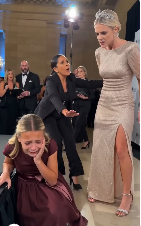
“Josef?” she whispered.
The man looked at Edmund Pemberton and said, “I kept the first ledger.”
Part 5: The First Ledger Had My Mother’s Name
The man with the satchel walked like every step cost him something.
His name was Josef Adler. I had seen him once in an old photograph hanging near the scholarship office, standing behind a table of students in winter coats. The caption called him a founding clerk. Nobody had ever mentioned why he left.
Now he stood beneath the chandeliers with rain on his shoulders and a ledger pressed to his chest.
Edmund Pemberton’s face changed.
Just for a second.
But it was enough.
“You are not welcome here,” Edmund said.
Josef smiled sadly. “That is how I know I came to the right place.”
Anneliese moved toward him, her eyes wet. “I thought you were dead.”
“Many people find it convenient to think that,” Josef replied.
He placed the old ledger on the podium beside my volunteer journal.
The contrast made my throat tighten.
One book old and cracked.
One book new and torn.
Both carrying names someone powerful had tried to erase.
Josef opened the ledger to a ribbon-marked page.
“This foundation began in Innsbruck,” he said. “Not under the Pemberton name. Under the West Fund for Working Students.”
My heart stumbled.
West.
The room seemed to recede.
“My family?” I whispered.
Josef looked at me gently. “Your mother’s family.”
I shook my head. “My mother cleaned hotel rooms. She never had a fund.”
“She inherited one,” Josef said. “And it was taken from her.”
The words went through me slowly, like cold water filling a locked room.
Matthias leaned over the ledger. “The founder was Maren West.”
“My grandmother,” I said.
I had only one photograph of her, a woman with tired eyes and a stubborn mouth. My mother used to keep it tucked inside a recipe book.
Josef turned the page.
There was my mother’s name.
Clara West.
Beside it, a note dated twenty years earlier.
Petitioned for restoration of family trusteeship. Denied by Pemberton board. Public record sealed after financial misconduct allegation.
Financial misconduct.
The phrase that had followed my mother like a shadow.
The reason she never applied for better work. The reason she cried when letters came with official stamps. The reason she told me, near the end, that some doors were not locked because you lacked a key.
They were locked because someone stole it first.
Edmund stepped forward. “This is ancient family bitterness.”
Josef lifted a yellowed envelope from the ledger.
“No,” he said. “It is evidence.”
Part 6: My Mother’s Letter Changed The Room
Josef’s hands shook as he opened the envelope.
Inside was a letter written in my mother’s careful script. I knew it instantly. I had seen that handwriting on birthday cards, school forms, grocery lists, and the little notes she left in my lunch when we could still afford bread with seeds in it.
Josef looked at me. “May I?”
I could not speak, so I nodded.
He read aloud.
If this letter reaches the board, then I am asking one final time for the West Fund to be returned to its purpose. My grandmother created it so working students would never have to beg the wealthy for permission to learn.
A sound escaped me.
Small. Broken.
The ballroom blurred.
Josef continued.
The Pemberton board has redirected scholarship money to donor families, disguised payments as administrative fees, and threatened to accuse me of fraud if I speak publicly. I am leaving copies with Josef Adler and Anneliese Hartmann because I believe records outlive fear.
Anneliese covered her mouth.
Edmund’s voice cut across the room. “A disgruntled woman making accusations.”
Celia Pemberton stood.
Her face was ashen.
“Do not speak of her that way.”
Everyone turned.
Even Edmund.
Celia looked at me, then at the letter. “Clara West came to our house once. I was newly married. She begged Edmund to stop using the fund as a private ladder for his allies.”
My breath caught.
“You knew my mother?”
Celia nodded, tears bright in her eyes. “She had you with her. You were asleep in a blue coat.”
The room tilted around me.
My mother had brought me to the house of the man who ruined her.
Celia faced her husband. “You told me she was unstable.”
“She was,” Edmund snapped.
“No,” Celia said, voice rising. “She was terrified.”
Blair stared at her mother. “You never told me.”
“I was told to forget,” Celia whispered. “And I was cowardly enough to do it.”
The honesty hit harder than denial would have.
Matthias clicked through the files again. “The current substitution plan mirrors the old ledger entries. Same structure. Same coded categories.”
Josef nodded. “Because it never stopped.”
Then Anneliese unfolded the final page from my mother’s envelope.
It was not a letter.
It was a key.
Small. brass. marked with the West family crest.
Josef looked toward the ceremonial ribbon at the stage entrance.
“This is not the key to a door,” he said.
He turned toward the old scholarship display cabinet behind the podium.
“It opens the founder’s box.”
Part 7: The Founder’s Box Exposed The Last Lie
The display cabinet had stood behind the podium all night, polished and ignored.
Inside were old photographs, a silver ribbon scissors, a faded founder portrait, and a small oak box nobody had bothered to label. I had dusted that cabinet twice during volunteer shifts. I had never known my family was trapped behind the glass.
Anneliese unlocked the cabinet with the archivist’s key.
Then she stepped aside.
“This one is yours, Lena.”
My legs felt unsteady as I approached.
The whole ballroom watched me reach for the oak box. My dress was wrinkled from Blair’s humiliation, my palms damp, my throat tight around every question I had never been allowed to ask.
I inserted my mother’s key.
It turned easily.
Too easily.
As if the box had been waiting for someone who knew how not to force it.
Inside lay a folded charter, a stack of photographs, and a small velvet pouch.
Matthias lifted the charter carefully.
The original name glowed beneath the document camera.
The Maren West Scholarship Trust.
Not Pemberton.
West.
A murmur spread through the donors.
Anneliese read the terms, her voice trembling.
“The trust may not be renamed, redirected, substituted, merged, pledged, or privately administered without consent from a direct West heir.”
Every face turned toward me.
Edmund laughed once. “She is a child.”
Josef closed the ledger. “She is the heir.”
Blair looked at me as if I had transformed in front of her, but I had not. I was still the same girl she had humiliated. The same girl who had saved the fund with café wages because I thought nobody else would.
Only now the room knew why.
Celia walked toward me.
“I am sorry,” she said.
The words sounded too small for twenty years.
But they were not empty.
She removed a diamond brooch from her gown—the Pemberton crest—and placed it on the podium like something poisonous.
“I will testify,” she said. “About Clara West. About the threats. About the donor substitutions.”
Edmund’s face darkened. “Celia.”
She did not look at him.
Blair began crying then, silently, angrily, like she hated the tears for arriving.
“I thought it was mine,” she whispered.
“The ribbon?” I asked.
She shook her head.
“The room.”
For the first time, I almost understood her.
Almost.
Then Matthias opened the velvet pouch.
Inside was a ribbon.
Not the glossy white one prepared for Blair’s family photo.
An old green ribbon, carefully preserved.
Pinned to it was a note in my grandmother’s handwriting.
When the fund is returned, let a working student cut the first ribbon.
Anneliese handed me the scissors.
Edmund stepped forward.
Security stopped him.
Part 8: The Ribbon Was Cut For The Girls Who Waited
For a long moment, I only stared at the scissors.
They were heavier than I expected. Silver, tarnished near the handles, engraved with tiny leaves along the blades. My grandmother had touched them. Maybe my mother had too. Maybe both of them had imagined this moment and then lost faith they would ever see it.
I looked out at the ballroom.
At the donors who had whispered when Blair humiliated me.
At the cameras that had captured my shame before they captured the truth.
At Blair, standing beside her mother with mascara streaking her face, no longer glowing beneath her family name.
At Edmund Pemberton, trapped behind security, still furious that facts would not kneel.
Then I saw Mira Vogel near the back.
She had been working coat check to earn extra money for textbooks. Her eyes were red. She had seen her name marked replace on the screen.
Anton Meier stood beside her, jaw clenched.
Sofia Brandt held her phone against her chest like she had forgotten how to move.
They were the reason I had emptied my savings.
Not legacy.
Not revenge.
Them.
I stepped away from the podium and carried the scissors to the back of the room.
The donors turned, confused.
I stopped in front of Mira, Anton, and Sofia.
“This ribbon is not mine alone,” I said.
Mira shook her head. “Lena, no.”
“Yes,” I said. “They tried to replace you first.”
Matthias brought the old green ribbon from the stage. Anneliese held one end. Josef held the other, his hands trembling.
The three students joined me.
Together, we cut it.
The applause did not explode.
It rose.
Slowly. Uneasily. Then fully.
Not the polished applause rich rooms give themselves.
Something rougher. Better.
Edmund Pemberton was removed from the foundation board before midnight. The police took copies of the ledgers, emails, substitution plans, and sealed records. Celia gave her statement before dawn. Blair gave hers two days later.
She did not make herself noble.
That mattered.
She admitted she humiliated me because she believed the room belonged to her. She admitted she helped hide the journal page. She admitted her father had taught her to call theft tradition if the stationery was expensive enough.
Months passed before the legal decision came.
The fund was restored under its original name.
The Maren West Scholarship Trust.
The first new board included Anneliese, Josef, two former scholarship students, and me as youth trustee. The money redirected to donor families was recovered. Mira, Anton, and Sofia kept their scholarships.
Blair left the society circuit. I did not forgive her quickly. I did not owe her speed.
But one winter afternoon, she came to the scholarship office with boxes of old files her father had hidden in a storage flat near Zürich.
She placed them on the table and said, “I found more names.”
That was the first useful thing she ever gave me.
A year after the gala, the resort hosted the reopening ceremony. No orchids worth more than rent. No family crest. No stage designed for one girl to look royal.
Just students, teachers, workers, records, and a green ribbon.
My mother’s letter was displayed beside my grandmother’s charter.
Under them, a new brass plaque read:
MAREN, CLARA, AND LENA WEST — THEY KEPT THE DOOR OPEN WHEN POWER TRIED TO SELL THE KEY.
I touched my mother’s name before I stepped back.
And this time, when the room looked at me, nobody made me smaller to understand why I belonged.
