Part 2: The Lawyer Said My Name Twice
The lawyer did not blink when Victoria Lancaster reached for the folder.
He only lifted it higher, just out of her jeweled fingers, and turned toward the microphone with the calm of a man who had been waiting all evening for someone powerful to make one mistake too many.
“Talia Ross,” he said.
My name cracked through the ballroom of the Lexington House in London louder than the slap had.
I was still half crouched near the honor table, one hand pressed to my stinging cheek, my little clutch lying open on the polished floor. A lipstick had rolled under a chair. My knees felt weak, and my ears rang from the awful silence that had followed Victoria’s hand across my face.
But when the lawyer said my name again, the room changed.
“Talia Ross is the registered restorer of the carriage centerpiece records.”
A whisper moved through the guests.
Victoria’s face hardened. “That is impossible.”
The lawyer, Mr. Albrecht, opened the file.
“Not impossible,” he said. “Documented.”
Her father, Lord Edmund Lancaster, rose from the head table. He wore a black dinner jacket, a white pocket square, and the expression of a man who considered interruption a personal insult.
“This is a family-sponsored event,” he said. “Any records involving our carriage collection should have been reviewed privately.”
Mr. Albrecht looked straight at him. “They were reviewed privately this morning.”
Lord Edmund’s mouth tightened.
The event host, Lady Marianne Voss, stepped beside the lawyer with the microphone still trembling in her hand. “The restoration minutes state that the central carriage badge was mislabeled, improperly mounted, and nearly placed on the wrong artifact before tonight’s unveiling.”
My cheeks burned.
Not from the slap now.
From being seen.
I remembered the old carriage room beneath the west wing, cold and dusty, with a tarp over the centerpiece and a cracked wooden box full of metal fittings. Everyone had walked past it for weeks. I had stayed after school, reading tiny labels, cleaning tarnished edges with cotton pads, comparing old photographs until my eyes ached.
Because something about the badge had felt wrong.
Because the screws did not match.
Because the crest was older than the frame.
Because quiet work still speaks if you listen closely enough.
Lady Marianne read from the page. “Talia Ross identified the original placement, documented the correction, and prevented the ceremony from unveiling a false historical display.”
A few guests gasped.
Victoria gave a sharp laugh. “She is a student volunteer. She probably copied someone else’s notes.”
Mr. Albrecht turned a page.
“No,” he said. “Someone else copied hers.”
The ballroom went colder than stone.
Victoria’s smile froze.
Lord Edmund stepped forward. “Careful.”
Mr. Albrecht did not lower his eyes. “The restoration file includes a rejected edit request submitted at 9:06 this morning. It attempted to remove Talia Ross’s name from the minutes and replace it with Lancaster Heritage Trust.”
My breath stopped.
Victoria whispered, “Father?”
He did not look at her.
That told me everything.
Part 3: The Edit Request Had His Seal
The file looked ordinary.
That was the worst part.
Cream paper. Blue tabs. Thin black type. The kind of document people in expensive rooms trusted more than shaking girls with red cheeks.
Mr. Albrecht placed the rejected edit request beneath the document camera, and the projection screen behind the stage filled with a scanned page.
My name was there.
Talia Ross — restoration assistant.
A line ran through it.
Beside it, in clean digital text, was the replacement:
Lancaster Heritage Trust — primary restoration authority.
At the bottom was a red rejection stamp from the archives office.
And below that, in the approval box, was Lord Edmund Lancaster’s private seal.
The room murmured.
Victoria stared at the screen.
“No,” she said. “No, he would not need to do that.”
Lord Edmund finally turned toward his daughter. “Victoria, sit down.”
She flinched.
Just slightly.
So slightly I might have missed it if humiliation had not made every detail in the room painfully sharp.
I saw, for the first time, that Victoria was not only cruel.
She was trained.
Trained to smile before cameras. Trained to attack before being questioned. Trained to believe credit was a family possession, and everyone else was either useful or in the way.
But that did not make my cheek hurt less.
Lady Marianne approached me carefully. “Talia, can you stand?”
I nodded, though I was not sure.
A teacher from my school, Frau Keller, rushed forward from the side aisle and helped me up. Her hands were warm and furious.
“You should have called me sooner,” she whispered.
“I thought I could handle it,” I whispered back.
Her jaw trembled. “You should not have had to.”
Lord Edmund’s voice cut through the room. “This is becoming theatrical. The girl made notes. Our family owns the collection. The distinction is administrative.”
“Administrative?” Frau Keller snapped.
People turned.
She was not rich, not titled, not part of the committee. She wore a plain navy dress and shoes scuffed at the heel from standing all day. But her voice did not shake.
“She was slapped in front of your guests after your office tried to erase her from her own work.”
Victoria’s eyes flashed. “I slapped her because she was making a scene.”
“You slapped her before she spoke,” someone near the livestream setup said.
A boy in a black server’s jacket held up his phone.
“I recorded it.”
Victoria’s face drained.
Lord Edmund looked at him with quiet threat. “Delete it.”
The boy swallowed, but did not lower the phone.
Mr. Albrecht closed the folder halfway. “There is also a witness statement.”
Lord Edmund’s expression changed.
Not much.
Enough.
The lawyer reopened the file.
“This statement was submitted by a member of the Lancaster household staff.”
Victoria went very still.
The boy in the server’s jacket stepped forward.
“My name is Felix Bauer,” he said. “And I heard Lord Lancaster order the archive staff to make sure Talia Ross did not appear in tonight’s program.”
Lord Edmund smiled faintly.
Then he said, “A waiter is not a witness. He is furniture with a memory.”
Part 4: The Waiter Remembered Everything
The insult landed across the ballroom like spilled ink.
Felix’s face reddened, but he did not step back.
That mattered.
Every rich guest in the room had just heard Lord Edmund say out loud what people like him usually hid behind soft manners: staff were invisible until they became inconvenient.
Mr. Albrecht turned to Felix. “Please continue.”
Felix glanced at me once, then at the floor, then lifted his chin.
“I was delivering water to the east archive room this morning,” he said. “Lord Lancaster was speaking with Mr. Vane from the trust office. He said the Lancaster name had to remain centered tonight, especially because donors would be watching the livestream.”
Lord Edmund sighed. “This is absurd.”
Felix’s voice shook, but held. “He said, ‘If the Ross girl is named, people will ask why a scholarship student understood the carriage better than our own curators.’”
My stomach twisted.
I had thought Victoria hated me because I looked wrong in that room.
But her father had feared me because I was right.
Victoria looked from Felix to her father. “You said she was trying to embarrass us.”
Lord Edmund’s patience snapped for half a second. “Because she was.”
“I was restoring the badge,” I said.
My voice surprised me.
It came out stronger than I felt.
Lord Edmund looked at me as though I were a stain he had expected someone else to remove.
“You were allowed near a family artifact,” he said. “Do not confuse access with significance.”
Something inside me went still.
Access with significance.
That was what these people believed. They opened doors, then acted like stepping through was a favor. They let you work, then called the work theirs because the building belonged to them.
I walked toward the display table.
Every eye followed me.
The carriage centerpiece sat beneath a velvet cover, waiting for the ceremonial badge to be mounted. The badge itself rested in a small glass case, polished now, its silver crest catching the stage lights.
I pointed to the underside of the badge.
“Do you see that notch?” I asked.
No one answered.
I looked at Mr. Albrecht. “May I?”
He nodded.
I lifted the badge carefully with gloved hands from the restoration tray. My fingers remembered the weight, the slight imbalance, the tiny mark near the lower rim.
“This notch proves it was not made for the display frame your family planned to use,” I said. “It matches the older bracket inside the carriage door.”
A curator from the committee leaned forward. “That is correct.”
Victoria stared at the badge as if it had betrayed her.
I continued. “The family file said the badge belonged to the decorative centerpiece. But the old restoration log said it belonged to the carriage itself.”
Lord Edmund’s face hardened. “And where is this old restoration log?”
Mr. Albrecht’s expression turned grave.
“That,” he said, “is the next issue.”
He removed a second folder from his briefcase.
It was smaller.
Older.
Tied with gray ribbon.
“This log was not in the Lancaster archive,” he said.
Lord Edmund’s eyes fixed on it.
“It was found in Vienna.”
Part 5: The Vienna Log Named My Grandmother
My mother stood up from the back row before I even understood what Vienna meant.
She had been silent all evening, sitting in the cheap black dress she wore to every important school event, her hands folded tightly in her lap. I had not wanted her to see Victoria slap me. I had not wanted her to see me on the floor.
But now she looked at the gray-ribboned folder like it had opened a door in her chest.
“Mama?” I said.
Her face had gone pale. “Where did you get that?”
Mr. Albrecht turned gently. “From the estate records of Anneliese Ross.”
My grandmother.
The name moved through me like cold water.
Anneliese Ross had died before I was born. I knew her only from one photograph on our mantel: a young woman with dark hair pinned back, standing beside a carriage wheel in an old workshop, sleeves rolled to her elbows and one hand resting proudly on the wood.
My mother never spoke much about her.
“She was a cleaner,” I had once been told.
A cleaner in a grand house.
A woman who kept keys, dusted rooms, polished silver, and knew when to disappear.
Mr. Albrecht untied the ribbon.
“She was listed as household maintenance staff in the Lancaster Vienna residence,” he said. “But the log suggests she performed restoration work.”
Lord Edmund snapped, “That log is not authenticated.”
“It was authenticated this afternoon.”
Victoria sank slowly into a chair.
Mr. Albrecht placed the first page under the camera.
The handwriting was elegant but firm.
Carriage badge removed for repair. Crest bracket unstable. Recommend remounting to original door panel. — A. Ross
My mother covered her mouth.
I could not move.
My quiet work had not begun with me.
It had been waiting in my blood.
The curator stood now, eyes wide. “This predates the Lancaster Heritage Trust records by twenty-eight years.”
Mr. Albrecht turned another page.
There was a sketch of the badge.
The same notch.
The same lower rim.
The same correction I had made.
My correction was not just mine.
It was an echo.
My grandmother had known first.
Lord Edmund’s voice came out low. “This is a sentimental coincidence.”
My mother stepped into the aisle.
“No,” she said.
The room turned toward her.
She looked frightened, but she kept walking.
“My mother was dismissed from the Lancaster residence after refusing to sign a false restoration report,” she said. “She came home with her hands blistered from cleaning metal polish out of old fittings, and she told me one day the carriage would expose them.”
Lord Edmund laughed coldly. “Convenient family folklore.”
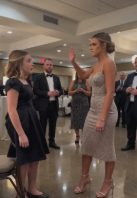
My mother looked at him with tears in her eyes.
“She kept the log because she knew your father would bury it.”
The words struck him.
His father.
Mr. Albrecht turned to the final page.
A folded note was attached.
He opened it.
The note was signed by Lord Edmund’s father.
Remove Ross from all carriage references. Credit must remain Lancaster.
Victoria made a small, broken sound.
And Lord Edmund finally stopped smiling.
Part 6: Victoria Saw The Inheritance She Had Defended
Victoria stared at the note as if it had been written on her skin.
“My grandfather?” she whispered.
Lord Edmund said nothing.
He did not need to.
His silence had become a family language.
Victoria rose unsteadily. Her jewelry glittered under the chandeliers, but her face had gone bare and young. “You told me the Ross family had always been trying to attach themselves to ours.”
My mother’s eyes filled with pain.
Lord Edmund turned on Victoria. “This is not your concern.”
“It was my concern when you told me to protect the family name.”
“Protecting the family name does not require public hysteria.”
“She hit me,” I said.
He barely looked at me. “My daughter behaved emotionally.”
Emotionally.
Such a soft word for violence when it came from someone in pearls.
Frau Keller stepped closer to me, but I lifted my hand slightly.
I wanted to answer for myself.
“She behaved exactly the way you trained her to,” I said.
The room stilled.
Victoria’s lips parted.
I looked at her, not kindly, but directly.
“You thought humiliating me would make your family look stronger. But your family only looked strong because women like my grandmother were erased from the work.”
Victoria’s eyes shone.
For the first time, she did not argue.
Lord Edmund did.
“You are enjoying this,” he said. “A scholarship girl suddenly discovering a grand injustice. How useful.”
My mother flinched, but I did not.
I was too tired to be small.
“No,” I said. “I am not enjoying anything. My face hurts. My mother is crying. My grandmother died with people calling her a cleaner instead of a restorer. You are the only one here still treating this like a game.”
A few guests applauded once, then stopped, unsure if they were allowed.
Lady Marianne stepped forward. “The committee will suspend the Lancaster dedication pending investigation.”
Lord Edmund turned sharply. “You do that, and the carriage collection funding ends tonight.”
There it was.
The lock on the door.
The threat that made good people hesitate.
The curator looked stricken. “The student programs depend on that funding.”
Lord Edmund’s smile returned, thin and cruel. “Exactly.”
Victoria looked at him as if she had just seen the basement beneath their mansion.
“You would punish students to keep your name on a plaque?”
He stared at her. “I would protect what is ours.”
She looked at the Vienna log.
Then at me.
Then at the livestream cameras still recording from the side.
“No,” she said. “You would rather burn the carriage than admit who repaired it.”
Lord Edmund stepped toward her. “Victoria.”
She reached up and removed the Lancaster crest brooch from her gown.
Her hands trembled.
“This was Grandmother’s,” she said. “You said it meant duty.”
“It does.”
She placed it on the table beside the Vienna log.
“Then my first duty is to stop lying.”
Part 7: The Heiress Gave Up The Plaque
The ballroom waited for Victoria to break.
She did not.
She turned toward the livestream camera with tears standing bright in her eyes and no polished smile left to hide behind.
“My name is Victoria Lancaster,” she said. “Tonight I slapped Talia Ross because I believed she was taking something from my family.”
Lord Edmund hissed, “Stop.”
She kept going.
“I was wrong. She restored the carriage badge. Her grandmother identified the correct restoration decades before her. My family removed both of their names.”
The words traveled instantly.
Across the ballroom.
Across the livestream.
Across every phone held by students, donors, staff, and the guests who had thought they were only recording a rich girl’s scandal.
Victoria looked at me then.
“I am sorry,” she said. “Not because I am embarrassed. I am embarrassed, but that is not the point. I am sorry because I wanted people to remember you as humiliated instead of talented.”
The room leaned toward us, hungry for a clean forgiveness.
I refused to feed it.
“Thank you for telling the truth,” I said. “But you still chose to hurt me.”
She nodded, tears falling now. “I know.”
“And you chose it before you knew the file existed.”
“Yes.”
“That matters.”
Her voice broke. “I know.”
Lord Edmund laughed under his breath. “This is touching, but worthless. The trust remains under my authority.”
Lady Marianne turned to the committee lawyer. “Is that true?”
The lawyer’s face tightened. “For the main collection, yes.”
Lord Edmund adjusted his cuff, regaining shape now that money had reentered the room.
But Victoria was staring at the brooch.
Then she looked at Mr. Albrecht. “What about the carriage itself?”
He frowned slightly. “What do you mean?”
“My grandmother’s will,” Victoria said. “She left the ceremonial carriage to me when I turned seventeen. Father manages the trust, but not the carriage.”
Lord Edmund’s face changed.
I saw it.
Everyone saw it.
Victoria did too.
“You never told me that,” she whispered.
He said, “You are confused.”
Mr. Albrecht was already searching through his tablet. His eyebrows lifted. “She is not.”
The ballroom buzzed.
“The carriage centerpiece,” he said slowly, “is owned by Victoria Lancaster personally under the late Lady Beatrice Lancaster’s estate.”
Lord Edmund’s voice turned icy. “Victoria.”
She picked up the brooch again, but she did not put it on.
“If the carriage is mine,” she said, “then I withdraw it from the Lancaster dedication.”
A gasp tore through the room.
Lord Edmund’s face darkened. “You would humiliate your own blood?”
Victoria looked at the Vienna log.
“No,” she said. “I am returning the honor to the hands that earned it.”
Part 8: The Carriage Finally Carried The Right Name
The dedication plaque was removed before midnight.
Not quietly.
Not later in a private office where rich people could soften the truth into a misunderstanding.
Right there.
In front of the honor table, the livestream cameras, the staff who had been told to stay invisible, and the students who had watched me fall.
The old plaque had read:
Lancaster Heritage Carriage — Preserved Through Generations Of Family Stewardship.
A maintenance worker unscrewed it while Lord Edmund Lancaster stood rigid near the exit, surrounded by committee members and two lawyers who no longer looked impressed by his title.
The sound of each screw turning was small.
But to me, it felt louder than applause.
Victoria stood on the other side of the display table. She had wiped her face, but her eyes were still red. Without the crest brooch, without her father beside her, she looked less like royalty and more like a girl who had finally seen the cost of her crown.
Lady Marianne turned to me.
“Talia,” she said gently, “would you like to mount the badge?”
My hands went cold.
The badge waited in its case, silver and old and heavier with truth than metal had any right to be.
My mother touched my shoulder. “You do not have to.”
That almost made me cry.
All night, people had shoved me, accused me, watched me, exposed me, defended me, used me as proof. But my mother was the first person to give me a choice.
I looked at my cheek in the reflection of the glass case.
Still red.
Still mine.
“Yes,” I said. “But my mother should hold the log.”
Mr. Albrecht handed the Vienna restoration log to her with both hands.
My mother carried it like something alive.
I lifted the badge and walked to the carriage centerpiece. The room stayed completely silent while I aligned the notch with the original bracket my grandmother had drawn decades before.
It fit perfectly.
A soft click echoed from the carriage door.
My mother sobbed.
Not loudly.
Not dramatically.
Just once, as if a locked room inside her had opened.
The curator stepped forward with a temporary card, handwritten because there had been no time to engrave the new plaque.
He placed it beneath the badge.
Restored Through The Work Of Anneliese Ross And Talia Ross
My grandmother’s name.
My name.
Together.
The applause began in the back, from the students and staff first. Then teachers. Then guests. Then donors who looked ashamed of how long it had taken them to stand.
Victoria did not clap immediately.
She bowed her head.
That was better.
Three months later, the carriage was moved to a public museum in Vienna, by Victoria’s legal request. The Lancaster family trust fought it and lost. Lord Edmund resigned from two heritage boards after the restoration file and livestream recording became evidence in a formal investigation.
The museum opened a new exhibit called The Hidden Hands Of Restoration.
My grandmother’s log was displayed under glass, beside the badge and the old removed plaque. Visitors could see the lie and the truth at the same time.
That mattered.
Victoria attended the opening without cameras.
She wore a plain dark dress and no jewelry. She approached me near the exhibit after the speeches ended.
“I wrote something,” she said, holding out a letter.
I did not take it right away.
She waited.
That mattered too.
Finally, I accepted it.
“I do not expect forgiveness,” she said. “I just wanted the apology to exist somewhere outside my mouth.”
I looked at her for a long moment.
“I might read it,” I said.
She nodded. “That is more than I deserve.”
Then she walked away before making my pain about her relief.
My mother and I stayed until the museum almost closed.
Near the end of the evening, she stood in front of my grandmother’s log and touched the glass with two fingers.
“She always said the carriage would expose them,” she whispered.
I looked at the badge, mounted exactly where Anneliese Ross had said it belonged.
For years, my family had been treated like background labor. Hands that cleaned. Hands that carried. Hands that repaired what others claimed.
But now those hands had names.
I thought about the moment Victoria slapped me, how badly she wanted me remembered as the girl on the floor.
Then I looked at the exhibit plaque, at the visitors reading slowly, at my mother standing taller than I had ever seen her stand.
The proof had done more than silence the richest girl there.
It had taught the whole room whose silence they had mistaken for absence.
