Part 2: The Binder Vivienne Never Expected To Exist
The emcee did not repeat my name.
He did not need to.
The first time he said “Uma Bell,” the room changed shape around me.
Every camera that had been pointed at the ruined frosting streak across my borrowed dress now lifted toward my face. I could feel the cake sliding cold and sticky against the fabric near my ribs, and somehow the humiliation of it burned hotter than if she had slapped me.
Vivienne Ashford stood three feet away, still holding the silver cake server.
Her smile had frozen in place.
The event director, Malcolm Reed, walked toward the stage with the marked binder hugged against his chest. He was an older man with a careful voice, the kind of man who usually made problems disappear quietly for rich families. But tonight, he looked like he was done hiding anything.
“Miss Bell,” he said, “please come forward.”
I could barely move.
The dress was not mine. It belonged to my mother’s old friend, Mrs. Klein, who had pressed it into my hands that afternoon and told me, “You don’t need diamonds to stand tall.” It had soft blue fabric, tiny pearl buttons, and sleeves I had carefully steamed twice because I wanted to look like I belonged.
Now a line of raspberry cream cut across it like a wound.
Vivienne laughed under her breath. “This is ridiculous. She’s covered in cake.”
Malcolm turned to her.
“That is because you put it there.”
The room gasped, not because they had not seen it, but because someone important finally said it out loud.
Vivienne’s father, Richard Ashford, stepped from the donor table. “Malcolm, perhaps we should discuss this privately.”
“No,” Malcolm said.
One word.
But it landed heavier than the chandelier above us.
He opened the binder on the podium. I saw tabs in different colors, handwritten notes, volunteer logs, receipts, envelopes, and copies of emails. My name appeared again and again in places I had never expected anyone to notice.
Vivienne’s face tightened.
Malcolm lifted the first page. “The scholarship fund was short by eleven thousand dollars three weeks ago. The gala would have announced reduced awards tonight.”
A murmur moved through the donors.
I swallowed.
I had known the fund was short. I had not known the number.
Malcolm looked at me. “Uma Bell donated nearly every dollar she earned from weekend work, tutoring, and cleaning shifts to keep three students from losing their awards.”
My eyes stung.
I had not wanted anyone to know.
Vivienne snapped, “That doesn’t make her special.”
“No,” Malcolm said. “But it makes your accusation very interesting.”
He flipped to a red tab.
“This binder also shows someone tried to remove Uma Bell’s name from the ceremony program.”
Vivienne stopped breathing for half a second.
And I knew, before he said it, that the seating chart had not been a mistake.
Part 3: The Name Taped Over In Pen
Malcolm held up a photo of the seating chart.
There it was.
My name, printed neatly under Ceremony Presenter, covered by a strip of white tape. Over it, in blue pen, someone had written “Vivienne Ashford.”
The room went silent in the way rooms do when everyone suddenly understands they have been part of something ugly.
Vivienne crossed her arms. “That could have been anyone.”
A volunteer near the curtain whispered, “I saw her.”
Vivienne turned so fast her earrings swung. “What?”
The volunteer was a college girl named Nora. I remembered her because she had given me a safety pin earlier when the borrowed dress felt loose near the shoulder. She looked terrified, but she stepped forward anyway.
“I saw you at the seating board,” Nora said. “You told me your father had approved the change.”
Richard Ashford’s face darkened. “Vivienne.”
She rolled her eyes. “It was one spot. Everyone knows the Ashfords built this gala.”
I heard myself speak before I planned to.
“No,” I said. “Your family sponsored it. Volunteers built it.”
Vivienne looked at me like I had broken some invisible law by answering back.
My voice shook, but I kept going. “People folded programs. People called donors. People stayed late to set tables. People carried boxes in through the service entrance while your friends took pictures under the flowers.”
A few volunteers lowered their eyes.
Not ashamed of me.
Ashamed that they had stayed quiet.
Vivienne stepped closer. “And you think that makes you equal to me?”
The sentence was so honest that it seemed to embarrass even her father.
Malcolm tapped the binder. “This is not about equality, Miss Ashford. This is about fraud.”
That word changed everything.
Fraud.
The donors looked at Richard. Richard looked at Malcolm. Vivienne looked at the binder as if it had become a living thing.
Malcolm turned another page. “The volunteer journal shows Uma’s donations were entered anonymously at her request. But two days later, a donor recognition draft listed those funds under Ashford Family Youth Outreach.”
My chest went cold.
I had not known that.
I had given the money quietly because I did not want pity. I did not want applause. I just remembered what it felt like when a scholarship letter became the difference between staying in school and disappearing from the room.
Vivienne’s mother, Celeste Ashford, rose from the front table.
Her diamond bracelet caught the light.
“Careful, Malcolm,” she said softly. “You are making a very serious accusation.”
Malcolm looked straight at her.
“Yes,” he said. “I am.”
Then he lifted a receipt with my signature at the bottom.
“And this receipt was altered after Uma signed it.”
Part 4: The Receipt With Two Different Truths
My knees nearly gave out.
Malcolm placed two papers side by side beneath the document camera, and the images appeared large on the screen behind him.
The first was my original receipt.
Donation source: Uma Bell.
The second was the version sent to the gala board.
Donation source: Ashford Family Youth Outreach.
The amount was the same.
The date was the same.
But my name had been erased from the story.
Vivienne laughed, but it came out thin. “So what? She wanted it anonymous.”
“Anonymous to the public,” Malcolm said. “Not stolen in private.”
Richard Ashford’s jaw tightened. “Who handled the donor recognition draft?”
Nobody answered.
Celeste Ashford slowly sat down again, her face smooth, her eyes sharp.
That was when I understood something worse.
Vivienne had shoved cake into my dress because she was angry.
But the adults at her table looked afraid.
This was bigger than one spoiled heiress losing the center spot.
Malcolm turned to me. “Uma, did anyone ask you to sign a donor release form?”
“No,” I whispered.
“Did anyone explain that your contribution had been reassigned?”
“No.”
Vivienne snapped, “Why are we acting like she’s some victim? She got to stand onstage. She got everyone looking at her. That’s what she wanted.”
I looked down at the ruined dress.
The borrowed dress.
The one I had promised to return clean.
For some reason, that was what broke me.
Not the stolen credit. Not the taped name. Not even the public humiliation.
It was imagining Mrs. Klein’s face when I handed back something damaged because a girl like Vivienne had decided I was allowed to be crushed for entertainment.
I lifted my head.
“I did not want everyone looking at me,” I said. “I wanted the scholarship students to get their money.”
The room softened.
But Celeste did not.
She leaned toward her daughter and whispered something I could not hear.
Vivienne’s eyes flashed.
Then she pointed at my dress.
“That dress is borrowed, isn’t it?” she said. “That’s why you’re crying. Not because you care about scholarships. Because you know you can’t replace it.”
A few people gasped.
My cheeks burned all over again.
Vivienne smiled, finally finding a new blade.
But before she could use it, Nora stepped forward holding a phone.
“Actually,” Nora said, “there’s one more thing.”
Vivienne’s smile disappeared.
Nora looked at Malcolm.
“I recorded what Vivienne said in the dressing room before the ceremony.”
Part 5: The Dressing Room Recording Changed Everything
Nora’s hands shook as she connected her phone to the sound system.
Vivienne lunged toward her, but Richard caught his daughter’s arm.
“Enough,” he hissed.
Vivienne yanked away from him. “You’re letting them do this to me?”
“No,” Richard said, looking pale now. “You did this.”
The ballroom speakers crackled.
Then Vivienne’s voice filled the room.
“Just tape over her name. Nobody will fight us on it.”
Another voice, one of her friends, laughed. “What if she notices?”
Vivienne answered, “Then I’ll make her look unstable.”
My stomach turned.
A cold ripple moved through the crowd.
The recording continued.
“She’s wearing some borrowed charity closet dress anyway. If something happens to it, she’ll run crying, and everyone will forget the ceremony piece.”
I pressed my fingers together until my nails hurt.
Vivienne stared at the floor.
Her friend’s recorded voice asked, “What about the donation?”
Vivienne said, “My mother says nobody respects anonymous money. If Uma wanted credit, she shouldn’t have hidden like a mouse.”
Celeste Ashford stood so abruptly her chair scraped.
“Turn that off.”
Malcolm did not move.
Nora did not move.
The recording kept playing.
Then came Celeste’s voice.
Clear.
Elegant.
Cruel.
“The Bell girl can be useful, but do not let her become symbolic. Poor girls become dangerous when people start calling them generous.”
Nobody breathed.
The sentence seemed to hang from the chandelier, glittering and poisonous.
Poor girls become dangerous.
I had been called quiet. Needy. Sweet. Hardworking. Lucky.
But dangerous?
Only because I had done something kind without asking permission from people who thought kindness belonged to them.
Vivienne’s face crumpled for the first time.
Not from guilt.
From realizing her mother had been exposed too.
Richard turned slowly toward his wife. “Celeste.”
She lifted her chin. “Do not pretend you did not enjoy the family name being praised.”
He flinched like she had struck him.
Malcolm closed the binder.
“The board will need to pause the ceremony.”
“No,” I said.
Everyone turned to me.
My voice came out small, then steadier.
“No. Don’t pause it. Those scholarships are not dirty because they tried to steal them. The students still deserve their moment.”
Vivienne stared at me like she could not understand why I was not using the room to destroy her.
But I was not thinking about her anymore.
I was thinking about every student waiting to hear if their future still had a door.
Part 6: The Ceremony They Tried To Steal
Malcolm looked at me for a long moment.
Then he nodded.
“Very well,” he said. “The ceremony continues.”
Celeste laughed once. “You cannot be serious.”
Malcolm ignored her and turned to the emcee. “Please call the scholarship recipients.”
The emcee’s hands trembled as he lifted the microphone.
One by one, students walked onto the stage.
A boy whose father drove delivery trucks.
A girl who wanted to study nursing.
Twins who had shared one laptop for three years.
Each name felt like a candle being lit in a room Vivienne had tried to darken.
I stood near the podium with frosting drying stiff against the borrowed dress. I wanted to hide, but every time I almost stepped back, Nora touched my elbow or one of the volunteers gave me a tiny nod.
Not applause.
Strength.
When the last student received her certificate, Malcolm handed me the ceremony piece.
It was a small glass sculpture shaped like an open door. I had helped repair its base after it cracked during setup. Nobody had noticed then. Tonight, my fingerprints were still faintly visible beneath the polished edge.
The emcee cleared his throat. “The presenter selected by the volunteer committee is Uma Bell.”
Applause rose slowly.
Then louder.
Then overwhelming.
I stepped forward.
Vivienne stood frozen below the stage, face pale, lips pressed tight.
Her mother was speaking sharply into a phone near the exit. Richard remained seated, staring at the table as if every rose centerpiece had turned into evidence.
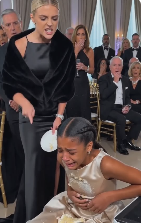
I lifted the glass sculpture.
“For every student who thought help only counted if rich people gave it publicly,” I said, my voice shaking, “this fund belongs to all of us.”
I heard someone cry.
Maybe it was me.
Then I said the words I had written on a note card that morning, before cake, before cameras, before the binder opened.
“Sometimes the people holding the room together are not the people standing in the spotlight.”
The applause hit like a wave.
For one impossible second, I did not feel poor, borrowed, taped over, or stained.
I felt seen.
Then the ballroom doors opened.
Two board members entered with a woman in a dark suit.
Malcolm’s expression changed.
Celeste stopped talking on her phone.
The woman held up an ID badge.
“My name is Dana Whitcomb,” she said. “I represent the state charity oversight office.”
Vivienne whispered, “What?”
Dana looked at the binder.
“We received a complaint about donor misattribution last month,” she said. “Tonight confirms it was not an isolated incident.”
Part 7: The Investigation No One Could Hide
The gala did not explode.
It froze.
That was worse.
Every donor in the ballroom suddenly understood they were not watching teenage drama anymore. They were sitting inside an investigation.
Dana Whitcomb walked to the podium and spoke quietly with Malcolm. He handed over the binder. Celeste Ashford stepped forward at once.
“That binder contains private family information.”
Dana looked at her. “It contains charity records.”
Celeste’s mouth tightened.
Richard stood slowly. “How many incidents?”
Dana did not answer him directly.
She opened a folder of her own.
“Over the past eighteen months, multiple small donations were publicly credited to Ashford Family Youth Outreach. Several original donors were students, volunteers, or community workers who requested privacy, not reassignment.”
The room turned.
Not to Vivienne.
To Celeste.
Vivienne looked at her mother with sudden horror. “You said it was just Uma.”
Celeste’s eyes flashed. “Be quiet.”
That command broke something.
Vivienne stepped back as if she had finally seen the machinery behind her own life. The polished outfits. The center spots. The family photos. The speeches about generosity. All of it had been built partly from people who could not afford to fight back.
I should have felt satisfaction.
Instead, I felt tired.
The kind of tired that lives under the skin.
Nora came beside me with a damp cloth. “For the dress,” she whispered.
I took it, but my hands shook too badly to use it.
Then Richard Ashford walked toward me.
The room stiffened.
He stopped several feet away, careful not to crowd me.
“I owe you an apology,” he said.
Vivienne looked up sharply.
Celeste laughed under her breath. “Richard, don’t embarrass yourself.”
He ignored her.
“I signed reports I did not read because the praise was convenient,” he said. “That makes me responsible too.”
I did not know what to say.
An apology from a powerful man did not clean the dress. It did not erase the panic. It did not give back the hours I had spent wondering if I had the right to stand in that room.
But it mattered that he said it where everyone could hear.
Dana closed the folder.
“The gala board will be suspended pending review,” she said. “All donor credits will be audited.”
Celeste’s face went white.
Vivienne turned to me then, but for once, there was no performance in her eyes.
Only fear.
Because the thing she had shoved into my dress had not ruined me.
It had marked the exact moment her family’s lie became visible.
Part 8: The Borrowed Dress Became The Evidence
Two weeks later, Mrs. Klein refused to let me pay for the dress.
I stood in her kitchen holding the cleaned blue fabric in a garment bag, my throat tight with guilt. The stain had faded, but if you knew where to look, you could still see a pale shadow near the ribs.
“I’m sorry,” I said for the fifth time.
Mrs. Klein zipped the bag closed and gave me a look over her glasses.
“Uma, stop apologizing for damage someone else caused.”
I looked down.
She softened. “Besides, that dress has more history now than anything in my closet.”
I almost laughed.
Then she handed it back to me.
“Keep it.”
I shook my head. “I can’t.”
“You can,” she said. “And you will wear it again when you speak at the scholarship hearing.”
The hearing happened in Hartford, in a plain room with ugly carpet and fluorescent lights. No roses. No perfume. No cameras arranged for beauty.
Only records.
Dana Whitcomb presented the audit.
Malcolm testified.
Nora submitted the recording.
I wore the blue dress.
Not because it was perfect.
Because it was not.
The faint stain remained like a quiet witness.
Vivienne attended with her father. Celeste did not. Her lawyer said she was unwell, but nobody believed it. The investigation had already forced her resignation from three charity boards. The Ashford name, once printed in gold across every program, now appeared in documents with page numbers and violations.
When it was my turn to speak, I expected to feel small again.
I did not.
I told them about the taped seating chart. The cake. The binder. The students whose donations and labor had been hidden behind wealthier names. I did not make my voice dramatic. I did not need to.
The truth was dramatic enough.
At the end, Dana asked, “What do you want to happen next, Miss Bell?”
I looked at Vivienne.
She looked thinner somehow, not physically, but in the way people look when the story protecting them has been stripped away.
Then I looked at the scholarship students sitting behind me.
“I want the fund renamed,” I said. “Not after a donor. Not after a family. After the volunteers.”
A murmur moved through the room.
Richard Ashford nodded once.
Vivienne lowered her eyes.
Months later, the first Volunteer Scholarship Night was held in a school auditorium instead of a luxury ballroom. No crystal chandeliers. No donor throne tables. Just folding chairs, handmade signs, donated flowers, and a stage full of students who had carried boxes, tutored younger kids, cleaned kitchens, translated forms, repaired decorations, and given what they could.
The blue dress hung in a display case near the entrance.
Beside it was a small card.
Borrowed dress worn by Uma Bell on the night hidden donations were exposed. Proof that dignity does not belong to the richest person in the room.
Vivienne came near the end.
She did not speak to me at first. She stood in front of the case for a long time.
Then she placed an envelope on the volunteer table.
No name.
No speech.
No photo.
Inside was a check made out to the scholarship fund, along with a note in careful handwriting.
Credit it to the volunteers. Not to me.
I watched her leave through the side door, alone.
I did not forgive everything that night.
But I understood something I had not understood before: sometimes justice is not watching someone fall.
Sometimes justice is watching the thing they tried to steal grow too large for them to own.
And when the first scholarship recipient stepped onstage under paper flowers and ordinary lights, I touched the faint stain on my dress in the display case and finally stopped feeling ashamed of where the cake had landed.
