Part 2: The Donor Who Pointed At The Screen
Vivienne Kensington’s smile stayed on her face for three seconds too long.
That was how I knew she was terrified.
Not sorry. Not ashamed. Terrified.
The donor beside me had risen so quickly that his chair scraped against the marble floor, making half the Beverly Hills dining hall turn toward him before they even understood what was on the tablet. He was an older man with silver hair, a black velvet dinner jacket, and a face that looked carved out of old money and colder patience.
His finger remained pointed at the screen.
“Why,” he asked again, slowly, “did Vivienne Kensington try to bury this restoration report?”
The room went silent in that expensive way, where nobody wanted to be the first person caught reacting.
Vivienne lowered her hand from the place where she had just slapped me. Her diamond bracelet trembled against her wrist.
“That report is incomplete,” she said.
The staff tablet rested on a small podium near the covered vintage Roadster. Under the gala lights, the screen showed my name clearly.
NOURA BLAKE — ORIGINAL KEY RECOVERY VERIFIED.
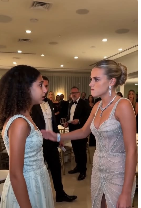
My cheek burned. My dress, the one I had altered myself with careful midnight stitches, hung crooked where Vivienne’s hand had caught the shoulder seam. One of the tiny beads I had sewn along the waist rolled near my flat shoe like a little white tear.
I bent down to pick it up.
Someone laughed softly.
I stopped.
Then the donor beside me bent first, picked up the bead, and placed it in my palm.
That tiny gesture changed the room more than the slap had.
Vivienne saw it too. Her eyes sharpened.
The organizer, Mrs. Langford, hurried toward the podium, her face pale beneath perfect makeup. “There seems to be a misunderstanding. The ceremony schedule can be adjusted.”
“No,” the donor said. “The ceremony schedule will not be adjusted.”
Vivienne’s mother stood from the honor table. “Mr. Ashcroft, surely this can be handled privately.”
Mr. Ashcroft.
I knew that name. Everyone in the room did. Elias Ashcroft had donated the vintage Roadster to the charity auction, the same car that was supposed to raise enough money to fund three mobile libraries across underserved schools.
He looked at Vivienne’s mother without blinking.
“Private handling is how rot survives.”
Vivienne’s jaw tightened. “With respect, Mr. Ashcroft, Noura found a key in a dusty storage crate. That does not make her important.”
The words hit me harder than the slap because half the room looked ready to accept them.
Then the staff member holding the tablet swallowed and tapped the screen again.
A second document opened.
RESTORATION DELAY AVOIDED DUE TO ORIGINAL IGNITION KEY MATCH.
Below that: estimated auction value increase — $1.8 million.
A gasp moved through the room.
Mrs. Langford whispered, “Oh no.”
Vivienne turned toward her. “Close that.”
The staff member did not move.
Vivienne stepped closer. “I said close it.”
And that was when Mr. Ashcroft looked directly at me.
“Miss Blake,” he said, “tell this room where you found the key.”
My throat tightened.
Vivienne gave me a look that said if I opened my mouth, I would regret it.
I opened it anyway.
“In the old tool roll,” I said. “Behind the passenger seat panel. The inventory tag had been switched.”
Vivienne’s face changed.
Because I had not only found the key.
I had found the first lie.
Part 3: The Tag That Had Been Switched
Mrs. Langford reached for the tablet with shaking fingers, but the staff member stepped back.
It was a small movement. Almost invisible.
But I saw it.
So did Vivienne.
“You work for this gala,” Vivienne snapped. “Not for her.”
The staff member’s cheeks flushed. His name tag read Milo. He looked no older than twenty-two, with nervous hands and a bow tie that had slipped crooked sometime during the chaos.
“I work for the foundation,” he said quietly.
Vivienne laughed, sharp and ugly. “Then act like it.”
Mr. Ashcroft’s voice cut in. “He is.”
The room shifted again.
Vivienne’s mother, Celeste Kensington, moved toward her daughter with a smile meant for cameras. “Darling, don’t let this become unpleasant.”
I almost stared.
Unpleasant.
My cheek was still hot from Vivienne’s palm. My dress was torn. People had whispered that I was a pity invite after watching me get humiliated in front of donors and trustees.
But to them, the danger was not what Vivienne had done.
The danger was that everyone might finally notice.
Mr. Ashcroft turned to me again. “The inventory tag had been switched?”
I nodded.
“With what?”
I could feel Vivienne watching me.
I looked at the covered Roadster. Beneath the cream silk sheet, its shape was elegant and waiting, like it had been holding its breath all night.
“With a duplicate tag from the Kensington family’s private storage list,” I said.
The words left my mouth and seemed to hang over every candlelit table.
Celeste’s smile vanished.
Vivienne whispered, “You little—”
“Careful,” Mr. Ashcroft said.
Vivienne stopped.
I pressed the loose bead into my palm until it hurt. “I wasn’t supposed to be in the restoration archive. I was helping move old donor boxes after the volunteer team got cut. One crate had two tags. One was fresh. The other was faded and half-stuck underneath.”
Mrs. Langford’s eyes closed.
She knew.
That realization chilled me more than the air conditioning.
She knew something had been wrong.
Milo placed the tablet on the podium and opened a photo. It showed the old leather tool roll, cracked with age, and the brass key tucked inside a hidden stitched pocket.
“The restoration team confirmed it,” he said. “The original key matched the Roadster’s ignition and glove compartment. Without it, the car would have been auctioned as incomplete.”
A donor muttered, “That would have lowered the bids.”
“By nearly two million,” Mr. Ashcroft said.
Vivienne tossed her hair back. “So what? The key was found. The charity benefits. Why are we acting like this girl discovered buried treasure?”
I looked down at my damaged dress.
For a second, I was tired. So tired that the room blurred.
Then I lifted my head.
“Because someone tried to make sure I never got credit for finding it.”
A woman near the dessert table whispered, “Who?”
Milo touched the tablet again.
A third file opened.
EMAIL TRANSFER REQUEST — CEREMONIAL HONOR REASSIGNMENT.
Requested by: Vivienne Kensington.
Reason: Noura Blake lacks appropriate donor-facing presentation.
The words were right there.
Not whispered.
Not denied.
Written down.
Vivienne’s expression hardened into pure panic.
Then Mrs. Langford whispered, “Vivienne, you said her invitation had already been revoked.”
Mr. Ashcroft turned slowly.
And suddenly every eye moved from Vivienne to Mrs. Langford.
Part 4: The Organizer Who Knew Too Much
Mrs. Langford looked as if someone had pulled the floor out from beneath her.
Vivienne stared at her with open fury. “Why would you say that?”
Mrs. Langford’s mouth trembled. She glanced at Celeste Kensington, then at Mr. Ashcroft, then at me.
That glance told me everything.
She was not afraid of the truth.
She was afraid of who had paid to hide it.
Celeste rose from the honor table. Her pearl earrings swung gently as she walked toward Mrs. Langford with the calm of someone crossing a room she believed she owned.
“Marianne,” she said softly, “perhaps you should take a breath.”
Mrs. Langford did not answer.
Celeste placed a hand on her arm.
Mrs. Langford flinched.
The room saw it.
Mr. Ashcroft’s eyes narrowed. “Mrs. Langford, did someone ask you to remove Miss Blake from the ceremony?”
Vivienne said, “Don’t answer that.”
It was the worst possible thing she could have said.
Because now nobody could pretend there was nothing to answer.
Mrs. Langford pressed one hand to her stomach. “The Kensingtons are major donors.”
“That is not an answer,” Mr. Ashcroft said.
“No,” she whispered. “It is the reason.”
A heavy silence fell.
Vivienne’s face twisted. “You ungrateful woman.”
Mrs. Langford’s eyes filled with tears, but she kept standing. “Your mother told me the foundation would lose next year’s funding if Noura pulled the cover.”
Celeste’s voice stayed low. “That is a serious accusation.”
“Yes,” Mrs. Langford said. “It is.”
Milo reached under the podium and picked up a small black folder. “There’s more.”
Celeste turned on him. “Who authorized you to access internal materials?”
“I didn’t access them,” Milo said. “They were already loaded to the staff tablet.”
Vivienne went still.
Milo looked at me, then at Mr. Ashcroft. “Someone scheduled the proof to open automatically at 8:15 p.m., right before the Roadster reveal.”
My breath caught.
“I didn’t do that,” I said.
“I know,” Milo replied.
Vivienne laughed suddenly. “This is ridiculous. Now we’re pretending the tablet is haunted?”
But her laugh sounded wrong. Too high. Too fast.
Mr. Ashcroft approached the podium. “Who uploaded the files?”
Milo checked the access log.
His face changed.
“What?” I asked.
He swallowed. “The upload came from the Kensington Foundation office.”
Celeste stepped back half an inch.
Vivienne blinked at her mother.
For the first time all night, they looked afraid of each other.
Milo scrolled lower.
“There was a note attached,” he said.
Mr. Ashcroft leaned in. “Read it.”
Milo hesitated.
Then he read the words aloud.
“If Vivienne humiliates the Blake girl tonight, open everything.”
The room seemed to stop breathing.
Vivienne whispered, “Mother?”
Celeste’s face turned white.
Part 5: The Note From Inside The Family
Vivienne stared at Celeste as if she had never seen her before.
“You did this?” she whispered.
Celeste’s expression hardened. “Lower your voice.”
“You set me up?”
Mr. Ashcroft looked between them, his face unreadable.
For one wild second, I thought maybe Vivienne had been trapped too. Maybe her mother had uploaded the files to punish her. Maybe the slap, the humiliation, the ruined dress—maybe all of it was part of something even uglier than jealousy.
Then Celeste looked at me.
And all the softness in that possibility disappeared.
“She was never supposed to be touched,” Celeste said.
The words were quiet.
They were also terrifying.
Vivienne’s mouth opened. “I slapped her because she embarrassed me.”
“No,” Celeste said coldly. “You slapped her because you have no discipline.”
A murmur passed through the gala.
Vivienne looked smaller suddenly, but not innocent. Just exposed.
Celeste turned to Mr. Ashcroft with a controlled smile. “My daughter behaved disgracefully. I will not defend that. But this does not concern the charity’s mission.”
“It concerns a restored car worth millions,” he said.
“It concerns a key,” Celeste replied. “Not the ownership of the vehicle.”
My fingers tightened around the bead.
Ownership.
Something about the word made the back of my neck prickle.
Mr. Ashcroft noticed. “Miss Blake?”
I looked at the Roadster.
The cream cover still hid it from the room, but I could see the curve of one headlight beneath the fabric. I remembered the smell of old leather in the archive. The dust on my fingers. The hidden stitched pocket. The folded paper tucked under the tool roll.
My heart began to pound.
“There was something else in the pocket,” I said.
Vivienne’s eyes flashed. “No, there wasn’t.”
I turned to her.
She knew.
I reached into the small cloth purse I had carried all night and pulled out a folded paper sealed inside a clear protective sleeve.
Mrs. Langford covered her mouth.
Milo whispered, “Is that the registration slip?”
“No,” I said. “It’s a letter.”
Mr. Ashcroft went very still.
“A letter from whom?”
I unfolded the sleeve carefully. The paper inside was yellowed, thin, and creased along the edges. The handwriting was elegant but faint.
“It was written by Clara Ashcroft,” I said.
Elias Ashcroft’s face changed completely.
The room watched the old man lose twenty years in one breath.
“My sister,” he whispered.
Celeste’s expression sharpened. “That letter is private family property.”
Mr. Ashcroft turned to her.
“How would you know what it is?”
Celeste said nothing.
I looked down at the letter. My hands trembled.
“It says the Roadster was never meant to be auctioned by the Kensingtons,” I said. “It says Clara Ashcroft gave it away before she died.”
Vivienne frowned. “Gave it to who?”
I read the final line.
“To the daughter of the mechanic who kept my family alive.”
My voice broke.
“His name was Daniel Blake.”
My father’s name.
Part 6: The Car That Belonged To My Father
For a moment, I could not feel the room.
The candles, the donors, the chandeliers, the ruined dress, Vivienne’s stare — everything pulled away until only my father’s name remained.
Daniel Blake.
He had died when I was twelve, leaving behind a dented toolbox, unpaid bills, and stories my mother could never finish without crying. He had worked on classic cars for wealthy families who remembered the vehicles but forgot the hands that kept them running.
I had never known he was connected to the Roadster.
Mr. Ashcroft reached for the edge of the podium to steady himself. “Daniel Blake saved my sister after the coastal crash.”
Celeste said quickly, “That story has nothing to do with tonight.”
“It has everything to do with tonight,” he said.
His voice was no longer polished. It shook with something old and wounded.
“My sister Clara drove that Roadster along the Pacific Coast Highway in 1998. The brakes failed. Daniel Blake pulled her from the wreck before the fuel line caught. He burned his hands getting her out.”
I stared at him.
My father’s hands.
I remembered the scars across his palms, pale and twisted like lightning. He used to tell me he got them from being careless with an engine. He had smiled when he said it.
He had lied to make heroism smaller.
Mr. Ashcroft continued. “Clara promised him the car after restoration. Not as payment. As gratitude. But she died before the transfer was finalized.”
Celeste lifted her chin. “And the Kensington family legally acquired the vehicle through the estate auction.”
“No,” Mr. Ashcroft said. “You acquired a vehicle whose attached transfer letter was missing.”
Every head turned toward her.
Celeste’s eyes moved to the letter in my hand.
I understood then.
The key had mattered because it revealed the hidden pocket.
The pocket had mattered because it held the letter.
And the letter mattered because it threatened the Kensington claim.
Vivienne looked at her mother. “You knew the letter existed?”
Celeste did not answer.
Mr. Ashcroft did. “Of course she knew. That is why Miss Blake had to be removed before the cover was pulled.”
I felt cold.
This had never been just about Vivienne wanting the spotlight.
It had been about burying my father.
Celeste’s calm finally cracked. “A sentimental letter does not override legal ownership.”
Milo looked at the tablet again. “Maybe not by itself.”
Celeste turned sharply.
Milo’s finger hovered above another file.
“There’s a scanned notarized addendum attached to the restoration archive,” he said.
Mrs. Langford whispered, “Oh my God.”
Milo opened it.
The document filled the screen.
TRANSFER INTENT CONFIRMED — CLARA ASHCROFT TO DANIEL BLAKE.
Witnessed.
Stamped.
Dated.
And at the bottom was a second signature.
Celeste Kensington.
Vivienne stared at her mother like the slap had finally landed on the wrong face.
Part 7: The Signature That Destroyed Everything
Celeste did not deny it.
That was the most shocking part.
She looked at the signature on the screen, then at Mr. Ashcroft, then at me, and for one second her face emptied of every polite mask she had worn into that room.
“You people have no idea what families like mine have to protect,” she said.
The words were so cold that even Vivienne stepped away from her.
Mr. Ashcroft’s voice dropped. “You witnessed my sister’s transfer document and hid it.”
Celeste’s lips pressed together.
Vivienne whispered, “Mother, what did you do?”
Celeste turned on her. “I protected your future.”
“My future?” Vivienne said, her voice cracking. “You made me fight over a car that wasn’t even ours?”
“You were supposed to win the room,” Celeste snapped. “Not lose control of yourself in front of cameras.”
There it was.
Not concern.
Not shame.
Only irritation that her daughter’s cruelty had been poorly timed.
My cheek still ached. My shoulder seam hung loose. But I stood straighter.
“You didn’t just hide a document,” I said. “You let my family struggle while using my father’s name as a footnote.”
Celeste looked at me like I had stepped too close to something sacred. “Your father was paid for his work.”
“My father was promised the car.”
“Your father was a mechanic.”
The room went dead.
I felt those words hit every server, every assistant, every staff member lining the walls.
Mr. Ashcroft stepped forward, fury burning through his restraint. “Daniel Blake was the reason my sister lived long enough to write that letter.”
Celeste’s mouth tightened.
Vivienne was crying now, but silently, angrily, like she hated the tears for betraying her.
“I didn’t know,” she said.
I looked at her.
Part of me wanted to believe that mattered.
Another part remembered the sound of her palm against my face.
“You knew enough to hurt me,” I said.
She flinched.
Mr. Ashcroft turned to the foundation board seated near the stage. “The auction is suspended.”
Celeste’s eyes widened. “You cannot do that.”
“I donated the car under false assumptions. The foundation will not sell disputed property.”
The board chair, a thin man who had avoided speaking all night, finally stood. “We will need legal review.”
“Begin it now,” Mr. Ashcroft said.
Milo looked toward the side doors. “There are reporters outside.”
Mrs. Langford whispered, “They were only supposed to cover the reveal.”
Vivienne looked toward the covered Roadster.
The ceremony that was supposed to crown her had become a trial.
Then Celeste did something none of us expected.
She walked to the Roadster, gripped the cream cover, and yanked it off herself.
The vintage car gleamed beneath the lights.
And taped across the windshield was one final envelope.
With my name written on it.
Part 8: The Envelope On The Windshield
Nobody moved.
The Roadster sat uncovered under the chandelier light, deep green paint shining like still water, chrome flashing along the edges, leather seats restored to a glow that looked almost alive.
But all I could see was the envelope.
NOURA BLAKE.
The handwriting was not Celeste’s. It was not Vivienne’s. It was not Mrs. Langford’s.
Mr. Ashcroft saw it and made a sound that broke my heart.
“That’s Clara’s hand.”
My fingers trembled as I approached the car.
For one second, I forgot the room. I forgot the phones recording, the donors staring, the ruined dress, the slap, the shame. I saw only the envelope and thought of my father’s scarred hands turning a wrench under a yellow garage light.
Mr. Ashcroft nodded gently. “Open it.”
I lifted the envelope from the windshield. The paper had aged, but the seal was intact. Inside was a short letter and a photograph.
The photo showed my father much younger, standing beside Clara Ashcroft and the unfinished Roadster. His hands were bandaged. He was smiling shyly, like he did not know what to do with gratitude.
I pressed the photo to my chest.
Then I read the letter aloud.
Clara had written that if Daniel Blake ever refused the car out of pride, it was to go to his child one day, not as charity, but as proof that his courage had not been forgotten.
My voice broke on the last line.
“Let this car carry the name of the person who saved me, not the family who can afford to own it.”
The room blurred.
Mr. Ashcroft removed his glasses and wiped his eyes.
Celeste looked smaller now, not humble, just cornered. The board chair spoke quietly with two attorneys near the stage. Mrs. Langford was crying. Milo stood beside the podium as if afraid the files might vanish if he stepped away.
Vivienne approached me slowly.
Security moved, but I lifted one hand.
She stopped several feet away.
“I am sorry,” she said.
The words were thin. Not enough. Maybe nothing would have been enough.
I looked at her, then at my torn dress.
“You were sorry when everyone knew,” I said. “Not when I was on the floor.”
Her face crumpled.
I did not comfort her.
That was not cruelty.
It was the first honest thing I had done for myself all night.
Mr. Ashcroft announced that the Roadster would be removed from auction and placed under legal transfer review. The Kensington Foundation’s pledge was suspended. Celeste was escorted into a private room with attorneys before the reporters could reach her. Vivienne followed, but not beside her mother. Behind her.
The gala did not end.
That was the strangest part.
The board asked if I still wanted to pull the ceremonial cover for the replacement auction item, a collection of restored first-edition books meant to fund the mobile libraries.
My dress was torn. My cheek was swollen. My hands shook.
But I said yes.
Milo found a small silver sewing kit from the wardrobe table. Mrs. Langford, with trembling hands, helped pin my shoulder seam back together. Mr. Ashcroft placed my father’s photograph inside my purse like it was something sacred.
Then I walked back to the center of the room in clean flats and a damaged thrifted dress that no longer felt embarrassing.
It felt like evidence.
When I pulled the cover from the books, the applause came slowly at first, then louder, until it filled the hall in a way no wealth could purchase.
Three months later, the court confirmed Clara Ashcroft’s transfer intent. The Roadster came to my family, but I did not hide it in a garage or sell it to the highest bidder.
I loaned it to a public museum with one condition: beside the car, they had to display my father’s photograph, Clara’s letter, and the original key.
The plaque did not call Daniel Blake a mechanic only.
It called him the man who saved a life, lost the credit, and still left behind a daughter brave enough to find the truth.
And every time I visit, I stand in front of that glass case, touch the tiny repaired seam on my old dress, and remember the night Vivienne tried to ruin me but accidentally handed me back my father’s name.
