Part 2: The Clip No One Wanted Played
The principal’s hand hovered over the laptop, and Brooke Ashford’s smile disappeared before the video even started.
That was what scared me most.
Not the shove. Not the way my palms still stung from hitting the roller-skating floor. Not the heat crawling up my neck as half the school watched me stand there with one red sneaker untied and my polo shirt twisted at the shoulder.
It was Brooke’s face.
She already knew what the camera had seen.
“Dr. Keller,” Brooke said quickly, her voice suddenly sweeter, “I really think this is being blown out of proportion.”
The principal did not look at her.
He looked at the paper on the floor.
The ballot form I had been trying to protect lay beside the concession table, one corner bent, the ink smudged where my thumb had pressed too hard. It was supposed to decide which student group received the fundraiser grant.
Dance team.
Debate.
The food pantry project.
Special needs peer-skating program.
All of them had counted on that money.
Brooke had acted like it was just paper because paper was easy to crush.
Dr. Keller pressed play.
The screen lit up with security footage from the roller rink office camera. Grainy, high-angle, slightly crooked.
There I was at the ballot table fifteen minutes earlier, checking signatures against the student roster.
There was Brooke, leaning over the box while her friends blocked the view with their designer jackets.
The room went quiet enough to hear wheels squeaking on the far side of the rink.
On the video, Brooke slipped something from her sleeve.
A stack of folded ballots.
My breath stopped.
Someone whispered, “No way.”
Brooke laughed too loudly. “That could be anything.”
The video kept going.
Her friend Marissa Vale moved closer to the table, pretending to fix her lip gloss in a compact mirror. Another girl, Paige Sutton, leaned toward me and asked a question, making me turn away.
Then Brooke opened the ballot box.
She didn’t drop in one ballot.
She dropped in a handful.
My stomach tightened.
I remembered that moment. I remembered feeling the box shift under my fingers, heavier than it should have been. I remembered reaching for the lid and Brooke snapping, “Do you always touch things that don’t belong to you?”
On the screen, I reached for the box.
Brooke grabbed my wrist.
Then the clip showed exactly what she had tried to rewrite.
She shoved me.
Not hard enough to send me flying across the room, but hard enough that I stumbled backward, hit the edge of the table, and dropped the official form.
A gasp moved through the students.
Brooke folded her arms.
“You can’t even see what the ballots said.”
Dr. Keller paused the clip.
Then he turned to the counselor standing beside him.
“Ms. Ramirez, please bring the envelope.”
Brooke’s father, standing near the sponsor banners in his charcoal suit, stepped forward.
“This is inappropriate,” he said. “My daughter is being publicly accused in front of her peers.”
Dr. Keller finally looked at him.
“So was Chloe.”
The words hit harder than a shout.
My eyes burned.
Ms. Ramirez placed a sealed envelope on the table.
Across the front, in my handwriting, were the words: questionable ballots — do not count.
Brooke stared at it.
I had filled that envelope before she shoved me.
Before she got loud.
Before she made herself the victim.
Dr. Keller broke the seal.
Inside were twelve ballots.
All for the same group.
All written in the same blue pen.
All signed with names of students who had not even attended the fundraiser.
And at the bottom of every ballot, beside the sponsor approval line, was a tiny printed mark Brooke had missed.
Ashford Youth Arts Initiative.
The name of her father’s foundation.
Part 3: The Sponsor Banner Started Looking Guilty
Mr. Ashford’s face hardened so quickly that I understood where Brooke had learned it.
He didn’t look shocked.
He looked interrupted.
“That logo appears on all our student materials,” he said. “We sponsor dozens of school events.”
Ms. Ramirez held up one of the ballots carefully.
“These forms were not printed by the school.”
Dr. Keller nodded toward the official table.
“Chloe was comparing them against our approved copies when she noticed the difference.”
Everyone looked at me again.
I hated it.
I hated being watched while my hands still shook. I hated that I could feel tears drying on my cheeks. I hated that Brooke had shoved me and somehow I still felt responsible for making the room uncomfortable.
But then I saw Marcus Lee near the back wall, standing with the peer-skating volunteers. His little brother used a wheelchair and had been waiting all year for the adaptive skating equipment the grant could fund.
Marcus mouthed, “Tell them.”
So I did.
“The fake forms were thicker,” I said. My voice cracked, so I swallowed and started again. “The real ballots have a gray watermark from the student council printer. These didn’t. And the signatures looked copied.”
Brooke rolled her eyes. “You’re acting like a detective over a fundraiser.”
“It was money for students,” I said.
“It was barely anything.”
Marcus’s face changed.
So did half the room.
Barely anything.
That was the phrase that exposed her more than the footage did.
Because to Brooke, the grant was a trophy. To everyone else, it was field trip buses, debate fees, pantry shelves, wheelchair-safe equipment, and winter coats.
Ms. Ramirez spread the twelve ballots in a row.
“Four names belong to students absent tonight,” she said. “Three belong to students who graduated last year. Two belong to freshmen who told me they never signed anything.”
Brooke’s friend Paige looked down at her skates.
Marissa stopped pretending she wasn’t scared.
Dr. Keller turned to the sponsor table.
“Mr. Ashford, your foundation requested that if the arts initiative won, the funds would be routed through your private youth program before distribution. Correct?”
Mr. Ashford smiled without warmth.
“For accounting support.”
“My office never approved that route.”
“It was pending.”
“It was denied.”
The silence sharpened.
Brooke whispered, “Dad.”
He didn’t turn toward her.
That was the second red flag I should have noticed about her family. When she was useful, he stood beside her. When she was exposed, he let her stand alone.
Dr. Keller clicked another file on the laptop.
“This is the budget proposal submitted under your foundation letterhead.”
A spreadsheet appeared on the projector.
Rows of costs filled the screen.
Venue partnership fee.
Consulting fee.
Branding fee.
Youth leadership package.
I blinked.
The actual student group amount was at the bottom.
Less than a quarter of the grant.
Marcus said aloud, “So most of the money wasn’t going to students?”
Brooke snapped, “You don’t understand how organizations work.”
“No,” I said, quieter this time. “But I understand when a ballot box gets stuffed.”
Her eyes cut to me.
“You think this makes you special?”
I shook my head.
“No. I think it makes the vote real.”
A teacher stepped toward Brooke’s friends.
“Marissa. Paige. Were you involved?”
Marissa’s mouth trembled.
Brooke turned on her instantly.
“Don’t you dare.”
Paige started crying.
And that was when I realized the final clip was not the only proof.
The weakest part of Brooke’s story had always been the people she expected to stay afraid.
Part 4: The Girl Who Kept The Receipt
Paige Sutton broke first.
Not loudly.
Not dramatically.
She just sat down on the bench near the skate rental counter, covered her face, and whispered, “I didn’t know it was stealing.”
Brooke’s head snapped toward her.
“Shut up, Paige.”
Ms. Ramirez moved between them.
“Let her speak.”
Paige looked smaller without Brooke’s confidence wrapped around her. Her expensive jacket was zipped to her chin, but she kept tugging the sleeves over her hands like she wanted to disappear inside it.
“She told us the school already chose the arts initiative,” Paige said. “She said the ballots were just for show, and we were helping avoid embarrassment.”
“That is not true,” Brooke said.
Marissa stared at the floor.
Dr. Keller’s voice softened. “Paige, who told you to print the extra forms?”
Paige lifted one shaking finger.
Not at Brooke.
At Mr. Ashford.
The entire rink seemed to tilt.
Mr. Ashford gave a small laugh.
“Teenagers panic. She’s confused.”
Paige reached into her jacket pocket.
Brooke went pale.
“Paige,” she warned.
But Paige pulled out a folded receipt.
“I paid cash at CopyMart,” she said. “He gave Brooke the template. Brooke sent it to me. I didn’t want my mom seeing the charge, so I kept the receipt because I was scared.”
Ms. Ramirez took it.
The paper was wrinkled from being opened and closed too many times.
At the bottom was a pickup code.
Dr. Keller typed it into the laptop.
A scanned order appeared.
Ballot forms, twenty-five copies.
Uploaded by: b.ashford@ashfordinitiative.org.
Brooke’s breath caught.
Mr. Ashford turned slowly toward his daughter.
For the first time all night, he looked angry at her.
Not because she had done wrong.
Because she had done wrong sloppily.
Brooke saw it too.
Something cracked behind her eyes.
“You said it would be fine,” she whispered to him.
He smiled tightly. “Brooke, stop talking.”
But she was already shaking.
“No. You said nobody checks paper at school events. You said everyone just wants a nice photo.”
My stomach tightened.
Dr. Keller leaned forward. “Mr. Ashford, did you instruct students to alter the fundraiser vote?”
He adjusted his tie.
“Absolutely not.”
Brooke stared at him.
It was painful watching her understand that he would rather let her take the fall than admit he had used her.
For one second, I almost felt sorry for her.
Then I remembered my shoulder hitting the table.
I remembered her telling everyone I was unstable.
I remembered Marcus’s brother waiting for equipment that might never come because rich people wanted branding fees.
Paige wiped her nose with her sleeve.
“There’s more,” she said.
Brooke closed her eyes.
Paige looked at me.
“I’m sorry, Chloe.”
Then she turned to Dr. Keller.
“The fake ballots weren’t the first thing. Brooke changed the volunteer forms too.”
My heart kicked.
“The volunteer forms?” Ms. Ramirez asked.
Paige nodded.
“She removed Chloe from ballot supervision this morning.”
I looked at the seating chart taped to the wall.
Then at the official volunteer binder.
The same binder Brooke had tried to grab before she shoved me.
Dr. Keller opened it.
My name was written in blue ink.
Then crossed out.
But underneath the correction fluid, faintly visible, were three words:
Approved by Principal.
Part 5: The Crossed-Out Name Under The Light
Dr. Keller carried the volunteer binder to the concession counter, where the rink manager kept a small UV stamp lamp for hand marks.
He slid the page beneath the purple glow.
The correction fluid turned cloudy.
My original assignment appeared beneath it.
Chloe Mensah — Ballot Integrity Lead.
Not assistant.
Not backup.
Lead.
A sound moved through the students, different from the earlier gasps. This one felt heavier.
People were realizing Brooke had not shoved me because I interfered.
She had shoved me because I belonged there.
Ms. Ramirez looked at me gently.
“Chloe, did you know you were assigned lead?”
I shook my head.
“I got a text this morning saying I’d been moved to skate return.”
“From who?”
I pulled out my phone with clumsy fingers and opened the message.
Unknown number.
Chloe, update from committee. Report to skate return. Ballot table reassigned.
My face burned.
“I thought maybe I did something wrong.”
Brooke looked away.
Dr. Keller photographed the message.
The technology teacher, Mr. Feld, came over from the DJ booth.
“I can check the sender through the school notification system.”
Brooke’s father immediately said, “You will not inspect private student messages without consent.”
Mr. Feld didn’t blink.
“It isn’t private if someone impersonated a school committee member.”
The principal nodded.
Mr. Feld connected my phone to his laptop.
Minutes stretched.
Skaters stood frozen around the rink, some still holding nachos, some with helmets under their arms. The disco lights kept spinning over everyone’s faces, throwing red and blue across fear, guilt, and curiosity.
Then Mr. Feld looked up.
“The number links to a prepaid messaging account.”
Mr. Ashford smiled faintly.
“Then this proves nothing.”
Mr. Feld continued.
“The account recovery email is connected to the Ashford Youth Arts Initiative.”
Brooke made a small sound.
Mr. Ashford’s smile vanished.
Dr. Keller turned the projector back on. “Show it.”
The recovery email appeared on the screen.
admin.events@ashfordinitiative.org.
Below it was a login location.
The Ashford Foundation office.
Timestamp: 8:14 a.m.
The room erupted.
Brooke shouted, “I didn’t send that one!”
Everyone stopped.
Her face went white.
Mr. Ashford said, “Brooke.”
But she was staring at the screen, breathing fast.
“I changed the forms,” she said. “I printed the ballots. I did what you told me. But I didn’t text her. I didn’t even know she had been officially assigned lead.”
Mr. Ashford’s jaw flexed.
For the first time, Dr. Keller looked truly unsettled.
“Then who did?”
The answer came from a voice near the rink entrance.
“I did.”
Everyone turned.
A woman stood beside the ticket counter in a navy coat, holding a folder against her chest. She looked familiar, but I couldn’t place her until Marcus whispered, “That’s the grant auditor.”
Her name tag read: Elena Ward.
Mr. Ashford went still.
“Ms. Ward,” he said carefully. “You are confused.”
She walked toward the stage.
“No, Mr. Ashford. I was confused when you asked me to ‘smooth out’ the student documentation. I was confused when your office sent me a list of names to deprioritize.”
She looked at me.
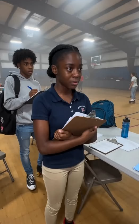
“I was not confused when I removed Chloe Mensah from the lead role.”
My chest tightened.
“You did that?”
Her eyes filled with shame.
“Yes.”
Then she opened her folder.
“And I came tonight because she was the only student who noticed the fraud I was too afraid to report.”
Part 6: The Auditor Who Finally Spoke
Elena Ward’s hands shook as she placed the folder on the ballot table.
She looked like someone who had carried heavy things quietly for too long. Not boxes. Not papers. Fear.
Mr. Ashford stepped toward her with a polished smile.
“Elena, this is not the appropriate setting.”
She didn’t look at him.
“That sentence is exactly how you kept me quiet.”
The rink went still.
Even the music had stopped now. Without it, the room sounded raw: sneakers scraping, someone sniffling, the low hum of arcade machines still flashing in the corner.
Elena opened the folder.
Inside were emails.
Printed spreadsheets.
A copy of the grant budget with handwritten notes in the margins.
She pointed to the first page.
“The fundraiser grant was supposed to be divided by student vote. But Mr. Ashford’s foundation planned to route the winning funds through its own youth arts initiative.”
Dr. Keller’s face was tight.
“We denied that.”
“Yes,” Elena said. “So he created pressure through students. If Brooke’s group won publicly, the board would look cruel refusing the transfer.”
Brooke stared at her father.
“You said the school wanted us.”
“They did,” he said.
Elena shook her head.
“No. They wanted student programs. You wanted a press release.”
She turned another page.
“This is the list his office sent me.”
The projector showed names.
Marcus Lee.
Sofia Hernandez.
Jalen Brooks.
Ava Patel.
Students connected to programs that needed the grant most.
Beside each name was a note.
Too emotional on camera.
No donor appeal.
Low visibility.
Then my name appeared.
Chloe Mensah — diligent, but likely to question process. Remove from ballot role.
My hands curled into fists.
Diligent, but likely to question process.
They had turned my responsibility into a warning label.
Ms. Ramirez stepped closer to me, not touching me, just standing there like a shield.
Elena’s voice cracked.
“I sent the fake reassignment text from the account Mr. Ashford’s office gave me. I told myself it was harmless because Chloe would still be helping somewhere else.”
She looked at me.
“I’m sorry.”
I wanted to say something mature.
Something graceful.
But all I could manage was, “You made me think I wasn’t trusted.”
Her face crumpled.
“I know.”
Brooke’s voice came thin and sharp.
“So everyone used me too.”
Mr. Ashford turned on her.
“Do not make yourself the victim.”
She flinched.
And that flinch told the room more than any spreadsheet.
Brooke had power at school, but not with him.
Elena removed one final document from the folder.
“This is why I came.”
She held it up.
A budget transfer request.
Already signed.
Scheduled for midnight.
If the fake ballots had stood, the grant money would move automatically into Ashford’s foundation account before Monday morning.
Marcus spoke from the back.
“So if Chloe hadn’t stopped the ballots tonight…”
Elena nodded.
“The money would have been gone.”
Brooke sank onto a bench.
Dr. Keller turned toward Mr. Ashford.
“I am calling the district superintendent.”
Mr. Ashford’s expression went flat.
“Call whoever you like.”
Then he looked directly at me.
“You should have stayed at skate return.”
The words were quiet.
But every phone in the room was recording now.
And this time, nobody needed a projector to know who had lied.
Part 7: The Midnight Transfer On The Screen
Dr. Keller moved fast after that.
Teachers guided students away from the ballot table, but no one truly left. They formed a wide circle around the center of the rink, skates angled inward, as if the whole school had become a jury.
Mr. Feld connected the laptop to the district finance portal.
Elena gave him the transfer ID.
Mr. Ashford stepped forward.
“You do not have authorization to access foundation accounts.”
Elena looked exhausted.
“It isn’t only your foundation account. It’s a pending transfer from a school-linked grant.”
The principal stood beside Mr. Feld.
“Proceed.”
The login page opened.
The rink manager lowered the overhead lights so everyone could see the projector. Disco stars still drifted over the wall, ridiculous and beautiful against the evidence.
Mr. Feld entered the code.
A pending transaction appeared.
Amount: $18,750.
Destination: Ashford Youth Arts Initiative.
Scheduled: 11:59 p.m.
Status: awaiting final verification.
A hush fell.
Eighteen thousand seven hundred fifty dollars.
It was not “barely anything.”
It was uniforms, buses, adaptive skate frames, tournament fees, pantry shelves, tutoring tablets, and a dozen small chances students had been told to be grateful for.
Brooke stared at the number.
“I thought it was just about winning,” she whispered.
I believed her.
That did not make it better.
Dr. Keller clicked the verification history.
Three required approvals appeared.
Foundation sponsor.
Event auditor.
Student ballot lead.
The first two were checked.
The third was pending.
My name was beside it.
Chloe Mensah.
My breath caught.
“They needed my approval?”
Elena nodded.
“That’s why you were removed. If Brooke’s fake ballots passed and your role was changed before the final submission, the system would accept a substitute verifier.”
“Who?” Ms. Ramirez asked.
The answer appeared when Mr. Feld expanded the field.
Substitute student verifier: Brooke Ashford.
Brooke covered her mouth.
Mr. Ashford finally lost his calm.
“This is a private financial matter being twisted by children who do not understand governance.”
Dr. Keller looked at him with disgust.
“These children understand theft.”
Mr. Ashford pointed at me.
“You think this girl is some hero? She was counting ballots without authorization.”
I stepped toward the screen before I knew I was moving.
“My name is on the authorization.”
He smiled coldly.
“Because a clerical error left it there.”
“No,” I said, voice shaking but clear. “Because I earned it.”
The words surprised me.
They surprised Brooke too.
Mr. Feld clicked one more tab.
“Final verification can still be completed or cancelled by the original ballot lead.”
Everyone looked at me.
The rink seemed suddenly enormous.
Dr. Keller spoke gently.
“Chloe, you don’t have to touch this if you don’t want to.”
But I did.
Not because I wanted power.
Because I knew exactly what happened when good people stepped away from paperwork and let polished liars sign instead.
I walked to the laptop.
My fingers trembled over the keys.
A warning appeared.
Cancel pending transfer?
Yes.
No.
I clicked yes.
The screen asked for a reason.
I typed slowly.
Fraudulent ballot process. Student funds must remain with approved programs.
Then I pressed submit.
For one second, nothing happened.
Then the status changed.
Transfer cancelled.
The room exploded into applause.
Not fancy applause.
Not donor applause.
Real applause, loud and messy, with skates stomping against the floor.
Marcus hugged his little brother so tightly the boy laughed.
Ms. Ramirez wiped her eyes.
Brooke stayed seated, staring at the screen like she had watched a door close.
Mr. Ashford turned to leave.
But two district officials were already standing at the entrance.
And one of them held a badge.
Part 8: The Vote That Finally Counted
The adults took Mr. Ashford into the small rink office with glass walls, so everyone could see him still arguing even when they couldn’t hear the words.
His hands sliced through the air.
The district officials did not flinch.
Brooke sat alone on the bench beneath the sponsor banner. Someone had turned the banner around so the Ashford logo faced the wall.
I should have felt victorious.
Instead, I felt tired all the way down to my bones.
My shoulder ached from the shove. My throat hurt from holding back tears. My red sneakers were scuffed from where I had slipped.
Then Marcus rolled his brother over to me.
His brother’s name was Eli. He was twelve, with bright eyes and a helmet covered in dinosaur stickers.
“Did we lose the equipment?” he asked.
I crouched so we were eye level.
“No,” I said. “Not if the vote is done right.”
Dr. Keller heard me.
He stepped out from behind the ballot table and looked around the rink.
“Then we do it right. Tonight.”
The room shifted.
Ms. Ramirez brought out a fresh stack of official ballots from the locked school bag. Mr. Feld projected the student roster. Teachers checked IDs. No sponsor representatives touched the box.
And this time, I stood at the center of the table.
Not because anyone was clapping.
Because the process needed someone willing to be careful when everyone else was emotional.
Brooke watched from the bench.
After a while, she stood and walked toward me.
Students went quiet again.
Her eyes were swollen.
“I won’t touch anything,” she said quickly. “I just… I want to say it where people can hear.”
My fingers tightened around the ballot list.
She swallowed.
“I lied. I shoved Chloe. I helped fake ballots because I thought winning meant I mattered.” Her voice broke. “And I let my father convince me that people who needed the money less loudly deserved it less.”
No one applauded.
That was good.
Some apologies should not get applause.
Brooke looked at me.
“I’m sorry.”
I held her gaze.
“Sorry doesn’t fix the vote.”
“I know.”
“Then help fix what you broke after the adults decide your consequences.”
She nodded.
For once, she did not argue.
The vote took forty-two minutes.
Every ballot was checked.
Every signature matched.
Every student group had a witness present.
When Dr. Keller read the result, his voice shook.
The grant would be split.
Half to the adaptive peer-skating program.
Half to the food pantry project.
Marcus shouted first. Eli spun his chair in a fast circle, laughing so hard his helmet slipped sideways. The pantry volunteers hugged each other near the vending machines.
I stood behind the table, smiling before I realized I was doing it.
Ms. Ramirez touched my shoulder gently.
“You protected more than paper tonight.”
Across the rink, Brooke lowered her head.
Not dramatically.
Not for attention.
Just quietly.
By Monday, the district froze Ashford Youth Arts Initiative’s school partnerships. Elena Ward turned over the full file. Brooke was removed from student council and assigned restitution hours under supervision, including inventory work for the pantry and setup for the adaptive skating program.
And me?
I still wore practical polos.
I still brought my own supplies.
I still checked forms twice.
But at the next fundraiser, when Dr. Keller handed me the ballot binder, my name was printed on the cover in bold black ink.
Chloe Mensah — Student Fairness Chair.
No tape.
No correction fluid.
No one else’s hand trying to cross me out.
I ran my fingers over the letters, then looked at the rink floor where I had almost let humiliation make me silent.
This time, when the music started, I stood exactly where I belonged.
