Part 2: The Binder With My Name Inside
The emcee’s whisper didn’t stay a whisper.
“Kira Shaw,” he repeated, louder this time, and my ruined dress seemed to become the center of the entire ballroom.
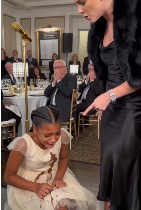
Chocolate slid in a dark streak down the pale blue fabric I had borrowed from Mrs. Bellamy upstairs, a retired seamstress who kept gowns in garment bags like memories. I pressed one hand over the stain, but it only spread under my palm, warm and sticky, while flashes burst around me.
Vivienne Ashford still stood beside the stage holding the silver dessert cup like it had jumped from her hand by accident.
“She shoved into me,” Vivienne said quickly. “Everyone saw.”
No one answered.
Because not everyone had seen that.
The event director, Mr. Laurent Marchand, stood under the stage lights with the marked binder clutched against his chest. His face had gone pale in a way that made the room feel colder.
“This binder,” he said, “contains the restoration log for tonight’s entire ceremony.”
Vivienne laughed once. “A log? You’re stopping a charity gala for paperwork?”
Mr. Marchand opened it.
I saw tabs marked in red, blue, gold.
Then I saw my own handwriting on the top sheet.
My stomach twisted.
I had written those notes at two in the morning in a service corridor, kneeling beside boxes of damaged place cards, rethreading torn ribbons, repainting gold borders with a tiny brush because the printer had sent the wrong crest.
I had done it because the scholarship ceremony mattered.
Not because anyone would know.
Mr. Marchand lifted the first page.
“Miss Shaw corrected the seating chart after a donor list was tampered with.”
A murmur moved through the guests.
Vivienne’s smile tightened.
“She repaired the award ribbons when they were found cut.”
Another murmur.
“She also restored the ceremonial donor screen after the wrong names were uploaded under the honoree section.”
Vivienne’s father, Lord Ashford, rose slowly from the front table.
“That is quite enough,” he said.
His voice was calm, polished, dangerous.
But Mr. Marchand did not stop.
“The mistake Miss Shaw fixed,” he said, “was not a mistake.”
The cameras swung toward Lord Ashford.
Vivienne’s fingers tightened around the dessert cup.
My mother, standing near the service doors in her plain black coat, shook her head slightly, like she was begging the room not to turn uglier.
But it was already too late.
Mr. Marchand turned another page.
“This log shows that Kira Shaw’s name was removed from the ceremony schedule three times.”
Vivienne said, “That proves nothing.”
Mr. Marchand looked at her.
“The edits came from your family’s private donor account.”
The ballroom went silent.
And for the first time that night, Vivienne Ashford stopped looking angry.
She looked afraid.
Part 3: The Donor Account That Lied
Lord Ashford stepped toward the stage with the slow confidence of a man used to doors opening before he touched them.
“This is a misunderstanding,” he said. “Our foundation staff handles dozens of files. A misplaced name hardly deserves public theatre.”
Mr. Marchand closed the binder halfway.
“That would be easier to believe if the same donor account had not uploaded a replacement honoree.”
Vivienne’s eyes flashed.
“Don’t.”
The word slipped out too fast.
Her father turned toward her.
“What did you say?”
She swallowed, lifting her chin again. “I said this is ridiculous.”
But the crack had already shown.
My hands were trembling, but I forced them away from my dress. Chocolate had soaked into the borrowed fabric. The stain looked like a wound.
Mrs. Bellamy would pretend it didn’t matter.
But I knew it mattered.
Everything borrowed came with fear attached.
Mr. Marchand pulled a printed schedule from the binder.
“Original center ceremony honoree: Kira Shaw.”
He laid down another page.
“Replacement honoree: Vivienne Ashford.”
A sound passed through the ballroom, sharp and hungry.
Vivienne’s face burned pink beneath the chandelier lights.
“I was asked to stand in,” she said. “Because she clearly wasn’t prepared.”
I looked down at myself and almost believed her.
Almost.
Then my mother moved.
She walked from the service doors to my side, past donors who were suddenly careful not to meet her eyes. She took a napkin from a tray, dipped it in water, and gently dabbed at the stain on my sleeve.
“You are prepared,” she whispered. “Stand straight.”
So I did.
Mr. Marchand looked toward the technical booth.
“Please play camera angle three.”
Vivienne’s father snapped, “Absolutely not.”
But the emcee had already nodded.
A screen above the stage flickered.
There I was, half an hour earlier, crouched behind the donor display with a roll of ribbon between my teeth, carefully reattaching name cards while everyone else drank champagne.
The footage changed.
Now Vivienne appeared near the seating chart.
She looked over both shoulders.
Then she peeled my name from the center table and pressed a new strip of paper over it.
Her own name.
The room erupted.
Vivienne shouted, “That doesn’t show why!”
Mr. Marchand froze.
That was the wrong thing to say.
My mother’s hand stopped moving on my sleeve.
Lord Ashford closed his eyes for half a second.
I stared at Vivienne.
“What reason could you possibly have?”
Her eyes locked on mine, wet and furious.
“Because you shouldn’t have been there.”
I heard cameras clicking, but her voice cut through everything.
“You were never supposed to come back into this family’s life.”
My mother dropped the napkin.
Part 4: The Locket Beneath The Borrowed Collar
The words hit the ballroom like glass hitting stone.
This family.
I turned to my mother, but she was staring at Vivienne with a grief so old it frightened me.
“Kira,” she said softly, “not here.”
Vivienne laughed, though her face was shaking.
“Oh, now she deserves privacy?”
Lord Ashford moved toward his daughter. “Vivienne, stop.”
“No,” she said. “You stop. You told me she was nobody. You told me her mother was some assistant who ran away with money.”
My mother flinched.
I had seen my mother tired. I had seen her worried, silent, disappointed.
I had never seen her look wounded by a name she refused to speak.
Mr. Marchand’s voice softened.
“Mrs. Shaw, would you like to continue this privately?”
Before she could answer, Vivienne pointed at my neckline.
“Ask her what she’s wearing.”
I looked down.
The borrowed dress had a high collar, but beneath it, against my skin, sat the small gold locket my mother had given me when I was six. She always told me it belonged to no one important. She said it was just pretty.
Vivienne’s stare made it feel suddenly heavy.
My mother whispered, “Kira, please.”
I opened the locket with shaking fingers.
Inside was the tiny painted portrait I had seen a thousand times: a woman with dark hair, serious eyes, and a pearl comb tucked above one ear.
Vivienne stepped closer.
“That is Isabelle Ashford.”
Lord Ashford’s voice snapped. “Enough!”
But the name had already entered the room.
Isabelle Ashford.
The woman from the old portrait gallery upstairs.
The missing sister from the charity foundation history wall.
The young patron who supposedly died before the scholarship program expanded.
My mouth went dry.
“My aunt,” Vivienne said. “His sister.”
Then she looked at me like the truth disgusted her.
“And apparently your mother.”
The room blurred.
My mother grabbed my hand.
“She loved you,” she said quickly. “Whatever else they say, she loved you.”
I could barely breathe.
“You told me she was a schoolteacher.”
“She was,” my mother said, tears rising. “Before she married into the Ashford name. Before she tried to leave it.”
Lord Ashford stepped close enough that his shadow touched my ruined dress.
“This is a cruel fantasy,” he said.
Mr. Marchand opened the binder again.
“No,” he said. “It is the reason the board invited Miss Shaw tonight.”
My head snapped toward him.
He looked ashamed.
“We needed the locket verified. Isabelle’s will referenced it.”
My fingers closed around the tiny gold heart.
“What will?”
Lord Ashford’s expression hardened.
Then a woman from the back of the room stood up.
She was elderly, dressed in emerald silk, with a cane carved like a bird’s head.
“I have the original,” she said.
And when Lord Ashford saw her, all the blood left his face.
Part 5: The Woman Who Remembered Everything
The elderly woman walked slowly, but the room moved aside as if a queen were crossing it.
“Countess Helena Voss,” Mr. Marchand said under his breath.
I had seen her name on the donor wall.
Not near the top, where the Ashfords appeared in gold.
Hers was engraved lower, smaller, almost hidden.
Lord Ashford looked as if he wanted to run.
“Helena,” he said. “This is not your concern.”
She stopped in front of him.
“You made it my concern when you told the world Isabelle died childless.”
Vivienne’s lips parted.
“Childless?”
The countess turned toward me.
Her eyes were sharp, but when they landed on the locket in my hand, they softened.
“You have her mouth,” she said. “Poor girl. That must have been a lonely inheritance.”
I didn’t know whether to laugh or cry.
She reached into her handbag and removed a cream envelope sealed in cracked red wax.
My mother covered her mouth.
“You kept it?”
“I promised Isabelle I would.”
Lord Ashford lunged for the envelope.
The security volunteer caught his wrist before he touched it.
For one second, Lord Ashford’s mask vanished. Rage twisted his face into something small and ugly.
“Give me that,” he hissed.
The countess did not even blink.
“No.”
Mr. Marchand took the envelope carefully and opened it in front of the cameras. Inside were several folded pages, a photograph, and a hospital card.
The photograph showed Isabelle Ashford holding a newborn wrapped in a white blanket.
On the back, in blue ink, was written:
Kira, my proof that love can survive a house built on pride.
My knees nearly gave way.
My mother wrapped an arm around me.
Mr. Marchand read the will summary with a voice that kept catching.
Isabelle Ashford had created the gala scholarship fund with her own private inheritance. If the Ashford family ever attempted to remove a rightful honoree for social or personal reasons, stewardship of the fund would pass to her direct descendant.
The direct descendant was named only by one identifying object.
A gold locket containing Isabelle’s portrait.
The room stared at my hand.
Vivienne shook her head.
“No. That can’t be real. Father?”
Lord Ashford didn’t answer.
The countess did.
“Your father knew,” she said. “He knew for seventeen years.”
Vivienne looked at him as if he had slapped her without touching her.
“You said she was lying.”
He adjusted his cufflinks.
“She was.”
My mother stepped forward, trembling.
“I raised Kira because Isabelle begged me to. She was afraid of you.”
Lord Ashford’s eyes narrowed.
“She was unstable.”
The countess struck her cane against the marble.
“She was trapped.”
That word traveled through the ballroom and found me.
Trapped.
My birth mother had not disappeared from history.
She had been buried under polished lies.
Then Vivienne looked at me, and for one strange second, she didn’t look like an heiress.
She looked like a daughter realizing her father was not a safe place.
But fear turned back into cruelty before it could become truth.
“She still ruined tonight,” Vivienne whispered.
The countess looked at her.
“No, child.”
Then she pointed to the binder.
“Your father did that long before she arrived.”
Part 6: The Receipt Sewn Into The Hem
The board called a recess, but no one left.
People drifted to the edges of the ballroom, pretending to give privacy while filming with lowered phones. Staff replaced champagne glasses nobody drank. The string quartet sat silent with bows in their laps.
My mother guided me behind a velvet curtain near the stage.
For the first time all night, I let myself shake.
“Why didn’t you tell me?” I asked.
Her face crumpled.
“Because knowing the Ashfords would not make your life safer.”
“But it was my life.”
“I know.”
The words were small.
Painfully small.
She touched the ruined dress.
“I borrowed this from Mrs. Bellamy because I wanted you to feel beautiful tonight. I didn’t know they would use it against you.”
I looked down at the stain.
“It isn’t even mine.”
“No,” my mother whispered. “But maybe that is why it matters.”
She knelt, surprising me, and turned the hem inside out.
“What are you doing?”
“Mrs. Bellamy told me something before we came. I thought she was being sentimental.”
My mother’s fingers found a seam hidden beneath the lining.
She pulled loose one pale thread.
A tiny paper packet slid into her palm.
I stared.
“What is that?”
She unfolded it carefully.
Inside was an old receipt from a Paris dressmaker, dated seventeen years earlier. Beneath it was a note in faded ink.
For my daughter, when she must stand in a room that wants her lowered.
Isabelle’s signature curled beneath the line.
My breath caught.
The borrowed dress had belonged to her.
Not Mrs. Bellamy’s friend.
Not some forgotten client.
My mother sat back on her heels, stunned.
“She never told me.”
I touched the stained fabric again, but now it felt different.
Vivienne hadn’t ruined a borrowed dress.
She had thrown chocolate over the last gift my birth mother had left for me.
Mr. Marchand stepped behind the curtain.
His expression changed when he saw the receipt.
“Where did you get that?”
“It was sewn into the hem,” my mother said.
He took one look and called for Countess Voss.
Within minutes, the countess arrived, moving faster than before.
When she saw the receipt, tears filled her eyes.
“Isabelle had it made in Paris before Kira was born,” she said. “She said every girl deserves armor that looks soft.”
My fingers tightened around the hem.
Then the countess turned over the receipt.
There was more writing on the back.
Not a message.
A list.
Names. Dates. Amounts.
Lord Ashford’s name appeared five times.
Beside each entry was the same phrase: withdrawn from scholarship reserve.
Mr. Marchand went still.
The countess whispered, “So that is where she hid it.”
The binder had proved they erased me.
The locket had proved who I was.
But the receipt proved something worse.
The Ashfords had not merely controlled the scholarship fund.
They had stolen from it.
And Vivienne, standing on the other side of the curtain, had heard every word.
Part 7: The Heiress Who Finally Broke
Vivienne pulled the curtain aside with one shaking hand.
No one spoke.
She stared at the receipt in Mr. Marchand’s hand as if it were alive.
“How much?” she asked.
Lord Ashford appeared behind her.
“Vivienne, come away.”
She didn’t move.
“How much did you take?”
His face hardened.
“This is adult business.”
“I am eighteen,” she snapped. “Old enough for you to parade me in front of donors. Old enough for you to make me smile beside names you stole from.”
He glanced toward the cameras gathering again.
“Lower your voice.”
That did it.
Something in Vivienne broke so completely that even I felt the sound of it.
“You made me hate her,” she said. “You made me think she was trying to take something from me.”
Lord Ashford’s jaw tightened.
“She is.”
Vivienne looked at me then.
The chocolate stain had dried dark across my dress. My face was probably blotched from crying. My locket was still open in my hand.
I didn’t look like a threat.
I looked like a girl who had been lied to by people with better furniture.
Vivienne turned back to him.
“No,” she said. “You were afraid she would return what you took.”
He reached for her arm.
She stepped away.
“Do not touch me.”
The ballroom heard that.
Everyone heard that.
Lord Ashford’s eyes changed.
Not with shame.
With calculation.
“You are upset,” he said smoothly. “You spilled dessert on a girl and now you are inventing drama to avoid consequences.”
Vivienne froze.
That was when I understood how his house worked.
First he used her.
Then he would sacrifice her.
The countess saw it too.
“Careful, Arthur,” she said. “You are running out of children to blame.”
Vivienne’s lips trembled.
Then she reached into her clutch and removed her phone.
“I have recordings.”
Lord Ashford went still.
She looked at me, then at Mr. Marchand.
“I recorded him because I thought he was protecting us. I thought if anything went wrong, I could prove he meant well.”
Her laugh cracked apart.
“He didn’t.”
She played the first recording.
Lord Ashford’s voice filled the stage speakers, low and cold.
“Move Kira Shaw from the center. If she speaks, people will ask why Isabelle’s locket is in the room.”
The second recording.
“Vivienne can stand there. She looks like what donors expect.”
The third.
“If the Shaw girl resists, make her seem emotional. Poor girls are always easier to dismiss when they cry.”
My mother made a sound like she had been cut.
I closed my eyes.
Then Vivienne played the final recording.
Lord Ashford said, “After tonight, we destroy the old receipt. Without it, Isabelle’s missing reserve can never be traced.”
The room exploded.
Lord Ashford lunged for the phone.
Vivienne threw it to Mr. Marchand.
Security blocked her father as police entered through the rear doors.
He shouted her name once.
Not lovingly.
Like an order.
But Vivienne did not move toward him.
She moved toward me.
Her eyes were red.
“I am sorry,” she said.
I wanted the apology to fix something.
It didn’t.
But it did open a door neither of us knew how to walk through yet.
Then Mr. Marchand looked at me and said, “Kira, the board needs your decision now.”
Part 8: The Center Spot No One Could Steal
The police took Lord Ashford through the side exit, away from the cameras, but the ballroom still felt full of him.
His anger lingered in the gold mirrors.
His lies sat heavy on the folded programs.
Vivienne stood alone near the stage steps, no longer glowing, no longer untouchable, just a girl in an expensive gown with nowhere safe to place her hands.
The board gathered around the marked binder, the locket, the Paris receipt, and Vivienne’s phone.
Proof looked so small when placed on a table.
Paper. Metal. Glass.
But it had dragged an entire family history into the light.
Mr. Marchand faced me gently.
“Under Isabelle Ashford’s will, if the family interfered with a rightful honoree, stewardship passes to her descendant. That is you.”
The countess added, “And with the receipt, the missing scholarship reserve can be recovered.”
I looked at my mother.
She had raised me in rented rooms, mended cuffs under dim kitchen lights, and lied only because truth had teeth.
“What happens if I accept?” I asked.
“You oversee the fund,” Mr. Marchand said. “You choose how it is repaired.”
Vivienne wiped her face with the back of her hand.
For one second, I saw the old version of her waiting for punishment to become humiliation.
Maybe she expected me to destroy her.
Part of me wanted to.
Then I looked at the dress.
The stain was still there.
But beneath it was Isabelle’s hidden receipt. Her note. Her soft armor.
“I accept,” I said.
The emcee returned to the microphone, voice unsteady.
“Ladies and gentlemen, tonight’s center ceremony will continue.”
A nervous applause began.
I raised one hand.
“Not yet.”
The room quieted.
I turned to the board.
“The stolen reserve should fund students whose names were removed, overlooked, or replaced because they didn’t look right to donors.”
Mr. Marchand nodded slowly.
“And the Ashford name?” asked the countess.
I looked at the giant gold crest above the stage.
It suddenly seemed less grand than tired.
“Take it off the scholarship.”
A gasp moved through the guests.
Vivienne looked up.
I continued.
“Name it after Isabelle Shaw Ashford, using both names. The one she was born with and the one they tried to control.”
My mother began to cry.
The countess smiled through tears.
Then I looked at Vivienne.
“She should not be chair. She should not be honored tonight. But she should be required to work with the records team until every stolen pound is traced.”
Vivienne nodded before anyone asked her.
“I will.”
I believed her.
Not completely.
But enough to begin.
Mr. Marchand handed me a clean shawl to cover the stain before I stepped to the center of the stage.
I almost took it.
Then I stopped.
“No.”
I walked into the stage lights with the chocolate still across my dress, the locket open at my throat, and my mother standing in the front row with both hands pressed over her heart.
The cameras lifted.
This time, I did not shrink from them.
“My name is Kira Shaw,” I said into the microphone. “And tonight, I am not here because my dress is perfect.”
I looked at the ruined fabric, then at the people who had mistaken polish for worth.
“I am here because someone tried to erase a name, and the name survived.”
The applause did not come all at once.
It started with my mother.
Then Mrs. Bellamy, weeping near the service doors.
Then the countess.
Then the staff.
Then, slowly, the donors rose too.
Vivienne remained seated, crying silently, and for once she did not try to turn the room toward herself.
After the ceremony, my mother touched the stained dress and whispered, “I am sorry it was ruined.”
I held the locket in my palm.
“It wasn’t ruined,” I said.
Because under the chocolate, under the borrowed seams, under seventeen years of silence, my mother’s hands and Isabelle’s courage had carried me into that room.
And when I finally stood at the center, nobody could tape over my name again.
