Part 2: The Clip Nobody Expected To Hear
The first sound from the auditorium speakers was not Hadley’s voice.
It was mine.
Small. Careful. Too polite for the way my chest had been tightening.
“Please don’t change the scores. The performers already turned them in.”
A rustle followed, then a sharp laugh from somewhere near the side curtain. The image on the projector was grainy at first, caught from the security camera above the sound booth, but it showed enough. It showed the table where the cultural festival score sheets had been stacked. It showed my hand pressing the folder flat. It showed Hadley leaning over me with that clean white blazer and that smile she wore when adults were close enough to impress.
Then her voice cut through the room.
“Move, Celine. Nobody cares about your little fairness routine.”
Someone behind me gasped.
Hadley’s head snapped toward the screen as if she could scare the recording into stopping.
The principal, Mrs. Larkin, did not move. She stood beside the laptop with one hand resting on the table, her face so still it made the air feel colder.
Onscreen, Hadley reached for the score sheet.
I pulled it back.
Not hard. Not dramatic. Just enough to protect it.
Then Hadley said the sentence that made half the auditorium stop breathing.
“If my group doesn’t win tonight, the sponsor pulls the donation. Do you understand what you’re ruining?”
Her father, seated in the front row with the other donors, shifted in his chair.
Hadley turned toward him so fast her earrings flashed under the stage lights. “Dad—”
“Quiet,” he said, but his voice had no power in it.
The clip continued.
A second figure appeared near the curtain: Marissa Vale, Hadley’s best friend, holding two score sheets and a black marker. She looked directly at the camera, froze, then ducked out of frame.
The room erupted.
Marissa stood up so quickly her chair scraped backward. “That’s not what happened.”
My face still burned from the drink Hadley had thrown. Something sticky had dried near my cheek, and my blazer smelled like citrus punch and humiliation. I wanted to wipe my face again, but I forced my hands to stay still.
Hadley pointed at me.
“She set this up.”
I almost laughed, not because it was funny, but because the lie was so desperate it sounded like a child breaking a glass and blaming the floor.
Mrs. Larkin clicked pause.
The frozen image showed Hadley’s hand gripping the score sheet.
My name was not on the stage, not on the trophy list, not on any spotlight. My hand was only covering another student’s privacy note.
Mr. Alvarez, the teacher supervising the event, picked the fallen folder from the floor. His fingers slowed as he opened it.
I knew what he was seeing.
The allergy forms. The performance order. The private accommodations sheet for a freshman dancer who had asked not to be announced publicly. The original score sheet with judge signatures. The changed one with Hadley’s clique magically ranked first.
Mr. Alvarez looked at me differently then.
Not with pity.
With understanding.
“Celine,” he said quietly, “you were protecting Sofia’s medical note?”
A tiny sob came from the second row.
Sofia Keller, fourteen, small enough to disappear inside her oversized cardigan, covered her mouth with both hands.
Hadley’s face twisted.
“You can’t say her name,” I whispered.
Mr. Alvarez immediately closed the folder, regret flashing across his face. “You’re right.”
That was the moment everyone understood.
Hadley had not only tried to steal a festival win.
She had tried to expose a younger student’s private information to force a performance change.
Sofia’s older brother, Lucas, rose from his seat. His jaw was clenched so hard I saw the muscle jump.
Hadley backed away from him, then from the screen, then from me.
But Mrs. Larkin clicked the laptop again.
“There is more,” she said.
Hadley went pale.
And this time, before the video played, her father stood up and said, “Turn it off.”
Part 3: The Donor Who Wanted Silence
Mrs. Larkin did not turn it off.
That was when I realized the adults were not all on Hadley’s side.
Mr. Pierce walked toward the aisle with the stiff confidence of someone used to doors opening before he touched them. His shoes sounded expensive against the auditorium floor. Every step made the students shrink back a little, as if money itself had entered the room wearing a tailored suit.
“Principal Larkin,” he said, smiling without warmth, “this is a student misunderstanding. Surely we don’t need to humiliate children in public.”
Children.
The word landed wrong.
Hadley was eighteen. Old enough to know exactly what she had done. Old enough to throw a drink in my face because she thought the room would laugh before it listened.
Mrs. Larkin folded her hands.
“A student was assaulted in front of witnesses,” she said. “Official school documents were altered. A private student record was mishandled. This is no longer a misunderstanding.”
Mr. Pierce’s eyes moved to me.
I had seen adults look at poor students like that before. Not angry exactly. More like annoyed that we had become visible at an inconvenient time.
“Celine,” he said, softening his tone as if kindness were a costume, “I’m sure you’re upset. Why don’t you clean up, and we can discuss this calmly tomorrow?”
Hadley seized the opening.
“Yes. She’s upset. She’s always upset. She takes everything personally because she wants attention.”
My throat tightened.
There it was.
The old trick.
Turn pain into drama. Turn protection into jealousy. Turn proof into attitude.
Sofia suddenly stood.
Her knees looked like they might give out, but she stayed upright.
“She didn’t want attention,” Sofia said, her voice trembling. “She helped me because Hadley told me if I didn’t switch time slots, she’d make everyone know why.”
The room went silent again, but this silence was different.
This one had teeth.
Hadley stared at Sofia. “You’re lying.”
Sofia flinched, and Lucas stepped halfway into the aisle.
But Sofia kept going.
“She said nobody would believe me because I’m a freshman and she’s Hadley Pierce.”
I felt something sharp move through me.
Not pride. Not victory.
Recognition.
Because Hadley had been right for too long.
Mr. Pierce’s jaw tightened. “This is absurd.”
Then the auditorium doors opened.
A woman in a navy coat stepped inside carrying a tablet against her chest. I recognized her from the district office, though I did not know her name. She had visited once during a safety review and asked questions nobody else wanted to answer.
Mrs. Larkin looked relieved for the first time.
“Ms. Renaud,” she said. “Thank you for coming.”
Hadley whispered, “No.”
Ms. Renaud walked down the aisle without rushing. She stopped near the stage and glanced first at Sofia, then at me, then at the paused security footage.
“I was already reviewing a complaint from last semester,” she said.
Hadley’s face changed.
A tiny thing, barely noticeable.
But I saw it.
The panic had been waiting underneath all along.
Mr. Pierce’s voice turned sharp. “Complaint from whom?”
Ms. Renaud looked at him.
“From three students whose scholarship projects were removed from public display after they refused to join Hadley Pierce’s committee.”
Murmurs spread across the auditorium.
Marissa sat down slowly, like her bones had disappeared.
I remembered those students. One had cried in the art hallway. One had transferred clubs. One had stopped coming to morning announcements.
At the time, everyone said they were sensitive.
Now the word sounded like another kind of weapon.
Ms. Renaud tapped her tablet.
“We also recovered deleted edits from the shared festival folder.”
Hadley shook her head. “No, you can’t—”
Mrs. Larkin’s eyes narrowed.
“You knew there were deleted edits?”
Hadley froze.
The entire auditorium heard the mistake.
Her own panic had answered before her lie could arrive.
Part 4: The Folder Hadley Forgot To Delete
The shared folder opened on the projector like a quiet trap.
Rows of file names filled the screen. Most looked harmless: performance order, donor seating, food table checklist, volunteer duties. But Ms. Renaud scrolled with the patience of someone who already knew exactly where the wound was hidden.
Then she clicked on “Festival Scores Final.”
A revision history appeared.
My stomach dropped.
There were my edits from earlier that afternoon, labeled with my school account, correcting misspelled student names and adding missing judge initials.
Below that came Marissa’s edits.
Then Hadley’s.
Then an account I did not recognize.
Pierce_Admin.
The auditorium seemed to inhale all at once.
Mr. Pierce stepped forward. “That is my office login. It has nothing to do with Hadley.”
Ms. Renaud did not look surprised.
“That login accessed the score file at 6:14 p.m. from the backstage tablet assigned to the student committee.”
Hadley’s lips parted.
Marissa whispered, “Hadley, you said it wouldn’t show.”
It was not loud.
It did not need to be.
The words traveled anyway.
Hadley turned toward her best friend with pure fury.
“You idiot.”
Marissa’s face crumpled.
For the first time, I saw the rich crowd fracture. Not dramatically, not with shouting. Just a small, ugly split where loyalty ended and self-preservation began.
Ms. Renaud clicked another file.
A screenshot filled the screen: a message thread between Hadley and Marissa.
Hadley: Move Sofia later. She’ll mess up the timing.
Marissa: She has a medical thing.
Hadley: Then she should not perform.
Marissa: Celine has the forms.
Hadley: Then make Celine look crazy.
My hands went cold.
There are sentences that do not just accuse you.
They explain the shape of every insult you swallowed before you understood it was planned.
Hadley took one step backward.
“That’s private.”
Sofia let out a small, broken laugh.
Private.
The word sounded obscene coming from her.
Lucas said, “You threatened my sister’s privacy.”
Hadley snapped, “I didn’t threaten anything. I was trying to keep the event professional.”
“By changing scores?” Mr. Alvarez asked.
She looked at him as if he had betrayed her by doing his job.
Then Mr. Pierce moved.
He did not grab the laptop. He did not shout. He simply placed himself between the projector and the audience, casting a tall shadow over the evidence.
“That’s enough,” he said. “My family has supported this school for years.”
Mrs. Larkin’s voice came like a blade.
“And no donation buys the right to endanger students.”
The words hit so hard that even the teachers looked stunned.
I saw Hadley’s eyes fill, but not with remorse. With rage. With disbelief that the world had failed to bend.
She pointed at me again.
“This is because of her. Nobody cared until she started digging.”
I finally spoke.
My voice came out rough, but steady.
“I wasn’t digging. You left people buried. I just picked up the paper you dropped.”
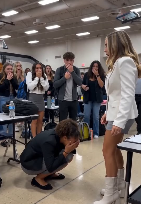
The room did not cheer.
It was better than cheering.
They listened.
Hadley’s face reddened, and for one frightening second, I thought she might come at me again.
But then Ms. Renaud scrolled one more time.
A new file appeared.
“Audio_Backstage_6_22.”
Hadley stopped breathing.
Marissa covered her mouth.
Mr. Pierce whispered, “Hadley, what is that?”
Hadley did not answer.
The audio began with laughter.
Then Hadley’s voice said, clear as glass, “After tonight, Celine Moreau will never touch another school event again.”
Part 5: The Laugh That Broke Her Crown
The audio played over the auditorium speakers, and Hadley’s laugh became the most hated sound in the room.
“She thinks rules protect people like her,” Hadley said in the recording. “Rules protect people who matter.”
A chair scraped somewhere behind me.
Someone whispered, “Oh my God.”
My body went still in a way that frightened me. The drink on my skin, the burning in my eyes, the ruined blazer, all of it became distant. I was not embarrassed anymore.
I was watching the truth make itself undeniable.
Marissa’s recorded voice came next, quieter.
“What if the camera catches us?”
Hadley laughed again.
“Then we say Celine was unstable. Everyone already believes she’s intense.”
A hard, sudden sound left my throat.
Not a sob.
Something smaller.
Mr. Alvarez looked at me with guilt written across his face, and I knew he was remembering every time he had told me to “keep my tone friendly” when I reported something unfair.
Mrs. Larkin paused the audio.
The silence after it was worse.
Hadley’s eyes moved wildly around the room, searching for one face still willing to protect her.
Her clique looked at their shoes.
Her father looked at the projector.
Her mother, who had been sitting perfectly still in the donor row, finally stood. She was elegant in a pale blue dress, her hair pinned smooth, her hands clasped so tightly her knuckles showed white.
“Hadley,” she said, almost inaudible. “Tell me that wasn’t you.”
Hadley’s mouth trembled.
For one second, she looked younger. Not innocent. Just smaller without the performance.
Then she ruined it.
“You don’t understand,” she said. “I had to fix it. The festival was supposed to show leadership. My applications—”
“Your applications?” her mother repeated.
Hadley blinked.
The whole room heard the answer.
Not culture. Not school pride. Not responsibility.
Applications.
Status.
A line on a future résumé.
Ms. Renaud lowered the tablet.
“Hadley Pierce, you will leave the auditorium with me and the assistant principal. There will be a formal investigation.”
Hadley’s head snapped up.
“No.”
“This event will continue without you.”
“No.”
The second no cracked.
She looked toward the trophy table at the edge of the stage, where three engraved plaques waited under gold paper.
“You can’t do that. My name is on the host list.”
Mrs. Larkin stepped forward.
“Not anymore.”
That was the first time I saw Hadley Pierce lose something she could not buy back immediately.
Her mother sat down slowly.
Mr. Pierce’s face hardened.
“This school is making a mistake.”
Mrs. Larkin turned to him.
“The mistake was letting students believe your donations mattered more than their safety.”
A low murmur rolled through the room.
Hadley looked at me one last time.
There was hatred there, yes. But beneath it was something stranger.
Fear.
Because I had not raised my voice. I had not touched her. I had not performed revenge.
I had simply refused to let go of a folder.
As Ms. Renaud led her toward the side doors, Hadley pulled free for half a second and hissed, “You think this is over?”
I wiped the sticky punch from my chin with my sleeve.
“No,” I said.
The words surprised even me.
“I think now people are finally looking.”
The side doors closed behind her.
And then Sofia’s mother arrived, breathless and terrified, holding a phone with a message on the screen that made Lucas go white.
Hadley had sent one more threat before the evidence played.
Part 6: The Message Sent Before She Fell
Sofia’s mother was named Elena Keller, and she looked like she had run from the parking lot without noticing the heel of one shoe had snapped.
She held the phone out to Mrs. Larkin with shaking hands.
“I need someone to explain why my daughter received this.”
Sofia looked tiny beside her.
Lucas read the message first. His face changed from anger to something colder.
I saw only the top line before Mrs. Larkin angled the phone away from the students.
Drop your complaint, or everyone sees why you needed special treatment.
My stomach twisted.
Hadley had sent it at 6:47 p.m.
Three minutes before she threw the drink in my face.
Three minutes before she tried to turn the room into a laughing crowd.
Sofia folded inward, her shoulders curling like she was trying to disappear into herself.
Elena pulled her close, but Sofia’s eyes found mine.
“I’m sorry,” she whispered.
I crossed the space before I knew I was moving.
“No,” I said. “You don’t apologize for being threatened.”
She started crying then, silently, with one hand covering her mouth.
Lucas turned toward the side doors.
“I’m going after her.”
Mr. Alvarez blocked him gently but firmly.
“Lucas. Don’t give them another story to use.”
That stopped him.
Not because he was calm, but because he understood exactly what Hadley’s family would do with one second of his anger.
Mrs. Larkin called campus security. Ms. Renaud spoke into her phone near the stage. Adults moved in quick, controlled lines, but the damage had already spread through the auditorium like smoke.
Students were reading screenshots.
Parents were whispering.
The festival decorations—paper flowers, flags, handmade posters—looked suddenly fragile under the fluorescent lights.
Then something unexpected happened.
One of the judges stood.
He was an older man with silver hair and a burgundy tie, Professor Adrian Bell from the local arts council. He had been silent all evening, reviewing scores from the front table.
“I want to make a statement,” he said.
Mrs. Larkin hesitated, then nodded.
Professor Bell faced the room.
“The original scores were not close.”
Hadley’s friends stiffened.
He lifted the judge packet.
“The winning performance was Sofia Keller’s dance ensemble.”
Sofia’s head jerked up.
Her mother pressed a hand to her mouth.
Professor Bell continued, “And the student committee member who preserved the original score sheet and prevented the altered sheet from replacing it was Celine Moreau.”
Heat rushed to my face again, but this time it was not shame.
Students began turning toward me.
Not laughing.
Not filming for cruelty.
Seeing.
Professor Bell looked directly at me.
“Miss Moreau, without your action, the award would have gone to students who had not earned it, and a younger performer would have been intimidated into silence.”
The words were too large for my body.
I wanted to hide from them.
Then Sofia stepped away from her mother and walked to the stage.
She was still crying, but she stood beside Professor Bell and faced the room.
“Celine told me I didn’t have to explain my medical note to anyone,” she said. “She said privacy isn’t something rich people get more of.”
The auditorium blurred.
I looked down because I could not hold all those eyes.
Then Marissa Vale stood again.
Her face was ruined with tears.
“I helped Hadley,” she said.
A shocked sound moved through the crowd.
Marissa’s voice shook.
“But there’s something else. Hadley wasn’t the one who first told us to change the score sheet.”
Mr. Pierce’s wife stood so fast her purse fell open.
Marissa pointed toward the donor row.
“It was him.”
Part 7: The Father Behind The Perfect Lie
For a moment, nobody understood where Marissa was pointing.
Then every head turned toward Mr. Pierce.
His expression did not change immediately. That was what made it frightening. He did not look guilty. He looked inconvenienced.
Marissa wiped her face with the heel of her hand.
“He told Hadley the Pierce Foundation needed the photo with her holding the award,” she said. “He said the scholarship board liked winners.”
Mrs. Pierce whispered, “Graham.”
Mr. Pierce gave a short laugh.
“This is a teenage girl trying to save herself.”
Marissa shook her head.
“No. I have the voicemail.”
Hadley’s mother went very still.
Marissa held up her phone like it was too heavy for her wrist.
“I saved it because I was scared Hadley would blame me if anything went wrong.”
Mr. Pierce stepped toward her.
“Marissa, think very carefully.”
Lucas moved in front of Sofia without a word.
Mr. Alvarez moved beside Marissa.
The auditorium watched a powerful man realize he could not reach the frightened girl without witnesses.
Mrs. Larkin’s voice was calm.
“Play it.”
Mr. Pierce looked at her. “You have no authority to—”
“Play it,” Mrs. Pierce said.
That silenced him.
Marissa tapped the screen.
Mr. Pierce’s voice filled the auditorium, smooth and low.
“Hadley, the foundation table needs a clean story tonight. Your group wins, you thank the school, we announce the scholarship partnership. If some little committee girl complains, make her look unstable. Do not let one charity case embarrass this family again.”
The words struck me so hard I forgot to breathe.
Charity case.
Again.
Again meant history.
Again meant I had been carrying someone else’s old shame without knowing it.
Mrs. Pierce slowly turned to her husband.
“What does ‘again’ mean?”
Mr. Pierce’s face had finally changed.
Not much.
Enough.
Ms. Renaud stepped closer.
“That may relate to the complaint from last semester,” she said. “A student’s scholarship display was removed after refusing to sign a promotional release for the Pierce Foundation.”
A girl in the back row stood.
Her name was Elise Martin. She had been quiet all year after her science project vanished from the district showcase.
“My project wasn’t incomplete,” she said. “They told me I should be grateful for exposure. When I asked to read the release first, my display was gone the next morning.”
Another student stood.
Then another.
Not shouting. Not dramatic.
Just standing.
One by one, the room filled with the shape of what Hadley and her father had treated as invisible.
Mrs. Pierce took a step away from her husband.
“Graham,” she said, “tell me you didn’t use school scholarships as advertising.”
He adjusted his cuff.
“That foundation pays for half the opportunities these children enjoy.”
“These children?” she repeated.
His eyes sharpened.
“And yes, Beatrice, sometimes order has to be maintained.”
The softness left her face.
I watched her remove the silver pin from her dress—the Pierce Foundation emblem—and place it on the chair.
The tiny click sounded final.
“Then maintain it without me.”
Hadley burst back through the side door at that exact moment, followed by the assistant principal and Ms. Renaud’s colleague. Her face was streaked with tears and fury.
“Dad, fix this,” she cried.
Mr. Pierce turned toward her.
For the first time all night, he looked afraid.
Not for Hadley.
For himself.
Because his daughter had said the quiet part in front of everyone.
Mrs. Pierce looked at both of them and said, “What exactly have you two been fixing?”
Part 8: The Award Hadley Never Saw Coming
By the next morning, the auditorium no longer looked like the scene of a school festival.
It looked like the beginning of an investigation.
District officials arrived before first period. The Pierce Foundation banner was taken down from the lobby wall. Students stood in clusters, speaking in low voices, not with gossip excitement but with the stunned seriousness that comes when a place you trusted admits it had locked some doors from the inside.
Hadley did not come to school.
Neither did Mr. Pierce.
But Mrs. Pierce did.
She walked through the main entrance without her foundation pin, without her husband beside her, and without the polished smile I had seen the night before. She asked to speak to Mrs. Larkin, Ms. Renaud, Sofia’s family, Elise Martin, and me.
I almost refused.
My mother squeezed my hand in the office hallway. She had left work early after I finally called her, and she still wore her pharmacy name tag on her sweater.
“You don’t owe rich people your forgiveness,” she whispered.
“I know,” I said.
But something in Mrs. Pierce’s face was not asking for forgiveness.
It looked like truth had reached her late, but had reached her fully.
We met in the library conference room.
Mrs. Pierce did not sit at the head of the table.
She sat near the side, like a person who understood the room did not belong to her.
“I cannot undo what happened,” she said. Her voice shook once, then steadied. “But I can stop pretending my family’s name belongs on money meant for students.”
Mr. Alvarez folded his arms. “What does that mean?”
She opened a folder.
Not a school folder.
A legal one.
“I am separating the foundation from Graham Pierce’s control. Effective immediately, the donation for this school year will be transferred into an independent student equity fund overseen by the district, not my family.”
Mrs. Larkin blinked.
Ms. Renaud leaned forward.
Mrs. Pierce slid the papers across the table.
“And the first funded position will be a paid student records and events integrity assistant. Open application. No family influence. No donor selection.”
I stared at the page.
My name was not on it.
That mattered.
It meant this was not hush money.
It meant the position would exist after the scandal stopped being interesting.
Then Mrs. Pierce looked at me.
“Celine, Professor Bell submitted a separate recommendation this morning. The arts council wants you on their youth advisory board.”
I froze.
My mother’s hand tightened over mine.
“That board reviews fairness procedures for student festivals across the region,” Mrs. Pierce said. “It comes with a stipend.”
A stipend.
The word hit my family differently than applause ever could.
Sofia smiled through fresh tears.
Elise Martin whispered, “You should do it.”
I looked down at my old black flats under the conference table. The dried punch stain still marked the edge of my blazer sleeve because I had not been able to wash it out overnight.
Yesterday, Hadley had wanted that stain to be the thing everyone remembered.
But now it felt like evidence of a different kind.
Not humiliation.
Survival.
Mrs. Larkin cleared her throat.
“There is one more matter.”
She placed the original award plaque on the table.
Sofia’s ensemble had won the performance category. Elise’s project would be restored to the district showcase. The altered score sheets would become part of the investigation.
But this plaque was blank.
Professor Bell had requested a new award.
The inscription had already been approved.
I leaned close enough to read it.
For Courage In Protecting Student Dignity And Fairness: Celine Moreau.
My throat closed.
“I didn’t perform,” I said.
Professor Bell, standing near the library door, smiled gently.
“No,” he said. “You made sure everyone else could.”
That afternoon, the school held a short assembly. No cameras from the Pierce Foundation. No donor speech. No polished rescue story.
Sofia accepted her award with her whole ensemble around her.
Elise’s restored project stood in the lobby.
Marissa gave a formal statement to the district and apologized to every student she had helped hurt.
Hadley was suspended pending the investigation, but the shocking part came three weeks later: Mrs. Pierce established the equity fund under her maiden name, Beatrice Laurent, and testified against her own husband when the district uncovered years of manipulated scholarship promotions.
As for me, I joined the youth advisory board.
At the first meeting, I wore the same blazer.
Clean now.
Pressed carefully by my mother.
And when they asked why I wanted the position, I did not mention Hadley first.
I said, “Because fairness should not depend on who is brave enough to bleed for it.”
The room went quiet.
Then every adult at the table began taking notes.
