Part 2: The Form That Fell On The Ice
The paper slid across the rubber mat and stopped beside the skate rental counter.
For a second, all I could hear was the scrape of blades beyond the glass, the dull music from the rink speakers, and my own breath catching in my throat. My cheek burned where Tinsley’s hand had landed. Not just from pain. From the shock of being hit in front of parents, students, teachers, and little kids holding hot chocolate in mittened hands.
Tinsley Morgan stood three feet away from me in her pastel dress and pearl-detailed cardigan, breathing hard like she was the one who had been attacked.
“She shoved the form in my face,” she snapped. “She was trying to make me look bad.”
I bent down slowly to pick it up, but Ms. Calder, the history teacher supervising the fundraiser table, got there first.
She saw the heading.
Her expression changed.
Winter Fundraiser Assistance Ticket Distribution List.
Tinsley’s eyes flicked to the paper.
Then to the principal.
Principal Harlan had just stepped out from the rink office with a laptop tucked under one arm, confusion turning into alarm as he noticed the red mark rising on my cheek.
“Ayla,” he said, “what happened?”
Tinsley answered before I could.
“She was accusing us of stealing.”
I pressed my palm against my cheek and forced myself to stand straight.
“No,” I said. “I was asking why the assistance tickets were being handed out at the public entry table.”
A few parents looked over.
The words were plain, but everyone understood the danger in them.
The assistance tickets were supposed to be private. The winter fundraiser included skate rentals, cocoa, pizza slices, and raffle entries. Some families could pay for everything without thinking. Some could not. The school had promised that students receiving help would get identical white tickets in sealed envelopes from the counselor’s office.
Not at the front table.
Not in a separate stack.
Not with names.
Tinsley laughed too loudly. “You are making this dramatic.”
I looked at the floor.
The item I had been protecting was half-crumpled now from where her shoe had landed near it.
“It has student names on it,” I said.
The room shifted.
Principal Harlan took the form from Ms. Calder.
His face tightened as he read.
Tinsley’s smile faltered.
Then Ms. Calder said quietly, “Why are several names marked in blue?”
Tinsley’s face went still.
A freshman near the coat rack whispered, “Wait, blue means free tickets?”
No one answered.
The silence did.
Principal Harlan turned toward the projector screen set up for donor slides.
“I think everyone needs to see the record,” he said.
Tinsley’s mother, Meredith Morgan, rose from the VIP sponsor table.
“That is confidential,” she said sharply.
Principal Harlan looked at her.
“So was this list,” he replied.
And that was when Tinsley stopped pretending she was not afraid.
Part 3: The Blue Marks Beside Their Names
The projector hummed to life against the white wall beside the skate sharpening booth.
Behind the glass, skaters kept circling under the winter lights, unaware that everything outside the rink had turned sharp and frozen. Parents gathered near the screen. Students hovered by the vending machines, phones half-lifted, unsure whether recording would make them witnesses or targets.
Principal Harlan opened the fundraiser folder.
“I received a message from Ayla Demir at 5:41 p.m.,” he said. “She reported that the ticket distribution process had been changed without approval.”
Tinsley rolled her eyes, but her hands were trembling.
“She reports everything,” she said. “That’s what she does.”
I swallowed. “Because someone has to.”
A few students looked down.
They knew it was true.
I was the one who refilled volunteer markers, corrected sign-in sheets, found missing permission forms, and stayed late taping labels on donation boxes. I did the small work rich students called annoying until they needed it done.
Principal Harlan clicked the first file.
It was the approved plan.
All fundraiser assistance tickets were to be delivered privately through the counseling office. No public labels. No visible markings. No separate line.
Then he clicked the second file.
The altered plan.
Student volunteers at the entry table would hand out tickets by name. Students receiving assistance were marked with a blue dot beside their names.
A mother near the cocoa stand covered her mouth.
“That’s horrible,” someone whispered.
Tinsley stepped forward. “It was just for organization.”
Ms. Calder looked at her. “Organization for whom?”
Tinsley had no answer.
Principal Harlan scrolled lower.
There was a note attached to the altered form.
“Blue marks help donor families see which students benefit from their generosity.”
The room changed.
It was not loud. It was worse than loud.
It was the sound of adults realizing a student had almost been publicly sorted by money.
My eyes found Mateo Ruiz near the skate rental bench. He was a sophomore who had been pretending to tie his shoes for five minutes. His name was on the list. So was Nina Keller’s. So was Jada Brooks’s. So was a quiet freshman named Elise Novak who had just joined the school choir.
Their faces all had the same look.
Please do not say my name.
Please do not make everyone know.
I stepped in front of the screen before Principal Harlan could scroll further.
“Don’t show the full list,” I said.
Tinsley scoffed. “Now you care about privacy?”
I turned to her.
“That is the whole reason I stopped you.”
Her mouth opened, but nothing came out.
Then Ms. Calder pointed to the bottom of the altered form.
“Principal Harlan,” she said. “Look at the approval line.”
He did.
His jaw tightened.
The approval signature was mine.
Except I had never signed it.
Part 4: The Signature I Never Wrote
For one strange moment, I forgot my cheek hurt.
All I could see was my name at the bottom of the page.
Ayla Demir.
Written in a careful, looping style that did not look anything like my handwriting.
The fake signature sat beneath a line that said I had confirmed the blue-dot system as student volunteer lead. It made it look like the whole thing had been my idea. Like I had chosen to expose students who needed help. Like I had created the very humiliation I had been trying to stop.
Tinsley found her voice first.
“Well,” she said, too quickly, “there it is.”
Her mother rose higher, chin lifted.
“If Ayla approved the form, then my daughter simply followed the volunteer lead’s direction.”
I stared at the screen.
A cold feeling spread through me.
This was why Tinsley had slapped me before I could explain. She did not just want me quiet. She wanted me emotional. Messy. Discredited. A poor girl crying in public with sauce-less tears and a burning cheek, accused of causing the same problem she had reported.
Ms. Calder stepped closer to me.
“Ayla,” she said softly, “did you sign that?”
“No.”
My voice cracked on the one word, and I hated that.
Tinsley pounced on it.
“She’s lying. She probably forgot.”
I turned to her slowly. “You think I forgot signing away other students’ dignity?”
The line landed harder than I expected.
A boy by the vending machine muttered, “Exactly.”
Tinsley flushed.
Principal Harlan clicked into the document history.
The file had been edited at 3:18 p.m. from a school office computer.
Not mine.
The room went quiet again.
Ms. Calder leaned in. “Which computer?”
Principal Harlan checked the device ID.
“Activities office desktop two.”
Tinsley’s eyes dropped.
That was the computer behind the volunteer supply closet. The one only student committee members and staff aides used. The one Tinsley had access to because she chaired the donor welcome table.
Principal Harlan looked at her.
“Tinsley?”
She shook her head. “Lots of people use that computer.”
Then a voice came from behind the sponsor table.
“I saw her.”
Everyone turned.
Nina Keller stood with her rental skates hugged against her chest. Her cheeks were bright red, but she did not sit down.
“I went to get tape for the poster,” Nina said. “Tinsley was at the office computer. She had Ayla’s old sign-in sheet beside the keyboard.”
Tinsley went pale.
My old sign-in sheet.
With my real signature on it.
Copied.
Meredith Morgan slammed her purse onto the table.
“This is becoming a witch hunt.”
Principal Harlan’s voice hardened.
“No, Mrs. Morgan. This is becoming a record.”
Then he opened the hallway camera file.
Part 5: The Camera Above The Supply Closet
The footage was grainy and silent, but it told the truth better than any of us could.
There was Tinsley in her pastel dress, slipping into the activities office at 3:11 p.m. She looked over her shoulder before she went in. That glance made several parents inhale at once.
At 3:19, she came out holding two pages.
One was the altered assistance ticket list.
The other was my volunteer sign-in sheet.
I felt something inside me settle.
Not peace.
Proof.
Tinsley’s mouth trembled. “That doesn’t prove I forged anything.”
Principal Harlan did not answer. He clicked to the next clip.
At 5:02 p.m., Tinsley stood at the entry table with her clique: Brooke Satterfield, Lila Crane, and Maren Holt. Brooke held the ticket stack. Lila pointed at names. Maren laughed behind her hand.
Then Mateo Ruiz walked up.
In the video, Brooke checked the list, pulled a ticket from the blue-marked pile, and held it a little too high. Tinsley said something. The girls laughed. Mateo stepped back without taking it.
My stomach twisted so hard I almost felt sick.
Mateo was standing in the real hallway now, staring at the floor.
Tinsley whispered, “We didn’t say anything bad.”
Mateo looked up.
His voice was low, but everyone heard it.
“You said, ‘Donor special.’”
Brooke started crying.
Lila covered her face.
Maren shook her head like she could shake herself out of the video.
Tinsley turned on them. “Don’t act innocent.”
Ms. Calder’s face looked carved from stone.
Principal Harlan paused the clip.
“I want every student named on that list moved away from the screen area,” he said. “No one is to identify them publicly.”
For the first time all night, an adult said the right thing before damage got worse.
I should have felt relieved.
Instead, I felt furious that it had taken this much.
Meredith Morgan crossed her arms. “You are destroying girls over a misunderstanding.”
“No,” I said before anyone else could answer. “They were destroying students over money.”
Her eyes cut to me.
“You should be careful,” she said.
Ms. Calder stepped between us. “Do not threaten a student.”
Meredith smiled thinly. “I was advising her.”
Then Principal Harlan opened one last folder.
It was not a video.
It was an email chain between Meredith Morgan and the school fundraiser committee.
Subject line:
Donor Visibility Enhancements.
Tinsley looked at her mother.
For the first time, she looked confused.
Part 6: The Email That Named The Donors
Meredith moved before the email fully loaded.
“Stop,” she said.
That one word told the room everything.
Principal Harlan did not stop.
The email appeared on the screen with Meredith Morgan’s name at the top. Her foundation had sponsored the rink rental, the hot cocoa bar, and the donor reception. Everyone had thanked her in the program. Her name was printed in silver on the banner hanging above the skate return window.
The first line of the email was polite enough to be cruel.
“Major donors respond better when impact is visible.”
A father near the entrance said, “Visible means children?”
No one answered because the email answered for itself.
Meredith had suggested that assistance-ticket students be routed through “sponsor engagement points” so donor families could “observe need-based participation.” She called it “humanizing the giving experience.”
My hands curled into fists.
Humanizing.
As if students like Mateo, Nina, Jada, and Elise were props for adults who wanted to feel generous.
Tinsley stared at the screen.
“You told me it was just tracking,” she said.
Meredith’s face tightened. “This is not the place.”
“You said Ayla was trying to ruin the fundraiser.”
“Tinsley.”
“You said if donors couldn’t see results, they wouldn’t give next year.”
“Tinsley, be quiet.”
But Tinsley was not looking at her mother like a queen anymore.
She was looking at her like a girl realizing she had been handed a script and told it was her own opinion.
Principal Harlan scrolled to the bottom of the email.
There was a reply from the committee treasurer, Mr. Voss.
“Concern: this may violate district privacy policy. We need written student approval or volunteer sign-off.”
Then Meredith’s response:
“Use the Demir girl. She already handles forms. No one will question it.”
The hallway went utterly silent.
Every eye turned to me.
I felt exposed in a new way.
Not poor.
Not dramatic.
Useful.
That was what I had been to them. A name they could borrow because I was always there doing the work. A responsible student they could hide behind because they assumed no one would believe me over them.
Tinsley took a step back from the screen.
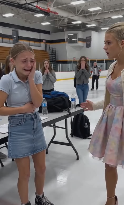
“I didn’t know she wrote that.”
I looked at her.
“You knew you slapped me.”
Her eyes filled.
She looked away.
Meredith gathered her coat. “This meeting is over. My attorney will contact the district.”
Principal Harlan shut the laptop halfway.
“No. The police liaison is already on the way, and so is the district superintendent.”
Meredith froze.
Then Ms. Calder picked up the crumpled form from the floor and handed it to me.
“Keep standing,” she whispered.
So I did.
Part 7: The Vote They Tried To Bury
The superintendent arrived in a navy coat dusted with snow.
Dr. Elaine Porter was not dramatic. She did not storm in or raise her voice. She listened, asked for the laptop, reviewed the files, and requested that the students directly affected be moved into the warming room with counselors before any more evidence was shown.
That small decision changed the feeling in my chest.
Finally, someone understood that proof could still hurt people if handled carelessly.
Tinsley sat on a bench near the skate rental counter, arms wrapped around herself. Brooke, Lila, and Maren sat far away from her now, as if distance could rewrite loyalty.
Meredith Morgan paced by the rink glass, speaking sharply into her phone.
Then Dr. Porter opened the original fundraiser ballot.
Not the assistance ticket form.
The vendor and policy ballot.
Parents and students had voted the previous week on whether the fundraiser should use private sealed envelopes or public sponsor tables for assisted tickets.
Private sealed envelopes had won by a landslide.
Eighty-seven to eleven.
The room reacted with exhausted anger.
Principal Harlan looked stunned. “I never saw this result.”
Mr. Voss, the treasurer, appeared near the back, face gray.
Dr. Porter turned to him. “Why not?”
He removed his glasses with shaking hands.
“Mrs. Morgan said the ballot was advisory.”
Ms. Calder’s voice was ice. “Was it?”
“No.”
“Then why was it ignored?”
Mr. Voss looked at Meredith.
She did not look back.
“She threatened to pull the rink sponsorship,” he said.
The hallway erupted.
Meredith snapped, “I offered this school thousands of dollars.”
A mother answered, “And thought that bought our children.”
That sentence stayed in the air like a cracked bell.
Dr. Porter raised a hand, and slowly the room quieted.
“Here is what will happen tonight,” she said. “The altered ticket system is canceled. All assistance distribution will follow district privacy policy. The fundraiser proceeds will be audited. The Morgan Foundation’s role is suspended pending review.”
Meredith’s face went cold. “You will regret that.”
Dr. Porter looked at her calmly.
“No. I regret not seeing this sooner.”
Then she turned to Tinsley.
“As for the assault and document falsification, those will be handled separately.”
Tinsley flinched at the word assault.
I did too.
Because hearing it made the slap real in a way my burning cheek had not.
Tinsley looked at me then.
Not angry.
Not superior.
Afraid.
“I’m sorry,” she whispered.
I wanted the apology to fix something.
It did not.
So I said the truth.
“Be sorry enough to tell them everything.”
Her lips parted.
Across the room, Meredith shook her head once.
A warning.
Tinsley saw it.
Then she stood.
Part 8: The Tickets With No Color
Tinsley’s voice shook so badly at first that Dr. Porter asked if she wanted water.
She said no.
Her pastel dress looked strange under the rink’s fluorescent lights now, too soft for the ugliness being pulled into the open. She stood beside the projector with her hands clenched and her mother staring at her like silence was still expected.
“I forged Ayla’s signature,” Tinsley said.
Meredith closed her eyes.
“I took her old sign-in sheet from the volunteer folder and copied it,” Tinsley continued. “Brooke, Lila, and Maren knew about the blue list, but I made the edited form.”
Brooke sobbed into her hands.
Tinsley looked at me once, then away.
“I slapped Ayla because she found the original ballot and I panicked.”
The hallway was quiet enough to hear skates cutting ice behind the glass.
Then Tinsley said the part her mother could not forgive.
“My mom told me the school needed people like us to make hard decisions because people like Ayla get emotional about money.”
Meredith stood. “Enough.”
Tinsley turned to her.
“No,” she said, and her voice steadied. “You taught me to call cruelty organization.”
That was the line that ended the room’s fear of Meredith Morgan.
Not the emails.
Not the camera footage.
That line.
The fundraiser did not continue that night. Dr. Porter closed the ticket table, refunded families who wanted to leave, and invited everyone else to skate for free while adults handled statements. No donor reception. No sponsor photos. No blue-marked list.
Just students on the ice, moving under pale winter lights with their names finally safe again.
The next weeks were messy.
Tinsley was suspended and removed from student leadership. Brooke, Lila, and Maren received disciplinary action and had to attend restorative meetings with students who agreed to participate. Mr. Voss resigned as treasurer. The Morgan Foundation lost its district partnership.
But the biggest change was quieter.
The school created a student privacy board, and Dr. Porter asked me to join it.
I almost said no.
I was tired of being the girl who fixed things adults should never have broken.
Then Mateo found me after English class.
“You don’t have to,” he said, eyes on his shoes. “But if you’re there, they’ll know we’re watching.”
So I said yes.
At the spring fundraiser, there were no special colors.
No public lists.
No donor engagement tables.
Every student received the same white envelope at advisory, whether it held a ticket, a thank-you note, or nothing at all. Nobody could tell. That was the point.
Tinsley came back to school in March.
She was quieter. Not magically kind. Not suddenly my friend. But she no longer walked like the hallway belonged to her.
One afternoon, she stopped beside my locker.
“I testified against my mom’s foundation,” she said.
“I heard.”
“She won’t speak to me.”
I looked at her carefully. “And was telling the truth worth that?”
Her eyes filled, but she nodded.
“I think it has to be.”
I closed my locker.
For a moment, we stood there as students moved around us, carrying backpacks, laughing, complaining about homework, living inside a school that had almost turned their private struggles into decoration.
Tinsley touched her own cheek, as if remembering the slap from the other side.
“I can’t undo it,” she said.
“No,” I answered. “You can’t.”
She accepted that without arguing.
That mattered more than another apology.
Weeks later, the final audit report was posted publicly with student names removed. At the bottom was a new district rule: no fundraiser, donor program, or school event could identify students receiving financial help in any visible or traceable way.
Ms. Calder printed the rule and taped it inside the volunteer closet.
Then she handed me the old crumpled form.
The one that had fallen when Tinsley slapped me.
“Do you want this destroyed?” she asked.
I looked at the paper, at the fake signature, at the blue marks blacked out by the district, at the evidence of how close they had come to making shame official.
“No,” I said.
I folded it carefully.
“Keep it in the file.”
Ms. Calder smiled a little. “For the record?”
I touched the place on my cheek where the bruise had faded but the memory had not.
“For the next student they think nobody will believe.”
