Part 2: The Microphone Caught Her Mother’s Whisper
The tiramisu cream was cold on my skin.
It slid from my cheek to my collarbone in one slow, humiliating line, and for a second I could not hear the party anymore. I saw only the bright flash of crystal chandeliers, the blur of diamonds, the silver trays, the marble floor shining under my shoes.
Then the room came back in pieces.
A gasp near the buffet.
A glass clinking too hard against a tray.
Someone whispering, “Oh my God, she actually did it.”
Genevieve Aldridge stood in front of me with her empty dessert plate still tilted in her hand, breathing like she had just won something.
“You don’t belong near that ceremony piece,” she said.
My fingers lifted toward my face, but I stopped myself. I would not wipe it away like I was ashamed. I would not give her that picture.
The emcee, Mr. Keating, had already raised the microphone when Genevieve’s mother stepped forward.
Helena Aldridge moved through the crowd in a silver gown that looked heavier than my rent. Her expression was perfect, worried in the way rich people looked worried when damage control had to happen fast.
“Genevieve,” she said softly.
But the microphone was still live.
Everyone heard the next words.
“I told you to handle this before the announcement, not in front of everyone.”
The room froze harder than the Alaska night outside the windows.
Genevieve’s face changed.
Her mother’s face changed faster.
Mr. Keating slowly lowered the microphone from his mouth, staring at it like it had betrayed him.
The committee chair, Mrs. Rourke, did not move. She held the technical hanging log in one hand, her reading glasses low on her nose. Behind her, suspended above the honor stage, the enormous crystal snowflake glittered like a thousand pieces of trapped ice.
That was what I had helped build.
Not by standing in photos.
Not by smiling beside donors.
By crawling under scaffolding, checking cable locks, relabeling weight tags, and catching a measurement error that could have sent the whole centerpiece crashing down during the ceremony.
Mrs. Rourke looked at Helena Aldridge.
“What exactly did you ask your daughter to handle?”
Helena’s smile returned, but only halfway.
“I meant emotionally,” she said. “Genevieve was upset. This is a misunderstanding.”
A laugh came from the back of the room.
Not loud.
Not friendly.
It belonged to Mr. Voss, the retired engineer who had supervised the rigging crew. He stepped forward with his cane tapping once against the marble.
“No,” he said. “The misunderstanding is that you thought nobody kept copies.”
Genevieve’s plate slipped from her hand and shattered at her feet.
I flinched.
She did not.
She was staring at Mr. Voss like he had just opened a door she had locked from the inside.
Mrs. Rourke turned the document toward the crowd.
“The technical log states Lucia Morgan identified the incorrect load rating on the west suspension cable at 4:42 p.m. yesterday,” she said. “It also states she refused to sign off until the cable was replaced.”
People began looking up.
At the crystal snowflake.
At the cable lines.
At the stage where the scholarship recipients and donors were supposed to stand in fifteen minutes.
Mrs. Rourke’s voice sharpened.
“If Lucia had stayed quiet, half this room would have been standing under unsafe rigging tonight.”
The cream on my face suddenly felt less like humiliation and more like evidence.
Genevieve whispered, “She’s lying.”
Mr. Voss lifted his cane and pointed toward the projection booth.
“Then play the maintenance camera.”
Part 3: The Camera Above The Service Door
The projection screen behind the stage came alive with a pale blue glow.
No one sat down.
Nobody wanted to be the first person to act like this was normal.
A technician in a black vest clicked through a security folder while Genevieve kept shaking her head.
“You can’t show that,” she said. “That hallway is staff-only.”
Mrs. Rourke looked at her. “Exactly.”
The video opened on the service corridor behind the ballroom. It was not glamorous like the party. It was gray walls, stacked crates, extension cords, and the dull metal frame of the stage lift.
Then I appeared on screen.
My hair was tied back. My sleeves were pushed up. I was holding a clipboard in one hand and a small flashlight in the other. I looked tired. Not lucky. Not decorative. Tired.
Mr. Voss appeared beside me, leaning heavily on his cane.
On the video, I pointed up toward the rigging label.
The crowd could not hear what I said, but they saw Mr. Voss’s face tighten. They saw him take the flashlight. They saw both of us check the tag again.
Then another figure entered the corridor.
Genevieve.
Not in her ruby gown yet. In a white rehearsal dress, her phone in her hand, irritation written across her whole body.
She spoke to me. I shook my head.
She stepped closer.
I shook my head again and pointed toward the cable.
Then Genevieve reached for my clipboard.
I pulled it back.
A ripple moved through the room.
The video continued. Genevieve turned away, made a call, and stood with her back to the camera. A moment later, Helena Aldridge entered the corridor.
My stomach went tight.
I remembered that moment.
Helena’s perfume had reached me before her words did, sharp and expensive over the smell of metal and dust.
On screen, Helena spoke to Mr. Voss first. He looked unmoved. Then she turned to me.
I remembered her smile.
Gentle. Polished. Dangerous.
“You’re clearly overwhelmed, sweetheart,” she had said. “Maybe let the adults handle the technical parts.”
I had shown her the numbers.
She had stopped smiling.
The video showed Helena taking the log from my hand. She read it. Genevieve looked over her shoulder. Then Helena glanced directly at the camera.
The technician paused the video.
Mrs. Rourke’s voice was quiet.
“Why did she look at the camera?”
Mr. Voss answered, “Because she knew exactly where it was.”
The technician pressed play again.
Helena stepped toward the wall.
The camera angle went black.
The ballroom erupted.
“She covered it?”
“Why would she do that?”
“Was she trying to hide the cable issue?”
Genevieve finally shouted, “Because Lucia was ruining everything!”
Her words sliced through the noise.
I turned toward her.
Her eyes were wet now, but furious wet, not sorry wet.
“This was supposed to be my night,” she said. “My family funded the ceremony. My mother designed the snowflake. I was supposed to hang the final crystal, not some charity invite.”
The phrase hit exactly where she meant it to.
Charity invite.
My hands curled at my sides.
Mrs. Rourke’s face hardened.
“Lucia was not invited by charity. Lucia was selected by the safety committee.”
Genevieve laughed bitterly.
“Because she scared everyone with numbers.”
Mr. Voss took one step forward.
“No,” he said. “Because she saved your mother from being remembered for a disaster.”
Helena’s hand flew to her necklace.
And I knew, from the way she touched it, that the disaster was not the only thing she was hiding.
Part 4: The Crystal With The Wrong Name
Mrs. Rourke ordered a staff member to bring towels.
A young waiter hurried toward me with a clean white cloth, his face red with embarrassment, as if he had personally thrown the dessert. I took it and wiped my eyes first, then my mouth, then the front of my dress.
The cream left a stain.
Of course it did.
Genevieve looked at that stain like it comforted her.
Mr. Keating cleared his throat. “We should move the ceremony to the side hall until we understand—”
“No,” Mrs. Rourke said.
The single word stopped him.
She looked up at the crystal snowflake.
“Bring down the centerpiece.”
Helena snapped, “Absolutely not.”
Mrs. Rourke turned slowly. “Why?”
The question landed too cleanly.
Helena’s lips parted.
Genevieve looked at her mother.
For the first time, I saw something pass between them that was not confidence. It was fear.
Mr. Voss tapped his cane twice. “The lift is already calibrated. We can lower it safely.”
Two rigging workers moved to the control panel. The ballroom watched as the huge crystal snowflake began descending from above the honor stage.
It came down slowly, shining cold light across everyone’s faces.
The closer it got, the more beautiful it became. Hundreds of crystal pieces hung from a metal frame shaped like branching ice. Each point carried a small engraved charm, names of old donors, previous honorees, committee families.
I had polished several of them myself.
Not because anyone asked.
Because fingerprints showed under stage lights, and I knew no one would remember the person who cleaned them.
The centerpiece stopped at chest height.
Mrs. Rourke stepped close.
“So,” she said, “where is the final crystal?”
Helena lifted her chin. “Genevieve has it.”
Genevieve’s face drained.
Her mother looked at her sharply.
“Genevieve.”
Genevieve reached into the small ruby clutch hanging from her wrist. Her fingers trembled as she pulled out a long, narrow crystal charm wrapped in velvet.
The photographer raised his camera.
Genevieve unwrapped it.
The charm glittered under the chandelier.
But Mrs. Rourke did not reach for it.
She stared at the engraving.
Then she looked at me.
My breath caught.
“What?” Genevieve demanded.
Mrs. Rourke took the charm at last and held it so Mr. Voss could see.
His face went still.
On the crystal, in delicate silver letters, was not Genevieve Aldridge.
It was not Helena Aldridge.
It was my name.
LUCIA MORGAN.
A sound moved through the ballroom, not quite a gasp, not quite a whisper.
Genevieve’s voice cracked. “That’s impossible.”
Mrs. Rourke looked at Helena.
“Would you like to explain why the final honor crystal carries Lucia’s name?”
Helena’s mouth tightened.
I could barely breathe.
“I don’t understand,” I said.
And I didn’t.
I had helped with the safety log. I had corrected the cable rating. I had stayed late because the workers needed one more person to read the measurements from below.
But nobody had told me anything about an honor crystal.
Genevieve suddenly turned on her mother.
“You said mine was delayed.”
Helena did not answer.
Genevieve stepped closer. “Mom.”
Mrs. Rourke’s eyes narrowed.
“What did you do?”
Helena’s polished face finally cracked.
She looked at me, and for one terrifying second, her expression was not contempt.
It was guilt.
Then a man’s voice came from behind the crowd.
“She replaced the nomination file.”
Everyone turned.
An older man in a dark coat stood near the ballroom doors, snow melting on his shoulders.
I recognized him from the foundation website.
Arthur Aldridge.
Genevieve’s grandfather.
And he was holding an envelope sealed with the committee’s gold stamp.
Part 5: The Envelope From The Founder’s Vault
Arthur Aldridge walked into the ballroom as if the room still belonged to him, even though he moved slowly and leaned on a black cane.
Genevieve whispered, “Grandfather?”
Helena looked like she might faint.
Arthur did not look at either of them. He looked at me.
“Miss Morgan,” he said, “I owe you an apology before anyone owes you applause.”
I had no idea what to say.
The entire ballroom seemed to lean forward.
Arthur handed the sealed envelope to Mrs. Rourke.
“This is the original selection packet from the founder’s vault,” he said. “I requested it after receiving a troubling phone call from Mr. Voss this afternoon.”
Mr. Voss gave one small nod.
Mrs. Rourke broke the seal.
Inside was a formal nomination sheet, printed on thick cream paper. She read silently at first. Her eyes moved fast, then slower, then stopped.
When she spoke, her voice had changed.
“The final crystal honor was awarded this year to Lucia Morgan for preventing a structural failure during installation and for documenting unsafe donor interference.”
Donor interference.
Helena closed her eyes.
Genevieve looked at her mother as if she no longer recognized her.
Mrs. Rourke pulled out a second page.
“This packet was signed yesterday by Arthur Aldridge, Mr. Voss, myself, and two members of the safety committee.”
Arthur turned to Helena.
“And then my daughter-in-law filed a replacement program naming Genevieve as ceremonial honoree.”
Helena’s voice came out thin. “I was protecting the family.”
“No,” Arthur said. “You were protecting the family image from the family behavior.”
Genevieve flinched like the words hit her physically.
For one second, I almost felt sorry for her.
Almost.
Then I remembered the plate hitting my face.
Helena straightened, gathering the last scraps of her pride.
“You think this girl deserves to represent us?” she asked. “She arrived through a service entrance yesterday.”
Arthur’s eyes sharpened.
“She arrived through a service entrance because you sent her there.”
The room went silent again.
I remembered that too.
The front desk had told me volunteers and technical assistants used the back entrance. I had not questioned it. I was used to side doors. Used to being helpful where no one needed to introduce me.
Arthur looked at the crowd.
“Lucia was invited through the main entrance. Her badge was changed.”
Mrs. Rourke pulled another paper from the envelope.
A guest credential form.
My name.
Original category: Honor Recipient.
Altered category: Technical Volunteer.
Changed by: H. Aldridge.
My throat closed.
I had not been lucky to be invited.
I had been invited with honor, then quietly moved to the shadows so Genevieve could stand in my place.
Genevieve stared at her mother.
“You told me she was trying to steal it.”
Helena’s lips trembled.
“She was.”
Arthur’s cane struck the floor once.
“No, Helena. You stole it first.”
The words echoed under the chandeliers.
And then, above us, one of the crystal branches gave a sharp metallic ping.
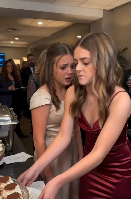
Every face lifted.
The snowflake trembled.
Mr. Voss shouted, “Back from the stage!”
Part 6: The Snowflake Started To Fall
The first crystal dropped like a tear.
It hit the marble and shattered.
Then another cable shifted.
The beautiful snowflake tilted, just a few inches, but enough to send panic through the room.
People screamed.
Chairs scraped backward.
Photographers stumbled away from the stage.
Mrs. Rourke grabbed my arm. “Lucia, move.”
But I was already looking at the west suspension line.
Not the cable I had flagged yesterday.
The replacement cable was holding.
This was something else.
The decorative branch on the right side had been overloaded with extra crystal charms. I saw them now, clustered too thickly near one point, pulling the frame unevenly.
“Stop the lift!” I shouted.
The operator froze with his hand over the control.
Mr. Voss looked where I pointed.
His face went white.
“Counterweight imbalance,” he said.
The snowflake groaned.
My body moved before my fear caught up.
I ran toward the side of the stage where the manual stabilizer rope hung behind a velvet curtain. Mr. Voss had shown it to me yesterday, half joking that old systems were honest because they made you use your hands.
Genevieve screamed, “What is she doing?”
I grabbed the rope.
It burned against my palms as the frame pulled.
A worker ran to help me, then another. Mr. Voss shouted instructions. Mrs. Rourke ordered guests back. Arthur Aldridge moved surprisingly fast, blocking people from rushing toward the wrong exit.
The snowflake dipped again.
For one awful second, the whole ballroom saw what could have happened if it had fallen during the honor ceremony.
Not a scandal.
A tragedy.
My arms shook.
The rope slipped an inch.
Then someone grabbed it beside me.
Genevieve.
Her ruby gown dragged across the marble, dessert plate fragments glittering near her shoes. Her face was streaked with tears.
“I don’t know what to do,” she gasped.
“Pull when I say,” I said.
She nodded.
No argument. No insult.
Just fear.
“Now!”
We pulled together.
The frame steadied.
The workers locked the emergency brace into place. Mr. Voss limped to the control panel and gave the command to lower the snowflake the rest of the way. It sank slowly, trembling, until its metal base touched the stage platform.
The second it was safe, my knees nearly gave out.
Genevieve let go of the rope and stared at her red palms.
For the first time all night, she looked at me without trying to stand above me.
“You knew,” she whispered. “You knew how to stop it.”
I swallowed, breathing hard.
“I listened when people explained things.”
Her face crumpled.
That answer hurt her more than anger would have.
Mr. Voss examined the overloaded branch and removed three extra crystal charms.
His mouth tightened.
“These were added after final inspection.”
Helena looked sharply at Genevieve.
Genevieve shook her head. “No. I didn’t.”
Arthur stepped closer to the branch.
He picked up one loose charm.
The engraving faced outward.
ALDRIDGE LEGACY CIRCLE.
Then another.
HELENA ALDRIDGE, CEREMONY VISIONARY.
Then a third.
GENEVIEVE ALDRIDGE, FUTURE CHAIR.
Arthur turned them in his palm.
Helena whispered, “They were symbolic.”
Mr. Voss’s voice was cold.
“They nearly brought the structure down.”
Part 7: The Apology Nobody Expected
Security guided guests into the adjoining winter garden while the stage crew secured the centerpiece.
Nobody wanted to leave.
They lingered beneath glass walls glazed with frost, whispering beside sculpted ice displays and untouched champagne towers. The luxury party had become a disaster scene dressed in velvet.
I sat on a bench near a potted spruce, wrapping a towel around my stained dress.
My palms were red from the rope.
Genevieve stood a few feet away, staring at her own hands.
For once, no friends surrounded her.
No photographers.
No mother smoothing her hair.
Just silence.
She looked younger than eighteen in that moment. Not innocent. Just smaller.
“I thought,” she began, then stopped.
I looked at her.
She swallowed.
“I thought if they honored you, it meant everything my mother promised me was fake.”
I did not answer quickly.
Because the cruelest thing was, she was probably right.
Not about me.
About the promise.
Genevieve’s whole life had been arranged like that crystal snowflake—beautiful, expensive, and hanging from pressure points nobody wanted to discuss.
But being pressured did not give her the right to break someone else.
“You threw dessert at me,” I said.
Her eyes filled again.
“I know.”
“In front of everyone.”
“I know.”
“You called me charity.”
Her mouth trembled.
“I know.”
The apology came out barely above a whisper.
“I’m sorry, Lucia.”
I wanted it to fix something.
It did not.
Not completely.
But it was the first honest thing she had given me all night.
Before I could respond, Helena Aldridge entered the winter garden with two security staff behind her. Her face was composed again, but now the composure looked fragile, like glass already cracked.
Arthur followed with Mrs. Rourke.
“The committee has made a decision,” Mrs. Rourke announced.
The whispers died.
“The honor ceremony will continue tonight in modified form. The crystal snowflake will not be raised again. It will remain grounded on the stage as a reminder that beauty without safety is failure.”
Mr. Voss nodded once.
Mrs. Rourke looked at me.
“Lucia Morgan remains the final crystal honoree.”
My chest tightened.
Then she turned to Helena.
“And the Aldridge family will no longer control the ceremony program.”
A shock moved through the room.
Helena’s eyes flashed. “You cannot remove us from our own event.”
Arthur stepped forward.
“Yes,” he said. “We can. I founded the grant. I never intended it to become a mirror for our vanity.”
Genevieve looked at him.
“Grandfather,” she whispered.
His expression softened, but only slightly.
“You will make public amends,” he said. “Not because it saves your reputation. Because it may be the first real thing you have done all evening.”
Genevieve looked terrified.
Helena grabbed her daughter’s wrist. “She will do no such thing.”
Genevieve pulled her hand away.
It was small.
It was quiet.
But everyone saw it.
“No,” Genevieve said. “I will.”
Helena stared at her.
And then Genevieve walked toward the ballroom doors, leaving her mother standing alone under the winter garden lights.
Part 8: The Crystal Hung Lower But Shined Brighter
They did not clean my dress before the ceremony.
Mrs. Rourke offered. A staff member offered. Even Genevieve, awkwardly, offered to find something from her own garment bag.
I said no.
The stain stayed.
Not because I wanted pity.
Because I wanted everyone to remember what happened before the truth became comfortable.
The ballroom had changed when we returned.
The crystal snowflake sat grounded at the center of the stage, no longer floating above us like a perfect dream. Up close, I could see the scratches on the metal frame, the fingerprints, the replaced cable, the places where emergency hands had steadied it.
It was more beautiful that way.
Real things usually are.
Mr. Keating stepped to the microphone, paused, and checked twice that it was on. A nervous laugh moved through the room.
Then Genevieve walked onto the stage.
No music played.
No applause came.
She stood beside the grounded snowflake in her ruby gown, with rope burns on her palms and shame in her eyes.
“I lied,” she said.
Two words.
The room held its breath.
“I let people believe Lucia Morgan was only here because someone felt sorry for her. I said that because I wanted her place. Then I humiliated her because I thought if everyone looked at the stain, nobody would look at the record.”
She turned toward me.
Her voice shook.
“But Lucia was the reason this ceremony was safe enough to happen. And when it became unsafe again, she helped save it anyway.”
She looked down at her hands.
“I don’t deserve to hang the final crystal.”
Then she stepped off the stage.
No performance.
No tears for sympathy.
Just the truth, left where everyone could see it.
Mrs. Rourke called my name.
For a moment, my feet would not move.
Then Mr. Voss stood from his chair with difficulty. Mia, one of the junior volunteers from the coat station, stood too. Then the waiters. Then the stage crew. Then Arthur Aldridge.
The room rose in pieces.
Not everyone.
But enough.
I walked to the stage with tiramisu still faintly sweet in my hair and my hands still sore from the rope.
Mrs. Rourke handed me the crystal charm engraved with my name.
It was heavier than I expected.
Arthur Aldridge approached with a small hook and a lowered branch from the snowflake.
“Would you like it placed at the top?” he asked gently.
I looked at the grounded centerpiece.
At the empty highest point where Genevieve’s charm had been meant to hang.
Then I looked at the lower branches, where the names of technicians, volunteers, drivers, kitchen staff, and past scholarship winners had been added quietly over the years, almost hidden beneath the donor crystals.
“No,” I said.
The microphone carried my answer.
“I want it here.”
I pointed to the lower frame.
Beside the maintenance crew charm.
Beside the safety inspection tag.
Beside the names nobody photographed.
Mrs. Rourke’s eyes shone.
Arthur smiled slowly.
Together, we fastened my crystal there.
Not above everyone.
With everyone.
The applause came differently than I imagined. Not explosive. Not fancy. It grew warm and uneven, like people were still learning how to clap for the truth.
Helena Aldridge left before it ended.
Genevieve stayed.
Weeks later, the Aldridge Society announced a new rule: every ceremony centerpiece, scholarship stage, and donor installation would require independent safety approval, with student workers credited by name.
Mr. Voss asked me to intern with his engineering nonprofit.
Mrs. Rourke gave me a copy of the technical log, framed simply in black wood.
And Genevieve sent one note, handwritten on plain paper.
No excuses.
Just six words.
“You belonged before I understood why.”
I kept the note folded inside the frame.
Not because I needed her approval.
Because it reminded me that some people only see the truth after they fail to destroy it.
The night Genevieve Aldridge threw dessert at me, she thought she had marked me as someone small.
Instead, under a grounded crystal snowflake in a ballroom full of witnesses, the stain became the first thing that proved I had never been invisible.
