Part 2: The Photo She Tried To Hide
The photo slid across the marble floor faceup.
For one second, nobody moved toward it.
Not Seraphina Aldridge, who was still clutching the folder like it was a weapon. Not the donors standing under the gold chandeliers. Not the photographer near the stage, whose camera hung from his neck while his mouth stayed half-open.
I saw the corner of the photo first.
A cracked gilt frame.
A gloved hand.
A smear of red paint across antique wood.
Then the staff member who had brought the folder, a young woman named Maribel from the restoration team, dropped to her knees and grabbed the photo before Seraphina could step on it.
“Don’t,” Maribel said, her voice shaking. “That’s part of the record.”
Seraphina laughed, but the sound came out wrong.
“The record?” she said. “She spilled something on my family’s display and now you’re acting like she saved the building?”
Chocolate was still soaking into the front of my dress. It smelled sweet and rich and sickening under the sharp scent of roses and champagne.
I wanted to wipe it off, but my hands would not move.
The committee chair, Mrs. Harlow, stepped forward. She was small, silver-haired, and usually gentle with everyone. That night, her face looked carved from stone.
“Give me the folder, Seraphina.”
Seraphina held it tighter.
“My mother needs to see this first.”
Mrs. Harlow looked at the donors, then back at her.
“No. The committee needs to see it now.”
The room shifted.
People who had looked at me like an accident suddenly looked at Seraphina like a locked door.
Maribel stood and placed the photo on top of the folder still trapped in Seraphina’s hands.
“That first photo,” she said, “was taken at 2:13 this afternoon.”
Mrs. Harlow looked down.
Her face changed.
“What am I looking at?”
Maribel pointed with one trembling finger.
“The Aldridge Heritage Mural. Before Willa repaired it.”
A low murmur moved across the room.
Everyone knew the mural. It covered the wall behind the ceremony stage, a hundred-year-old painted city skyline with gold leaf windows and a ribbon of blue lake water under the buildings. The gala was built around unveiling it after six months of expensive restoration.
But in the photo, the mural looked damaged.
A long, ugly streak cut through the lower corner, right across the painted foundation of the first Aldridge building.
Mrs. Harlow whispered, “This was hidden from me.”
Seraphina’s eyes flashed. “Because it was handled.”
Maribel turned toward me.
“No,” she said. “Willa handled it.”
Every face turned.
My throat tightened.
I remembered the smell of dust in the restoration room. The panic when I saw the streak. The way the assistant curator kept saying they would have to cover the mural with flowers and hope the press did not ask questions.
I remembered kneeling there in borrowed gloves, testing solvent on the smallest possible corner because the older restorer’s hands were shaking too hard.
Mrs. Harlow took the folder from Seraphina.
This time, Seraphina let go.
The chair opened it and read the first page aloud.
“Final restoration log. Emergency surface correction completed by Willa Gray after unauthorized pigment damage discovered near donor plaque section.”
Her voice sharpened on the next line.
“Work verified by Dr. Eleanor Price, lead conservator.”
Somewhere near the front row, an older woman in a black velvet jacket stood.
“That is correct,” Dr. Price said.
Seraphina went pale.
Mrs. Harlow looked at her.
“Unauthorized pigment damage,” she repeated. “Who damaged the mural?”
Before Seraphina could answer, another photo slipped from the folder.
This one landed at my feet.
I looked down.
And my stomach turned cold.
It showed Seraphina in front of the mural, holding a red paint marker.
Part 3: The Mural Remembered Everything
Seraphina moved before anyone else did.
Her heel struck the floor beside the photo, but I bent faster and picked it up with shaking fingers.
The chocolate on my dress dripped onto my wrist. I barely felt it.
The photo was clear.
Too clear.
Seraphina stood in the restoration room wearing a white satin robe over her gown, her hair pinned halfway up, her mouth open mid-laugh. In her hand was the red marker used by restoration staff for temporary grid lines.
Behind her, the mural was exposed.
And across the lower corner, before the ugly streak became wide, someone had written two words in red:
CENTER HER.
Nobody understood at first.
Then Dr. Price spoke.
“That marker was not paint,” she said slowly. “It was a conservation pencil meant for removable measurements. But on unrestored gold leaf, used with pressure, it stains.”
Mrs. Harlow looked at Seraphina. “Why would you write that?”
Seraphina’s lips parted.
No sound came out.
A donor near the front whispered, “Center her?”
Maribel’s voice rose, stronger now.
“She meant herself.”
The silence that followed was not empty. It was full of people understanding one piece at a time.
The ceremony stage had been arranged around the mural. The center mark, where the honoree was supposed to stand during the unveiling, had been moved that afternoon. I had noticed it, corrected it, and then found the damage behind the draped cloth.
Seraphina had not splashed chocolate on me because she thought I embarrassed the event.
She did it because the folder proved she had almost ruined it first.
Mrs. Harlow turned a page.
“There are more photos.”
Seraphina whispered, “Please.”
The word was tiny.
It almost made people pity her.
Then Mrs. Harlow revealed the second photo.
This one showed Seraphina with two friends in the restoration room. One of them held the ceremonial floor plan. The other pointed at the center mark. Seraphina had the marker pressed against the mural’s protective sheet, laughing like rules were decorations.
Dr. Price walked forward slowly.
“I locked that room at noon,” she said. “Only committee members and authorized family representatives had access cards.”
Mrs. Harlow’s eyes narrowed.
“Seraphina, how did you get in?”
Seraphina looked toward the ballroom entrance.
That was when her mother arrived.
Vivienne Aldridge moved through the doorway in a pale gold gown, her diamond earrings glittering every time she turned her head. She did not rush. She never rushed. People like Vivienne made rooms wait for them.
“What is happening here?” she asked.
Then she saw my dress.
For one strange second, her eyes flickered with satisfaction.
Then she saw the photos.
That satisfaction vanished.
Mrs. Harlow faced her. “Your daughter accessed the restoration room and damaged the mural.”
Vivienne smiled faintly.
“That is a serious accusation to make in a room full of donors.”
Dr. Price lifted the log.
“It is a documented accusation.”
Vivienne looked at me then.
Not at my face.
At the chocolate stain.
“Willa Gray,” she said softly. “This evening has become very unfortunate for you.”
I should have looked away.
I did not.
“No,” I said, my voice trembling but clear. “It became unfortunate for Seraphina when the folder opened.”
Part 4: The Woman Behind The Donor Wall
Vivienne Aldridge’s smile did not break.
That was worse.
She crossed the room toward me, her perfume cutting through the smell of chocolate, roses, and old varnish.
“Young lady,” she said, “do you understand how much this family has given to this institution?”
I heard someone behind me mutter, “Here we go.”
Mrs. Harlow stepped between us.
“That is not the question.”
Vivienne’s eyes stayed on me. “It is always the question.”
My face burned again, but this time it was not shame.
It was anger.
Because she meant it.
She meant money could become a door, a lock, a broom, a blindfold. Money could clean up a daughter’s mistake and sweep a poorer girl behind the curtains.
Dr. Price moved beside Mrs. Harlow.
“I need to add something,” she said.
Vivienne’s head turned sharply.
Dr. Price did not flinch.
“At 2:29 p.m., after Willa began the emergency repair, Mrs. Aldridge entered the restoration room and instructed me to list the correction as work completed by the Aldridge preservation fund.”
Vivienne’s face hardened.
“That is not how I phrased it.”
Dr. Price’s mouth tightened. “No. Your exact words were, ‘The public does not need a confusing little worker story when the family name already explains excellence.’”
A sound moved through the donors.
Not loud.
Enough.
Seraphina looked at her mother.
“You said it would be fine.”
Vivienne’s eyes flashed at her daughter.
“I said be quiet.”
The microphone near Mr. Keating’s hand was still on.
The words traveled through every speaker in the ballroom.
Vivienne realized it instantly.
Mrs. Harlow closed her eyes for half a second, almost like she was tired of the room revealing itself faster than she could manage.
Then the big screen behind the stage blinked.
Everyone turned.
The technician in the projection booth leaned out, confused.
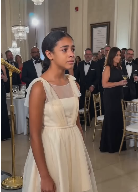
“I’m sorry,” he called. “The gala slideshow is auto-starting.”
A polished video filled the screen.
A tribute to the Aldridge family.
Black-and-white photos. Old buildings. Elegant captions. Smiling board members. The donor wall.
Then the image changed to a behind-the-scenes clip from that afternoon.
The restoration room.
The mural.
Me.
I was kneeling in front of the damaged gold leaf, wearing gloves, my hair tied back, my face serious under the work lights. Dr. Price stood beside me, watching closely as I tested the correction.
Maribel gasped.
“That footage wasn’t supposed to be in the public reel.”
Vivienne’s face drained of color.
The clip continued.
My voice came faintly through the speakers.
“If we rush this, the gold will lift. We need thinner pressure, not more solvent.”
Dr. Price’s voice answered.
“You’ve done this before?”
I shook my head on screen.
“No. I just read the restoration packet twice.”
Someone laughed softly.
Not mockery.
Amazement.
Then the video showed Vivienne entering the room.
The room on screen became tense.
Vivienne’s voice played clear through the speakers.
“Cover the damaged section with flowers. Let Seraphina stand center. Nobody came here to applaud Willa Gray.”
The entire ballroom went still.
Then the clip revealed one more thing.
Seraphina, standing behind her mother, whispering:
“If she walks onstage, I’ll make sure nobody looks at anything but her dress.”
Part 5: The Dress Became Evidence
The chocolate stain suddenly felt different.
Not dirty.
Planned.
A waiter appeared beside me with a damp cloth, but Mrs. Harlow gently stopped him.
“Not yet,” she said.
I looked at her, confused.
Her voice softened.
“Willa, I’m sorry. But that dress is now evidence of what she just admitted.”
Evidence.
The word steadied me.
Seraphina had wanted the stain to shrink me. Instead, it had become the loudest witness in the room.
Vivienne turned toward the projection booth.
“Turn that off.”
The technician hesitated.
“Now.”
Mrs. Harlow said, “Leave it.”
Vivienne stared at her. “You are making a mistake.”
“No,” Mrs. Harlow replied. “I made the mistake when I trusted your family’s version before checking the record.”
Seraphina’s breathing grew shallow.
Her friends, who had been standing near the photographers all evening, had moved away from her without making a scene. That made it worse. They did not defend her. They did not even look shocked anymore.
They looked relieved that the room had chosen someone else to blame.
I knew that look.
People liked truth best when it arrived with a name attached.
Dr. Price took the microphone.
“I want the donors to understand what Willa did,” she said. “The mural behind this stage was not simply decorative. Its lower section contains original gold leaf from 1928. The wrong cleaning method would have destroyed the surface permanently.”
She turned toward me.
“Willa preserved it.”
A few people began clapping.
Then more.
The applause felt strange. Too warm. Too sudden. I stood there in a ruined dress, wishing I could step out of my own skin.
Seraphina’s face twisted.
“She’s not even a real conservator,” she snapped.
The clapping stopped.
“She’s a committee assistant.”
That word hit hard because it was true and not true at the same time.
I was an assistant. I carried boxes, checked lists, printed labels, refilled water cups, and stayed late when paid staff went home.
But I had also read every restoration note because I cared. Because old things deserved careful hands. Because no one had told me I was allowed to care less.
Dr. Price looked at Seraphina.
“Titles do not repair murals. People do.”
Mrs. Harlow nodded. “And tonight, the person who repaired ours will stand center.”
Vivienne stepped forward.
“If that girl stands center, the Aldridge family withdraws its pledge.”
The room seemed to drop ten degrees.
The pledge was the reason half the donors had come. The Aldridge name was printed on the program cover, the wall banner, the invitation seal.
Mrs. Harlow went still.
I saw the calculation on every face.
Truth had been inspiring when it cost nothing.
Now it had a price tag.
Vivienne knew it too. Her smile returned.
“Let us be sensible,” she said. “Clean the dress. Remove the footage. Let Seraphina apologize privately. The gala continues. The institution survives.”
Nobody spoke.
Then a voice came from the back of the room.
“No.”
Everyone turned.
An elderly man in a plain black suit stood near the entrance, holding a worn leather binder.
He looked at Vivienne with tired eyes.
“The institution survived before your pledge,” he said. “It will survive after your threat.”
Vivienne whispered, “Father.”
Seraphina looked like the floor had vanished beneath her.
The man stepped forward.
And every donor in the room suddenly understood.
Gideon Aldridge had arrived.
Part 6: The Founder’s Binder Opened
Gideon Aldridge was not listed on the program.
He had not appeared in the tribute video. His photograph was on the donor wall, yes, but as history, not as a person expected to walk into the room with snow still dusting his shoulders.
He moved slowly, but nobody interrupted him.
Even Vivienne stepped back.
Gideon stopped beside the stage and placed the leather binder on a marble table. The cover was cracked at the corners, the kind of old object no one dared call ugly because it carried too much memory.
“I built the first Aldridge fund with my wife,” he said. “Not so my descendants could rent admiration.”
Vivienne’s face tightened. “This is not the place.”
“It is exactly the place.”
He opened the binder.
Inside were yellowed letters, photographs, old board minutes, and a folded document sealed in plastic.
Gideon looked at me.
“Miss Gray, did anyone tell you why the mural mattered tonight?”
I shook my head.
My voice barely came out. “Only that it was the centerpiece of the restoration.”
He nodded sadly.
“That is what they made it. But that is not what it was.”
He lifted an old photograph.
The same mural appeared in black and white, unfinished, with workers standing beneath it in paint-spattered clothes.
Gideon pointed to a young woman on a ladder.
“This was Clara Voss,” he said. “The artist who restored the mural after the 1956 fire. She was not wealthy. She was not invited to donor dinners. But she saved the wall when my family nearly abandoned it.”
Mr. Keating whispered, “Voss?”
Dr. Price turned toward the elderly engineer sitting near the front.
“Your mother?”
Mr. Voss nodded once, his eyes wet.
Gideon turned a page.
“Clara’s name was removed from the dedication plaque before the unveiling because the board felt a working woman did not match the image of the gala.”
The room was silent now in a different way.
A deep way.
Gideon looked at Vivienne.
“I spent sixty years regretting that I allowed it.”
Vivienne’s jaw clenched. “This has nothing to do with Willa Gray.”
Gideon placed the old dedication document beside the restoration log.
“It has everything to do with her.”
He turned the binder so the committee could see.
“My wife left instructions before she died. If the mural was ever restored again, the center honor would go to the person who protected the work, not the person who funded the room.”
Mrs. Harlow covered her mouth.
Gideon reached into the binder and removed a small brass plaque.
It was wrapped in cloth.
He unfolded it carefully.
The engraved name caught the chandelier light.
CLARA VOSS — RESTORER OF THE ALDRIDGE MURAL.
Mr. Voss lowered his head.
Gideon’s voice shook.
“I brought this tonight to correct an old wrong. I did not know I would find the same wrong happening again.”
He looked at Seraphina.
Then Vivienne.
Then me.
“The center of the ceremony belongs to Willa Gray.”
Vivienne’s voice came out low and sharp.
“If you do this, the family name will be humiliated.”
Gideon closed the binder.
“No,” he said. “The family name will finally tell the truth.”
Part 7: Seraphina Faced The Room Alone
The ceremony did not begin with music.
It began with waiting.
Staff moved the donor podium away from the center of the stage. Someone quietly removed the Aldridge banner from behind the flowers. Dr. Price and Mr. Voss checked the mural lights one last time while Mrs. Harlow spoke with the board in a tight circle near the side curtains.
Vivienne stood apart from everyone, her hands folded so tightly her rings pressed into her skin.
Seraphina stood near the first row, alone.
For most of the evening, I had seen her as untouchable. A girl made of diamonds, silk, and casual cruelty. But under the stage lights, with her mother refusing to look at her and her grandfather holding the truth like a blade, she looked painfully human.
That did not erase what she had done.
It only made it harder to hate her cleanly.
A staff member brought me a wrap to cover my stained dress. I almost took it.
Then I remembered what Mrs. Harlow said.
Evidence.
I left the stain visible.
Mrs. Harlow returned with the microphone.
“The board has voted,” she announced. “The Aldridge pledge will not determine tonight’s honoree. The mural dedication will proceed according to the founder’s original restoration clause.”
Vivienne laughed once. “You will regret this.”
Gideon looked at her.
“I already regret enough.”
Mrs. Harlow turned to Seraphina.
“Before we continue, you have a choice. You may leave quietly, or you may address what happened.”
Vivienne snapped, “She will leave.”
Seraphina did not move.
Her eyes were fixed on my dress.
I expected another insult. Another lie. Another polished sentence her mother had taught her.
Instead, Seraphina walked onto the stage.
Her designer gown whispered across the floor. Her hands shook when she took the microphone.
At first, nothing came out.
The ballroom waited.
“I thought the center spot was mine,” she said finally. “I thought that because people kept telling me it was. My mother. My friends. This room.”
Vivienne’s face went rigid.
Seraphina swallowed.
“But Willa earned it. And when I found out, I didn’t just get angry. I tried to make her look dirty because I felt dirty being replaced.”
My chest tightened.
Seraphina looked at me.
“I splashed chocolate on her dress before the cameras turned on because I wanted the first picture of her to be humiliating.”
Someone gasped.
Seraphina’s mouth trembled.
“I damaged the mural by accident. Then I let my mother try to hide it. Willa fixed what I damaged. And I punished her for saving me from being exposed sooner.”
She lowered the microphone.
For the first time all night, Vivienne looked afraid.
Not of scandal.
Of losing control.
“Seraphina,” she said.
Seraphina turned toward her mother.
“No,” she said. “You don’t get to finish my sentence anymore.”
That line broke something open in the room.
Not applause.
Not yet.
Just air.
Seraphina walked off the stage and stopped in front of me.
“I’m sorry,” she whispered. “Not because they heard it. Because I finally did.”
I looked at her for a long second.
Then I said the only honest thing I could.
“Sorry is a start. It is not the repair.”
She nodded, tears slipping down her face.
“I know.”
Behind us, the mural lights came on.
The damaged section I had restored shimmered gold.
And for the first time that evening, the cameras turned toward me.
Part 8: The Center Was Never Hers To Steal
Mrs. Harlow called my name like it belonged in that room.
“Willa Gray.”
I walked toward the stage slowly, afraid that if I moved too fast, the moment would vanish and I would be back near the buffet with chocolate on my dress and shame in my throat.
But the room stayed.
The lights stayed.
The mural stayed.
At the center of the stage, the old Chicago skyline glowed behind me, its gold windows catching the chandelier light. The repaired section was not invisible if you knew where to look. There was a faint difference in the surface, a place where careful hands had chosen patience over panic.
I liked that.
Perfect things made people lie.
Repaired things told better stories.
Gideon Aldridge stepped beside me with the brass plaque in his hands.
“This plaque should have been placed here decades ago,” he said.
Mr. Voss stood in the front row. His cane trembled slightly in his grip.
Gideon turned to him.
“Daniel, may I?”
Mr. Voss nodded, unable to speak.
Together, Gideon and Dr. Price fixed Clara Voss’s plaque beneath the mural, right where the original dedication had left an empty decorative border.
The room applauded softly.
Not gala applause.
Human applause.
Then Mrs. Harlow handed me a second plaque.
It was smaller than Clara’s, newly engraved.
WILLA GRAY — RESTORATION ASSISTANT WHO PROTECTED THE FINAL UNVEILING.
I stared at it until the letters blurred.
Assistant.
Not charity case.
Not problem.
Not embarrassing.
Assistant who protected.
Dr. Price leaned close and whispered, “You know this is not the last title you will have.”
My laugh came out broken.
The plaque was placed beside the restoration log display, not above Clara’s, not below the Aldridge name, but beside the record of the actual work.
Then Mrs. Harlow faced the donors.
“Tonight’s fundraising goal has changed,” she said. “Effective immediately, all gala donations will support a paid training program for young restoration workers without family connections in the arts.”
Vivienne stood near the exit, pale with anger.
“You cannot use our event to fund that.”
Gideon turned.
“It was never your event,” he said. “It belonged to the work.”
One donor started clapping.
Then another.
Then the whole room rose in uneven waves.
Some people looked embarrassed. Some looked inspired. Some looked like they were calculating how quickly they could distance themselves from Vivienne Aldridge.
I saw all of it.
But I did not let it swallow me.
Seraphina remained near the side wall, watching with red eyes. When the applause grew louder, she did not join immediately. Then slowly, carefully, she lifted her hands and clapped too.
Not for herself.
That mattered.
Weeks later, the official gala photo was released.
Not the one Seraphina wanted.
Not me covered in chocolate near the buffet.
The photo showed me standing at the center of the stage in a stained dress, one hand resting beside Clara Voss’s plaque, the restored mural glowing behind me like a city refusing to disappear.
The caption did not mention scandal.
It said:
THE PEOPLE WHO SAVE HISTORY ARE FINALLY BEING NAMED.
Dr. Price offered me a real apprenticeship.
Mr. Voss gave me his mother’s old restoration brush, sealed in a glass case, and told me Clara would have liked my stubborn hands.
Gideon Aldridge funded the training program anonymously, though everyone knew.
Seraphina wrote one letter.
It was not dramatic. It did not beg for friendship. It said she had started volunteering in the archive basement, where nobody photographed anything, and for the first time she understood how heavy quiet work could be.
I folded it once and put it behind my plaque.
Not as forgiveness.
As evidence that even people raised to steal the center can learn to step aside.
That night in Chicago, Seraphina Aldridge thought she attacked me before the cameras turned on, but the truth was already recording everything.
And by the time the final photo was taken, the stain on my dress had become the mark that proved I was never meant to disappear.
