Part 2: The Receipt Nobody Expected To Survive
The water was so cold it stole the sound out of my mouth.
For one stunned second, I sat in the decorative pond outside the public library in Innsbruck, my palms pressed against the slick stone bottom, my soaked maternity dress clinging to my knees, and all I could hear was the thin splash of water dripping from my sleeve.
Then people started shouting.
“Anna!”
“Someone help her!”
“Did she just push her?”
Claudia Finch stood at the edge of the pond with one hand still lifted, her face frozen in that awful space between guilt and performance. She looked at me, then at the crowd, then at the phones rising around her like little black mirrors.
“I did not push her,” she said too loudly. “She lost balance.”
My stomach tightened harder than the cold.
I was seven months pregnant. Everyone there knew it. The book sale volunteers knew it. The mothers with strollers knew it. The city councilwoman holding a paper cup of coffee knew it.
And Claudia knew it best of all, because ten minutes earlier she had said, “Maybe pregnancy has made you careless.”
A teenage volunteer, Emil, stepped into the shallow pond without waiting for permission. “Give me your hand.”
I wanted to stand by myself. I wanted not to look weak. I wanted not to cry in front of the people Claudia had gathered to shame me.
But my fingers were shaking.
So I took his hand.
The crowd parted when Emil helped me out. My shoes made wet sounds against the stone path. Someone wrapped a wool coat around my shoulders. Someone else asked if they should call an ambulance.
“I’m fine,” I whispered, though I was not sure yet.
Then from the library steps, my colleague Marta lifted the folder I had reached for before Claudia shoved me.
Her voice trembled, but she did not lower it.
“The receipt was logged at 9:14 this morning,” Marta said. “The box of books was donated by the Citizens for Clean Shelves committee.”
Every head turned toward Claudia.
That was her group.
Her group’s printed name sat at the top of the page in black ink.
Claudia’s mouth opened.
Marta kept reading.
“Donation category: children’s sale overflow. Delivered by: Claudia Finch.”
A sound moved through the crowd.
Not outrage yet.
Recognition.
The first crack in a lie.
Claudia shook her head. “That is impossible.”
Marta flipped to the last page.
Her eyes widened.
Then she looked at me, soaked and shivering on the library path, and said the sentence that made Claudia stop breathing.
“The delivery order was requested by Dr. Helena Kraus.”
Part 3: The Name On The Last Page
Nobody spoke Helena Kraus’s name casually in our town.
She was the library board chair, the woman whose portrait hung in the reading room after she donated money for the children’s wing. She wore pearls to morning meetings and corrected people’s grammar with a smile sharp enough to draw blood. Parents called her “traditional.” City officials called her “valuable.” Staff called her careful when what we meant was dangerous.
And Claudia Finch had just been exposed as her messenger.
Claudia recovered by reaching for outrage.
“That page is fake,” she snapped. “Anna prepared it because she knew we were coming.”
My wet hair stuck to my cheek. My hands were still trembling under the borrowed coat, but something inside me steadied at the stupidity of that accusation.
“You watched Marta take it from the locked intake binder,” I said.
Claudia’s eyes cut to the binder.
So did everyone else’s.
Marta held it tighter.
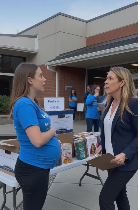
The book sale table behind her looked suddenly innocent: cardboard boxes, paper price tags, children’s picture books stacked by color, a jar of coins for the summer reading fund. That was all the morning had been supposed to be. Nothing grand. Nothing political. Just old books finding new homes.
Then Claudia had arrived with six parents, two local bloggers, and a speech ready before anyone even knew what box she was pointing at.
She had held up three books from the donation pile and called them inappropriate for children. She had said I was using the library to “push corruption.” She had said my unborn child deserved a mother with better judgment.
And I had believed the receipt would end it quietly.
I had not understood that Claudia did not want the truth checked.
She wanted me ruined before the truth could speak.
A man near the fountain lowered his phone. “Why would your own group donate the box, Mrs. Finch?”
Claudia glared at him. “We did not.”
Marta turned another page. “There is a pickup log too. The books were collected from a private address yesterday evening.”
Claudia went pale again.
The city councilwoman, Sofia Lindner, stepped forward. “What address?”
Marta hesitated.
I knew why.
The address would drag this out of gossip and into something official.
“Read it,” I said.
Marta swallowed. “Seegasse 18.”
Sofia’s face changed.
“That is Dr. Kraus’s house,” she said.
The crowd shifted. Someone whispered, “The board chair?”
Claudia’s jaw tightened. “You people are twisting a simple concern.”
I looked at the pond water dripping from my hem.
“No,” I said. “You pushed me into water to stop a receipt from being read.”
Her face flushed.
Then a new voice came from behind the crowd.
“Anna?”
My husband, Lukas, stood by the library gate, still in his baker’s apron, flour on one sleeve, horror draining the color from his face.
He saw my soaked dress.
He saw Claudia.
And then he saw my hand resting protectively over my stomach.
His voice dropped into something I had never heard from him before.
“Who touched my wife?”
Part 4: The Board Chair Came Smiling
Claudia did the worst thing she could have done.
She smiled at Lukas.
Not with warmth. With strategy.
“Your wife is emotional,” she said. “This is exactly why records must be handled by stable people.”
Lukas moved so fast I caught his sleeve.
Not because he would hurt her. Lukas had never been that kind of man. But his anger was clean and enormous, and Claudia looked too pleased to have pulled it from him.
“Don’t,” I whispered.
He stopped.
Then he took off his apron and wrapped it over the coat around my shoulders, as if flour and warmth could repair humiliation.
“I am calling Dr. Bauer,” he said.
“Our doctor can check me later,” I said.
“Now,” he answered, and his voice broke on the word.
That was what nearly undid me. Not Claudia. Not the water. Not the phones. Lukas trying to stay calm and failing because he loved me.
Before anyone could move, a black car stopped near the library entrance.
The back door opened.
Dr. Helena Kraus stepped out in a charcoal coat with a cream scarf pinned at her throat. She looked around at the wet path, the crowd, the phones, the receipt binder in Marta’s hands, and finally at me.
Her eyes did not show surprise.
That told me everything.
“Goodness,” she said. “What a scene.”
Claudia looked relieved for exactly half a second.
Then Helena said, “Mrs. Finch, what have you done?”
The crowd murmured.
Claudia blinked. “I followed the plan.”
Helena’s expression cooled.
One sentence.
That was all it took.
Claudia realized too late that powerful people do not protect tools once the tool has been seen.
“What plan?” Sofia Lindner asked.
Helena gave a delicate sigh. “Councilwoman, surely we can discuss this inside. Anna needs privacy.”
I almost laughed.
Now she wanted privacy.
When I was dripping pond water in front of half the town.
When strangers had filmed me climbing out of the shallow pool.
When Claudia had called me dangerous in front of children.
I stepped away from Lukas just enough to stand on my own.
“No,” I said. “We discuss it here.”
Helena’s gaze sharpened.
“Anna, you are a library employee. You may want to be careful.”
There it was.
The threat beneath the pearls.
Marta stepped beside me, still holding the binder.
“She is not just an employee,” Marta said. “She is the sale coordinator. And the records are public intake records.”
Helena looked at her like she had forgotten Marta could speak.
Then Emil, the teenage volunteer, raised his phone.
“I recorded Claudia saying Dr. Kraus told her which box to accuse Anna over,” he said.
Claudia spun toward him.
“Delete that.”
Emil shook his head.
“I already sent it to the library staff group.”
For the first time all day, Helena Kraus lost her smile.
Part 5: The Video In The Staff Chat
Marta opened the staff chat on her phone with fingers that kept slipping.
The crowd had gone silent again, but it was not the silence Claudia had wanted. It was not shame pointed at me. It was waiting.
The video began with shaky footage of the book sale table. Claudia’s voice came through clearly, bright and rehearsed.
“Anna Voss approved these books for children.”
Then my voice, quieter: “Please stop. We can check the intake record.”
Claudia: “You always hide behind paperwork.”
A parent asked, “How did you know which box to check?”
Claudia answered before she could think.
“Dr. Kraus marked it.”
The clip stopped.
Nobody needed more.
Helena’s face did not move, but her hand tightened around the handle of her leather bag.
Sofia Lindner looked from the phone to Helena. “You marked a donated box for public accusation?”
Helena gave a small laugh. “Marked is a vague word.”
“No,” Emil said. “There is more.”
He tapped the next clip.
This one had been recorded earlier, before Claudia shoved me. I had not known Emil was filming then. The camera pointed mostly at the ground, at fallen leaves and shoes, but the audio was sharp.
Claudia’s voice: “By noon, the board will have enough complaints to suspend her access to children’s programming.”
Another woman: “But the books came from us.”
Claudia: “Exactly. That is why it works.”
My skin went cold again, but this time not from water.
Lukas closed his eyes.
Marta whispered, “Anna…”
I could feel the shape of the plan now.
The false accusation had never been about one box of books.
It was about removing me.
For months, I had resisted Helena’s new policy proposal: pre-approval lists for children’s books, closed review panels, donor influence over displays, and a “family values shelf” funded by private money. I had argued that libraries served the public, not the loudest committee.
I thought Helena disliked me.
I had not realized she was building a trap.
Sofia turned to me. “Anna, have you been pressured before today?”
Helena answered before I could.
“Every employee receives performance guidance.”
I looked at her.
Then I thought about the emails. The meeting notes. The sudden complaint forms that appeared every time I refused to move a book. The anonymous messages saying pregnancy should make me focus on motherhood, not public influence.
My voice was hoarse but steady.
“Yes,” I said. “For three months.”
Helena smiled coldly. “Can you prove that too?”
She expected fear.
Instead, Marta reached into the binder pocket and pulled out a blue USB drive.
“Actually,” she said, “Anna asked me to back up the complaint records last week.”
Helena stared at the USB.
And Claudia, still standing near the pond, whispered, “You said there were no copies.”
Part 6: The Copies Helena Never Found
The library doors opened behind us.
Old Mr. Weber, the retired archivist who still volunteered every Thursday, stepped out slowly with his cane in one hand and a cardboard archive box in the other. His white hair was ruffled from the wind, and his spectacles sat crooked on his nose.
“I heard shouting,” he said. “Then I heard the word copies.”
Marta almost smiled. “Mr. Weber.”
He set the box on the stone bench.
“People are careless with digital things,” he said. “Paper is slower to betray you.”
Helena looked annoyed. “This is absurd.”
Mr. Weber ignored her and opened the box.
Inside were printed emails.
Dozens of them.
My breath caught.
I recognized the subject lines. Board review. Children’s programming. Staff conduct. Community concern.
Mr. Weber lifted the first stack. “These were misfiled under historical donations.”
Marta blinked. “Misfiled?”
He looked at Helena over his glasses. “Very badly.”
Sofia took the top page.
Her eyes moved quickly.
Then slower.
She read aloud.
“From: Dr. Helena Kraus. To: Claudia Finch. Subject: Voss Removal Timeline.”
The crowd stirred.
Helena’s voice snapped. “That is private board correspondence.”
Sofia kept reading.
“‘The pregnancy may work in our favor. A public incident will make concerns about judgment easier to frame.’”
Lukas made a sound like he had been struck.
My hand went to my stomach again.
Not because anything hurt.
Because I needed to remind myself I was still here.
Still standing.
Still mine.
Claudia took one step away from Helena.
“Helena,” she whispered. “You wrote that?”
Helena did not look at her.
That was answer enough.
Mr. Weber handed Sofia another page.
This one had a printed attachment: a donor agreement draft.
Sofia’s mouth tightened. “This agreement gives the Citizens for Clean Shelves committee influence over children’s acquisitions in exchange for funding.”
“That is not illegal,” Helena said.
“No,” Sofia said. “But framing a pregnant employee with planted material might be.”
Claudia’s face collapsed. “Planted?”
I stared at her.
She looked suddenly less like a villain and more like a woman realizing she had set fire to someone’s house because another person handed her the match.
“You knew,” I said.
Claudia’s eyes filled.
“I knew the box was arranged,” she said. “I thought it was to expose your choices. I did not know she wanted you gone from your job.”
Lukas’s voice was quiet and brutal.
“You pushed my wife into a pond.”
Claudia looked at the water.
For once, she had no speech ready.
Then Mr. Weber pulled one final folder from the box.
“This,” he said, “is the oldest record.”
Helena went completely still.
The folder label read: Kraus Donation Restriction — 1989.
Part 7: The Old Record Under The New Lie
Mr. Weber held the folder like it weighed more than paper.
Helena’s face had changed in a way that frightened me more than her threats. The arrogance was still there, but now it sat on top of something raw.
“Put that away,” she said.
Mr. Weber did not.
“You asked me once,” he said, “why I kept duplicate archives.”
Helena’s lips thinned.
“This is why.”
Sofia opened the folder.
Inside was a yellowed donation agreement from 1989, signed by Helena’s late father, Otto Kraus. The handwriting looked formal and old-fashioned. The language was polite. The meaning was not.
Sofia read silently, then looked up.
“This says the Kraus family donation was conditional on the library removing certain political, religious, and social materials from youth access.”
Helena’s voice was ice. “That was a different time.”
Mr. Weber tapped the page. “The city rejected it.”
“Because weak people were afraid of standards,” Helena snapped.
The words came out too quickly.
Too honestly.
There she was.
Not the careful board chair.
The daughter of a failed campaign, trying to finish an old family project under a new name.
I felt the whole day tilt.
The planted box. The staged outrage. The donor agreement. The pressure against me. It had never been only about me, or the books, or Claudia’s group.
It was about control that had waited decades for softer language.
Helena looked at the crowd and seemed to realize she had said too much.
She straightened. “Libraries require boundaries.”
I stepped forward.
My shoes were still wet. My dress clung cold against my legs. Lukas’s flour-streaked apron hung over my shoulders like a ridiculous little shield.
“Boundaries are not the same as traps,” I said.
Helena’s eyes cut to me.
I should have been afraid.
Maybe I was.
But fear had nowhere to go anymore except through my voice.
“You could have argued your policy in a board meeting,” I said. “You could have let parents speak. You could have let staff respond. Instead, you used a donation box, a public accusation, and my pregnancy because you thought people would rather shame me than check a receipt.”
Claudia covered her mouth.
Marta began to cry silently beside me.
Sofia closed the old folder.
“Dr. Kraus,” she said, “I am requesting your immediate suspension from the library board pending investigation.”
Helena laughed once. “You cannot do that alone.”
“No,” Sofia said. “But the mayor can.”
She lifted her phone.
Helena reached for her bag.
For a terrifying second, I thought she would run.
Instead, she pulled out a folded document and threw it onto the wet stone near my feet.
“Then explain that,” she said.
It was my signature.
On a resignation letter I had never written.
Part 8: The Signature That Proved Too Much
For one horrible moment, the resignation letter worked.
People saw my name at the bottom, and confusion moved through the crowd like fog. Even Lukas looked down before looking back at me, not doubting me, but trying to understand how deep the trap went.
Helena’s voice steadied. “Anna submitted this last night. She intended to leave and now regrets it. Everything today is an attempt to create scandal before her departure.”
My stomach turned.
The signature looked like mine.
Almost.
The slant was right. The first letter curved correctly. Whoever made it had seen enough of my handwriting to imitate the shape.
But they had missed one thing.
I started laughing.
It came out small and shocked, not happy, but sharp enough to make Helena’s eyes narrow.
“That is not my signature,” I said.
Helena smiled. “Denial is not evidence.”
“No,” I said. “But maternity clinic forms are.”
Lukas understood first.
His face changed.
Every appointment form I had signed for seven months had the same strange mark. After my wrist injury last winter, my signature developed a tiny break in the second stroke. My doctor had joked she could identify my paperwork from across the room.
Marta grabbed her phone. “I have the staff medical accommodation copy.”
Sofia took the resignation letter and held it beside the scanned form Marta opened.
The difference was tiny.
But visible.
My real signature broke in the middle.
The forged one did not.
Then Mr. Weber leaned over the paper and frowned.
“This letter is dated yesterday,” he said. “But the library printer code at the bottom is from the board office printer.”
Helena’s face emptied.
Marta whispered, “Board office is locked on Sundays.”
Sofia looked up slowly. “Who has access?”
Nobody answered.
Nobody needed to.
Helena’s hand trembled once before she hid it behind her bag.
Claudia sat down on the stone bench like her legs had failed. “You forged her resignation?”
Helena said nothing.
That silence convicted her more cleanly than any confession.
The mayor arrived twenty minutes later. So did a police officer, an ambulance, and three more reporters than anyone expected for a book sale outside a library.
I was checked in the ambulance with Lukas holding my hand so tightly his knuckles went white. The baby’s heartbeat was strong. Mine took longer to calm.
By evening, Helena Kraus had resigned before she could be removed.
Claudia Finch issued a public statement admitting the accusation had been staged, though she called the shove “a regrettable movement.” Nobody let her keep that phrase for long. The video had already shown the truth.
Two months later, the children’s book sale reopened under a new banner:
READING BELONGS TO EVERYONE.
The first box sold was labeled “Donated by Citizens for Clean Shelves.”
Marta had insisted.
Claudia did not attend.
I did.
My daughter was born three weeks after that, early but healthy, with a furious cry that made Lukas laugh and cry at the same time.
We named her Clara.
Not after Claudia.
Not after anyone powerful.
After the Latin word for clear.
Because one tiny record had cleared my name, and one small life had arrived in a town that finally understood the difference between protecting children and controlling them.
On my first day back at the library, I found a new plaque beside the intake desk.
It did not have my name.
It had a rule.
Check the record before you judge the person.
