Part 2: The Name Brielle Tried To Erase
The project lead did not raise his voice.
That made the silence worse.
He stood beside the laptop with one hand resting near the trackpad, his gray suit jacket pulled tight across his shoulders, and said, “Show the deletion request.”
Brielle’s father turned toward him so sharply that the water bottle in his hand cracked under his grip.
“Henrik,” he said, low and warning, “this is not appropriate in front of officials.”
Henrik Adler did not look at him. “Neither was striking a student in front of three cameras.”
My cheek was still burning. I could feel every eye on me, every phone lifted halfway, every breath waiting for permission to become a scandal. The big screen behind the stage flickered again, and a new page opened.
There it was.
A deletion log.
My name.
Maya Bailey.
Requested for removal at 7:14 that morning.
My stomach folded in on itself.
The account attached to the request was not Brielle’s.
It was Harrington Foundation Executive Access.
A county official in a navy coat leaned forward. “Who controls that access?”
Brielle’s father, Edmund Harrington, went pale in a way that made his expensive tan look painted on.
Brielle snapped, “This is ridiculous. Anyone could have used that terminal.”
Henrik clicked once more. A small image expanded beside the log: a security capture from the backstage office. Brielle stood in front of the admin laptop, one hand on the desk, the other holding her phone close to her chest.
She stared at her own face on the screen.
For the first time since I had met her, she looked younger than me.
Then she looked at me, and the fear turned poisonous.
“You set this up,” she whispered.
I almost laughed, but my throat hurt too much.
“I was sewing a torn sleeve at midnight,” I said. “I didn’t even know the archive had cameras.”
A woman from the county arts office stood and walked toward the stage. Her badge swung against her blouse. “Ms. Bailey, are you able to continue?”
The question broke me more than the slap.
Because nobody had asked whether I was able to continue before.
I looked at the folding tables, at the rows of restored dolls in their miniature national costumes, at the lace cuffs I had stitched with numb fingers, at the painted faces I had cleaned one by one while other students went home. The room smelled like plastic chairs, dust, coffee, and wet pavement from the church parking lot outside.
“I can,” I said.
Brielle laughed once, sharp and ugly. “Of course she can. This is what she wanted. Attention.”
Henrik turned from the laptop. “No. What she wanted was credit for her work.”
Edmund Harrington stepped onto the stage without being invited. His shoes struck the boards with hard little sounds.
“Enough,” he said. “My family funded this exhibition. My daughter made an emotional mistake, but this public humiliation stops now.”
The county official’s eyes narrowed. “Mr. Harrington, your funding does not purchase silence.”
A murmur rolled across the room.
Brielle lifted her chin, but her lips trembled.
Then an elderly woman near the front row rose slowly, gripping the back of her chair as if her bones hurt.
She wore a black wool coat and a pearl brooch shaped like a tiny bird. I had seen her earlier near the costume cases, touching one of the older dolls with strange tenderness.
She looked straight at Edmund.
“You always did mistake money for ownership,” she said.
The room changed.
Edmund stared at her as if the floor had vanished.
“Clara,” he breathed.
Brielle frowned. “Dad?”
The woman took one step into the aisle.
And Henrik Adler whispered, almost to himself, “That is Clara Voss.”
Part 3: The Woman In The Black Coat
Nobody clapped anymore.
Nobody whispered.
Even the cameras seemed to freeze.
Clara Voss walked toward the stage with slow, careful dignity, and the crowd parted like they somehow understood they were seeing the real center of the day arrive late.
Edmund Harrington stepped down from the stage.
“You should not be here,” he said.
Clara smiled faintly. “That is what you said thirty-one years ago in Vienna.”
The words struck him visibly.
Brielle looked between them. “What is she talking about?”
Henrik’s face had gone tight. The project lead no longer looked like a man managing a student exhibition. He looked like someone who had been waiting years for a locked door to open.
Clara stopped beside me.
Up close, I noticed her hands. They were thin and spotted with age, but steady. One fingertip brushed the edge of a small doll wearing a faded blue folk dress.
“You repaired this one,” she said to me.
I nodded, confused.
“The hem was damaged,” I said. “And the sleeve had smoke marks.”
Clara’s eyes softened. “I made that sleeve when I was nineteen.”
The room inhaled.
Edmund said, “Clara, don’t.”
She ignored him.
“This exhibition was not founded by the Harrington family,” Clara said. “It was founded in Vienna by my sister, Elise Voss, after the war, to preserve handmade dolls from displaced European families. Edmund’s father handled shipping and storage. That was all.”
Brielle’s mouth opened.
“My grandfather built this foundation,” she said.
Clara looked at her with something colder than anger.
“Your grandfather built a story.”
The county official stepped forward. “Ms. Voss, do you have documentation?”
Clara reached into her black handbag and removed a flat leather folder, cracked at the corners. Edmund moved at once, too fast, his hand shooting toward it.
I stepped between them without thinking.
He stopped.
For one second, his eyes landed on me like I was dirt again.
Then Henrik said, “Touch her and every camera in this hall records it.”
Edmund lowered his hand.
Clara opened the folder.
Inside were letters, photographs, receipts, and yellowing papers with official seals. She laid them on the table one by one. Vienna. Prague. Antwerp. Paris. Names written in fountain pen. Doll descriptions. Donation records. Shipping crates.
Then she placed down a photograph.
Two young women stood outside an old European workshop, smiling beside rows of dolls. One had Clara’s eyes.
The other woman looked like someone I had seen before, but I could not understand why.
Henrik leaned closer.
“Maya,” he said carefully, “may I see your necklace?”
My fingers moved to my collar before my mind caught up.
The necklace was cheap now, the chain replaced twice, but the pendant was old: a tiny silver bird with one wing bent. My grandmother had left it to my mother. My mother had left it to me before she died.
Clara saw it.
Her hand flew to her mouth.
“No,” she whispered.
The entire hall seemed to tilt.
I stepped back. “What?”
Clara reached into her blouse and pulled out a matching pendant. Same bird. Same bent wing. Only hers was gold.
Edmund staggered as if someone had shoved him.
Brielle whispered, “Dad, what is happening?”
Clara looked at me, and her eyes filled with tears she refused to let fall.
“That pendant belonged to Elise Voss,” she said. “My sister.”
I could barely hear her over my heartbeat.
“My grandmother’s name was Eliza,” I said. “Eliza Bellamy.”
Clara closed her eyes.
When she opened them, the grief inside them was decades old.
“She changed her name after they stole everything from her.”
Part 4: The Pendant No One Expected
The county official asked everyone to remain calm, which only made people stand up faster.
Chairs scraped. Phones rose. Someone near the back muttered that the press should be called, though the press was already there, blinking red lights at the edge of the stage.
I could not move.
My fingers held the silver bird so tightly the wing cut into my palm.
Elise Voss.
Eliza Bellamy.
My grandmother, who used to hum while sewing buttons onto my school shirts. My grandmother, who kept a locked tin under her bed. My grandmother, who once told me, “People can steal rooms, dresses, and names, Maya, but they cannot steal hands that know how to make beauty.”
I had thought she meant poverty.
I had not known she meant history.
Edmund Harrington looked around at the officials, donors, teachers, and students, then lowered his voice into something almost pleading.
“Clara is confused,” he said. “She has been unwell. These old papers prove nothing about this child.”
Clara’s back straightened.
“This child,” she said, “has repaired the costumes exactly as Elise taught our family to do. The hidden stitch under the cuffs. The blue thread inside the hem. The wax seal on the storage tags.”
Henrik moved to the archive computer and searched one of my upload folders. A photo appeared: the inside of a repaired doll sleeve. A tiny line of blue thread ran beneath the seam.
Clara touched the screen.
“Elise’s signature.”
My knees almost buckled.
Brielle snapped, “Lots of people can sew blue thread.”
I turned to her.
Until that moment, I had been scared of her. Scared of her perfect hair, her polished laugh, her father’s money, the way people stepped aside when she entered a room.
But fear has a limit.
After that, it becomes something sharper.
“You slapped me,” I said quietly. “You deleted my name. You called me pathetic. And now you’re mad because my grandmother may have had a name before yours covered it?”
Her eyes flashed. “You don’t belong here.”
Clara placed one hand on my shoulder.
“She belongs here more than anyone.”
Edmund’s face hardened.
“Careful,” he said. “A claim like that can destroy reputations.”
Henrik laughed once. “Yours, mostly.”
Then he clicked another archive folder. “There is more.”
Brielle’s eyes darted to the screen.
That was how I knew.
She knew something else was there.
Henrik opened a restricted file titled PRIVATE DONOR INVENTORY — NOT FOR PUBLIC DISPLAY.
Inside were photographs of dolls that were not on the tables.
Twenty-four missing pieces.
Clara gasped.
One by one, the images filled the screen: hand-carved faces, embroidered skirts, tiny leather shoes, lace veils, painted wooden boxes.
The county official said, “Where are these items now?”
Henrik looked at Edmund.
Edmund said nothing.
But Brielle whispered, “No.”
It was not denial.
It was recognition.
Clara turned slowly toward her.
“Where are they?” she asked.
Brielle’s confidence cracked down the middle.
“I didn’t know they were stolen,” she said.
Her father closed his eyes.
The room erupted.
Part 5: The Dolls Hidden Beneath The Ballroom
The officials moved quickly after that.
Not dramatically, not like in movies. No shouting, no handcuffs, no thunderous music. Just clipped voices, phone calls, badges, and the strange terror of powerful people realizing paperwork had finally caught up with them.
Edmund Harrington tried to leave through the side doors.
Two county officers blocked him.
Brielle stood near the stage stairs, shaking so hard her bracelet clicked against the railing.
I should have hated watching it.
Part of me did.
Another part of me remembered the sting of her palm and did not look away.
Henrik spoke to the officials in a low voice. Clara sat in a folding chair beside me, her hand wrapped around her pendant.
“I looked for Elise,” she said.
Her voice was so quiet I had to lean close.
“After she disappeared, I searched every registry I could. Vienna, Paris, London. Nothing. Then a letter came back unopened. I thought she was dead.”
“She wasn’t,” I whispered. “She lived in Manchester for a while. Then Liverpool. Then after my mother was born, they moved again.”
Clara swallowed.
“Was she happy?”
I thought of my grandmother’s tiny kitchen. Her tin of buttons. Her careful silence whenever rich families appeared on television giving speeches about charity.
“She loved me,” I said. “I think that was the happiest part she allowed herself.”
Clara pressed her hand to her mouth.
Across the room, Brielle suddenly broke away from her father’s lawyer and came toward us.
I stood.
Henrik moved too, but I shook my head.
Brielle stopped two feet away. Her makeup had begun to run at the corners of her eyes, leaving dark lines that made her look less like a sponsor’s daughter and more like a girl trapped in a house full of lies.
“My father keeps a private collection,” she said.
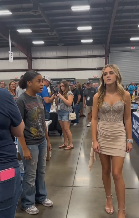
The room quieted again.
Edmund shouted, “Brielle.”
She flinched, but did not turn.
“In our summer house near Lake Como,” she continued. “There is a lower ballroom under the old wine cellar. He shows it to private buyers sometimes. I thought they were duplicates. I thought—”
Her voice cracked.
“No,” Clara said. “You thought not asking made you innocent.”
Brielle looked at me.
For one absurd second, I thought she might apologize.
Instead she said, “You have no idea what it’s like to grow up with a father who makes love feel conditional.”
I stared at her.
Then I touched my swollen cheek.
“You have no idea what it’s like to be hit by someone who thinks pain is proof of status.”
Her mouth trembled.
The county official asked Brielle to repeat the location. This time, she gave the full address.
Edmund Harrington’s face changed completely.
All warmth, all polish, all public generosity vanished.
“You stupid girl,” he said.
Brielle recoiled.
The words landed harder than any slap.
Clara looked at him with disgust. “There he is.”
But Edmund was staring at me now.
And he smiled.
A small, vicious smile.
“You think a pendant makes you an heir?” he said. “Wait until they test the bloodline.”
Part 6: The Bloodline Trap
The word bloodline spread through the hall like a stain.
People who had been whispering about stolen dolls now whispered about me.
I felt it happen.
The old doubt returning.
The same look people gave me when I walked into expensive rooms wearing secondhand clothes. The same question hidden behind polite smiles: Are you sure you are supposed to be here?
Edmund knew exactly what he had done.
He had moved the story from evidence to identity.
From records to my body.
Clara stood so fast her chair tipped backward.
“You do not get to demand anything from her.”
“I am not demanding,” Edmund said smoothly. “I am protecting a historic foundation from opportunistic claims. If Ms. Bailey is truly connected to Elise Voss, she should welcome verification.”
Brielle stared at him, horrified. “Dad, stop.”
He ignored her.
The county official said, “Mr. Harrington, this is not the place for—”
“It is exactly the place,” Edmund cut in. “You are all prepared to destroy my family over a trinket and a fairy tale.”
The pendant in my hand suddenly felt too small to carry so much.
Henrik walked to Clara’s folder and removed one photograph. The image of Elise Voss outside the workshop.
He placed it beside a printed still from my student ID in the archive.
For a moment, no one spoke.
The resemblance was not perfect.
It was worse than perfect.
It was human.
Same narrow chin. Same heavy-lidded eyes. Same uneven left eyebrow.
Edmund’s smile faded, but only slightly.
“Faces are not proof.”
“No,” Henrik said. “But letters are.”
He lifted another page from Clara’s folder. “Elise wrote to Clara after reaching England. This letter says she was pregnant.”
Clara’s hand flew to her chest. “I never saw that letter.”
Henrik nodded toward Edmund. “Because it was found in a Harrington storage box donated last month by mistake.”
Edmund lunged.
This time, officers caught him.
The crowd gasped as he fought them, not wildly, but with the panic of a man grabbing at the edge of a cliff.
Henrik read aloud, his voice shaking.
“Elise wrote: ‘If my daughter survives, I will give her the silver bird, so she knows there was once a family before shame.’”
I stopped breathing.
My mother had worn the silver bird in every photograph I had of her.
Clara made a sound that broke something inside me.
She reached for my face, then stopped herself, as if afraid I might vanish.
“Maya,” she whispered.
I stepped into her arms.
The hall blurred.
For the first time that day, I cried.
Not because Brielle had slapped me.
Not because the room had watched me suffer.
Because somewhere across all those lost years, my grandmother had left a trail so thin and fragile that everyone rich had missed it.
But my hands had followed it home.
Then Henrik’s phone rang.
He listened for five seconds.
His face went white.
“They found the ballroom,” he said.
Clara gripped my arm.
Henrik looked at Edmund.
“And there’s a locked nursery behind it.”
Part 7: The Nursery Behind The Stolen Dolls
By evening, the exhibition hall had become a storm.
Officials sealed the archive computers. Reporters gathered outside the church parking lot. Students huddled near the tables, pretending not to stare at me and failing badly.
I sat beside Clara in a small office that smelled of printer toner and old coffee while Henrik took a video call from the inspection team in Italy.
The screen showed stone stairs descending beneath a villa near Lake Como.
Then a ballroom appeared.
Not a ballroom for dancing.
A ballroom for hiding.
Glass cases lined the walls. Dolls stood behind them in perfect rows, lit by soft golden lamps, their painted eyes shining like witnesses.
Clara covered her mouth with both hands.
“There,” she whispered. “That one belonged to a family from Prague. And that one from Antwerp. That bride doll was my sister’s favorite.”
Henrik’s jaw tightened.
The inspector on the call moved deeper into the room. “There is a secondary door. It was concealed behind a velvet panel.”
The camera shifted.
A narrow nursery appeared.
White crib.
Dusty rocking chair.
Faded wallpaper with blue birds.
On the wall hung framed sketches of doll costumes, all signed Elise Voss.
And on the crib lay a small wooden box.
The inspector opened it carefully.
Inside was a bundle of letters tied with blue thread.
Clara began to shake.
Henrik said, “Read the top name.”
The inspector turned the first envelope toward the camera.
For My Daughter, If They Ever Find Her.
My whole body went cold.
Clara whispered, “Elise had a child there?”
Edmund, sitting under officer supervision in the next room, suddenly shouted, “Those are private family materials!”
Brielle stood outside the office door. She had been silent for nearly an hour.
Now she stepped inside.
“Why would your family have a nursery hidden under a stolen collection?” she asked him through the open doorway.
Edmund looked at her with pure contempt.
“Because your grandfather was smarter than sentimental women.”
The sentence killed whatever daughter remained in her eyes.
Brielle walked to the office table and placed her phone down.
“I recorded him,” she said.
Everyone turned.
Her voice was flat now. Not brave. Not healed. Just empty enough to become useful.
“This morning, before the event. He told me to delete Maya’s name. He said if anyone looked too closely at the costume repairs, Clara Voss might recognize the stitching.”
She tapped her screen.
Edmund’s voice filled the office, cold and clear:
“Erase the Bailey girl before she makes the dead woman useful.”
Nobody moved.
Then the inspector on the call lifted another letter from the wooden box.
“This one has a birth record,” he said.
Henrik leaned toward the screen. “Whose?”
The inspector paused.
Not for drama.
For shock.
“The child’s name was recorded as Anna Elise Voss,” he said. “But there is an adoption transfer attached. Signed by Harrington.”
Clara gripped the table.
I whispered, “Anna was my mother’s name.”
The inspector looked closer.
“There is more,” he said. “The transfer does not list Anna as adopted out.”
He swallowed.
“It lists Elise Voss as deceased.”
Clara went completely still.
“But Elise was alive,” she said.
The inspector nodded slowly.
“That is not the worst part.”
Part 8: The Family Brielle Never Knew She Had
The worst part was a photograph.
It arrived by secure email an hour later, scanned from the wooden box beneath the nursery.
The image showed Elise Voss holding a newborn baby in front of the hidden crib. She looked exhausted, thin, and fiercely alive.
Behind her stood Edmund’s grandfather.
Beside him stood a young woman with a face I recognized from portraits in the Harrington Foundation lobby.
Brielle’s great-grandmother.
On the back of the photograph, in Elise’s handwriting, were seven words:
They took my daughter but not my truth.
Clara read them once.
Then again.
Then she sat down as if her body could no longer carry history.
The documents revealed the shape of it slowly. Elise had not died when the Harrington records claimed she did. She had been kept at the Lake Como villa long enough to repair the most valuable dolls and sign transfer papers under pressure. Her newborn daughter, Anna, had been sent away under a false surname.
Bellamy.
My mother’s surname.
My surname before the foster system shortened everything into case numbers and school forms.
But the final document changed the room.
It was not a will.
It was a guardianship trust, written by Elise before she disappeared, naming Clara Voss or Elise’s direct descendants as the rightful custodians of the World Dolls archive if fraud was ever proven.
Not owners.
Custodians.
That word mattered.
It meant the collection was not mine to sell, not Clara’s to hide, not the Harringtons’ to polish into a brand.
It belonged to the families whose hands had made it.
By midnight, Edmund Harrington was removed from the foundation board. The stolen collection was frozen under international cultural protection. Clara Voss was named interim custodian.
And me?
Everyone expected me to take the stage again and give some perfect wounded speech.
I didn’t.
I walked to Brielle instead.
She stood alone near the empty bottled water crates, staring at her own hands like she had only just realized what they were capable of doing.
When she saw me, she whispered, “I’m sorry.”
I believed she meant it.
I also knew sorry could not erase the sound of the slap.
“Don’t apologize to make yourself clean,” I said. “Apologize by telling the truth when it costs you.”
Her face crumpled.
Then she nodded.
The next morning, Brielle testified against her father.
Not because she became good overnight.
Because, for once, she chose truth over inheritance.
Three months later, the exhibition reopened in Vienna, not as a Harrington event, but as The Voss-Bellamy World Dolls Archive. Clara insisted my name be on the restoration plaque. I insisted every student volunteer’s name be there too.
At the opening, a little girl in a green coat asked why one doll had blue thread hidden inside the sleeve.
I knelt beside her and smiled.
“So it remembers who made it,” I said.
Clara stood behind me, wearing her gold bird. I wore the silver one.
Across the room, Brielle quietly arranged chairs for the visiting schoolchildren. No cameras pointed at her. No one applauded.
For the first time, she looked relieved not to be watched.
And when the doors opened, the dolls did not look stolen anymore; they looked like they had finally come home.
