Part 2: The Ticket Scarlett Never Thought Would Surface
Scarlett Winthrop’s mother did not look at my cheek.
That was the first thing I noticed.
Margot Winthrop stepped forward in black silk and diamonds, her face arranged into the kind of calm rich people use when they are deciding who to destroy later. She looked at the committee chair, then at the microphone, then at the celadon vase waiting under the soft museum lights.
Not once did she look at the red mark on my face.
“Surely,” Margot said, “we can avoid turning a cultural honor into a public embarrassment.”
The committee chair, Mr. Alden Greaves, held the document in both hands.
“It became public the moment your daughter struck the honoree.”
The word honoree hit the room harder than the slap.
Scarlett’s eyes flashed. “She is not the honoree.”
Mr. Greaves looked over his glasses. “She is the reason the vase survived.”
The phones came higher.
Photographers who had frozen in shock now leaned forward like the gala had turned into breaking news. The honor table was silent. Silver forks rested untouched beside plates of expensive food nobody could swallow.
I stood near the pedestal with my hand halfway to my cheek, trying not to shake.
Mr. Greaves lifted the kiln ticket.
“This ticket records the emergency refire at the Santa Fe Ceramic Arts Institute. The first firing temperature submitted for the repair glaze was incorrect by nearly eighty degrees.”
A murmur moved through the room.
Scarlett laughed, sharp and fake. “That sounds like workshop nonsense. Nobody cares.”
“I cared,” I said before I could stop myself.
Every camera turned.
My voice was thin, but it stayed standing.
“I cared because eighty degrees would have spider-cracked the glaze. The vase would have looked fine for the ceremony and failed later.”
Margot’s expression tightened.
Mr. Greaves nodded. “Miss Petrova noticed the discrepancy, stopped the firing cycle, and filed a correction ticket before irreversible damage occurred.”
Scarlett stared at me like I had stolen her oxygen.
“You were cleaning shelves,” she snapped.
“I was checking the kiln board.”
“You were not authorized.”
“No,” Mr. Greaves said. “But she was correct.”
The room shifted again.
That was the part Scarlett could not survive.
Not that I had been chosen.
That I had been right.
Margot reached for the ticket. “Let me review that privately.”
Mr. Greaves pulled it back.
“No.”
Her face changed by one inch, but it was enough.
Then the emcee, still holding the microphone, looked at the bottom of the ticket.
“Mr. Greaves,” he said slowly, “why is Scarlett Winthrop’s name listed as the person who submitted the wrong temperature?”
Part 3: The Wrong Number In Her Perfect Handwriting
Scarlett’s face went blank.
Not pale. Not angry. Empty.
Like someone had opened a trapdoor beneath her and she was still deciding whether to fall.
“That’s impossible,” she said.
Mr. Greaves lowered his gaze to the kiln ticket. “The original entry was handwritten on the prep sheet before it was entered digitally.”
Margot lifted her chin. “Many people handle those sheets.”
“Yes,” Mr. Greaves said. “But not many sign them.”
He turned the paper toward the room.
There, beneath the incorrect temperature, was Scarlett Winthrop’s neat signature.
The same dramatic S she used on donor cards, invitation notes, and the glossy program booklet where her name appeared three times.
A woman at the honor table whispered, “Oh my God.”
Scarlett shook her head. “That is not what happened.”
I wanted to feel triumph.
I did not.
I felt the awful, sick weight of being watched by people who had ignored me until pain made me interesting. My cheek burned. My eyes stung. The vase stood between us under the light, pale green and delicate, like it had survived more dignity than any of us.
Margot stepped beside her daughter. “Scarlett was asked to assist ceremonially. She is not a technician.”
“Then why,” Mr. Greaves asked, “did she alter a technical firing sheet?”
Scarlett’s mouth opened.
No answer came.
A young assistant from the institute moved quietly toward Mr. Greaves and whispered something. His eyes narrowed.
“Bring it,” he said.
The assistant disappeared through a side door.
Scarlett noticed.
So did Margot.
“What are you bringing?” Margot asked.
Mr. Greaves did not answer her.
He looked at me instead.
“Lina, did you keep your correction copy?”
My fingers tightened around the little cloth bag I had brought with me. Inside was my phone, lip balm, a cracked compact, and the folded yellow duplicate ticket I had kept because the workshop printer was unreliable and my supervisor always told me, “If it matters, keep your copy.”
I pulled it out.
Scarlett whispered, “No.”
That one word told everyone enough.
I handed the duplicate to Mr. Greaves.
He placed both tickets side by side on the ceremony table.
The original wrong temperature in Scarlett’s signature.
My correction ticket beneath it.
Time-stamped twenty-two minutes later.
If I had waited even one more minute, the vase would have been ruined.
The assistant returned carrying a sealed gray folder.
On the front was a label:
WINTHROP FAMILY DONATION — CONDITION REVIEW.
Margot’s diamonds flashed as her hand curled into a fist.
Mr. Greaves opened the folder.
And the first photograph inside showed the vase broken before it ever reached our kiln.
Part 4: The Crack Hidden Beneath The Donor Story
The photograph was brutal in its quietness.
The celadon vase lay on a padded table, its neck fractured, one side bruised with a long pale crack that ran through the glaze like lightning trapped under ice. Beside it was a measuring card, a date stamp, and a handwritten note.
Damage present upon delivery.
The ballroom stopped pretending.
Until that moment, the Winthrop family story had been beautiful. They had “rescued” a rare vase from a private collection, donated it to the cultural institute, funded its restoration, and allowed it to be placed on a ceremonial pedestal as the symbol of the gala.
That was why Scarlett had expected to stand beside it.
That was why her mother had smiled for the magazine preview.
That was why every rich guest had clapped when the program thanked the Winthrops for “protecting fragile beauty.”
But the photograph said something else.
The vase had arrived damaged.
The Winthrops had known.
And someone had tried to rush a bad repair in time for the ceremony.
Margot spoke first. “The transport company caused that.”
Mr. Greaves turned another page.
“According to the intake report, the transport crate was unopened when it arrived. The damage was internal and older than the delivery date.”
A donor at the front table frowned. “Then why were we told the piece was in stable condition?”
Margot looked at him like he had betrayed her by asking.
Scarlett’s breathing had become uneven. “Mom?”
Margot’s eyes never left Mr. Greaves. “This is a restoration event. Damage is not a scandal.”
“No,” Mr. Greaves said. “Hiding damage from the insurance appraisal is.”
The room erupted.
The word insurance moved faster than any accusation before it.
Photographers clicked. Reporters whispered into phones. A museum trustee stood so quickly her chair struck the floor behind her.
Margot’s voice sharpened. “Careful, Alden.”
He looked tired then.
Not afraid.
Tired.
“I was careful when your family requested a rushed ceremony. I was careful when your office insisted Scarlett be named youth arts ambassador. I was careful when Lina’s name was removed from the first program draft.”
My stomach dropped.
Removed?
Scarlett looked at me, then away.
Mr. Greaves continued. “I was too careful for too long.”
The emcee lowered the microphone like he no longer trusted his own hands.
Mr. Greaves pulled a second photo from the folder.
This one showed the underside of the vase before repair.
A small maker’s mark was visible near the base.
Not the mark printed in the gala catalog.
A different one.
An older one.
He held it beneath the light.
“This vase was not from the Winthrop collection,” he said.
Margot went still.
“It was reported missing from a provincial museum collection twelve years ago.”
Part 5: The Missing Vase With My Father’s Mark
The words did not reach me all at once.
Missing.
Museum.
Twelve years.
They floated above the ballroom like pieces of broken glass, too sharp to touch.
Then Mr. Greaves placed the photograph on the table, and I saw the mark clearly.
A small crescent pressed into the clay beside three tiny dots.
My breath vanished.
I knew that mark.
Not from books. Not from museum catalogs.
From my father’s old sketchbook.
My father, Pavel Petrova, had been a ceramic conservator before he died. He used to draw maker’s marks for me on napkins while I did homework at the kitchen table. He would say every object had a memory if you knew where to look.
The crescent and three dots belonged to a Balkan workshop whose pieces had vanished during a private collection transfer years before.
My father had been obsessed with that case.
I looked at the vase.
My hands went cold.
“That mark,” I whispered.
Mr. Greaves heard me. “You recognize it?”
I nodded, but my throat closed.
Margot turned toward me for the first time that night.
Now she saw me.
Not my cheek. Not my dress. Not the girl she wanted removed from the ceremony.
Me.
And she looked afraid.
“My father documented that mark,” I said. “He said one of the missing pieces was never recovered.”
Mr. Greaves reached into the folder again.
“Your father filed a report before his death.”
The floor seemed to move beneath me.
Scarlett whispered, “What?”
Mr. Greaves held up a scanned document.
Pavel Petrova — Independent Conservation Notice.
My father’s name looked impossible under the chandelier light.
I stepped closer.
The report described a celadon vase matching the one before us. It stated that the piece may have entered a private American collection through improper channels. It requested a formal provenance review.
At the bottom was a note added years later.
Review delayed after donor objection.
Margot’s face had gone pale beneath her perfect makeup.
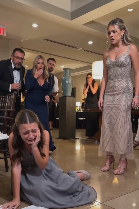
A trustee said, “Which donor objected?”
No one answered.
No one needed to.
Scarlett stared at her mother. “You told me it was ours.”
Margot’s voice was low. “It is ours.”
“No,” I said.
The word came out stronger than I felt.
Everyone looked at me again.
I touched the edge of my father’s report with two fingers.
“It belonged to a museum. My father tried to prove it. And you buried him in paperwork.”
Margot stepped forward. “You know nothing about what your father tried to do.”
I looked straight at her.
“Then why did you remove my name from the program before I ever touched the vase?”
The question hit her cleanly.
Before she could answer, a man rose from the back of the room.
He was old, thin, and holding a cane with both hands.
“My name is Emil Novak,” he said. “I was the curator who received Pavel Petrova’s last call.”
Margot closed her eyes.
And the whole room understood that the worst part had not been revealed yet.
Part 6: The Last Call They Pretended Never Happened
Emil Novak walked slowly toward the honor table.
No one stopped him.
Even the photographers lowered their cameras for a moment, not out of respect for wealth, but for age and grief and the feeling that the room had become a witness stand.
He stood beside the celadon vase and looked at it like he was seeing a ghost.
“Pavel called me two nights before the review meeting,” Emil said. “He said he had found a private appraisal linking the vase to the Winthrop family.”
My heart pounded so hard it hurt.
Mr. Greaves pulled out a chair for him, but Emil shook his head.
“I will stand.”
Margot said, “This is absurd.”
Emil looked at her. “You said the same thing twelve years ago.”
The room went cold.
Scarlett stepped back from her mother.
It was only one step, but I saw it.
Margot did too.
Emil continued. “The next morning, Pavel’s review request was withdrawn.”
“My father would never withdraw it,” I said.
My voice broke on father.
Emil’s eyes softened. “He did not.”
He reached into his coat and removed a folded envelope, worn at the corners.
“I kept this because I was ashamed.”
He handed it to Mr. Greaves.
Inside was a faxed letter supposedly signed by my father, withdrawing his provenance concern.
My father’s name sat at the bottom.
But the signature was wrong.
Even after all these years, I knew it instantly.
My father had written his P like a hook. This P was smooth, elegant, practiced.
A rich person’s forgery.
“That’s not his signature,” I whispered.
Mr. Greaves looked at the paper, then at Margot.
Emil said, “Pavel called me that evening. He was furious. He said someone had forged his withdrawal and that he was going to deliver the appraisal personally.”
My mother had always told me my father died after a sudden heart attack two weeks later.
She had never told me about a forged letter.
She had never told me about the vase.
Maybe she had not known.
Or maybe grief had swallowed more than words.
Margot’s voice became sharp as broken porcelain. “Enough.”
Emil turned to her.
“No. I said enough too late once. I will not do it again.”
He looked at me.
“Your father left something with me before he died. I was afraid to give it to your family. The Winthrops were powerful. Your mother was grieving. You were a child.”
My eyes burned.
“What was it?”
Emil lifted a small brass key from his pocket.
“Evidence box 27. Stored at the old conservation archive.”
Scarlett suddenly covered her mouth.
Margot saw.
Her eyes narrowed at her daughter.
“Scarlett,” she said quietly, “what have you done?”
Scarlett’s voice shook.
“I found the box last week.”
Part 7: The Daughter Who Opened The Evidence Box
The room shifted toward Scarlett like a storm changing direction.
Her face was wet now, not with theatrical tears but with the ugly kind that ruin makeup and leave someone looking younger than their cruelty.
Margot stared at her daughter as if she had become a stranger.
“You had no right,” Margot said.
Scarlett laughed, but it broke halfway. “No right? You gave me the archive passcode so I could pose for donor photos.”
Mr. Greaves stepped forward. “Scarlett, where is the box?”
She looked at me.
For the first time all night, she looked at my cheek and flinched.
“I didn’t know what all of it meant,” she said. “Not at first.”
I did not answer.
She deserved to stand in the silence she had made.
Scarlett reached into her tiny beaded evening bag and pulled out a flash drive no bigger than her thumb.
Margot moved so fast the nearest trustee gasped.
“Give that to me.”
Scarlett stepped back.
Security stepped between them.
The gala, which had begun as a night of chandeliers and champagne, now looked like a courtroom in evening clothes.
Scarlett held the drive out to Mr. Greaves.
“My mother kept scans from the box in her private office,” she said. “I copied them after I found my name on the ceremony script as the restoration lead.”
Margot’s voice was ice. “You ungrateful child.”
Scarlett’s whole body shook.
“You told me Lina was trying to steal my night. You told me her family had always been jealous. You told me if she placed the vase, people would ask why a Petrova was near it.”
She looked at me.
“And I believed you because it made me feel important.”
The words landed quietly.
They did not fix anything.
But they were real.
Mr. Greaves connected the drive to the monitor.
Folders appeared.
APPRAISAL.
FORGED WITHDRAWAL.
DONOR OBJECTION.
PAVEL PETROVA NOTES.
The last folder opened.
There was my father’s handwriting, scanned page after page. Notes about the maker’s mark. Photographs of the vase before the Winthrops claimed it. A letter addressed to my mother but never delivered.
Then a final audio file.
PAVEL_CALL_ARCHIVE.
Mr. Greaves looked at me. “Do you want us to play it?”
I could not breathe.
But I nodded.
The ballroom speakers crackled.
Then my father’s voice filled the room.
Soft. Tired. Alive.
“If anything happens to this review, look for the kiln record. Clay remembers heat. People can forge signatures, but they cannot make fired earth forget the truth.”
I covered my mouth.
The recording continued.
“I am not protecting a vase. I am protecting the hands that made it, the museum that lost it, and the daughter who should grow up knowing that truth is not a luxury item.”
My knees almost gave out.
Scarlett began sobbing.
Margot stood frozen, defeated not by shame, but by exposure.
Then Mr. Greaves turned off the audio and said, “The ceremony will continue, but not in the Winthrop name.”
Part 8: The Vase That Remembered My Father
They removed the Winthrop crest from the stage.
Not dramatically.
Not with applause.
Two staff members climbed a short ladder while the ballroom watched in a silence heavier than music. The gold initials came down from behind the pedestal, leaving a pale square on the velvet backdrop where power had been hanging all night.
The celadon vase remained.
Soft green. Fragile. Real.
Margot Winthrop was escorted out before the ceremony resumed. She did not look at Scarlett. She did not look at me. She looked only at the cameras, as if she could still negotiate with the version of herself they would show the world.
Scarlett stayed.
No one asked her to.
Maybe no one knew what to do with her.
Her slap still burned on my cheek. Her words still sat inside me like dirt under a fingernail. But now she stood alone beside a collapsed family story, and for the first time, nobody’s money reached out to rescue her.
Mr. Greaves returned to the microphone.
“Tonight was meant to honor a donation,” he said. “Instead, it will honor restoration in the truest sense.”
He looked at me.
“Lina Petrova was chosen to place the vase because she noticed what others ignored. A kiln temperature. A mismatched mark. A record almost buried.”
My mother, who had been watching from the back of the room in the plain navy dress she saved for serious occasions, pressed both hands over her mouth.
I had not even known she was there until then.
Mr. Greaves continued.
“The vase will not remain in private hands. It will enter legal review for return to its rightful museum collection. The gala fund will be redirected to establish the Pavel Petrova Conservation Fellowship for young restorers without family connections or private sponsorship.”
I heard my father’s name.
Not whispered.
Not buried.
Spoken under chandeliers in a room that had tried to sell silence as elegance.
The emcee stepped aside.
The pedestal waited.
My hands were shaking when I lifted the vase with Mr. Greaves guiding one side. It was lighter than I expected, but the responsibility of it felt enormous. I thought of my father saying clay remembered heat. I thought of every small detail people dismiss because they would rather believe the expensive version of a story.
I placed the vase on the pedestal.
This time, no one clapped immediately.
For a moment, everyone simply looked.
At the repaired glaze.
At the maker’s mark.
At the object that had outlived theft, forgery, vanity, and fear.
Then my mother began to clap.
One sound.
Then another.
Then the room stood.
Scarlett approached me after the ceremony ended. Her face was bare where tears had washed through her makeup.
“I’m not asking you to forgive me,” she said.
“Good,” I answered.
She nodded like she deserved that.
Then she handed me a folded paper.
“A signed statement,” she said. “Everything my mother told me. Everything I copied. Everything I did to help hide it before I understood.”
I took it.
The paper felt heavier than her apology would have.
Scarlett looked at the vase. “She said your father was a nobody who couldn’t prove anything.”
I touched the edge of the kiln ticket in my pocket.
“He proved enough for the clay to finish the sentence.”
Six months later, the vase was returned to the museum it had been taken from. My mother and I attended the reopening ceremony in a small European town where the streets smelled of rain and old stone.
There were no champagne towers there.
No photographers shouting for Scarlett.
No luxury heels clicking across marble.
Just a glass case, a restored label, and my father’s name printed beneath the conservation history.
PAVEL PETROVA — PROVENANCE WARNING PRESERVED THROUGH FAMILY RECORDS.
Below it, in smaller letters, was my name.
LINA PETROVA — KILN CORRECTION AND RESTORATION VERIFICATION.
I stood in front of the case until the museum lights blurred.
My mother slipped her hand into mine.
For years, I thought my father had left us only grief and unfinished questions.
But the vase had remembered him.
And when I finally saw our name beside the truth, I understood that some inheritances do not arrive as money, houses, or applause—they arrive as the courage to notice the one wrong number everyone powerful hoped you would ignore.
