Part 2: The Page Nicole Could Not Tear Away
The director’s hand trembled slightly under the lights, but his voice did not.
He turned the page toward the microphones, and the paper caught the glare from the sponsor cameras like something alive.
“On three separate nights,” Lukas Stein said, “Emina Kovac stayed after the ceremony team left. She sorted the trial-lens boxes by prescription range, cleaned the damaged labels, rebuilt the missing index cards, and corrected the station order for the opening eye chart.”
A murmur moved through the hall.
Nicole Harrington’s bracelet clicked against her wrist as she clenched her fist.
I stayed on the floor because my knees still hurt too much to trust them. The polished wood felt cold through my skirt. Someone near the first row whispered my name like they had only just realized I was a person.
Lukas lifted the second page.
“And this,” he said, slower now, “is the vision-playlist list.”
The phrase landed strangely, because nobody outside the volunteer group knew what it meant.
It was not music.
It was the rotating visual checklist that paired every trial-lens box with every demonstration station, every student handler, every sponsor camera slot, every locked storage return.
I had made it because the official spreadsheet kept failing.
Nicole laughed once, sharp and ugly. “That proves she touched everything.”
Lukas looked at her.
“No,” he said. “It proves she saved everything after someone else altered the order.”
The room turned.
Nicole’s friends lowered their phones. Her father, Alaric Harrington, stood near the sponsor wall with one hand around a glass of water he had stopped drinking. His face did not change, but the skin around his eyes tightened.
Lukas read the next line.
“April fourteenth. Station six. Box C-12 removed from storage without signature. April fifteenth. Station eight. Box D-4 returned with broken seal. April sixteenth. Eye chart file renamed before Emina arrived.”
My throat closed.
I had written those notes thinking nobody would care.
I had written them because every missing box meant some student, some clinic, some child on the other end of the project would be blamed for disorder they had not caused.
Nicole stepped forward. “This is ridiculous. She could have written that herself.”
A woman in a navy coat rose from the second row. Marta Novak, the outside auditor from Prague. I had seen her name on emails but had never heard her speak.
“She did write part of it,” Marta said. “That is why I checked the access logs.”
Nicole went still.
Marta held up a tablet.
“The edits that removed Emina Kovac’s name from the official credit file were made from a sponsor-family guest terminal.”
The room inhaled all at once.
Lukas turned one more page.
“And the login used,” he said, “belonged to Nicole Harrington.”
Nicole’s mouth opened, but nothing came out.
Then, from the back of the room, a quiet voice said, “That is not the worst page.”
Everyone turned.
A boy in a black jacket stood beside the doors, pale as chalk.
I knew him.
Adrien Moreau. Nicole’s cousin.
And in his hand was a sealed envelope with the Harrington crest pressed into the corner.
Part 3: The Cousin Who Brought The Hidden Envelope
Adrien walked like every step cost him something.
Nicole stared at him with open disbelief, as if betrayal was something that happened to other families.
“Adrien,” she said under her breath, “don’t.”
That one word told the room more than any confession could have.
He stopped beside Lukas and placed the envelope on the table without looking at her.
“I found it in my aunt’s office in Geneva,” he said. “I was told to destroy it.”
Alaric Harrington’s glass hit the floor.
Water spread in a thin shining line beneath his shoes.
Nobody moved to clean it.
Lukas did not touch the envelope immediately. He looked at Marta Novak first. She nodded, took out her phone, and recorded as he broke the seal.
My heart pounded so hard the room seemed to tilt around the edges.
The paper inside was thick, cream-colored, expensive. The kind of paper wealthy people used when they wanted even their lies to feel official.
Lukas read silently.
His face changed.
Not surprise.
Anger.
He looked at me, and for one unbearable second, I thought I had done something wrong simply by being the girl named in that letter.
Then he spoke.
“This memo instructs the sponsor committee to remove Emina Kovac from all public recognition materials.”
Nicole’s mother, Seraphine Harrington, rose from the front row so quickly her chair scraped the floor.
“That document is private.”
Marta’s voice cut through the hall. “Privacy does not protect fraud.”
Seraphine turned toward me.
Her eyes were colder than Nicole’s.
“You have no idea what you are involved in, girl.”
I pushed myself to my feet.
My knees shook, but I stood.
“I know exactly what I arranged,” I said. “I know what went missing. I know which boxes were returned broken. And I know your daughter shoved me because she thought fear would work faster than truth.”
A sound moved through the audience.
It was not applause yet.
It was recognition.
Seraphine smiled faintly. “Truth is expensive.”
Adrien flinched.
Then he reached into his jacket and pulled out a small drive.
“My aunt made me copy the storage feed,” he said. “She said it was insurance against the committee. But it shows Nicole entering the locked room.”
Nicole’s face drained.
“You promised me,” she whispered.
Adrien finally looked at her.
“No,” he said. “I promised myself I would stop being useful to cruel people.”
Marta took the drive with both hands, as if receiving something dangerous.
Before Lukas could insert it into the laptop, the main projector suddenly flickered.
The eye chart vanished.
A blank sponsor screen appeared.
Then a message flashed across it in red letters.
FILE DELETED.
The room erupted.
Nicole looked terrified.
Not relieved.
And that was when I understood.
Someone worse than Nicole had just entered the story.
Part 4: The Deleted File That Exposed Another Hand
Marta did not panic.
She moved with the calm speed of someone who had expected a fire and already counted the exits.
“Disconnect the sponsor network,” she ordered.
A technician beside the stage froze.
“Now,” she said.
He pulled a cable from the back of the console. The projector snapped black, and the hall fell into a strange half-darkness filled with phone screens, whispers, and the low hum of emergency lights.
Nicole kept looking at the blank screen.
Her lips barely moved.
“I didn’t do that.”
For the first time all morning, I believed her.
Not because she deserved trust.
Because fear had stripped the performance from her face.
Alaric Harrington stepped forward. “This event is over. My family will not allow a staged attack on our name.”
Lukas blocked him before he reached the table.
“You do not own this room.”
Alaric’s smile was thin. “I funded it.”
From the side aisle, an older woman rose slowly with the help of a cane.
I had seen her earlier near the back, sitting alone, wearing a dark wool coat and a small silver pin shaped like an eye.
“Actually,” she said, “you did not.”
The hall quieted again.
Seraphine turned sharply. “Eleanor, sit down.”
The woman ignored her.
“My name is Eleanor Varga,” she said. “I represent the Varga Sight Trust in Budapest. The Harringtons were never principal donors. They were intermediaries.”
Marta closed her eyes for half a second, as though a missing piece had finally clicked.
Eleanor looked at Lukas.
“The trust paid for those trial-lens boxes to be sent to student clinics in Brussels, Sarajevo, and Kraków. They were not meant to decorate sponsor tables.”
My stomach dropped.
Sarajevo.
My mother’s city.
My father’s city.
The city whose name still lived in our kitchen whenever my mother went quiet over bills and old photographs.
Eleanor continued, “If boxes were removed, renamed, or delayed, then children waiting for screenings were left without equipment.”
A heavy silence settled over the guests.
This was no longer about credit.
No longer about Nicole’s jealousy.
It was about the kind of theft that dressed itself as charity.
Marta reopened her laptop, not connected to the sponsor network now, but to her own secure drive.
“I mirrored the list last night,” she said.
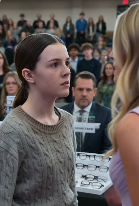
Nicole whispered, “No.”
Marta looked at me. “Emina, did anyone else have your handwritten station codes?”
I thought of the gray notebook I kept in my bag. The one with torn corners and pencil marks pressed so hard they dented the next page.
“No,” I said.
Then I stopped.
Because one person had borrowed it.
One person had smiled kindly and said she only needed to check a lens number.
I turned slowly toward the assistant organizer standing near the curtains.
“Sofia?” I said.
Sofia Rainer’s face crumpled before anyone accused her.
And in her hand, half-hidden behind her clipboard, was my missing notebook.
Part 5: The Notebook Stolen By The Kindest Smile
Sofia did not run.
That somehow made it worse.
She stood there with my notebook pressed against her clipboard, tears filling her eyes as if she were the one who had been pushed to the floor.
“I’m sorry,” she said.
The words came out small.
Nicole snapped, “You took her notebook?”
Sofia looked at her with sudden bitterness. “You told me she was trying to ruin the event.”
“I never told you to delete files.”
“No,” Sofia said. “Your mother did.”
Seraphine’s face did not move.
But Adrien stepped back from her like the air had turned poisonous.
Marta walked to Sofia and held out her hand.
“The notebook.”
Sofia hesitated.
I heard paper shift under her fingers, and a strange panic rose in me. That notebook was ugly, cheap, and stained with tea from mornings when I had gone without breakfast, but it was mine. It held weeks of work nobody wanted to see until someone needed a scapegoat.
“Please,” I said. “Don’t make me beg for my own handwriting.”
Sofia’s face broke.
She gave it to me.
My fingers closed around the bent cover, and I nearly cried from the stupid relief of feeling cardboard and pencil dust.
Lukas asked gently, “Why did you help them?”
Sofia wiped her cheek with the back of her hand.
“My father’s surgery,” she whispered. “Seraphine said the Harrington Foundation could move him up the waiting list in Vienna. She said all I had to do was borrow the notebook, copy the station codes, and replace one file.”
Eleanor Varga’s cane struck the floor once.
“There is no Harrington Foundation surgery list.”
Sofia stared at her.
“That is not how our medical grants work,” Eleanor said. “You were lied to.”
Sofia’s mouth opened, but grief arrived before sound.
Nicole looked at her mother.
For the first time, she seemed young.
Actually young.
“Mother,” she whispered, “what did you do?”
Seraphine finally smiled.
“Protected what belongs to us.”
Lukas said, “Charity equipment for children does not belong to you.”
“No,” Seraphine replied. “But influence does.”
Then she looked straight at me.
“You think being named today makes you important? Poor girls are useful when they are grateful and dangerous when they start keeping records.”
The sentence struck harder than Nicole’s shove.
Not because it was new.
Because it was the truth people like her built rooms around.
I opened my notebook.
A folded page slipped out.
I frowned.
I had not placed it there.
It was a photocopy, thin and old, with a signature at the bottom.
My father’s name.
Damir Kovac.
And above it, the original design title:
THE VISION-PLAYLIST SYSTEM — CREATED FOR THE VARGA SIGHT TRUST.
Part 6: The Signature That Made Emina Stop Breathing
For a moment, the hall vanished.
The cameras, the guests, Nicole’s pale face, Seraphine’s cold smile — all of it blurred into noise.
My father had died when I was twelve.
To the world, he had been a repairman who fixed optical frames, old lamps, and anything with screws small enough to test his patience. To me, he had been warm hands, quiet jokes, and a man who could turn broken things into something useful.
Nobody had ever said he created anything important.
Nobody had ever said his name belonged in a ceremony hall.
Eleanor Varga stepped closer, and the cane in her hand shook.
“Where did you get that?” she asked.
“I don’t know,” I said. My voice sounded far away. “It fell from my notebook.”
Adrien looked at Sofia.
Sofia shook her head rapidly. “I didn’t put it there.”
Marta took a photograph of the page before touching it.
Eleanor stared at the signature.
Then she whispered, “Damir never signed the transfer.”
Seraphine’s expression changed.
Only for a second.
But enough.
Lukas caught it.
“What transfer?”
Eleanor did not look away from the page.
“Years ago, Damir Kovac designed the original tracking method for our mobile vision clinics. Simple. Cheap. Brilliant. It allowed volunteers to rotate lens kits without losing accountability. After he died, someone submitted paperwork claiming he had transferred all rights and recognition to a consulting company.”
Marta turned toward Seraphine.
“Harrington Optical Consulting?”
Adrien closed his eyes.
Seraphine said, “This is absurd.”
Eleanor’s voice sharpened. “His widow disputed it. Then the file disappeared.”
My hand tightened around the photocopy until the corner bent.
“My mother disputed it?”
Eleanor looked at me then, truly looked.
“You are Damir’s daughter.”
I could not answer.
All I could think of was my mother at our kitchen table in Brussels, counting coins, refusing to throw away my father’s old tool case, telling me once that some people steal loudly and some people steal with signatures.
Nicole whispered, “Emina…”
I turned on her so fast she stepped back.
“Don’t say my name like you just found it.”
Her eyes filled, but I had no space left for her regret.
Marta’s phone buzzed. She glanced down.
“The mirrored files recovered,” she said. “Including the deleted one.”
Lukas opened the recovered document on the separate laptop.
Rows appeared.
Names.
Payments.
Shipments.
Then one folder title made every adult in the room go silent.
KOVAC TRANSFER — RECONSTRUCTED.
Eleanor gripped her cane.
“That file should not exist.”
Seraphine moved toward the exit.
But two security staff stepped in front of the doors.
Marta clicked the folder open.
Inside was a scanned contract bearing my father’s signature.
Except my father’s real signature sat on the page in my hand.
And they did not match.
Part 7: The Forged Contract In The Sponsor’s Archive
The difference was obvious.
Painfully obvious.
My father’s real signature had a sharp upward stroke at the end, like he was refusing to let the pen fall. The contract signature was too smooth, too careful, too dead.
Lukas placed both images side by side on the projector.
No sponsor screen now.
No polished branding.
Just two signatures, one honest and one stolen, filling the wall.
The guests began to speak all at once.
Seraphine turned to Alaric. “Say something.”
But Alaric Harrington was staring at the forged contract like a man watching a locked door open from the inside.
Adrien said, “Uncle?”
Alaric’s lips moved once.
Then he looked at me.
And the arrogance left his face so completely that he seemed older by ten years.
“I signed the witness line,” he said.
Seraphine’s head snapped toward him. “Alaric.”
He shook his head.
“I was told Damir had agreed before he died. I was told the widow was confused. I was told the trust needed clean ownership to expand.”
Eleanor’s voice was low. “And did you ask the widow?”
Alaric did not answer.
That was answer enough.
Nicole covered her mouth.
The sound she made was small, almost childlike.
For all her cruelty, she had lived inside a family story where power was proof and money was permission. Now the walls were speaking back.
Marta saved copies to three drives. “This becomes a legal matter.”
Seraphine laughed.
Not loudly.
Worse.
Softly.
“You have a photocopy, a notebook, and a room full of emotional children,” she said. “You have nothing that survives court.”
The doors opened behind her.
A woman entered carrying a black folder against her chest.
My mother.
Amra Kovac.
She wore her cleaning uniform from the train station, her hair pinned badly because she had probably rushed from work. Her cheeks were flushed from the cold outside, and for one terrible second I wanted to hide everything from her.
The shove.
The accusation.
The signature.
The stolen years.
But she walked straight to me, took my face in her hands, and looked into my eyes the way she did when storms hit the windows at night.
“Are you hurt?”
That broke me more than anything.
I shook my head, though my knees ached and my pride felt bruised purple.
She kissed my forehead.
Then she turned to Eleanor.
“I kept the originals.”
Seraphine stopped smiling.
Amra opened the black folder.
Inside were letters, receipts, registered notices, and one sealed document with an old notary stamp from Sarajevo.
“My husband knew they would try,” my mother said. “Before he died, he sent one copy away.”
Eleanor’s eyes filled.
Marta whispered, “To whom?”
My mother looked at me.
“Not to me,” she said. “To his daughter. To be opened when she finished the work he started.”
She placed the sealed document in my hands.
My name was written across the front.
EMINA KOVAC.
And beneath it, in my father’s handwriting:
WHEN THEY FINALLY LOOK AT YOU, MAKE THEM SEE EVERYONE.
Part 8: The Eye Chart That Named Every Forgotten Child
My fingers would not obey at first.
The seal felt too old, too important, too impossible for a girl in worn boots standing under borrowed lights.
My mother stood beside me.
Not in front of me.
Beside me.
That gave me courage.
I opened the document.
Inside was not a contract.
It was a chart.
An eye chart.
But instead of random letters, each line carried names.
Lejla. Tomasz. Mirela. Oskar. Anika. Pavel. Selma. Jakob. Nina. Emir.
Dozens of children from early mobile clinics across Sarajevo, Kraków, Budapest, and Zagreb.
At the bottom, my father had written a note.
Lukas read it aloud because my voice could not yet survive the words.
“If this system is ever used for prestige instead of service, return it to the children it was built for. No donor name should stand above a child’s right to see the world clearly.”
The room was silent.
Not the silence of scandal.
The silence of people being asked to become better than they had planned.
Eleanor Varga straightened.
“Then the trust will honor Damir Kovac’s instruction immediately.”
Seraphine said, “You cannot simply erase our involvement.”
Eleanor turned to her.
“I am not erasing it. I am recording it accurately.”
Marta nodded. “The Harringtons’ role will be documented as disputed, investigated, and suspended.”
Nicole began to cry.
Quietly, without drama.
She looked at me, and for once there was no performance in her face.
“I thought,” she said, then stopped.
I waited.
She swallowed hard.
“I thought if you were honored, it meant something had been taken from me.”
I looked at the eye chart in my hands.
“No,” I said. “It meant something had finally been returned.”
Nicole flinched, but she did not look away.
That was the only apology I could accept from her in that room: not words, not tears, but the beginning of shame.
Lukas stepped to the microphones.
“The ceremony will continue,” he said. “But not as planned.”
He looked at me.
“Emina Kovac will open the eye chart.”
My old boots sounded too loud as I walked to the stage.
Every camera followed, but this time I did not feel poor under their gaze.
I felt unfinished.
I felt terrified.
I felt like my father’s hand was somewhere near my shoulder, not pushing, just steadying.
I lifted the chart.
The names filled the screen behind me.
And then something unexpected happened.
The guests stood.
Not all at once.
First my mother.
Then Adrien.
Then Sofia, crying into her hands.
Then Eleanor Varga, leaning on her cane.
Then the students, the reporters, the technicians, the sponsors who suddenly understood that applause could not buy forgiveness but could still witness truth.
Nicole stood last.
Her face was wet.
Her bracelet was gone from her wrist; she had taken it off and placed it on the donation table without a word.
Months later, the investigation would recover the missing grants.
The Varga Sight Trust would rename the tracking system after Damir Kovac.
Sofia’s father would receive treatment through a real medical program, not a lie.
Adrien would testify.
Nicole would leave her family’s foundation and spend a year doing the kind of volunteer work where nobody clapped.
But that morning, I only knew one thing.
I had entered the hall as the girl nobody wanted near the project.
I left it carrying my father’s chart, my mother’s hand in mine, and a room full of people finally seeing clearly.
And for the first time in my life, I understood that being overlooked had not made me invisible — it had made me impossible to counterfeit.
