The first drop of mango smoothie slid down my cheek before I understood that the whole room had gone silent for me.
Not silent because they felt sorry.
Silent because everyone was waiting to see what I would do next.
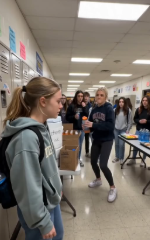
I stood in the middle of the gym lobby with orange-yellow smoothie dripping from my hairline, soaking into the collar of my school event T-shirt, and pooling at the edge of my sneakers. Around me, students held their phones chest-high, faces glowing with that awful hunger people get when someone else’s humiliation becomes entertainment.
Kenzie Fairchild stood inches away from me, breathing hard, her empty plastic cup crushed in one hand.
“There,” she said, loud enough for the whole crowd to hear. “Maybe now you’ll stop acting innocent.”
My name is June Walker. I was seventeen years old, a junior at Silver Ridge High in Idaho, and until that afternoon, I honestly thought the worst thing that could happen at a school wellness fair was running out of cups.
I had been wrong.
Very wrong.
The problem started with the electrolyte drink cooler.
It was supposed to be simple. Three flavors. Three labels. One allergy list printed by the school nurse. Students coming in after the charity fun run would grab a drink, cool down, and go back to the event booths. I was only volunteering because my counselor said it would look good on scholarship applications, and because I liked tasks with lists, labels, and rules. Rules made sense. People did not.
The coolers sat on a folding table near the gym entrance: lemon-lime, berry, and mango. The mango flavor had a coconut additive. Not a huge deal for most people, but a very serious deal for one freshman named Talia Price, who had a documented coconut allergy. Nurse Rowe had texted the student volunteers in our event group chat that morning with a clear warning: keep the mango cooler separate, label it correctly, and make sure nobody mixed the lids.
I read that text at 8:14 a.m.
I remembered the time because I had been sitting on the school bus, staring at my cracked phone screen, watching the message appear under Nurse Rowe’s name.
ALLERGY WARNING: Mango electrolyte mix contains coconut. Keep mango label visible. Do not serve mango to students on allergy list. Confirm labels before opening.
At 8:15, Kenzie Fairchild replied.
Got it. I’ll handle the drink table.
That should have been the end of it.
But by 2:37 p.m., everyone was saying I had switched the labels.
“June did it,” someone whispered when I arrived.
“June messed with the cooler.”
“She’s the one who kept checking the drinks.”
“Talia almost took one.”
The words circled me before I even reached the table. The gym lobby smelled like sweat, floor cleaner, popcorn from the concession stand, and fruit syrup. Cheerleaders in matching shirts clustered near the trophy case. Parents drifted in and out. Teachers tried to pretend they had control. The wellness fair banners sagged slightly from the walls like even they were tired.
I stopped at the drink table and saw the problem instantly.
The mango cooler had a berry label taped across the front.
My stomach dropped.
“Who changed this?” I asked.
Kenzie turned before anyone else did.
She was eighteen, a senior, and the kind of girl adults described as “a natural leader” even when she was just telling people what to do. Her father sat on the district fundraising board. Her mother organized half the school’s charity events. Kenzie moved through Silver Ridge like she had been born with a key to every locked door.
She wore a spotless white jacket over her event shirt, her hair pulled into a glossy ponytail, her smile sharp enough to cut paper.
“Oh, please,” she said. “Don’t start.”
I looked from her to the cooler. “The mango label is wrong.”
“That’s funny,” she said. “Because you were the last one touching it.”
A few students turned toward me.
I felt the shift immediately. It was like stepping onto ice and hearing the first crack.
“I checked the labels because Nurse Rowe sent a warning,” I said carefully. “Talia can’t have coconut.”
Kenzie’s eyes narrowed for half a second. So fast most people would have missed it.
I did not.
I had spent years noticing small changes in people’s faces. When you are quiet, people assume you are not paying attention. But quiet girls notice everything.
“Exactly,” Kenzie said. “You knew about the allergy, and then the label got switched. That looks pretty bad, June.”
“It got switched after I checked it.”
“Can you prove that?”
The question hit harder than it should have.
Because the answer was yes.
Or at least, I thought it was.
“There’s a volunteer log,” I said. “And the receipt from when the drinks were mixed. And Nurse Rowe’s text. We can check the timestamps.”
The word timestamps changed Kenzie’s expression.
Only for a heartbeat.
Then her face hardened.
She stepped closer. “You really want to drag this out in front of everyone?”
“I want the truth.”
“No,” she snapped. “You want attention.”
My hands were shaking, so I folded them together in front of me and pressed my thumbs hard against each other. I had learned that trick after my dad died. Press thumb to thumb. Breathe in. Count to four. Breathe out. Do not cry until you are somewhere safe.
“I didn’t switch anything,” I said.
Kenzie laughed, but there was no humor in it. “You always do this.”
I blinked. “Do what?”
“Act like you’re the only responsible person in the room. Like the rest of us are too stupid to read a label.”
A murmur moved through the crowd.
Kenzie knew how to perform. She knew where to stand, when to raise her voice, when to look wounded instead of angry. She could turn a room into a jury without anyone realizing they had been sworn in.
I saw Mr. Calder, the activities coordinator, hurrying toward us from the check-in table with his laptop tucked under his arm. “What’s going on?”
Kenzie spun toward him. “June switched the mango label. Talia almost drank it.”
“That is not true,” I said.
Mr. Calder looked exhausted already. His tie was crooked, and his glasses sat low on his nose. “Everyone calm down.”
But nobody calmed down.
Kenzie pointed at the cooler. “She was seen touching it.”
“I was checking it.”
“She always says that.”
“Open the log,” I said to Mr. Calder. “Please. Just open the file.”
Kenzie’s voice dropped. “Don’t.”
It was one word.
Not loud.
Not dramatic.
But I heard it.
So did Mr. Calder.
He looked at her. “Kenzie?”
She recovered instantly. “I mean, don’t let her waste time. The freshman could have gotten hurt.”
Talia Price stood near the wall, pale and wide-eyed, her curly hair tied back with a purple ribbon. She held an unopened drink in both hands like it might explode. Her older brother Mason stood beside her, jaw clenched.
I looked at Talia and felt something stronger than embarrassment.
Fear.
Not for myself.
For her.
Because if the label had been wrong and nobody checked it, this could have become more than a rumor. More than a school scandal. More than a video shared in group chats with laughing emojis.
It could have become an ambulance.
“Mr. Calder,” I said, my voice shaking now, “please open the timestamped file.”
Kenzie moved before he could answer.
She grabbed the mango smoothie from the sample tray, stepped into my space, and threw it in my face.
The cold hit first.
Then the smell.
Sweet, sticky mango filled my nose and mouth. My eyes burned. Someone gasped. Someone else whispered, “Oh my God.” Phones rose higher.
Kenzie’s voice cut through the room.
“She could have hurt Talia, and you’re all standing here listening to her?”
For a second, I disappeared inside the humiliation.
I was not June Walker, the girl who kept her grades high because scholarships were the only bridge out of town.
I was not June Walker, whose mom worked double shifts at the clinic and still left notes in my lunch bag.
I was not June Walker, who kept an old voicemail from her dad because his voice saying “proud of you, June Bug” was the only thing I had left that still sounded warm.
I was just the girl with smoothie dripping off her chin while everyone watched.
My throat tightened.
My eyes filled.
Kenzie wanted me to run.
I knew that suddenly with perfect clarity.
She wanted me to cover my face and leave the room. She wanted the video to end with me looking guilty, ashamed, defeated. She wanted the story to freeze there forever.
But my father’s voice rose in my memory.
When the room gets loud, look for the record.
He used to say that when he worked as a county clerk. People argued. People shouted. People blamed. But paperwork, he said, had a quiet kind of courage.
So I wiped smoothie from my eyelashes with the back of my hand and looked at Mr. Calder.
“Open it,” I said.
My voice was not loud.
But it carried.
Mr. Calder stared at me for one long second. Then he opened his laptop.
Kenzie’s face changed again.
This time everyone saw it.
“Kenzie,” one of her friends whispered. “What’s wrong?”
“Nothing,” Kenzie snapped.
Mr. Calder set the laptop on the folding table. His fingers moved over the keys. The crowd leaned in. Someone shut off the music from the speaker booth, and the sudden silence made the clicking keys sound enormous.
“Volunteer folder,” Mr. Calder muttered. “Wellness fair. Drink station. Here.”
Kenzie crossed her arms. “This is ridiculous.”
I watched the screen.
My heart slammed so hard I felt it in my wrists.
Mr. Calder opened the digital check-in sheet. Names. Times. Assigned tasks.
JUNE WALKER — ARRIVED 1:52 P.M. — LABEL CHECK COMPLETED 2:03 P.M.
KENZIE FAIRCHILD — DRINK TABLE LEAD — ARRIVED 1:10 P.M. — COOLER SETUP COMPLETED 1:28 P.M.
That proved I had checked the labels, but not who had switched them.
Kenzie smiled faintly.
“See?” she said. “She touched them.”
“Keep going,” I said.
Mr. Calder opened the photo receipt folder. Every station had been required to upload setup photos for the school newsletter and donor report. He clicked the drink table image.
There it was.
A photo taken at 2:04 p.m.
The mango cooler had the correct mango label.
The berry cooler had the correct berry label.
The lemon-lime cooler had the correct lemon-lime label.
The room shifted.
Kenzie’s smile faded.
Mr. Calder swallowed. “This photo was uploaded one minute after June’s label check.”
I looked at Kenzie. “So it was correct when I finished.”
She rolled her eyes, but her voice had lost its sharpness. “Then she changed it after.”
“I left for the registration table at 2:05,” I said. “Check the camera by the trophy case.”
A ripple went through the students.
Kenzie’s head snapped toward me. “There is no camera there.”
I turned to her slowly.
“How would you know which camera angles work?”
It was the first time I saw real fear in her face.
Mr. Calder glanced up. “There is a hallway camera near the trophy case. It catches part of the drink table.”
Kenzie’s friends had gone quiet.
Mr. Calder logged into the security portal. He was not supposed to do that in front of students, but by then two teachers had joined him, and Principal Hargrove had appeared at the edge of the crowd with her lips pressed into a thin line.
The video loaded slowly.
Painfully slowly.
The little spinning circle on the screen felt like it was chewing through my nerves.
Then the footage opened.
2:05 p.m.
I appeared on-screen, leaving the drink table and walking toward registration.
2:11 p.m.
Two sophomores walked past.
2:18 p.m.
Mason Price stopped near the cooler, checked his phone, and walked away.
2:26 p.m.
Kenzie Fairchild entered the frame.
The whole lobby seemed to inhale at once.
On-screen, Kenzie looked over both shoulders. She lifted the mango label, peeled it carefully from the cooler, and pressed the berry label in its place. Then she tucked the mango label under a stack of napkins and walked away.
No one spoke.
Kenzie’s empty cup slipped from her hand and hit the floor.
Mr. Calder froze the footage.
The timestamp glowed in the corner like a verdict.
2:26:43 p.m.
Principal Hargrove turned to Kenzie. “My office. Now.”
Kenzie’s face twisted. “No. You don’t understand.”
“I understand enough.”
“No, you don’t!” Kenzie shouted.
Her voice cracked in a way I had never heard before. Not anger. Panic.
Everyone stared at her, but I was looking at the screen.
Something was wrong.
The footage proved Kenzie switched the labels, yes. But it did not explain why she had looked terrified before I even asked for the log.
It did not explain why she had said, “Don’t,” like a person trying to stop a door from opening.
And it did not explain one detail I could not stop replaying in my mind.
At 8:15 that morning, Kenzie had replied to Nurse Rowe’s warning.
Got it. I’ll handle the drink table.
But when Mr. Calder opened the group chat, that message was not there.
I noticed because I notice missing things.
The chat showed Nurse Rowe’s warning at 8:14.
Then my thumbs-up reaction.
Then two messages from other volunteers.
Kenzie’s reply was gone.
I wiped more smoothie from my chin and stared at the screen.
“Wait,” I said.
Principal Hargrove looked irritated. “June, we will handle this.”
“No,” I said. “The nurse text is missing a message.”
Kenzie went still.
Mr. Calder frowned. “What message?”
“Kenzie replied at 8:15,” I said. “She said she would handle the drink table.”
Kenzie laughed too loudly. “That’s insane. You’re making things up.”
I looked at Nurse Rowe, who had just pushed through the crowd after hearing the commotion. Her face was flushed, and her badge swung from her lanyard.
“Nurse Rowe,” I said, “can you check your phone?”
Everyone turned to her.
Nurse Rowe hesitated. “My phone?”
“The original group chat. Not the school export. Your phone.”
Principal Hargrove’s eyes sharpened. “Why would the export be different?”
Nobody answered.
Nurse Rowe pulled out her phone. Her hands moved quickly. She opened the group chat, scrolled, and stopped.
Her face drained of color.
“It’s here,” she said softly.
Mr. Calder leaned toward her screen.
Nurse Rowe read aloud.
“8:15 a.m. Kenzie Fairchild: Got it. I’ll handle the drink table.”
The crowd stirred.
Principal Hargrove looked at Mr. Calder’s laptop. “Why isn’t it in the exported record?”
Kenzie whispered, “Please don’t.”
There it was again.
Please don’t.
Not the voice of someone caught in a petty lie.
The voice of someone watching a buried thing come alive.
Principal Hargrove took Nurse Rowe’s phone. “Kenzie, what did you do?”
Kenzie shook her head. “I didn’t delete anything.”
“Then who did?”
Kenzie looked toward the gym doors.
And for the first time, I followed her eyes.
Standing near the entrance was Mrs. Fairchild.
Kenzie’s mother.
She wore a navy blazer, pearl earrings, and the calm expression of a woman who had never once waited in an office without being offered coffee. She had been there the whole time, half-hidden behind a fundraiser display, watching.
When our eyes met, she smiled.
Not warmly.
Not kindly.
Just enough to tell me she was not surprised.
Principal Hargrove saw her too. “Mrs. Fairchild.”
The woman stepped forward with perfect composure. “This has gone far enough.”
“Your daughter switched an allergy label,” Principal Hargrove said.
“My daughter made a mistake under pressure.”
“She threw a drink in another student’s face.”
“She was emotional because she cares about safety.”
A bitter laugh escaped Mason Price. “My sister was the one put in danger.”
Mrs. Fairchild turned toward him. “And thankfully, nothing happened.”
Talia flinched.
I saw Mason’s hand curl around his sister’s shoulder.
Nothing happened.
The phrase landed like ice.
Because something had happened. A student had almost been given a drink with an allergen. A girl had been publicly humiliated. A record had been altered. A room full of people had been trained to believe the loudest voice first.
But to Mrs. Fairchild, none of that counted because nobody had left in an ambulance.
Principal Hargrove’s face tightened. “We need to review all digital records.”
Mrs. Fairchild’s smile thinned. “Be careful, Dana.”
The principal stiffened.
She had a first name in Mrs. Fairchild’s mouth.
That meant history.
That meant pressure.
That meant the room was not as safe as I had hoped.
Kenzie suddenly burst into tears.
“I didn’t want to do it,” she said.
Her mother’s head snapped toward her. “Kenzie.”
“I didn’t!” Kenzie cried. “You said it was just to make June look careless. You said nobody would actually drink it.”
The room exploded.
“What?” Mr. Calder whispered.
Kenzie covered her mouth, horrified by her own words.
Mrs. Fairchild’s expression finally cracked. “Kenzie, stop speaking.”
But Kenzie could not stop. Once fear found an exit, it poured out.
“You said the event needed a problem,” Kenzie sobbed. “You said if people thought the volunteer system failed, the board would approve your private vendor contract. You said June was the easiest one because she always checks everything and nobody likes a know-it-all.”
My body went cold.
The words did not make sense at first. They came too big, too ugly, too organized.
Private vendor contract.
Volunteer system failed.
June was easiest.
I looked at Principal Hargrove, then Mr. Calder, then Nurse Rowe.
They all looked stunned.
Except Mrs. Fairchild.
She looked furious.
Not guilty.
Furious.
“Kenzie,” she said, each syllable polished and deadly, “you are confused.”
“No, I’m not.” Kenzie wiped her face with shaking hands. “You told me to switch the labels after June checked them. You told me the timestamp would make it look like she missed it. Then when Nurse Rowe’s text showed I was in charge, you said you had someone clean the export before the meeting.”
Principal Hargrove took a step back. “Someone altered school records?”
Mrs. Fairchild lifted her chin. “These are wild accusations from a stressed teenager.”
I should have felt victory.
I did not.
I felt sick.
Because suddenly the smoothie on my face was not the worst part of the day. It was almost small compared to the machine behind it: adults with money, contracts, access, and the confidence that students were pieces they could move around.
Kenzie looked at me then.
Really looked at me.
For the first time all year, she did not look like a queen.
She looked like a scared girl who had mistaken popularity for protection and discovered too late that power eats its own children first.
“I’m sorry,” she whispered.
I did not know what to say.
Part of me wanted to scream at her.
Part of me wanted to ask why.
Part of me, the bruised and sticky and humiliated part, wanted her to feel every second of what she had done.
But before I could answer, my phone buzzed in my pocket.
Once.
Then again.
I pulled it out with trembling fingers.
Unknown number.
A message appeared.
CHECK THE SECOND TIMESTAMP.
Attached was a video file.
My pulse stopped.
I looked around the room, but everyone was staring at Mrs. Fairchild.
Everyone except Talia.
The freshman with the purple ribbon was looking directly at my phone.
Her face was pale, but her eyes were steady.
I tapped the video.
The angle was low, slightly tilted, filmed from under the drink table. At first all I saw were table legs, cooler shadows, and the edge of a cardboard box. Then voices.
Mrs. Fairchild’s voice.
“After Walker checks the labels, wait twenty minutes.”
Kenzie’s voice, smaller than I had ever heard it.
“Mom, what if Talia takes one?”
“She won’t. I already told Andrea to keep her near the raffle table until the announcement.”
“But what if—”
“Don’t be dramatic. The label switch only needs to be discovered. The school needs a documented failure before Monday’s board vote.”
The video shook slightly.
Then Mrs. Fairchild leaned into frame.
“Remember,” she said, “June Walker is perfect for this. Scholarship girl. Quiet. No connections. People believe girls like that are either saints or liars, and saints are boring. Give them a liar.”
The timestamp glowed at the bottom.
1:49:12 p.m.
Before I had even arrived.
Before I had touched a single cooler.
Before anyone could claim this was confusion.
I could barely breathe.
Mr. Calder saw my face. “June?”
I held up the phone.
The room watched the second timestamp open.
If the first video had silenced them, the second one changed the air itself.
Mrs. Fairchild’s composure vanished.
“Where did you get that?” she demanded.
No one answered.
Then Talia stepped forward.
Small, shaking, brave.
“From my brother’s allergy monitor bag,” she said.
Mason stared at her. “Talia?”
She swallowed. “Mom makes me keep a tiny camera clipped inside when I’m at big events. Not to spy. Just because last year someone gave me the wrong cookie at camp and nobody believed me until I got sick. I set my bag under the drink table because I didn’t want people teasing me about it.”
Her voice trembled, but she did not stop.
“It recorded them.”
Mrs. Fairchild pointed at her. “That is illegal.”
Nurse Rowe moved in front of Talia like a shield. “A student with a medical safety device accidentally recorded a conversation about endangering her. I would choose your next words very carefully.”
For the first time, Mrs. Fairchild had no answer.
Principal Hargrove called the district office.
Then she called security.
Then, in front of everyone, she asked Mrs. Fairchild to leave the building.
Mrs. Fairchild refused at first. She said names. She mentioned donations. She said the board would hear about this. She said people would regret humiliating her family.
But nobody moved to help her.
Not the teachers.
Not the parents.
Not even Kenzie.
When security escorted Mrs. Fairchild out, her pearl earrings caught the gym lights one last time before she disappeared through the doors.
The sound that followed was not cheering.
It was worse.
It was silence full of shame.
Students lowered their phones. Some looked at me. Some looked away. A few deleted videos quickly, as if deleting proof could erase the fact that they had enjoyed needing it.
Kenzie stood alone beside the drink table.
Her white jacket was still spotless.
Mine was ruined.
That felt unfair in a way I could not explain.
Principal Hargrove approached me slowly. “June, I am so sorry.”
I wanted to say something mature. Something brave. Something people would quote later when they told the story.
Instead, I asked, “Can I wash my face?”
Nurse Rowe’s eyes softened. “Of course.”
She led me to the nurse’s office through the side hallway. Talia came with us. So did Mason, hovering protectively near his sister. The further we got from the gym, the more my legs shook.
In the nurse’s office, I leaned over the sink and rinsed mango from my hair with cold water. The sticky sweetness clung stubbornly to my skin. Nurse Rowe handed me paper towels, then a clean school hoodie from the lost-and-found bin.
It was too big and smelled faintly like laundry detergent.
I put it on anyway.
Talia sat on the exam cot, twisting the end of her purple ribbon.
“I’m sorry,” she said.
I looked up. “For what?”
“For not saying something sooner.”
“You didn’t do anything wrong.”
“I knew Kenzie was acting weird. I saw her mom talking to her. I thought maybe it was family stuff.”
I sat in the chair across from her. “You’re the reason they got caught.”
She looked down. “I was scared.”
“Me too.”
That made her look at me.
People always think courage feels strong. It does not. Courage feels like shaking so hard you can barely stand and doing the thing anyway because the alternative is worse.
Mason cleared his throat. “For what it’s worth, I believed you before the video.”
I almost smiled. “Why?”
He shrugged. “You looked more worried about Talia than yourself.”
That was when I finally cried.
Not loudly.
Not dramatically.
Just a few tears I could not hold back anymore.
Nurse Rowe pretended to organize bandages so I would not feel watched.
Later, my mom arrived.
She came straight from the clinic, still in scrubs, her hair falling loose from its clip, her face tight with the kind of fear parents try to hide and never can. When she saw me in the oversized hoodie with red eyes and damp hair, she stopped in the doorway.
“June.”
That was all she said.
I stood up, and she crossed the room and wrapped me in her arms.
For one minute, I was not the girl who had stood in front of a crowd. I was just my mother’s daughter, breathing in the clean soap smell of her scrubs, letting her hold me together.
“I’m okay,” I whispered.
“No,” she said softly. “But you will be.”
The district investigation moved faster than anyone expected.
Maybe because of the video.
Maybe because Mrs. Fairchild had finally scared the wrong people.
Maybe because Talia’s parents threatened legal action, and suddenly everyone remembered that student safety mattered.
Within a week, Mrs. Fairchild resigned from the fundraising board. The private vendor contract was frozen. The school launched an audit of event purchases and digital record access. Someone in the district technology office admitted that Mrs. Fairchild had pressured him to “clean up duplicate messages” from the export. He lost his job.
Kenzie was suspended pending a disciplinary hearing.
For three days, I did not go to school.
I told everyone I needed time.
The truth was, I was afraid.
Not of Kenzie.
Of the hallway.
Of the whispers.
Of walking past people who had filmed me instead of helping me.
On the fourth morning, my mom made pancakes shaped badly like circles and placed one in front of me.
“You don’t have to go back today,” she said.
I stared at the syrup bottle. “If I don’t, it feels like they still get to keep part of me.”
Mom sat across from me. “Then take it back slowly.”
So I did.
When I walked into Silver Ridge High, the hallway quieted.
I hated that.
Then Talia appeared near the office wearing her purple ribbon.
Beside her stood Mason, Nurse Rowe, Mr. Calder, and about twenty students from the wellness fair.
For one awful second, I thought it was another confrontation.
Then Talia stepped forward holding a folded piece of paper.
“We wrote something,” she said.
She unfolded it with shaking hands.
“It says we’re sorry for believing the accusation before the evidence. We’re sorry for recording instead of helping. We’re sorry for making the room unsafe for you. And we’re grateful that you asked for the record when everyone else wanted a rumor.”
My throat closed.
A girl from my English class raised her hand awkwardly. “I deleted the video. I should’ve helped. I’m sorry.”
Another student said, “Me too.”
Then another.
Not everyone apologized.
Some people avoided my eyes and slipped around us.
But enough did.
Enough to make the hallway feel less like a trap.
Kenzie returned two weeks later.
I saw her first in the library.
She looked smaller without her usual circle of friends. Her hair was pulled back messily. No white jacket. No perfect smile. She stood near the biography shelf holding a stack of textbooks against her chest.
For a moment, we just stared at each other.
Then she walked toward me.
Every muscle in my body tightened.
“I’m not here to ask you to forgive me,” she said.
That surprised me.
She looked down at her shoes. “I don’t deserve that. Not now. Maybe not ever. I just wanted to tell you the truth without my mom in the room.”
I said nothing.
Kenzie swallowed. “She told me my whole life that people are either useful or dangerous. She said you were dangerous because adults trusted you. Because you noticed details. Because you wouldn’t sign things just to make events run smoothly.”
Her voice broke.
“I hated you for that. Not because you did anything to me. Because I knew you were the kind of person I should have been, and I wasn’t brave enough.”
The library clock ticked above us.
I thought about smoothie on my face. Phones in the air. Talia’s pale hands around the unopened drink. Kenzie’s voice saying, “Maybe now you’ll stop acting innocent.”
“I can’t make you feel better,” I said.
She nodded quickly. “I know.”
“And I’m not going to carry what you did just so you can put it down.”
Her eyes filled with tears.
“But,” I said, surprising myself, “you can become someone who never does it again.”
Kenzie pressed her lips together and nodded.
For the first time since I had known her, she did not look like she wanted an audience.
She just looked like she had heard me.
Spring came late that year.
Snow clung to the edges of the football field long after the sidewalks cleared. The wellness fair became one of those school legends people retold in pieces, always changing details, always making themselves look better. Some said they had known I was innocent immediately. Some claimed they had been “just about to” speak up.
I stopped correcting every version.
Not because truth stopped mattering.
Because the official record existed.
The timestamps existed.
And so did I.
At the end of the semester, Principal Hargrove called an assembly. I hated assemblies, especially after everything, but Nurse Rowe asked me to attend.
The gym looked different from the bleachers. Smaller somehow. Less powerful.
Principal Hargrove stood at the microphone and announced a new student safety policy. All allergy-related event setups would require double verification. Digital records would be locked from outside edits. Student volunteers could challenge unsafe instructions without punishment.
Then she paused.
“This policy exists because one student insisted that truth mattered even when the room turned against her.”
My face burned.
Mom squeezed my hand from the seat beside me.
Principal Hargrove looked toward me. “June Walker, would you stand?”
I did not want to.
But Talia turned around from the row in front and smiled.
So I stood.
The applause began softly.
Then grew.
It filled the gym, not like the silence after the smoothie, not like the hungry quiet of humiliation, but like rain after a fire.
I saw Mason clapping. Nurse Rowe. Mr. Calder. Students who had apologized. Students who had not.
And near the back, half-hidden beside the doors, Kenzie Fairchild stood clapping too.
Her eyes met mine.
She did not smile.
She just nodded once.
I nodded back.
Not forgiveness.
Not friendship.
Just recognition.
A month later, a letter arrived at our house.
It came in a thick envelope from the Idaho Youth Civic Integrity Foundation. I assumed it was a rejection from some scholarship I barely remembered applying for. I opened it at the kitchen table while Mom sorted bills.
Then I stopped breathing.
Mom looked up. “June?”
I read the first line again.
Then the second.
Then I laughed and cried at the same time.
I had won.
A full scholarship for students who demonstrated courage in public accountability and community safety.
My mom covered her mouth.
“Oh, June Bug,” she whispered.
Nobody had called me that since Dad.
For a second, grief and happiness folded together so tightly I could not separate them.
Inside the envelope was a note from the selection committee.
Your application was strengthened by a letter submitted on your behalf by Talia Price and Nurse Rowe. We were especially moved by your statement: “When the room gets loud, look for the record.”
I touched the sentence with my fingertip.
Dad’s words.
Still here.
Still helping me.
That summer, before senior year, I volunteered to help train new student event leaders. I stood in the same gym lobby where everything had happened and taught freshmen how to label coolers, check allergy lists, and document setup photos.
Talia helped.
She had become fearless in a quiet way, the kind that did not need to announce itself. Mason teased her about carrying three backup chargers for her medical device. She told him preparation was not paranoia if it saved lives.
I liked her immediately for that.
At the end of training, a freshman raised his hand.
“What if someone important tells us not to make a big deal?”
The room went still.
I looked at the drink table.
For a moment, I saw it all again: the mango label, the phones, Kenzie’s face, the timestamp glowing like a tiny square of truth.
Then I looked back at the freshman.
“Then make a big deal,” I said. “Politely if you can. Loudly if you must.”
Everyone laughed a little.
But they wrote it down.
The final twist came in September.
I was cleaning out the volunteer storage closet when I found an old cardboard box labeled ARCHIVED EVENT MATERIALS. Inside were tangled lanyards, faded banners, broken clipboards, and a stack of unused donor plaques from previous fundraisers.
One plaque had my father’s name on it.
WALKER FAMILY COMMUNITY ACCESS FUND.
I stared at it so long the letters blurred.
Mr. Calder found me sitting on the floor with the plaque in my lap.
“I wondered when that would turn up,” he said softly.
I looked up. “What is this?”
He sat on an overturned crate. “Your dad helped create the original student volunteer accountability system after a budget issue years ago. The logs, timestamps, photo receipts. That was his proposal.”
I could not speak.
Mr. Calder continued, “The Fairchilds hated it. Made it harder to push private vendors without oversight. After your dad passed, the system stayed, but people forgot who built it.”
My hands tightened around the plaque.
All this time, I thought I had been saved by paperwork.
But it had been more than that.
I had been saved by my father’s last quiet act of protection.
The record I asked for existed because he had believed students without power needed proof stronger than popularity.
I pressed the plaque against my chest and cried right there on the storage room floor.
Not from fear this time.
From love.
At graduation the next spring, I wore a small silver charm on my bracelet shaped like a clock.
Mom said it was perfect.
Talia said it was dramatic.
Mason said it was “intimidating in a nerd way,” which I decided to accept as a compliment.
Kenzie graduated too. She walked across the stage to polite applause, quieter than before, changed in ways I could not fully know. I heard she had written her college essay about accountability and losing the version of herself her mother had built. I hoped she meant it.
When my name was called, I stepped into the sunlight spilling across the football field.
For one second, I remembered the smoothie, the silence, the accusation.
Then I heard my mother cheering.
I heard Talia shouting my name.
I heard Nurse Rowe whistle so loudly Principal Hargrove jumped.
And somewhere inside me, I heard my father’s voice.
Proud of you, June Bug.
I crossed the stage, took my diploma, and smiled.
Because they had blamed me in front of everyone.
They had tried to bury me under a lie.
They had counted on power, fear, and silence.
But the timestamp opened.
Then the second timestamp opened.
And after that, so did my future.
THE END
