The moment Kennedy Blake threw food at me, the camera in someone’s hand shook so badly that, for three seconds, the whole room looked like it was falling.
Maybe it was.
Not the arts classroom itself, with its paint-splattered tables, drying racks, film posters, and half-finished student projects taped along the walls.
Not the high-school noise outside the door, where lockers slammed and students laughed like nothing terrible had happened yet.
What fell apart was Kennedy’s perfect version of the story.
If you watched the first video with the sound off, you would think I was the problem.
You would see Kennedy standing in front of me, pointing like a prosecutor. You would see me frozen beside the editing computer, hands low, shoulders tight, face pale. You would see her friends behind her, forming a glossy little wall of judgment. You would see the bowl leave her hand. You would see noodles, sauce, and humiliation hit my shirt while everyone gasped.
What you would not see at first was the film edit.
You would not see the missing four seconds.
You would not see the release form.
And you definitely would not understand why Kennedy Blake’s own account was sitting inside the proof file like a fingerprint she had forgotten to wipe away.
My name is Lila Tran. I was seventeen years old, Vietnamese American, with black hair I usually clipped back because I hated when it fell into my eyes while editing. That day, I wore a faded green hoodie, black jeans, and paint-stained sneakers from the mural club project I had finished the week before. I was not rich, not famous, not the daughter of anyone the school board called by first name.
Kennedy Blake was.
She was eighteen, polished, blonde, and impossible to ignore. Her mother produced charity events in Los Angeles. Her father had donated cameras to the arts department. Kennedy’s older sister had won a student film award three years earlier, and people still talked about the Blake family like creativity was something they owned.
Kennedy did not walk into a classroom.
She arrived.
And people made room.
For most of senior year, I tried not to stand in that room.
But the film festival changed everything.
Every spring, Westbridge High held a student arts showcase in Los Angeles. There were paintings, photography portfolios, theater monologues, short films, music performances, and one big evening where parents, teachers, sponsors, and district guests walked through the building pretending teenagers were less chaotic than we were.
The short-film category mattered most to Kennedy.
Everyone knew it.
She had been talking about her film, Glass House, for months. It was supposed to be emotional, elegant, and brave. She told everyone it was about “the invisible loneliness of privilege,” which sounded deep enough that people nodded before asking what it meant.
My film was smaller.
It was called After the Bell.
I made it with three friends, one borrowed camera, and a microphone that kept picking up traffic noise from Sunset Boulevard. It was about a girl who cleaned classrooms after school with her mother and secretly recorded sounds from empty rooms because silence felt safer than people.
I did not expect to beat Kennedy.
I just wanted the film shown correctly.
That should not have been too much to ask.
The problem began on Wednesday afternoon in the arts classroom, two days before the showcase. Ms. Calder, our film teacher, had asked me to help organize final exports because I was careful with file names and never complained about boring technical work. We had a shared folder for every film, every permission form, every music license, and every release form signed by students who appeared on camera.
“No form, no face,” Ms. Calder always said. “If someone appears clearly, we need permission. Art does not get to ignore consent.”
I respected that rule more than most students did.
Maybe because my mother hated being photographed without warning. Maybe because I knew what it felt like to have people make a version of you that you did not choose.
Around 3:40 p.m., I was checking final film folders when I saw the strange edit.
Kennedy’s film had a new cut uploaded that morning.
GLASS_HOUSE_FINAL_FINAL_REAL.mp4.
That was already suspicious, because anyone who edited knew that too many finals meant trouble.
I opened it only to check export settings.
At first, the film looked exactly like Kennedy’s earlier version. Slow piano music. Sunlight through expensive windows. Kennedy looking out at the city from a balcony. Beautiful shots of a house that looked too clean to belong to real people.
Then came the classroom scene.
I froze.
There, for four seconds, was Marisol Vega.
Marisol was a sophomore scholarship student in the visual arts track. She was quiet, talented, and painfully shy about being recorded. A week earlier, she had asked Ms. Calder to remove her from all behind-the-scenes footage because she did not want her face in any public showcase.
Kennedy knew that.
Everyone knew that.
But in Kennedy’s new cut, Marisol appeared in the background of a hallway shot, crying beside a display board after her painting had been criticized during peer review.
The shot was brief.
But it was cruel.
Not because Marisol looked bad.
Because she looked private.
The camera had captured something she had never agreed to share.
My stomach tightened.
I checked the release folder.
There was no signed release for Marisol in Kennedy’s film.
Then I opened the edit notes.
A marker had been added over the clip.
KEEP. EMOTIONAL TEXTURE.
The account name attached to the note was KBlake.
Kennedy.
I sat there staring at those two words.
Emotional texture.
That was what she had called someone else’s humiliation.
I took a screenshot.
Then another.
Then I downloaded the version history and sent a message to Ms. Calder.
Kennedy’s final cut includes Marisol Vega in hallway crying shot. I don’t see a release form for Marisol. Version note says KEEP. Please review before showcase export.
I expected Ms. Calder to answer quickly.
She did not.
The arts classroom was loud around me. Students painted backdrops, argued over glue sticks, practiced monologues, and heated noodles in the microwave even though the sign clearly said food stayed outside the editing area. Nobody noticed me sitting at the computer with my pulse kicking in my throat.
Then Kennedy walked in.
The room shifted before she said a word.
Her friends followed her: Tessa, who laughed at everything Kennedy said half a second too late, and Brooke, who wore sunglasses indoors and called it a “visual choice.”
Kennedy’s eyes went straight to me.
That was when I knew Ms. Calder had said something.
Or worse, someone had shown Kennedy my message.
She crossed the room slowly.
“Lila,” she said. “Why are you in my film folder?”
“I’m checking exports for Ms. Calder.”
“Funny. Because I heard you’re accusing me of violating a release.”
I glanced at the students nearby.
A few heads turned.
“I asked Ms. Calder to review a clip.”
Kennedy smiled.
It was the kind of smile that made people think she was calm if they did not know how to read cruelty.
“You mean Marisol?”
I did not answer.
That was answer enough.
Kennedy leaned one hand on the table beside the keyboard. “She’s barely visible.”
“She’s identifiable.”
“It’s four seconds.”
“She didn’t sign a release.”
Kennedy’s smile thinned. “You’re not the teacher.”
“No. But Ms. Calder asked me to check folders.”
“You checked mine because you’re jealous.”
The room quieted a little more.
There it was.
The easier story.
Jealous girl. Rich girl. Film competition. Sabotage.
People understood that story faster than they understood consent forms.
“I’m not jealous,” I said.
“Then why are you trying to get my film disqualified?”
“I’m trying to keep Marisol out of a public screening she didn’t agree to.”
Kennedy’s eyes flashed.
For one second, the performance dropped.
“You don’t even know her.”
“I know she said no.”
Tessa laughed. “Lila, you’re being dramatic.”
Brooke lifted her phone.
My skin went cold.
Kennedy noticed me noticing.
Her voice grew louder, clearer, more theatrical.
“Everyone should hear this. Lila Tran went into my private film folder and tried to remove part of my work because she thinks she gets to control the showcase.”
“That’s not what happened.”
“Then explain it.”
“I already told an adult.”
That made Kennedy’s face harden.
She did not want that conversation happening where witnesses could hear it. She wanted emotion, not explanation. She wanted a clip, not context.
She wanted me to look guilty before anyone opened the proof.
Behind her, someone whispered, “Is she messing with Kennedy’s film?”
Another voice said, “Why would she even be in the folder?”
I tried to breathe slowly.
“The release form is missing,” I said. “That’s all.”
Kennedy stepped closer.
“No, Lila. That’s not all. You’ve been waiting for a reason to take me down since the judges liked my rough cut.”
“I don’t care about your rough cut.”
“You care because your film is sad and boring and nobody knows how to compliment it without sounding guilty.”
The words landed exactly where she aimed them.
I thought of my mother cleaning offices at night. I thought of the quiet rooms I had recorded. I thought of all the parts of my life Kennedy would call boring because nobody had taught her the difference between ordinary and invisible.
Still, I kept my voice low.
“Remove Marisol’s clip.”
Kennedy looked around at the room, making sure everyone was watching.
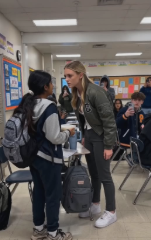
Then she reached for the takeout bowl sitting beside Tessa’s backpack.
I saw it too late.
The noodles hit my chest first, warm and wet, followed by sauce across my hoodie. A few strands slid down my sleeve and dropped onto the floor. Someone gasped. Someone laughed once and then stopped. Brooke’s camera shook.
Kennedy stepped back with both hands raised.
“She grabbed my project file!” she cried.
I had not moved.
The room went sharp and silent.
Every phone that had not been recording was recording now.
I stared down at my hoodie.
For one second, shame rose so fast I almost swallowed the truth.
Almost.
Then I looked at the editing computer.
The folder was still open.
The release-form file sat on the screen within reach.
And I remembered exactly why I had not backed down.
Ms. Calder arrived from the hallway, breathless. “What happened?”
Kennedy spoke first.
“Lila was in my folder trying to change my film.”
I said, “Open the release form.”
Kennedy turned toward me.
Her eyes were bright with warning.
Ms. Calder looked at the noodles on my hoodie, then at the room full of phones, then at Kennedy.
“What release form?”
“Marisol Vega,” I said. “She didn’t sign one. Kennedy kept her in the hallway clip.”
Kennedy laughed, but the sound cracked. “That’s insane. There is a release.”
“Then open it.”
The room held still.
Ms. Calder moved to the computer.
Kennedy’s hand shot out.
“Wait.”
Everyone saw it.
The panic.
The timing.
The fear.
Ms. Calder stopped.
“Why?”
Kennedy’s mouth opened, but no words came.
Principal Hawthorne entered two minutes later, called by Ms. Calder after she realized this was bigger than a classroom argument. He was tall, tired-looking, and usually careful around families like the Blakes. I had watched him smile through enough donor events to know he preferred problems that could be solved quietly.
This one could not.
The arts classroom was still full. Nobody wanted to leave. Nobody wanted to admit they wanted to stay.
Principal Hawthorne looked at me, at Kennedy, at the food on the floor, and finally at the editing computer.
“Phones down,” he said.
A few students lowered them.
Most did not.
Ms. Calder said, “We need to review a release issue.”
Kennedy immediately said, “Lila is lying.”
I looked at the principal. “Please check the file history.”
He frowned. “File history?”
“She had a clip of Marisol Vega crying in her final film. There is no release form. I reported it before Kennedy threw food at me.”
Kennedy snapped, “She went into my folder without permission.”
Ms. Calder cut in. “Lila had permission to check export folders.”
Kennedy’s face changed.
That was the first crack.
Principal Hawthorne moved closer to the computer. “Open the release folder.”
Ms. Calder clicked.
A list of PDF files appeared.
Student release forms.
Actor release forms.
Music licensing.
Location permission.
No Marisol Vega.
Kennedy folded her arms. “Maybe it was uploaded somewhere else.”
“Search her name,” I said.
Kennedy glared at me.
Ms. Calder searched.
Nothing.
The silence thickened.
Then Principal Hawthorne said, “Open the film notes.”
Ms. Calder hesitated.
Kennedy looked suddenly very young.
The notes opened.
The room saw it.
Clip marker: KEEP. EMOTIONAL TEXTURE.
Account: KBlake.
Timestamp: Tuesday, 11:48 p.m.
A murmur moved through the classroom.
Kennedy’s cheeks flushed.
“That doesn’t mean anything,” she said.
“It means you saw the clip,” I replied. “You chose to keep it.”
Kennedy pointed at me. “You’re twisting it.”
Principal Hawthorne raised a hand. “Enough. We are going to my office.”
But the proof was not finished.
Ms. Calder clicked the release-form archive one more time, searching for related uploads.
A deleted file appeared in the recovery panel.
MARISOL_VEGA_RELEASE_DRAFT.pdf.
My stomach turned.
Ms. Calder opened it.
The form was unsigned.
But at the bottom, in the metadata panel, there was an upload account.
KBlake.
Kennedy’s name.
Then a modification account.
Also KBlake.
Then a deletion timestamp from that morning.
The last frame of Brooke’s shaky video would later show Kennedy staring at her own name on the proof.
Not angry.
Not insulted.
Terrified.
Principal Hawthorne looked from the proof to Kennedy.
“Why is your account there at all?”
Kennedy said nothing.
Tessa whispered, “Kennedy…”
Kennedy turned on her so sharply Tessa stepped back.
And that was when Ms. Calder’s phone rang.
She looked at the screen, frowned, then answered.
“Marisol? Slow down. What happened?”
The room seemed to forget how to breathe.
Ms. Calder listened, her face growing paler with every second.
Then she said, “No, do not come to the classroom. Go to the main office. I’ll meet you there.”
She hung up.
Principal Hawthorne asked, “What is it?”
Ms. Calder looked at Kennedy.
“Marisol says someone sent her a message this morning telling her the clip was already approved and that if she complained, she would look ungrateful to the scholarship committee.”
Kennedy’s face went white.
“That wasn’t me.”
Ms. Calder’s voice was cold. “She says it came from an anonymous student account.”
Principal Hawthorne turned back to the computer.
“Check shared access on the deleted draft.”
Ms. Calder clicked through the details.
There it was.
A second account had viewed the unsigned draft.
WBLAKE-PRODUCTIONS-GUEST.
Kennedy’s mother’s company account.
For the first time, even Kennedy looked shocked.
“No,” she whispered.
Principal Hawthorne said, “Office. Now.”
The walk to the office felt longer than any hallway in the school had ever been.
Students watched us pass.
Me in a sauce-stained hoodie.
Kennedy pale and rigid.
Ms. Calder carrying the laptop like it contained something fragile and dangerous.
Principal Hawthorne walking ahead with the expression of an adult who had finally realized the floor under him was not solid.
Marisol was already in the office when we arrived.
She sat beside her aunt, who had clearly come straight from work, still wearing a grocery store name badge. Marisol’s eyes were red, but when she saw me, she stood.
“I’m sorry,” she said immediately.
I blinked. “For what?”
“For not saying something before. I was scared.”
“You didn’t do anything wrong.”
Kennedy made a small sound, almost a scoff, but it died when everyone looked at her.
Principal Hawthorne closed the conference room door.
For the next hour, the story unspooled.
Marisol explained that she had first discovered the clip when a student working on sound design mentioned seeing her in Kennedy’s rough cut. She had emailed Kennedy privately asking for it to be removed. Kennedy replied that it was just background and “artistically necessary.” Marisol then told Ms. Calder she did not consent to being shown.
That part matched the school records.
Then, the week before the final submission, Marisol received a message from an anonymous account.
The message said Kennedy’s film had already been cleared, that complaining would make Marisol look difficult, and that scholarship committees paid attention to whether students could “handle visibility.”
Visibility.
That word made my skin crawl.
Marisol had cried in the hallway because of a harsh critique. Kennedy filmed it without permission, called it emotional texture, then someone tried to scare her into silence using the scholarship she needed.
Principal Hawthorne asked Kennedy, “Did you send that message?”
“No,” she whispered.
“Did you ask anyone to send it?”
“No.”
“Did you tell your mother Marisol had objected to the clip?”
Kennedy looked down.
That was answer enough.
Ms. Calder opened the access records again. The Blake Productions guest account had viewed the unsigned release draft the same night the anonymous message was sent.
Kennedy’s mother arrived forty minutes later.
Vivian Blake entered the office in a cream suit, sunglasses on her head, and a smile polished enough for cameras. She kissed Kennedy’s hair, ignored me completely, and said, “I’m sure this is all a misunderstanding.”
Marisol’s aunt stood.
“My niece was threatened.”
Vivian’s smile cooled. “Threatened is a strong word.”
“So is ungrateful,” Marisol’s aunt replied.
Vivian looked at Principal Hawthorne. “I hope we’re not letting teenage insecurity derail months of artistic work.”
Ms. Calder closed the laptop halfway.
“That artistic work included a student who refused consent.”
Vivian sighed. “It was a background shot.”
“It was a student crying.”
“A beautiful moment of vulnerability.”
Marisol flinched.
I felt anger move through me, clean and sharp.
“She said no,” I said.
Vivian finally looked at me.
Her eyes moved over my stained hoodie.
“And you are?”
“The person who checked the release folder.”
Kennedy whispered, “Mom, stop.”
But Vivian did not stop.
She smiled at me like I was a stain she knew someone else would clean.
“Then perhaps you should learn the difference between helping and interfering.”
My hands shook under the table.
My mother was not there yet. She was on a bus across the city, leaving work early because I had texted her only three words.
I need you.
I wished she were beside me.
Then Marisol spoke.
“She helped me.”
Vivian turned.
Marisol’s voice trembled, but she did not look away.
“Lila helped me. She protected the record. Your daughter didn’t.”
Kennedy closed her eyes.
Something broke in her face.
Maybe she had expected me to fight. Maybe she had expected Ms. Calder to challenge her. Maybe she had expected Principal Hawthorne to hide behind procedure.
But Marisol—the girl whose pain Kennedy had borrowed for her film—standing up in front of Vivian Blake was not part of the script.
Vivian’s phone buzzed.
She glanced at it.
Principal Hawthorne said, “Mrs. Blake, we will need the district technology office to review the guest account access.”
Vivian’s smile vanished.
“That account is used by multiple interns.”
“Then the review will clarify that.”
“My company’s accounts are private.”
“They accessed a school student release document.”
The room went quiet.
Kennedy stared at her mother.
“You sent it,” Kennedy whispered.
Vivian’s eyes snapped to her.
“Not now.”
“You sent Marisol that message.”
“I protected you.”
The words came out before she could dress them up.
Everyone heard them.
Kennedy recoiled.
Marisol’s aunt said, “There it is.”
Vivian straightened. “I will not apologize for preventing a small consent issue from destroying my daughter’s opportunity.”
“A small consent issue?” Ms. Calder repeated.
“Yes,” Vivian said. “A four-second shot. In a student film. This has become absurd.”
My mother arrived then.
She opened the door with Principal Hawthorne’s secretary behind her and looked first at me.
Her face changed.
Not loudly.
My mother rarely did loud.
But when she saw the sauce on my hoodie, her eyes became still in a way that frightened me more than shouting.
She sat beside me and took my hand.
Then she looked at Vivian Blake.
“My daughter was attacked because she told the truth?”
Vivian opened her mouth.
My mother held up one hand.
“I did not ask you.”
The room went silent.
Principal Hawthorne cleared his throat and summarized what had happened. He explained the film clip, the missing release, the deleted draft, the guest account, the anonymous message, and Kennedy throwing food.
My mother listened without interrupting.
When he finished, she asked one question.
“Was my daughter authorized to check the file?”
Ms. Calder answered immediately. “Yes.”
My mother nodded.
“Then she did her job.”
Something about that simple sentence loosened the knot in my chest.
Then Kennedy spoke.
“I knew Marisol didn’t want the clip in.”
Everyone turned to her.
Vivian said, “Kennedy.”
Kennedy flinched but kept going.
“I knew. I told Mom because I thought she’d tell me how to convince Marisol. She said artists can’t let people with small thinking control the final cut.”
Vivian’s face hardened.
Kennedy’s voice cracked.
“She told me the release form was a formality. She said if we uploaded a draft, nobody would notice it wasn’t signed unless someone went looking.”
Ms. Calder whispered, “Kennedy…”
Kennedy wiped her eyes angrily.
“I didn’t know she messaged Marisol. But I knew the form wasn’t signed. And when Lila found it, I panicked because I knew it would all point back to me.”
She turned to me.
“I threw the food because I needed everyone looking at you instead of the screen.”
There it was.
The truth.
Ugly, direct, complete.
Vivian stood. “We are leaving.”
“No,” Kennedy said.
It was barely a word.
But it stopped her mother.
Kennedy lifted her head. “No. I’m not leaving.”
Vivian looked stunned.
“Kennedy, don’t be dramatic.”
Kennedy laughed once through her tears.
“You made my whole life dramatic. You made every mistake into a branding problem. You made me think if something hurt someone but looked good, it was worth keeping.”
Vivian’s face flushed.
Principal Hawthorne said quietly, “Mrs. Blake, please sit down.”
She did not.
But she also did not leave.
By the end of the day, Kennedy’s film was disqualified from the showcase.
Not because I ruined it.
Because she had.
The district froze the arts department’s outside guest access. Blake Productions was removed from the sponsor list pending review. The anonymous account was traced to a device connected to Vivian Blake’s company office. The school issued a formal apology to Marisol for failing to protect her consent sooner.
And Kennedy was suspended.
The videos spread, of course.
The first one made me look ridiculous.
Sauce on my hoodie. Kennedy pointing. Students gasping.
Then the second version spread.
Brooke’s full video with sound.
My voice saying, “Open the release form.”
Ms. Calder finding the missing document.
The recovery panel.
Kennedy staring at her own name.
By Friday, no one was asking why I had been in the folder.
They were asking why Kennedy had tried so hard to keep everyone out.
A week later, the showcase happened without Glass House.
Marisol almost did not attend.
Then Ms. Calder offered her a choice.
Not pressure.
Not a guilt trip.
A choice.
Marisol could remove her painting from the display, or she could replace it with a new piece.
She chose a new piece.
It was a mixed-media portrait of a girl holding a camera with the lens turned backward, reflecting the person who tried to film her.
The title was Consent Is Not Background.
People stopped in front of it all night.
Some got quiet.
Some looked uncomfortable.
Good.
My film screened near the end.
After the Bell played on a white wall in the darkened theater room. I sat beside my mother, heart hammering as the first shot appeared: an empty classroom at sunset, desks glowing gold, the sound of a vacuum in the hallway, a girl’s hand pressing record.
For twelve minutes, the room stayed silent.
Not bored silent.
Listening silent.
When the credits rolled, applause filled the room.
My mother cried into a napkin.
Ms. Calder hugged me so hard my glasses nearly fell off.
Then Principal Hawthorne stepped forward.
He announced a new policy. Every student film would now go through a consent review panel before public screening. No sponsor, donor, parent company, or outside account would have access to student release forms. Students would be trained to report consent violations without fear of retaliation.
Ms. Calder called it necessary.
Students called it the Lila Rule.
I pretended to hate that.
I secretly loved it.
Kennedy returned to school two weeks later.
She was quieter.
Not broken. Not suddenly kind in a magical way. Real life does not work that neatly.
But quieter.
One afternoon, she found me outside the editing lab.
“I owe you an apology,” she said.
I waited.
She looked down at her hands.
“I’m sorry I threw food at you. I’m sorry I lied. I’m sorry I used Marisol’s pain like it was footage I owned.”
I said nothing for a while.
Then I asked, “Are you sorry because you got caught?”
She looked like the question hurt.
Good.
“At first,” she admitted. “Yes.”
That surprised me.
She kept going.
“But then I watched your film.”
I blinked.
Kennedy swallowed.
“I always thought if something looked beautiful, that meant it mattered. Your film made an empty classroom feel more honest than anything I shot in my house.”
My throat tightened despite myself.
“I’m still angry,” I said.
“You should be.”
“I don’t forgive you yet.”
“I know.”
“But that was the first honest thing you’ve said to me.”
A small, sad smile crossed her face.
“I’m trying to learn how.”
That was all.
No instant friendship.
No clean ending tied in a ribbon.
But it was something.
The real ending came in June.
At the district student film night, my film was selected for a special screening. Marisol’s artwork was displayed in the lobby. Ms. Calder sat with both our families, beaming like she had personally invented justice.
Before the screening, a representative from a local youth media nonprofit asked to speak with me.
She had seen After the Bell at the showcase.
She offered me a summer fellowship.
Paid.
With real editing equipment, mentors, and a final public screening at an independent theater downtown.
For a second, I could not speak.
My mother answered for me by grabbing my arm hard enough to leave finger marks.
“She accepts,” she said.
The representative laughed. “I hoped so.”
That night, after the screening, I stood outside under the Los Angeles sky with Marisol. The city hummed around us, bright and restless.
She looked at me and said, “You protected my no.”
I smiled softly.
“You gave it back its volume.”
She laughed, and for once, she did not look afraid of being seen.
Across the courtyard, Kennedy stood with Ms. Calder. She was not the star of the night. She was not surrounded by admirers. She was just a student listening while a teacher spoke, nodding like she understood there were rules bigger than her ambition.
Maybe she would change.
Maybe she would not.
That was no longer mine to carry.
My phone buzzed.
It was a message from Ms. Calder with a photo attached.
A still from Brooke’s video.
Not the food hitting me.
Not Kennedy pointing.
The last frame.
Kennedy staring at her own name on the proof.
Below it, Ms. Calder had written:
Sometimes the truth is already in the frame. We just have to stop letting people cut around it.
I saved the message.
Then I looked at my mother, Marisol, the theater lights, and the fellowship email still open on my phone.
Kennedy had thrown food at me to make the room watch my humiliation.
Instead, she made the room watch her cover-up fall apart.
Her family had tried to treat consent like a detail.
Instead, the release form became the detail that changed everything.
The video that was supposed to make me look guilty became the record of the exact moment the truth stepped into focus.
And the girl who once clipped back her hair to disappear behind editing screens walked into summer with her name on a fellowship letter, her film on a theater wall, and her voice finally louder than the lie.
THE END
