My phone was still zipped inside my backpack when someone posted that I had cracked the driving-simulation helmet.
By the time I reached the school parking lot, nearly half of Detroit Central High had already decided I was guilty.
Students stood between orange traffic cones and demonstration vehicles, staring at their screens and then at me. The marching band’s practice music drifted from the athletic field, mixing with the sharp instructions of police officers teaching parallel parking and volunteers directing students toward Safe Driving Day stations.
Nothing looked unusual.
That was what made the rumor feel so powerful.
The school day continued normally while my name moved from one phone to another.
“Did you really drop it?”
“I heard she was angry because Audrey got chosen for the demonstration.”
“She probably broke it on purpose.”
“Her family can’t pay for that thing.”
The final sentence followed me farther than the others.
My name is Ana Silva. I was seventeen years old, Brazilian American, and used to people deciding what my family could afford before they knew anything about us.
My mother managed a neighborhood pharmacy. My father repaired city buses. We were not wealthy, but we paid our bills, kept our promises, and never asked anyone to protect us from consequences.
That morning, I wore a green school hoodie, straight-leg jeans, and white sneakers with blue marker stains near the soles. My hair was tied back, and my backpack still carried three textbooks, a water bottle, and the phone everyone claimed I had used to film myself destroying school property.
I had not filmed anything.
I had not touched the helmet.
What I had done was ask one question.
Why had the demonstration checklist been changed after the equipment inspection?
Safe Driving Day was one of Detroit Central’s largest annual events. The school partnered with the city transportation department, local police, hospitals, and insurance sponsors to teach students about impaired driving, seat belts, distractions, and emergency response.
The most popular station was the crash simulation.
Students wore a specialized helmet connected to virtual-reality goggles and balance sensors. The program created the delayed vision and poor coordination associated with dangerous driving.
The helmet was expensive.
According to the sponsor card, it cost more than twelve thousand dollars.
Audrey Beaumont had been selected to introduce the demonstration.
Of course she had.
Audrey was eighteen, polished, confident, and always positioned where cameras could find her. Her father served on the district business council. Her mother organized the school’s largest donor luncheon. Teachers did not openly favor Audrey, but they rarely interrupted her, corrected her, or asked her to wait.
She treated visibility like an inheritance.
I was assigned to the safety records table.
My job was to confirm that each piece of equipment had been inspected, label completed forms, and hand the demonstration leader the correct checklist.
At 7:20 that morning, the helmet was intact.
I knew because I held it while Mr. Han, the school technology coordinator, tested the visor, balance sensor, strap, and internal display.
He signed the inspection sheet.
I signed beneath him as student assistant.
Condition: Operational.
Exterior damage: None.
At 8:05, I left the records table to help carry cones from the storage shed.
When I returned, Audrey was standing beside the demonstration platform.
The helmet was gone.
“Where is the simulator helmet?” I asked.
She barely looked at me.
“Probably with the equipment team.”
“It was on this table.”
“You should ask whoever moved it.”
“You were standing here.”
Audrey lifted one shoulder.
“So were twenty other people.”
I checked the prop bins beneath the stage.
The first contained foam road signs.
The second contained reflective vests.
The third held a cracked helmet beneath a black cloth.
A fracture ran from the left side of the visor housing toward the sensor mount.
My stomach dropped.
I lifted it carefully.
Audrey turned.
“What are you doing?”
“Finding the helmet.”
She moved toward me faster than I expected.
“Put it down.”
“It is cracked.”
“I can see that.”
“It was intact twenty minutes ago.”
“You signed the inspection?”
“Yes.”
“Then maybe you missed it.”
“The crack is obvious.”
Audrey glanced toward the sponsor tent.
Her father, Charles Beaumont, was speaking with Principal Wallace beside a large banner carrying the logo of Beaumont Mobility Group.
The company had donated part of the equipment funding.
“I would be careful,” Audrey said quietly.
“About what?”
“Accusing people when your name is on the inspection.”
“I am not accusing anyone.”
“You’re holding damaged equipment after signing that it was safe.”
The warning became clear.
If nobody checked anything else, the record would point to me.
I placed the helmet back in the bin and removed my phone from my backpack long enough to photograph the crack, the bin location, and the original inspection sheet.
Then I returned the phone to my bag.
That was the only time I used it.
Ten minutes later, an altered checklist appeared at the records table.
Condition: Minor exterior damage noted before inspection.
Student assistant: Ana Silva.
The signature beside my name was not mine.
It looked close from a distance.
The first letter had the same loop. The last name leaned right.
But I never connected the letters in Silva, and the false signature did.
I carried both checklists to Ms. Turner, the Safe Driving Day coordinator.
“Someone replaced the original,” I said.
She looked from one page to the other.
“Where did you get this copy?”
“It was in the completed binder.”
“The original?”
“I kept the carbon sheet.”
Her expression changed.
The inspection forms created two copies when signed. The white page went into the public event binder. The yellow carbon copy remained in the equipment folder.
Whoever altered the white page had forgotten about the duplicate.
Ms. Turner lowered her voice.
“Do not discuss this with students.”
“Are you going to check it?”
“Yes.”
“When?”
“After the event begins.”
“The helmet could be unsafe.”
“We will remove it.”
“And the altered record?”
“I said I will handle it.”
I wanted to believe her.
Then I saw Charles Beaumont walking toward us.
Ms. Turner slid both pages beneath another folder.
“Ana, return to your station.”
Mr. Beaumont smiled.
“Everything ready?”
Ms. Turner hesitated.
“We discovered damage to the simulator helmet.”
His smile remained, but his eyes sharpened.
“When?”
“We are determining that.”
“Ana inspected it,” Audrey said from behind him.
I turned.
She had approached without my noticing.
Mr. Beaumont looked at my badge.
“You signed the checklist?”
“The original checklist said there was no damage.”
Audrey crossed her arms.
“The binder copy says otherwise.”
“That copy was changed.”
Mr. Beaumont looked toward Ms. Turner.
“Is that true?”
“We are comparing records.”
He gave a quiet sigh.
“These events require trust. Public accusations create unnecessary problems for partners.”
“I am not accusing the sponsors,” I said.
“No one suggested you were.”
His tone implied that I had already gone too far.
Audrey stepped beside him.
“She has been upset all morning because she wasn’t chosen for the stage introduction.”
I stared at her.
“I never applied for it.”
“You complained that donors always choose the visible students.”
“I said student volunteers should be credited.”
“There.”
She turned to her father.
“She has been angry about the program.”
Angry became motive.
Motive became rumor.
Before the first demonstration began, someone posted a photograph of me holding the cracked helmet.
The caption read:
ANA SILVA BROKE THE SAFE DRIVING SIMULATOR AFTER BEING REPLACED BY AUDREY.
The photograph had been taken from behind the sponsor tent.
It showed the helmet in my hands.
It did not show me finding it inside the prop bin.
Students shared it without asking who had taken it or why.
Ms. Turner told me to remain at the records table.
Principal Wallace told me not to leave the parking lot.
A school security officer asked for my phone.
“It is in my backpack,” I said.
He opened the bag with my permission, removed the phone, and checked the time of the photograph I had taken.
8:11 a.m.
The rumor post had appeared at 8:16.
“You photographed the damage,” he said.
“To preserve it.”
“Why?”
“Because the checklist was changed.”
Principal Wallace frowned.
“Were you expecting a dispute?”
“The crack had just appeared.”
Audrey stood several feet away, surrounded by student leadership members.
She looked calm.
Too calm.
Her eyes kept moving toward the records table.
I asked the same question again.
“Can someone open the original file?”
Principal Wallace sighed.
“What file?”
“The equipment checkout history.”
Ms. Turner looked uneasy.
The helmet had been stored overnight inside the school technology room. The checkout system recorded who removed it, when it was scanned, and which staff or student identification card authorized the movement.
“If the helmet left storage intact,” I said, “the checkout history will show who had it next.”
Mr. Beaumont stepped forward.
“My company provided that system. It does not track damage.”
“It tracks custody.”
“Ana,” Principal Wallace said, “this is becoming confrontational.”
“I am asking for a record.”
“You have already implied that multiple people falsified documents.”
“One document was falsified.”
Audrey laughed.
“You signed it.”
“Not the altered copy.”
“You expect everyone to believe someone forged your signature?”
“I expect someone to compare it.”
She walked toward the records table.
Her clothes were simple but expensive: fitted black trousers, a pale blue sweater, spotless leather sneakers, and a thin gold chain at her neck. Everything about her looked controlled.
“I think you should admit what happened,” she said.
“I did not break the helmet.”
“You were holding it.”
“I found it.”
“Convenient.”
“The parking lot has cameras.”
Her eyes shifted again.
That was when I knew the camera mattered.
Not the main Safe Driving Day livestream camera.
The fixed parking-lot security camera mounted above the maintenance garage.
Its angle covered the prop bins, sponsor tent, and demonstration platform.
“Open the parking footage,” I said.
Principal Wallace’s expression hardened.
“Security footage is not shown publicly.”
“Then review it privately.”
“We will follow school procedure.”
“After everyone has already decided I did it?”
Audrey moved closer.
“You are embarrassing the entire event.”
“I am trying to protect the record.”
“You are trying to make yourself the victim.”
“I did not post the rumor.”
“You created the scene.”
“No. Someone cracked the helmet and hid it.”
Students had begun gathering around us.
Phones rose.
Audrey noticed the audience.
Her voice changed.
It became louder, wounded.
“You have been blaming me since this morning!”
“I asked where the helmet was.”
“You said my family controls the school.”
“I said donors should not control student credit.”
“Because you hate me.”
“I do not know you well enough to hate you.”
The crowd reacted.
Audrey’s cheeks reddened.
That answer had not given her the emotional fight she wanted.
She reached for the original carbon checklist in my hand.
I pulled it back.
“Give me that.”
“No.”
“It belongs to the event.”
“It is evidence.”
“You are not an investigator.”
“Neither are you.”
Her eyes flashed.
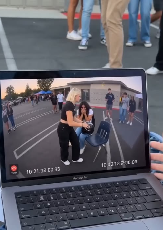
Then she grabbed a paper tray of nachos from the refreshment table and dumped it over my head.
Warm cheese struck my hair and forehead.
Chips broke against my shoulder.
Red salsa ran down the front of my hoodie.
The parking lot went silent.
That horrible school silence.
Everyone watched.
Nobody wanted to be the first to move.
Audrey pointed at me with the empty tray.
“She has been harassing me for an hour!”
My eyes burned.
My hands shook.
But I kept hold of the yellow carbon copy.
Ms. Turner rushed toward me with napkins.
Principal Wallace stepped between us.
“Audrey!”
“She would not stop!”
“That does not justify this.”
“She accused my family!”
“I asked for the camera,” I said.
My voice sounded distant.
Mr. Beaumont moved toward his daughter.
“She felt cornered.”
I wiped cheese from my eyelid.
“She felt scared.”
Audrey glared at me.
“Of what?”
“The original file.”
The crowd shifted.
The accusation was no longer moving entirely in her direction.
The side door of the maintenance garage opened.
Mr. Han emerged with a district laptop under one arm.
Behind him walked Dr. Naomi Brooks, the district safety compliance officer, and Lieutenant Renee Ford from the school police unit.
Principal Wallace looked startled.
“Dr. Brooks, why are you here?”
“Mr. Han reported conflicting equipment records.”
Ms. Turner looked at him.
“You contacted the district?”
He nodded.
“The helmet contains an impact sensor. Its internal log showed a fall after the morning inspection.”
Everyone became still.
I looked at him.
“The helmet records impacts?”
“Yes.”
Audrey’s face changed.
Mr. Beaumont stepped forward.
“That data is proprietary.”
Dr. Brooks looked at him.
“The device belongs to the school.”
“My company’s sponsorship agreement includes maintenance protections.”
“It does not prevent a safety investigation.”
Lieutenant Ford saw the food covering my clothes.
“What happened?”
“Audrey dumped it on Ana,” Ms. Turner said.
Audrey looked at her in disbelief.
“You saw how she was acting.”
“I saw you take the tray.”
For the first time, an adult had stated the event without softening it.
Dr. Brooks looked at me.
“Were you physically injured?”
“No.”
“Do you want the nurse?”
“After the file is opened.”
Something like approval passed through her expression.
“Which file?”
“The parking-lot footage and the helmet custody record.”
Mr. Han opened the laptop on the records table.
The helmet’s internal sensor showed:
7:21 a.m. — Inspection completed.
7:46 a.m. — Device activated.
7:52 a.m. — Sudden impact detected.
7:53 a.m. — Visor alignment failure.
I had been carrying cones behind the gym at 7:52.
Ms. Turner confirmed it.
Audrey looked at her father.
He did not look back.
Mr. Han opened the equipment checkout record.
The helmet had been scanned out of the technology room at 7:39.
Authorized user:
AUDREY BEAUMONT — STUDENT LEADERSHIP ACCESS.
Students began whispering.
Audrey shook her head.
“I was given permission to collect it.”
“By whom?” Dr. Brooks asked.
“My father.”
Mr. Beaumont said, “The event was delayed. I asked her to help.”
“Did you see the helmet after she collected it?”
“No.”
Audrey spoke quickly.
“I delivered it to the platform.”
“At what time?” Lieutenant Ford asked.
“I don’t remember.”
“The impact occurred thirteen minutes after checkout.”
“I didn’t drop it.”
“Then the camera may show who did.”
Mr. Beaumont stepped closer to Dr. Brooks.
“Displaying student footage would violate privacy.”
“We are not displaying protected footage publicly.”
The students were moved back from the records table, but they remained close enough to see the adults’ faces.
Mr. Han opened the maintenance-garage camera.
At 7:43, Audrey crossed the lot carrying the helmet beneath one arm.
She stopped near the sponsor tent and answered a phone call.
The footage had no sound.
She placed the helmet on the roof of a demonstration car.
Then she walked several feet away.
At 7:52, a volunteer moved the car.
The helmet slid from the roof.
It struck the pavement.
Audrey turned.
She ran toward it, lifted it, and inspected the crack.
For nearly twenty seconds, she stood completely still.
Then she carried the helmet to the prop bins.
She looked around.
She placed it beneath the black cloth.
The footage continued.
At 7:57, she entered the records area.
At 8:02, she removed a blank inspection form.
At 8:04, she carried it toward the sponsor tent.
Mr. Beaumont stood there.
The two spoke.
He took the form.
The camera did not show what he wrote.
At 8:07, Audrey returned the altered form to the binder.
No one spoke.
The evidence was silent.
That made it louder.
Audrey stared at the screen.
“You told me the camera did not cover that area.”
Every head turned toward Mr. Beaumont.
His face hardened.
“Do not say another word.”
Audrey looked frightened.
“You said the maintenance camera had been disconnected.”
“Audrey.”
“You told me to hide the helmet until after the demonstration.”
“Stop.”
Dr. Brooks looked at him.
“Did you instruct your daughter to conceal damaged safety equipment?”
“No.”
The camera showed him accepting the blank form.
Lieutenant Ford asked, “Did you complete the replacement checklist?”
“It may have been an event copy.”
“Did you forge Ana’s signature?”
“Absolutely not.”
Mr. Han enlarged the footage.
The pen in Mr. Beaumont’s hand moved across the student-signature line.
The angle did not show the writing itself.
But it showed enough to demand further investigation.
Audrey began crying.
“I didn’t mean to break it.”
I wiped salsa from my sleeve.
“You did not drop it deliberately.”
She looked at me.
For a moment, she seemed relieved.
Then I said, “But you hid it deliberately.”
The relief disappeared.
“I panicked.”
“And then you blamed me.”
“My father said the event would be canceled.”
Mr. Beaumont snapped, “Do not shift responsibility.”
Audrey turned toward him.
“You changed the form.”
“You brought me a damaged helmet and demanded help.”
“You told me it was a sponsor disaster.”
“It was.”
“You said Ana’s signature was already on the original.”
“It was.”
“You said changing the damage line would only correct the timing.”
His eyes turned cold.
“I said no such thing.”
The same man who had protected her minutes earlier was now preparing to leave her alone inside the lie.
Audrey saw it.
Her crying stopped.
She stared at him as if she had never understood him before.
Dr. Brooks asked Mr. Han to open the digital source record attached to the equipment inspection.
The school used a tablet photograph to confirm high-value equipment condition during morning checks.
At 7:21, Mr. Han had photographed the helmet from four angles.
The images showed no crack.
The photo metadata recorded the exact time, location, and device.
At 8:09, someone replaced those images in the event folder with photographs showing the cracked helmet.
The replacement images were taken after the fall.
The upload account belonged to Audrey.
But the administrator approval belonged to another user.
CHARLES BEAUMONT — SPONSOR SYSTEM ADMIN.
Dr. Brooks stared at him.
“Why did a private sponsor have administrator access to school safety records?”
Principal Wallace looked alarmed.
“Charles, you told us your company only had technical support access.”
“That is what the account provided.”
“It approved replacement evidence,” Mr. Han said.
Mr. Beaumont’s voice became colder.
“Your system permissions were poorly configured.”
“You requested administrator privileges during installation,” Mr. Han replied.
“For emergency support.”
“You used them to alter source photographs.”
“I approved an event correction.”
“You replaced original inspection images.”
“They were inaccurate.”
“They were accurate when taken.”
Principal Wallace stepped back from him.
The rumor against me had not been improvised by one frightened student.
It had been built through access, influence, and altered records.
But something still did not make sense.
Why take such a risk over one damaged helmet?
The school could have canceled the demonstration, reported the accident, and submitted an insurance claim.
Audrey’s family could easily afford embarrassment.
They were hiding something larger than the fall.
I looked at the helmet’s sensor log.
“Why was it activated at 7:46?”
Mr. Han checked the record.
“The simulation software was opened.”
“By Audrey?”
“The user field is blank.”
Dr. Brooks leaned toward the laptop.
“Why?”
“The demonstration profile was launched through maintenance mode.”
Mr. Beaumont’s company had supplied the software.
Mr. Han opened the diagnostic report.
Several safety limits had been disabled.
The balance distortion had been increased beyond the approved school setting.
The visual delay had been nearly doubled.
If a student wore the helmet during the demonstration, the simulation could have caused a real fall.
Ms. Turner looked horrified.
“Who changed those settings?”
The system named the administrator account.
CHARLES BEAUMONT — SPONSOR SYSTEM ADMIN.
Mr. Beaumont’s face went still.
He did not look surprised.
Audrey did.
“Dad?”
He ignored her.
Dr. Brooks looked at him.
“Why did you modify the safety limits?”
“It was a temporary calibration for a stronger demonstration.”
“Were school staff informed?”
“The default simulation lacked impact.”
“Impact?”
He gestured toward the sponsor cameras.
“These programs depend on engagement. Students do not learn from weak demonstrations.”
“You increased physical disorientation without authorization.”
“The helmet is designed for simulation.”
“Within safety limits.”
He said nothing.
I understood then.
Audrey had activated the helmet that morning to preview her demonstration.
The altered settings caused her to stumble.
She placed the helmet on the car while recovering.
The car moved.
The helmet fell.
If the damage became public, technicians would inspect the internal log and discover the unsafe software changes.
The cracked helmet was not the main secret.
It was the doorway to her father’s unauthorized modification.
Audrey looked at the diagnostic screen.
“You said the new setting was safe.”
Mr. Beaumont replied through clenched teeth.
“It was.”
“I nearly fell while wearing it.”
“You said you were fine.”
“I grabbed the car.”
“You are not injured.”
“That does not make it safe.”
His expression sharpened.
“Everything this family built for you depends on learning when not to create unnecessary problems.”
Audrey flinched.
I had spent the morning seeing her as someone protected by power.
Now I saw the shape of that protection.
It lasted only while she served the story her father wanted.
Lieutenant Ford closed the demonstration area.
The district seized the helmet, laptop, forms, and sponsor-access records.
Charles Beaumont’s administrator privileges were revoked before he left the parking lot.
Audrey received a suspension for hiding damaged equipment, altering records, making a false accusation, assaulting me with food, and allowing the rumor to spread.
Principal Wallace was placed under review for granting a sponsor access to school safety systems without district approval.
Beaumont Mobility Group lost its Safe Driving Day contract.
The district investigation found that Charles Beaumont had modified simulator settings at four schools to create more dramatic sponsor videos. Two students had reported dizziness and falls during earlier demonstrations, but the complaints had been recorded as individual sensitivity.
The company had never disclosed the changes.
The case became much larger than a damaged helmet.
Audrey’s accusation had been designed to make me look reckless before anyone examined the source file.
If I was blamed for breaking the equipment, the event could classify the damage as student misconduct and remove the helmet without a technical inspection.
The unsafe settings might never have been discovered.
For several days, videos of the nachos falling over my head circulated online.
Then the parking-lot footage leaked.
Suddenly, students who had mocked me began saying they had always known Audrey was lying.
They had not.
They had simply changed sides when the evidence made cruelty less safe.
I stopped reading comments.
My mother helped wash the cheese and salsa from my hoodie, but a faint orange stain remained near the pocket.
“Throw it away,” she said.
“No.”
“Why keep it?”
“Because it was mine before they tried to turn it into evidence against me.”
She studied my face.
Then she folded the hoodie and returned it.
Three weeks after her suspension, Audrey asked to meet me in the counselor’s office.
She wore plain jeans and a dark sweatshirt. No gold chain. No perfect posture. No group of students waiting outside.
“I am sorry,” she said.
I remained silent.
She continued.
“I’m sorry I hid the helmet, changed the file, let people blame you, and dumped food on you.”
“You forgot posting the rumor.”
Her face tightened.
“I didn’t post it.”
“Then who did?”
“My father’s assistant.”
I stared at her.
“He photographed you holding the helmet. My father told him to send it to the student leadership chat.”
The lie had entered the school through an adult.
That should not have surprised me anymore.
“Did you know?”
“Not before it was posted.”
“But you used it.”
“Yes.”
“Why?”
She looked down.
“Because once people blamed you, I thought maybe the whole thing would disappear.”
“You knew I had signed the original inspection.”
“Yes.”
“You watched me ask for the file.”
“Yes.”
“You still threw food on me.”
Her eyes filled.
“I thought if you looked unstable, adults would stop listening.”
“That nearly worked.”
“I know.”
The room remained quiet.
An apology was not supposed to become a shortcut past discomfort.
I let her sit inside the truth.
Finally, she said, “My father says I ruined his company.”
“Did you change the simulator settings?”
“No.”
“Did you give the company school access?”
“No.”
“Then you exposed what he did.”
“He says families are supposed to protect each other.”
“Protection is not hiding danger.”
She nodded.
“My mother filed for separation.”
I had never heard anyone mention Audrey’s mother during the investigation.
“She said this was not the first time he used my name for company promotion.”
Audrey folded her hands.
“I thought being chosen for everything meant people believed in me.”
“What do you think now?”
“Sometimes it meant I was useful.”
The answer was painful and honest.
I did not forgive her that day.
But I believed she finally understood that being manipulated did not erase the harm she had chosen to cause.
“What will you do?” I asked.
“I agreed to testify in the district hearing.”
“Against your father?”
“For the students who fell.”
That mattered.
Audrey completed community accountability hours with the city traffic-safety office. At first, many people assumed it was another attempt to rebuild her image.
Then she requested assignments away from cameras.
She organized equipment forms, checked helmet settings, and assembled education packets in a basement office where nobody knew her family name.
Months later, she sent me one message.
We rejected a simulator today because the calibration record did not match. Nobody wanted to delay the event, but I made them open the original file.
I read it twice.
Then I replied:
Good.
Safe Driving Day returned the following year.
The event looked different.
Sponsors could fund equipment but could not access school records.
Every simulation device required independent inspection.
Students could view the safety settings before participating.
The cracked helmet was replaced, but the district kept it inside a training case.
A label beneath it read:
EQUIPMENT DAMAGE MUST NEVER BE HIDDEN. SOURCE RECORDS MUST NEVER BE REPLACED.
I was asked to open the event.
I almost refused.
Then Ms. Turner said, “You were the reason the program became safer.”
“No. The file was.”
“You kept asking for it.”
That was the difference.
Records did not open themselves.
I stood on the parking-lot stage wearing the same green hoodie, orange stain and all.
My parents sat in the second row.
Behind them were students who had once repeated the rumor.
Audrey stood near the traffic-safety booth in a volunteer vest. She did not approach the microphone.
I spoke for less than three minutes.
I did not tell everyone to trust systems.
Systems had almost been used to bury me.
I told them to preserve originals, question unexplained changes, and never confuse an official-looking record with the truth.
“Safety depends on what actually happened,” I said, “not on what is easiest to report afterward.”
The demonstration began.
The new helmet was scanned.
The inspection photographs appeared on a public monitor.
The settings remained within approved limits.
A student volunteer put it on and completed the simulation safely.
No dramatic stumble.
No sponsor-directed performance.
Just a controlled lesson.
It was less exciting.
It was better.
After the event, Dr. Brooks handed me a scholarship letter from the city’s transportation safety program. The award supported students interested in engineering, public safety, or data integrity.
I chose transportation systems engineering.
My father laughed when I told him.
“You spent years complaining about bus equipment,” he said.
“I learned from you.”
“No, you learned to complain more precisely.”
He was probably right.
On my last day at Detroit Central, I returned to the parking lot after everyone had left.
The painted safety course remained on the pavement.
The records table was empty.
Above the maintenance garage, the camera still faced the prop bins.
I looked toward the place where Audrey had hidden the cracked helmet.
The entire scandal had begun with a mistake.
She placed the helmet on a car.
The car moved.
The helmet fell.
That part could have happened to anyone.
The disaster began afterward.
She hid it.
Her father altered the record.
An assistant started the rumor.
Adults hesitated because donors were involved.
Students believed the first dramatic story they received.
Each decision added another layer until one accident became a system-wide lie.
But the quiet evidence remained.
The impact sensor preserved the fall.
The camera preserved the hiding place.
The source photographs preserved the helmet’s original condition.
The access history preserved the altered file.
The diagnostic report preserved the unsafe settings.
They could change what people saw first.
They could not change what happened.
I pulled my phone from my backpack.
This time, I took one photograph of the empty parking lot.
No damaged equipment.
No crowd.
No public humiliation.
Just the place where the truth had waited inside several quiet files until someone finally opened them.
Then I put the phone away and walked toward the school doors.
Audrey had believed one loud accusation could define me.
Her father believed influence could turn a replacement record into an original.
The school believed protecting a sponsor was the same as protecting an event.
They were wrong.
A safe system does not protect the most powerful person in the room.
It protects the person who will be harmed if everyone else chooses silence.
I had not broken the helmet.
I had not started the rumor.
I had not created the scandal.
I had only noticed that the record did not match.
And once the hidden file opened, the lie they placed on my name returned to the people who had built it.
THE END
