Part 2: The Tablet That Turned Every Face
The donor’s voice cut through the garden like a glass cracking under pressure.
“Why did you try to bury this?”
Helena Carrington froze with one hand still lifted, as if she could wave the question away before it became real. Water streamed from my sleeves. My thrifted dress clung to my knees, heavy and cold, its hand-sewn hem ruined by chlorine and humiliation.
For a moment, nobody moved.
Then the staff tablet changed hands.
A tall man with silver hair took it from the trembling coordinator and tilted the screen toward the light. His name tag read Matthias Leclerc, one of the foundation’s largest donors. His brow furrowed as he scrolled.
“Access log,” he said quietly. “Lighting sequence. Centerpiece diagnostics. Emergency override.”
Helena laughed once, thin and sharp.
“That is internal equipment data. It proves nothing except that someone let her touch things she should never have touched.”
My stomach twisted, but I forced myself to stand straight. My flats squelched against the stone. Someone near the bar whispered, “Oh God, she’s soaked.”
Matthias did not look away from the screen.
“It says the main ceremony display failed at 6:12 p.m.,” he said. “It says Miss Stone restored the entire model lighting system at 6:19.”
A murmur spread across the terrace.
Helena’s smile twitched.
“That could have been anyone using her login.”
The coordinator, Elise Moreau, stepped forward. Her black dress was plain, her face pale, her hands clasped so tightly her knuckles had gone white.
“No,” Elise said. “It was her. I watched her do it.”
Helena turned on her so fast Elise flinched.
“Elise, careful.”
Two words. Soft. Poisonous.
Elise swallowed, but she didn’t step back.
“The centerpiece was dead. The donor ceremony would have failed. Farah rerouted the control panel while everyone else was upstairs rehearsing.”
My throat burned.
I remembered kneeling under the table earlier, needle scratches still on my fingers from altering my dress, holding a flashlight between my teeth while Elise whispered, “Please tell me you can fix this.”
I had fixed it.
Quietly.
Because that was what people like me were expected to do—save the night and disappear before the applause began.
Matthias looked at Helena.
“Then why was your name requested for the switch-on?”
The air changed again.
Helena’s face went still in a way that frightened me more than her anger.
“I don’t know what you mean.”
Elise’s voice trembled.
“There was an email.”
Helena’s eyes narrowed.
“Elise.”
The coordinator glanced at me, then at the guests, then at the pool behind me where ripples still shimmered under gold lights.
And then she said it.
“Helena asked me to remove Farah’s name from the ceremony card.”
The terrace erupted.
Helena’s mother pushed back from a table. A photographer lowered his camera. Someone muttered, “That’s sabotage.”
Helena stepped toward Elise.
“You confused a conversation.”
“No,” Elise whispered. “I saved the email.”
Before anyone could stop her, she tapped the tablet again.
A message opened on the screen.
From: Helena Carrington.
Subject: Program correction.
The donor read silently. His mouth hardened.
Then he turned the tablet toward the nearest camera.
“Put Carrington on the switch. The Stone girl can be thanked privately after.”
My ruined dress suddenly felt less heavy than the silence that followed.
Helena’s lips parted.
Then, behind us, the ballroom doors opened.
A woman in a navy suit stepped out with a leather folder tucked beneath one arm.
Helena went white.
And Elise whispered, “Oh no… she came.”
Part 3: The Woman Helena Feared Most
The woman in the navy suit did not rush.
That was what made everyone watch her.
She crossed the terrace with calm, deliberate steps, her heels clicking against wet stone while the entire gala seemed to hold its breath. Her hair was silver at the temples, her posture straight, her eyes fixed on Helena Carrington like she had already read the ending and was only waiting for the rest of us to catch up.
Matthias Leclerc lowered the tablet.
“Madame Voss,” he said.
Helena’s face flickered.
It was small, almost invisible, but I saw it.
Fear.
Not embarrassment. Not anger.
Fear.
The woman stopped beside me first, not Helena. She looked at my soaked dress, my shaking hands, the water dripping from my sleeve onto the stone.
“Miss Stone,” she said, her voice low. “Are you hurt?”
Nobody had asked me that.
Not one person.
The question hit harder than the shove.
“I’m fine,” I said, though my voice cracked.
Madame Celine Voss removed a folded handkerchief from her pocket and handed it to me. It was crisp, white, embroidered with a small silver crest.
“You are not fine,” she said. “But you are standing. There is a difference.”
Helena recovered just enough to speak.
“Celine, this has become theatrical. I’m sure we can handle it privately.”
Madame Voss turned.
“Privately?” she repeated. “You shoved a woman into a pool in front of donors, cameras, trustees, and half the city’s philanthropic board.”
Helena’s cheeks flushed.
“She caused a scene.”
“No,” Celine said. “You caused evidence.”
A low sound moved through the guests.
Helena’s father, Edmund Carrington, rose from his table. He had the polished calm of a man used to buying silence before it grew teeth.
“Madame Voss,” he said, “my daughter made a mistake. A regrettable impulse, certainly, but not something requiring public spectacle.”
Celine opened the leather folder.
“That depends on what else is inside the mistake.”
The pool lights flickered behind us, blue and gold. I wrapped the handkerchief around my fingers, trying to stop them from shaking.
Celine pulled out a printed document.
“Elise Moreau submitted a sealed complaint this afternoon.”
Elise looked down.
Helena’s eyes snapped toward her.
“You didn’t.”
Elise’s mouth trembled, but she lifted her chin.
“I did.”
Celine continued, “The complaint alleges repeated pressure to alter program credits, donor acknowledgments, volunteer records, and technical logs.”
Edmund Carrington’s smile disappeared.
“That is a serious accusation.”
“It is,” Celine replied. “Which is why I did not come alone.”
At the ballroom entrance, two more people appeared.
One was a security officer holding a laptop.
The other was a young man in a catering jacket, his face tense, his eyes locked on the floor.
Helena took one step back.
I recognized him.
He had been near the control room earlier.
His name was Nico Laurent.
He had watched me fix the centerpiece.
Celine looked at him.
“Mr. Laurent,” she said gently. “Tell them what you found in the staff archive.”
Nico’s jaw worked.
Helena’s voice sliced across the terrace.
“Don’t be stupid.”
That did it.
Nico looked up.
“I already was,” he said. “When I helped you.”
The silence became something alive.
Helena whispered, “Nico.”
He pulled a small black drive from his pocket.
Then he said the words that made her father grip the back of his chair.
“The file she wanted deleted wasn’t only about Farah.”
Part 4: The File Beneath The File
Nico’s hand shook as he held up the drive.
The cameras caught it. The donors saw it. Helena saw it too, and the color drained from her face so completely she looked carved from candle wax.
Celine Voss nodded to the security officer.
“Open it.”
“No.” Helena’s voice broke for the first time. “You cannot access private material without authorization.”
Celine did not blink.
“This is foundation property. Stored on foundation devices. Concerning foundation records.”
Edmund Carrington moved toward his daughter.
“Helena,” he said under his breath, “what is on that drive?”
She didn’t answer.
That scared him.
The security officer connected the drive to the laptop. A projection screen near the terrace bar, meant for donor slides, flickered awake. The foundation crest appeared first.
Then folders.
Ceremony Drafts.
Vendor Payments.
Lighting Logs.
Private Transfer.
My pulse stumbled.
Celine’s eyes sharpened.
“Open Private Transfer.”
Helena lunged.
It happened fast—too fast for the elegance of the setting. Her satin dress flashed silver under the terrace lights as she reached for the laptop.
Matthias caught her wrist before she touched it.
Gasps cracked through the garden.
“Let go of me,” she hissed.
“No,” he said.
The officer opened the folder.
Inside were scanned invoices, donor lists, altered schedules, and files renamed with dates.
Celine pointed.
“That one.”
A document opened.
At first, I didn’t understand what I was seeing.
It was a program layout. The same gala program card that had my name printed for the centerpiece switch-on. But this version had Helena’s name in gold script.
Then another file opened.
A donor acknowledgment.
Then another.
A technical credit sheet.
My name appeared, then vanished across drafts like someone scraping me out of the night one document at a time.
A hot ache rose behind my eyes.
I had been prepared for mockery. For snide looks. For the kind of pity that dressed itself up as kindness.
But seeing my name erased again and again felt different.
It felt intimate.
Like someone had reached inside my chest and tried to delete proof that I had ever mattered.
Celine’s voice remained steady.
“Continue.”
The next file opened.
A transfer request.
Amount: €48,000.
Recipient: Carrington Cultural Advisory.
Purpose: Emergency installation consultancy.
Matthias looked up sharply.
“That installation was repaired by Miss Stone.”
Nico’s voice was barely audible.
“Helena told me to submit the consultancy request after Farah fixed it.”
Elise covered her mouth.
I stared at the number.
Forty-eight thousand.
For my work.
For seven minutes on a tablet and three years of learning systems nobody believed I understood.
Helena laughed, but it came out wrong.
“This is absurd. That kind of transfer requires board approval.”
Celine turned one page in her folder.
“It was approved.”
Edmund’s face tightened.
“By whom?”
Celine slid the paper across the nearest table.
Edmund looked down.
His expression changed so violently that nobody needed to read it.
But Celine read it anyway.
“Approved by Edmund Carrington.”
The terrace exploded.
Edmund staggered back as if the page had struck him.
“That signature is forged.”
Helena whispered, “Father—”
“Is it?” Celine asked.
The security officer clicked another file.
A video appeared.
Not from the ballroom.
From the control room.
Helena stood beside the scanner, pressing Edmund’s signet ring against a digital authorization pad.
And beside her, helping steady the screen, was Nico.
Helena’s father turned to her.
Not angry yet.
Worse.
Devastated.
“Where did you get my ring?”
Helena’s lips trembled.
Then Nico answered.
“She took it from your coat before the speech.”
Part 5: The Ring That Broke Her Father
Edmund Carrington looked suddenly old.
The proud set of his shoulders collapsed by an inch, then another, until the man who had entered the gala like a carved monument seemed made of paper in the rain.
“My coat,” he said.
Helena reached for him.
“Father, please.”
He stepped away from her hand.
That tiny movement hurt more than shouting would have.
Helena saw it too. Her face twisted, not with guilt, but with panic at losing the one shield she had always trusted.
“It was temporary,” she said quickly. “I was going to correct everything after the gala.”
Celine’s voice was cold.
“After receiving payment?”
“I did not receive anything.”
Matthias pointed to the screen. “You attempted to.”
“I was protecting the family’s position.”
My breath caught.
There it was.
Not an apology.
A philosophy.
Helena turned toward the guests, desperate now, searching for someone willing to believe the prettier version.
“Do you understand what would have happened if she stood up there?” she said, pointing at me. “Every donor would have asked why the foundation needed charity from a girl who came in a homemade dress.”
The words landed like stones.
A woman at the nearest table sucked in a breath.
My face burned, but I did not look down.
I had stitched that dress under a lamp with aching fingers because renting one would have cost half my month’s groceries. I had washed those flats until they looked new because I refused to arrive ashamed.
Helena’s eyes flashed.
“I was saving the ceremony from embarrassment.”
Then Madame Voss said, “No, Helena. You were saving yourself from comparison.”
That silenced even the whispers.
Celine walked to the projection screen and tapped the technical log.
“Miss Stone was selected because she designed the backup sequence six months ago. She was not a decorative choice. She was the reason this centerpiece exists.”
My heart stopped.
I looked at Elise.
She nodded through tears.
“You weren’t supposed to know until tonight,” she whispered. “The committee picked your design.”
My mouth opened, but nothing came out.
The centerpiece.
The glittering model of the city, built from glass towers and illuminated bridges, the symbol of the entire fundraising campaign.
I had submitted that design anonymously through the foundation’s youth technical program.
I thought they had rejected it.
Celine turned another page.
“The selection panel chose the anonymous submission marked F.S.-17.”
F.S.
Farah Stone.
Helena’s expression went blank.
“You knew?” I whispered.
Elise nodded. “Only after the finalist review. Helena found out yesterday.”
Helena’s hands curled into fists.
“It was a student exercise.”
“It won,” Matthias said.
The word struck the terrace with quiet finality.
Won.
Not helped.
Not assisted.
Won.
Celine looked at Helena.
“And that is why you wanted her wet, humiliated, and removed before the ceremony began.”
Helena’s lips parted, but no defense came.
Then a sharp beep came from the tablet.
The screen refreshed.
A new notification appeared across the top.
External Archive Restored.
Nico stared.
“I didn’t open that.”
The security officer leaned closer.
Celine’s face changed.
Another folder appeared.
Its title made Helena let out a sound like a wounded animal.
CARRINGTON SCHOLARSHIP REVIEW — SEALED.
Part 6: The Scholarship She Stole First
Nobody touched the laptop for three seconds.
It felt longer.
The new folder sat on the projection screen, bright and merciless, while Helena Carrington stared at it as if it had crawled out of a grave.
Celine Voss went still.
“Where did that archive come from?”
The security officer checked the source path.
“Automatic recovery from the foundation cloud. It was scheduled to purge tonight.”
Elise whispered, “Purge?”
Nico looked sick.
“I only helped with the gala file. I swear. I didn’t know about scholarships.”
Celine’s gaze moved to Helena.
“Open it.”
Helena shook her head once.
Not a command.
A plea.
Celine gave the nod.
The folder opened.
Rows of applicant files filled the screen.
Names. Scores. Interviews. Recommendations.
My name appeared near the top.
Farah Stone — Final Rank: 1.
My lungs forgot how to work.
Another file opened below it.
Helena Carrington — Final Rank: 7.
Someone whispered, “Seventh?”
I heard water dripping from my dress. Drop by drop. Absurdly loud.
Celine clicked into my file.
There were essays I remembered writing with frozen hands in the library. Technical sketches. Volunteer hours. Letters from instructors. A note from one reviewer read: Exceptional design instinct. Recommend full scholarship and public recognition.
Then the screen shifted to a change log.
Rank adjustment.
Manual override.
Reviewer notes removed.
Final selection modified.
Authorized by: H.Carrington.
Helena whispered, “No.”
Celine’s mouth tightened.
“You changed scholarship results.”
“I corrected a conflict.”
“What conflict?”
Helena looked around wildly.
Her father said her name once.
“Helena.”
She snapped.
“She already had enough sympathy!”
The terrace recoiled.
Helena’s voice rose, raw and ugly now that the satin had torn off the truth.
“Everyone loves a poor girl with talent. Everyone claps for her like she’s proof they are good people. I worked for this family my whole life. I represented this foundation. And suddenly some girl in flats submits one clever model and everyone acts like she deserves the stage?”
I felt strangely calm.
Not because it didn’t hurt.
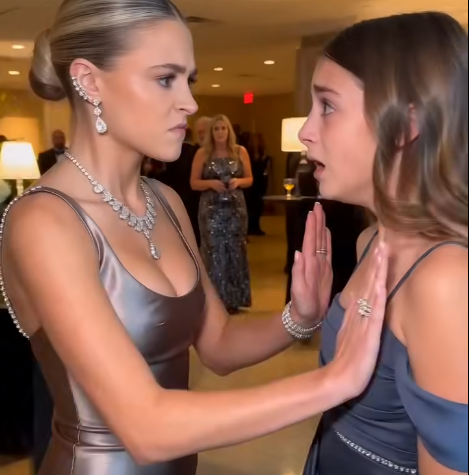
Because it finally made sense.
She had not shoved me because of a dress.
She had shoved me because I had won twice without knowing it.
Celine opened another document.
It was a letter addressed to me.
Dear Miss Stone, We are pleased to inform you—
The letter had never reached me.
My throat closed.
I remembered the week I waited for that decision. Refreshing my inbox. Checking spam. Pretending it didn’t matter when nothing came.
I remembered telling myself, Maybe I wasn’t good enough.
And all this time, someone had stolen the answer.
Matthias removed his glasses and pressed his fingers to his eyes.
“This foundation awarded the scholarship to Helena’s recommended candidate instead.”
Elise looked at Helena.
“That candidate was your cousin.”
Helena’s silence answered.
Edmund gripped the table edge.
“My God.”
Celine closed the folder slowly.
“No,” I said.
Everyone looked at me.
My voice shook, but it held.
“Don’t close it.”
Celine studied me.
I stepped closer, water trailing behind me.
“Open the final page.”
Helena’s head snapped up.
“Farah, don’t.”
It was the first time she said my name like I had power.
So I knew.
There was more.
Celine opened the final page.
A scanned note appeared, handwritten across the bottom of a review sheet.
If Stone is selected, investigate link to Voss estate.
Madame Voss stopped breathing.
I turned to her.
“What does that mean?”
For the first time all night, Celine Voss looked afraid.
Part 7: The Name Hidden Inside My Past
Celine Voss reached for the table, not because she was weak, but because the past had walked onto the terrace and taken her by the hand.
“Zoom in,” she said.
The security officer enlarged the handwritten note.
If Stone is selected, investigate link to Voss estate.
Under it was a second line, half-cut from the scan.
Possible relation to Anneliese.
The name moved through Celine like a blade.
She closed her eyes.
Matthias stepped toward her.
“Celine?”
She opened them again, but now they were wet.
“Where did you get your surname?” she asked me.
The question struck me sideways.
“My mother,” I said. “Mara Stone.”
Celine’s lips trembled.
“And before that?”
“I don’t know.”
The terrace had gone silent again, but this silence was different. Less hungry. More frightened.
Celine turned to Edmund.
“You knew about this note.”
Edmund looked lost.
“I have never seen it.”
Helena laughed suddenly.
It was brittle. Unstable.
“Oh, this is perfect. Truly. Now she gets a secret lineage too?”
Celine ignored her.
She opened another section of the archive. Old correspondence. Scanned letters. A foundation memo dated seventeen years earlier.
The screen loaded slowly.
I wanted it to stop.
I wanted answers.
I wanted to run.
A photograph appeared.
A young woman stood beside a half-built model bridge in a workshop, smiling at the camera. Her hair was darker than mine, her hands covered in paint, her eyes bright with the same stubborn focus I had only ever seen in the mirror.
Celine made a sound that was almost a sob.
“Anneliese.”
My hands went numb.
“Who is she?”
Celine touched the projected image with shaking fingers, though it was only light.
“My younger sister.”
The world narrowed to that photograph.
Celine continued, each word dragged from somewhere deep.
“She disappeared after refusing an arranged board appointment. She wanted to build public art programs, not attend dinners. We searched for years. Then a letter came saying she wanted no contact.”
She looked at the archive.
“I never believed it.”
The security officer opened the attached letter.
The signature at the bottom read Anneliese Voss.
But Celine shook her head before anyone spoke.
“That is not her signature.”
My chest tightened.
“My mother never talked about family.”
“What was her full name?” Celine asked.
“Mara Anneliese Stone.”
Celine covered her mouth.
The terrace blurred.
Helena whispered, “No.”
Celine turned toward me slowly, as if afraid I might disappear.
“Your mother was my niece.”
The words did not land all at once.
They unfolded inside me, impossible and precise.
Mara Anneliese Stone.
Daughter of the missing Voss sister.
Hidden from the family.
Hidden from the foundation.
Hidden from herself.
Celine looked at Helena.
“That scholarship note was not about prestige,” she said. “It was about keeping Farah away from records that could connect her to us.”
Edmund’s face darkened.
“Who wrote it?”
The security officer checked the metadata.
His voice lowered.
“Original upload by Carrington office.”
Edmund stared.
“That office was run by my wife.”
Across the terrace, Helena’s mother, Beatrice Carrington, stood very slowly.
Until that moment, she had been silent.
Too silent.
Celine turned to her.
“Beatrice,” she said. “What did you do?”
Beatrice’s face remained composed, but her hands trembled around her pearl clutch.
Helena looked from her mother to the screen.
“Mama?”
Beatrice took one breath.
Then she said, almost calmly, “I did what your father was too sentimental to do.”
Part 8: The Dress They Could Not Erase
Beatrice Carrington did not cry.
That made her confession colder.
She stood beneath the terrace lights in pearls and silk while my ruined dress dripped onto the stone, and she spoke as if she were explaining seating arrangements.
“Anneliese Voss was unstable,” she said. “Brilliant, yes, but reckless. She would have dragged the foundation into chaos.”
Celine’s voice shook with fury.
“She was twenty-three.”
“She was dangerous to the order of things.”
“To your order,” Matthias said.
Beatrice’s eyes flicked toward him, then back to Celine.
“When she left, I made sure she stayed gone. Later, when rumors surfaced that she had a daughter, I protected the institution.”
I heard myself ask, “My grandmother?”
The word felt strange in my mouth.
Beatrice looked at me without softness.
“She chose poverty over legacy.”
Celine stepped forward.
“You forged Anneliese’s no-contact letter.”
Beatrice did not deny it.
“You buried Mara’s connection to the family,” Edmund said, his voice hollow.
“I preserved your future.”
“Our daughter stole scholarship records,” he said.
Beatrice’s gaze moved to Helena.
“Because I taught her not to let sentimental weakness open doors to people who would take everything.”
Helena flinched as if slapped.
For the first time all night, I saw the child inside her cruelty—the frightened heir trained to believe love was a limited inheritance.
It did not excuse her.
But it explained the shape of the knife.
Celine looked at me.
“Farah,” she said softly, “your mother should have known where she came from. You should have known.”
I thought of my mother folding bills into envelopes. Laughing when dinner was simple. Telling me, “Never let a rich room decide your worth, darling. Rooms lie.”
Maybe some part of her had always known.
Maybe she had chosen silence because truth had hurt too many people before me.
Helena’s voice broke.
“I didn’t know about Anneliese.”
Beatrice turned sharply. “Enough.”
But Helena was staring at the screen, at the scholarship file, at my name ranked first.
“I knew about the scholarship,” she whispered. “I knew about the gala credit. I knew I hated her.”
She looked at me, and her face folded.
“But I didn’t know my mother built the whole lie before we were even born.”
Beatrice hissed, “Do not humiliate yourself.”
Helena laughed through tears.
“I already did.”
Then she walked to the pool’s edge.
For one wild second, I thought she might jump.
Instead, she removed Edmund’s signet ring from her clutch and placed it on the wet stone at his feet.
“I forged your approval,” she said. “I erased Farah’s name. I pushed her. I will say that to the board, to the police, and to every donor here.”
Beatrice went rigid.
“Helena.”
Her daughter turned.
“No. You made me afraid of being ordinary. But I chose to be cruel.”
That was the first honest thing she had said all night.
Celine ordered the files copied to the board archive, legal counsel, and the foundation trustees before anyone left. Beatrice tried to walk out, but Matthias blocked the path with two words:
“Not tonight.”
The ceremony still happened.
Not as planned.
Elise brought towels. Someone found me a dry jacket. My dress was stained, stretched, and ruined beyond repair, but when Celine asked whether I wanted to postpone, I looked at the glowing city model and shook my head.
“No,” I said. “Switch it on.”
So I stood before every donor in a thrifted dress wrecked by pool water, clean flats squeaking softly beneath me, hair damp against my cheeks.
Celine stood on one side.
Elise on the other.
And when I pressed the switch, the glass city lit from within.
Bridges shimmered. Towers glowed. Tiny streets filled with golden light.
Then the hidden final feature activated.
A name appeared beneath the centerpiece, projected in silver letters across the base.
Not Helena’s.
Not mine.
ANNELIESE VOSS — ORIGINAL COMMUNITY ARTS FOUNDER.
Celine gasped.
I looked at Elise.
She was crying.
“I didn’t add that,” she whispered.
Nico raised his hand from behind the control table, ashamed and hopeful at once.
“Farah’s old design file had a dedication layer. It was disabled. I restored it.”
My knees nearly gave out.
I had named the prototype after a woman I thought was just a forgotten artist from an archive article.
I had unknowingly honored my own blood.
Six months later, the Carrington name was removed from the foundation board. Beatrice faced formal investigation. Helena gave testimony that helped uncover years of manipulated records, then disappeared from society pages completely.
The scholarship was restored.
But Celine offered me something larger than money.
A key.
Not to a mansion.
To Anneliese’s abandoned workshop in Prague, preserved for seventeen years by a sister who never stopped hoping.
Inside, among dust-covered models and old sketches, I found a sewing box on the workbench. In it were needles, silver thread, and a note in handwriting that looked almost like mine.
Build what they refuse to see.
I used that thread to mend the only piece of my ruined gala dress worth saving: a small strip of hem, uneven and stubborn.
I framed it beside my first foundation design, not because the dress survived the night, but because I did.
And every time the workshop lights came on, the glass city below them glowed like a promise my mother, my grandmother, and I had finally kept.
