Part 2: The Question That Turned Her Father Pale
The microphone did not just carry the organizer’s question.
It sharpened it.
“Why did your daughter try to erase the official record?”
For one terrible second, every sound around the playground ceremony seemed to disappear. The balloons near the gate bobbed in the warm Tampa air. The red ribbon fluttered between two metal posts. Somewhere behind me, a child laughed without understanding why hundreds of older students had gone completely still.
Victoria Sterling’s family representative, a stiff man in a navy suit, kept one hand half-raised toward the inspection record.
The organizer, Mrs. Elena Brooks, pulled the papers closer to her chest.
“Do not touch this,” she said.
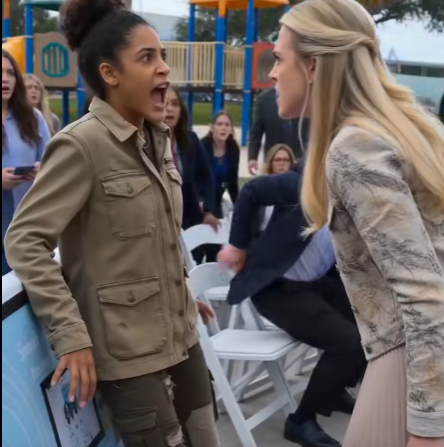
Victoria’s smile had vanished. Her perfect blonde hair still framed her face like nothing had happened, but her eyes were glassy with panic.
“My daughter didn’t erase anything,” the man said quickly.
Mrs. Brooks turned the folder around.
“Then explain why her name is written over Carmen Cooper’s on the recognition draft.”
A wave of whispers hit the ceremony area.
My knees were still burning from the fall. I felt dust on my palms, grit pressed into my skin, and the ugly sting of people staring at me while I tried to stand without looking weak.
A hand appeared in front of me.
It belonged to Mr. Harris, the maintenance supervisor. He was an older man with tired eyes and paint on his sleeve.
“Up,” he said quietly. “You earned this moment standing.”
I took his hand.
Victoria’s father, Grant Sterling, stepped forward from the sponsor row. He had the same polished blond hair, the same expensive stillness, the same expression that said the world usually moved when he wanted it to.
“This is a misunderstanding,” he said.
Mrs. Brooks held up the inspection record.
“No. A misunderstanding is when a name is misspelled. This is a signed safety record documenting that Carmen found a structural crack near the slide bracket yesterday afternoon.”
I swallowed hard.
The crack.
I had seen it while tightening screws after my shift, a thin dark split under the platform where little kids would climb. I could still feel the wrench in my hand, the sick drop in my stomach when the metal shifted.
Grant Sterling’s face tightened.
Mrs. Brooks continued, “She reported it at 5:42 p.m. She stayed until the replacement brace was installed. She signed the final check at 7:18.”
Mr. Harris nodded. “I signed under her. So did the city inspector.”
A teacher near the front whispered, “City inspector?”
Victoria snapped, “She’s lying.”
But her voice cracked on the last word.
Mrs. Brooks flipped one page.
“Then why did someone from Sterling Play Systems call my office at 8:03 last night asking us to remove her name before the ceremony?”
Grant Sterling went pale.
The phones lifted higher.
Victoria looked at her father.
And in that single glance, I saw the first crack in her confidence.
Because he wasn’t looking at me anymore.
He was looking at her like she had just opened a door he had spent years keeping locked.
Part 3: The Safety Report No One Expected
Grant Sterling reached for the microphone with a smile that looked glued onto his face.
Mrs. Brooks stepped back.
“Mr. Sterling,” she said, “this is a student ceremony. You do not get to control the microphone.”
That sentence landed like thunder.
A few students gasped. Someone near the playground fence said, “Finally.”
Victoria’s cheeks flushed.
“My family paid for this playground,” she said.
Mr. Harris turned toward her, his voice rough. “Your family sponsored part of it. Carmen made it safe.”
For the first time, people clapped.
Not loudly at first.
Just a few hands. Then more.
The sound reached me like warmth through a wall.
Victoria’s eyes filled with hatred.
“You all love this,” she said. “You love pretending she’s some kind of hero because she wears dirty boots.”
I looked down at my scratched ankle boots.
They were dirty.
They were also the reason I had not slipped while climbing under the slide platform after everyone else left.
Mrs. Brooks opened another plastic sleeve inside the folder.
“There is more.”
Grant Sterling’s head jerked up.
“No,” he said too fast.
Mrs. Brooks looked at him. “Excuse me?”
He corrected himself. “I mean, there is no need to turn a minor student issue into a public accusation.”
A new voice answered from the crowd.
“It stopped being minor when children could have been hurt.”
Everyone turned.
A woman in a gray blazer stepped out from behind the front row. Her badge read Marisol Vega — City Safety Office.
My breath caught.
She had been the inspector who came after my call.
I remembered her kneeling beside the slide with a flashlight, running her fingers along the crack, then looking at me with sudden seriousness.
“You found this before opening day?” she had asked.
“Yes, ma’am.”
She had said only one thing after that.
“Good.”
Now she walked to Mrs. Brooks and took the folder.
“This report was filed with the city last night,” Ms. Vega said. “The break point Carmen Cooper identified was not cosmetic. It was load-bearing.”
A shiver moved through the crowd.
Victoria’s lips parted.
Ms. Vega looked toward the sponsor row.
“And according to our preliminary review, that bracket should not have failed before the playground opened.”
Grant Sterling’s face became expressionless.
Too expressionless.
Ms. Vega lifted a second document.
“The manufacturer’s stamp on the installed bracket does not match the approved part list.”
The silence that followed was different from before.
It was not shock.
It was suspicion.
Mrs. Brooks stared at the paper. “Are you saying the wrong part was installed?”
Ms. Vega’s eyes went to Grant Sterling.
“I’m saying the part Carmen found may have been substituted.”
Victoria whispered, “Dad?”
Grant did not answer.
Then Mr. Harris stepped forward, holding up his phone.
“I took photos before the replacement.”
Grant’s jaw tightened.
Mr. Harris tapped the screen, and Ms. Vega connected it to the ceremony display behind the ribbon.
A close-up of the broken bracket appeared.
The company stamp was visible.
Sterling Play Systems.
But beneath it, scratched into the metal, was a second marking.
One Ms. Vega had circled in red.
REJECTED SAMPLE — NOT FOR INSTALLATION.
Part 4: The Marking Under The Broken Slide
A sound rolled through the crowd, low and furious.
Rejected sample.
Not for installation.
The words glowed on the display like they had been carved there just to ruin the Sterling family’s clean white tent, spotless boots, and ribbon-cutting smiles.
Grant Sterling’s voice dropped.
“That photo is being misinterpreted.”
Ms. Vega did not look intimidated.
“Then you will be welcome to clarify it during the official inquiry.”
Victoria’s face had gone pale beneath her makeup.
She turned to her father again, but he kept his eyes on the screen.
That was when I understood something that made my stomach twist.
Victoria had expected him to defend her.
But he was calculating how to survive her.
Mrs. Brooks touched my shoulder.
“Carmen, do you want to sit down?”
“No,” I said.
My legs were shaking, but I meant it.
I had spent too many years sitting quietly while students like Victoria stood in the middle of everything.
Not today.
Grant Sterling stepped toward Ms. Vega. “You are making a very damaging implication in front of minors and media.”
Ms. Vega’s voice hardened.
“A student was shoved in front of minors and media after your daughter accused her of faking a safety report. I am correcting the record.”
A few students cheered.
Victoria snapped, “Stop clapping for her!”
Her voice cracked so sharply that the cheering died.
She looked around, breathing fast, her superior expression breaking apart piece by piece.
“You don’t understand,” she said. “This was supposed to be ours. My father promised—”
Grant turned on her.
“Victoria.”
One word.
A warning.
But she was too humiliated to hear it.
“You promised they would announce me,” she said. “You said the list could be fixed.”
The microphone caught every syllable.
The crowd went still again.
Grant’s face changed.
Mrs. Brooks slowly looked at him.
“You told your daughter the recognition list could be fixed?”
“No,” he said. “She is upset.”
Victoria realized too late what she had done.
“Dad, I—”
“Enough,” he said.
But it was not enough.
A student near the front shouted, “Play the call!”
Everyone turned toward the sound.
A boy in a school media vest stepped forward, holding a recorder.
His name was Leo Martinez, one of the students who filmed ceremonies and announcements. He looked terrified, but he lifted the recorder higher.
“I was testing audio near the sponsor tent yesterday,” he said. “I didn’t mean to record it, but after Carmen got pushed, I checked.”
Grant Sterling stared at him.
“Delete it.”
Leo’s hand trembled.
Ms. Vega stepped between them.
“No one is deleting anything.”
Leo pressed play.
Static hissed.
Then Victoria’s voice filled the ceremony area.
“She can’t open the gate. She looks like maintenance.”
A pause.
Then Grant Sterling’s voice.
“Don’t worry. By morning, her name will be gone.”
My chest tightened.
Then another voice entered the recording.
A woman’s voice, calm and sharp.
“And if the inspection record points to the rejected bracket, make sure that disappears too.”
Victoria went completely still.
Grant’s mouth opened, but no words came.
Mrs. Brooks whispered, “Who was that?”
Ms. Vega looked at the sponsor tent.
A woman in a cream suit rose from the back row.
Victoria’s mother.
Diane Sterling.
Part 5: The Mother Behind The Sponsor Tent
Diane Sterling moved like someone who had never been forced to explain herself in public.
Her cream suit did not have a wrinkle. Her hair was pinned perfectly. Her face held no shock, no embarrassment, no fear.
Only annoyance.
“This is becoming inappropriate,” she said.
Ms. Vega faced her. “Mrs. Sterling, was that your voice on the recording?”
Diane smiled faintly.
“I will not answer a chopped-up student recording in a crowd.”
Leo turned red. “It wasn’t chopped up.”
Grant hissed, “Diane, stop.”
That made every camera swing back to him.
Because powerful people only said stop when there was still more to hide.
Diane’s eyes narrowed at her husband.
“You let this get messy.”
Victoria stared at her mother. “Mom, what does that mean?”
Diane looked at her daughter, and for one second I expected comfort.
Instead, she said, “It means you were supposed to keep your temper until after the cameras left.”
The crowd erupted.
Victoria flinched as if the words had struck her.
I almost felt sorry for her.
Almost.
Diane turned to Mrs. Brooks.
“The Sterlings have invested heavily in this school’s facilities. A recognition adjustment would have been reasonable.”
Mrs. Brooks clutched the folder tighter. “A recognition adjustment? Carmen found a dangerous part before children used that slide.”
Diane’s smile thinned.
“And now she will be thanked. What more does she want?”
My hands curled.
For years, that question had followed me in different voices.
What more do you want?
A paycheck and dignity.
A chance and credit.
A moment without someone taking it because their last name was louder.
I stepped toward the microphone.
Mr. Harris started to stop me, then didn’t.
I wiped my dusty palm on my patched cargo pants and took the mic.
My voice shook at first.
“I want the truth written where you tried to erase it.”
The crowd quieted.
I looked at Victoria, then at Grant, then at Diane.
“I want every kid who climbs on that playground to be safe. I want every student who works after school to know their work still counts when nobody rich is watching. And I want you to stop acting like my name was a stain on your ceremony.”
No one spoke.
Then Ms. Vega said, “Carmen, did anyone contact you after you filed the report?”
I hesitated.
Victoria’s eyes sharpened.
I had not planned to say it.
But the microphone was warm in my hand, and my knees still hurt from the shove.
“Yes,” I said.
Diane’s expression flickered.
“Who?” Ms. Vega asked.
I pulled my phone from my jacket pocket.
“There was a message last night from an unknown number.”
I opened it with damp fingers and read it aloud.
Drop the playground story, or your work permit question becomes a school board problem.
A collective gasp rose from the crowd.
Victoria whispered, “Mom?”
Diane’s face finally changed.
Not with guilt.
With rage that the threat had survived.
Ms. Vega took my phone carefully.
Grant Sterling stepped back.
And Diane looked at me like I had just become something much more dangerous than poor.
I had become documented.
Part 6: The Message That Opened The Old File
Ms. Vega did not read the message twice.
She did not need to.
She photographed it, logged it, and handed my phone back with a look that made my throat tighten.
“Carmen,” she said quietly, “you should not have been threatened for reporting a safety issue.”
Behind her, the school principal, Dr. Nolan Price, looked like he wanted the ground to open beneath the ribbon table.
“This will be investigated,” he said.
Students murmured angrily.
Someone shouted, “Investigated by who? Them?”
That hurt him because it was a fair question.
Diane Sterling crossed her arms.
“You are all being manipulated by emotion.”
I laughed once.
I did not mean to.
It just came out, small and sharp.
Diane looked offended.
“You think a threat about my work status is emotion?” I asked. “You think a rejected bracket under a children’s slide is emotion?”
Victoria stared at the pavement.
She was no longer performing.
Her face had gone blank in the way people look when the truth has outrun them.
Then Mr. Harris spoke.
“There’s an older file.”
Grant Sterling turned so fast his shoe scraped the floor.
“What file?”
Mr. Harris reached into the folder Mrs. Brooks had been holding and pulled out a yellowed inspection copy.
“I wasn’t sure it mattered today,” he said. “Now I do.”
Diane’s lips pressed together.
Ms. Vega took the paper.
“This is from three years ago.”
Mr. Harris nodded. “Different playground. Same supplier. Same rejected sample marking.”
The sponsor tent fell silent.
My stomach dropped.
Dr. Price whispered, “Three years ago?”
Mr. Harris looked tired suddenly, older than he had before.
“A swing chain snapped at a community park. No child was seriously hurt, thank God, but the report was buried after Sterling Play Systems sent a replacement set and a donation check.”
Grant said, “That is confidential.”
Ms. Vega’s eyes flashed.
“Safety records are not a family secret.”
Diane stepped forward. “That incident was settled.”
“With money?” Mrs. Brooks asked.
“With discretion,” Diane replied.
The word was so ugly in her mouth that several parents groaned.
Mr. Harris looked at me.
“I should have said something then.”
His voice broke slightly.
“I thought if no one got hurt badly, maybe it was better to keep my job. But Carmen found the same marking yesterday. Same shortcut. Same danger.”
I looked at the old paper.
The rejected sample stamp was circled in faded ink.
Beside it was a handwritten note from three years earlier.
Do not escalate. Sponsor relationship sensitive.
Dr. Price covered his mouth.
Ms. Vega turned the page over.
There was a signature at the bottom.
Not Grant’s.
Not Diane’s.
The signature belonged to someone from the school district.
Dr. Price read the name and went rigid.
“That’s impossible,” he whispered.
Mrs. Brooks looked over his shoulder.
Her face turned white.
The name on the buried file was Margaret Cooper.
My grandmother.
Part 7: The Signature That Was Not Hers
For a moment, I forgot the cameras.
I forgot Victoria, Diane, Grant, the playground gate, even the ache in my knees.
All I saw was my grandmother’s name at the bottom of a buried safety file.
Margaret Cooper.
The woman who raised me after my mother’s shifts stretched too long. The woman who kept extra bandages in her purse, who taught me how to tighten loose screws because “small things fail before big things fall.”
She had died two years earlier.
She could not defend her signature.
I stepped closer to the page.
“That’s not hers,” I said.
Dr. Price looked at me. “Carmen—”
“That is not my grandmother’s signature.”
My voice rose before I could stop it.
“She signed birthday cards with a loop under the C. She signed rent receipts in blue pen. She never wrote her M like that.”
Diane Sterling looked away.
It was quick.
Too quick.
Ms. Vega saw it.
“You knew Margaret Cooper?” she asked Diane.
Diane’s jaw tightened.
“She worked for the district facilities office years ago. Many people did.”
Mr. Harris shook his head. “Margaret refused to close that swing report.”
My eyes stung.
“What?”
He looked at me with shame.
“She wanted it escalated. She told me rejected parts don’t appear by accident. A week later, the file changed. Her name was on the closure memo, and she was transferred.”
The world seemed to tilt.
My grandmother had not been quiet because she didn’t know.
She had been punished because she knew too much.
Victoria whispered, “Mom… did you forge it?”
Diane’s eyes snapped to her.
“Do not be ridiculous.”
But her voice had lost its polish.
Grant stepped away from Diane now, slowly, as if discovering he had been standing next to a fire.
“Diane,” he said, “tell me you didn’t.”
She looked at him with pure contempt.
“You loved the donations when they opened doors.”
“That is not an answer.”
Diane’s mouth tightened.
Then Leo, still shaking in his media vest, lifted his recorder again.
“There’s another part,” he said.
Diane’s head turned.
Leo swallowed. “The recording from yesterday. After Mr. Sterling left.”
Ms. Vega nodded.
“Play it.”
Diane said, “Absolutely not.”
Leo pressed play anyway.
Static.
Then Diane’s voice.
“If Carmen Cooper keeps pushing, remind the district how her grandmother closed the old report. Families with messy records should not throw stones.”
My breath left me.
Then Victoria’s voice, quieter than before.
“But what if the grandmother didn’t close it?”
A pause.
Diane answered coldly.
“Then it is fortunate dead women cannot correct paperwork.”
The ceremony area exploded.
Grant looked sick.
Victoria put both hands over her mouth.
I stood frozen as every story my grandmother had never told me suddenly opened at once.
Ms. Vega took the old file, the new inspection record, and Leo’s recorder.
Then she looked straight at Diane Sterling.
“This ceremony is over for your family.”
Diane’s face went hard.
But Victoria stepped forward, trembling.
“No,” she whispered. “It’s over because of me too.”
Part 8: The Gate Carmen Opened Anyway
Victoria Sterling walked toward me with mascara gathering under her eyes and hundreds of phones recording every step.
For a second, I braced myself.
I expected another insult.
Another accusation.
One last attempt to make the fall my fault.
Instead, she stopped three feet away and looked at the dust on my jacket, the scrapes on my palms, the inspection folder in Ms. Vega’s hands.
Then she turned toward the microphone.
“I shoved Carmen Cooper,” she said.
Her voice shook, but it carried.
“I tried to take her recognition. I told myself she stole something that belonged to me because I was too weak to admit she earned what I didn’t.”
Diane hissed, “Victoria.”
Victoria did not look back.
“And I heard my mother talk about the old file. I didn’t understand all of it, but I knew enough to stay quiet.”
The crowd had gone silent again, but this time the silence was not cold.
It was listening.
Victoria looked at me.
“I’m sorry,” she said.
The words did not fix my knees. They did not restore my grandmother’s name. They did not erase the years people like Diane Sterling had spent treating safety, credit, and truth like private property.
But they were public.
And public mattered because the lie had been public too.
Ms. Vega stepped forward.
“The playground will not open today,” she announced. “Not until every part is independently inspected.”
A few parents nodded immediately.
Mrs. Brooks took the ribbon scissors off the table and set them down.
“No ribbon-cutting.”
My chest sank, even though I knew she was right.
The moment I had worked for was gone.
Then Mr. Harris lifted the old inspection file.
“Not a ribbon-cutting,” he said. “A correction.”
He looked at Dr. Price.
“Say her grandmother’s name.”
Dr. Price’s face flushed.
He took the microphone with both hands.
“Three years ago, Margaret Cooper raised concerns about rejected playground parts. Those concerns were buried. Today, Carmen Cooper found the same danger and made sure it could not be buried again.”
My throat closed.
Students began clapping.
Slowly at first.
Then louder.
A sound that rose over the tents, over the playground, over the Sterling banner still hanging uselessly behind the gate.
Diane tried to leave, but Grant blocked her path.
“No,” he said, his voice hollow. “You will answer questions.”
For the first time, Diane Sterling looked small.
Not poor.
Not powerless.
Just exposed.
In the weeks that followed, Sterling Play Systems lost its district contracts. The city reopened old inspection files. Diane Sterling faced a formal investigation for document manipulation and intimidation. Grant Sterling resigned from the sponsorship board. Victoria transferred out before graduation, but before she left, she gave a sworn statement confirming what she had heard.
I did not forgive her.
Not then.
Maybe not ever.
But I used her statement.
My grandmother’s old transfer was reversed on record. Her name was cleared in a public board meeting where my mother cried so hard she could not speak.
The playground reopened six weeks later.
No Sterling banner.
No sponsor speech.
No custom jackets.
Just children waiting behind the gate, bouncing on their toes while parents checked the new inspection certificate posted in clear plastic beside the entrance.
Mrs. Brooks handed me the key.
It was heavier than I expected.
Mr. Harris stood beside me, smiling through wet eyes.
On the new plaque near the slide, there were two names.
Margaret Cooper, who refused to ignore danger.
Carmen Cooper, who made sure the truth stayed open.
I unlocked the gate.
Children rushed past me, laughing, climbing, shouting, alive and safe under the bright afternoon sun.
And for the first time in my life, I did not feel like the girl everyone looked past.
I felt like the reason they could move forward.
