The first thing that hit my face was not the food.
It was the silence afterward.
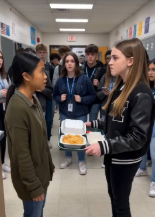
One second, the community garden behind East Ridge High was full of shovels scraping cold soil, students laughing too loudly for a Monday morning, teachers calling out instructions over folding tables, and volunteers passing trays of donated lunches under a banner that read MLK DAY OF SERVICE. The next second, a sour-smelling scoop of chicken salad and wilted greens slid down my cheek, cold against my skin, and every sound around me seemed to pull back like the whole world had taken one step away.
Phones rose first.
Then came the gasps.
Then Madison Whitmore smiled.
She stood in front of me in her black varsity jacket, polished boots clean despite the mud, blond hair tucked behind one ear like she had planned even that small gesture. Her friends hovered behind her, not shocked enough, not confused enough, their cameras already pointed at me from three different angles.
I could feel something dripping from my chin onto my moss-green cardigan.
Nobody moved.
Not even Ms. Carver, who had been standing ten feet away with a clipboard in her hand.
Madison’s voice cut through the frozen air.
“Maybe next time,” she said, loud enough for the closest students to hear, “don’t act like you’re in charge of things you don’t understand.”
My face burned, but not from the food. From the sudden, humiliating awareness that everyone was watching to see what kind of girl I would become in the next five seconds.
The crying girl.
The angry girl.
The guilty girl.
I swallowed hard. The taste of spoiled dressing touched the corner of my mouth, and my stomach turned.
“I understand enough,” I said quietly.
Madison’s smile twitched.
That was the first sign.
At the time, I didn’t know it meant fear.
My name is Avery Nguyen. I was seventeen, a Vietnamese American junior at East Ridge High in Memphis, Tennessee, and I had learned early that being quiet made people underestimate you. My parents ran a small repair shop off Summer Avenue, the kind with old fans in the windows, calendars from local markets, and a bell above the door that had been there longer than I had been alive. My father could fix almost anything with careful hands and patience. My mother remembered every customer’s name, even the ones who forgot hers.
At school, I was the girl teachers trusted to stay late. The girl who organized volunteer sign-in sheets, checked inventory, wiped tables after everyone else left, and apologized when other people bumped into me. I was not poor, exactly, but I was not Madison Whitmore either.
Everyone knew what Madison was.
Her grandfather’s name was engraved on the football stadium entrance. Her mother sat on three school committees and smiled in photos with district leaders. Her father owned Whitmore Civic Supply, a company that had contracts with half the school programs in the county, including boxed lunches, produce donations, event equipment, and “community outreach partnerships,” which sounded noble until you saw how much money moved behind it.
Madison did not walk through East Ridge High like a student.
She moved through it like a future decision already made.
That morning, the MLK Day of Service event was supposed to be simple. Students would clean garden beds, repaint signs, pack care baskets, and serve lunch donated through a district supplier partnership. I was helping the service club because I had spent two months helping organize the garden restoration. The soil was too compact, the storage shed needed repairs, and the irrigation hose had been leaking since October.
But by 8:15 a.m., before most volunteers had finished their coffee, I noticed the smell.
It was faint at first, buried under wet earth and mulch.
Then I opened the first cooler.
The chicken salad trays inside were sweating under the lids. The ice packs had gone soft. A thin sourness rose from the container, sharp enough to make me step back.
I checked the label.
Cold delivery required: 40°F or below.
The thermometer taped inside the cooler read 57°F.
My hands went cold.
I opened another cooler. Same thing. Then another. Lettuce browned at the edges. Fruit cups sticky where the seals had loosened. Milk cartons warmer than they should have been.
People were already lining up near the tables.
I found Ms. Carver, our student activities coordinator, near the garden gate.
“The lunch delivery isn’t safe,” I said.
She looked distracted. “What do you mean?”
“The cold food is too warm. The chicken salad smells off. We can’t serve it.”
Her eyes flicked toward the table, then toward the parking lot where a white delivery van had just pulled away.
“Are you sure?”
I hated that question. Not because it was unfair, but because I knew what sat behind it. Are you sure enough to create a problem? Are you sure enough to embarrass the wrong people?
“Yes,” I said. “The cooler thermometers are over fifty degrees.”
Ms. Carver lowered her voice. “Avery, this delivery came through Whitmore Civic Supply. It’s already been signed into the event system.”
“By who?”
She hesitated.
That was the second sign.
“Just help me move the trays aside,” she said. “We’ll figure it out.”
But before we could, Madison appeared.
She walked up like she had been waiting for her cue.
“What’s the issue?” she asked, though her eyes were on me, not Ms. Carver.
“The food needs to be held,” I said. “It may not be safe.”
Madison laughed once, short and sharp. “You’re joking.”
“No.”
“You’re going to shut down lunch for a hundred volunteers because you think lettuce looks sad?”
“It’s not about lettuce.”
Madison stepped closer. “My family donated this.”
“Then your family should want it checked.”
The air around us changed.
A few students turned.
Madison’s friends shifted their phones lower, pretending not to record yet.
“My family has been supporting this school since before you got here,” Madison said.
I felt my hands tighten around the clipboard.
“And people can still get sick,” I said.
Her eyes narrowed.
Ms. Carver touched my arm. “Avery, maybe we should talk inside.”
But Madison had already reached for one of the serving trays. Her hand closed around a scoop of chicken salad and greens, and for one ridiculous second my brain refused to understand what she was doing.
Then she threw it.
Straight at my face.
Afterward, people would argue about whether she meant to hit me or just scare me. They would say she was emotional. They would say I provoked her. They would say stress makes people do things.
But I saw her eyes.
She aimed.
And she smiled before it landed.
I did not run to the bathroom. I did not scream. I did not slap her back, even though for half a second every part of me wanted to.
I stood there with spoiled food on my face and heard Madison say, “Stop making yourself the victim.”
That was when I knew something was wrong beyond cruelty.
Because she should have been angry that I challenged her.
Instead, she sounded desperate for me to look guilty.
Ms. Carver finally moved. “Madison! Office. Now.”
Madison’s friends erupted.
“She didn’t even touch her that hard.”
“Avery was trying to ruin the event.”
“She always does this.”
I looked around at the faces, some shocked, some thrilled, some already watching the video on their screens. The garden seemed suddenly too bright, too open, too full of people pretending not to choose sides while choosing anyway.
Then I saw Mr. Alvarez near the supply table.
He was the facilities supervisor, a broad-shouldered man with gray at his temples and keys clipped to his belt. He had always treated me kindly, not in a dramatic way, but in the way adults did when they noticed the students who stayed behind after applause ended.
His expression was not surprised.
It was careful.
He looked at the coolers.
Then at me.
Then at the parking lot.
And when our eyes met, he gave the smallest shake of his head.
Not now.
That was the third sign.
I cleaned my face in the girls’ bathroom with brown paper towels that scratched my skin raw. My cardigan smelled sour no matter how much water I used. In the mirror, I barely recognized myself. Black hair tied low, cheeks flushed, eyes too bright with tears I refused to let fall.
My phone buzzed.
A message from my best friend, Lina:
DO NOT POST ANYTHING. COME TO THE MEDIA ROOM. NOW.
I found her sitting behind the editing computers, dark curls spilling from her hoodie, fingers flying over the keyboard. Lina Patel had been filming B-roll for the school news segment on the service day. She knew cameras better than most teachers knew attendance software.
She looked up when I walked in and froze.
“Oh, Avery,” she whispered.
“I’m fine.”
“You’re not.”
“I need to be.”
That made her mouth tighten.
She turned the monitor toward me. “I pulled the footage from my camera before anyone asks me for it.”
The screen showed the garden from a wide angle. Volunteers, coolers, Madison walking in. Me pointing to the thermometer. Madison leaning close. Her hand moving.
I looked away before the food hit me again.
Lina paused the video.
“She wanted the phones on you,” she said.
“I know.”
“No. Listen.” She rewound ten seconds, zoomed in, and paused on Madison’s face. “Look behind her.”
At first I saw only her friends.
Then I saw the man in the background.
A delivery driver in a gray cap stood near the van, holding his phone up, not like he was calling someone, but like he was waiting for confirmation.
The moment Madison threw the food, he lowered the phone and left.
My skin prickled.
“Why would the driver still be there?” Lina asked.
“He said the delivery was finished before I checked the coolers.”
“Exactly.”
A knock sounded at the door.
We both jumped.
Mr. Alvarez stepped in, closing the door behind him.
His face darkened when he saw my cardigan, but he only said, “You still have the clipboard?”
I held it up.
He nodded. “Good. Did you sign anything?”
“No.”
“Did anyone ask you to?”
“Ms. Carver said it was already signed into the system.”
His jaw tightened.
Lina leaned forward. “By who?”
Mr. Alvarez looked at the hallway through the narrow window before answering.
“According to the event portal,” he said, “Avery signed it at 7:42 a.m.”
The room went quiet.
I stared at him.
“I wasn’t even here at 7:42,” I said.
“I know.”
The words landed harder than the food.
For the first time that morning, fear moved fully through me.
Not embarrassment. Not anger.
Fear.
Someone had used my name.
Mr. Alvarez pulled a folded paper from his jacket and placed it on the desk. It was a printed copy of a sign-off form. My name was typed under RECEIVED BY. Below it, a shaky digital signature tried to look like mine.
It did not.
But if people wanted to believe it, maybe that would be enough.
Lina whispered, “That’s forgery.”
Mr. Alvarez nodded. “And not a very smart one.”
“Then why use my name?” I asked.
He looked at me with a sadness that made my stomach sink.
“Because they thought no one would fight too hard for you.”
I could not speak.
He regretted it instantly. “Avery, I don’t mean—”
“No,” I said, voice small. “You’re right.”
And the worst part was, he was.
Madison could throw food in my face in front of fifty witnesses and people still asked what I did first. A supplier could put my name on a form, and some adults would find it easier to believe the scholarship kid made a mistake than admit a donor family’s company delivered unsafe food.
My parents had taught me not to make myself smaller for people who confused kindness with weakness.
But they had also taught me the cost of being noticed.
Years earlier, when I was ten, my father lost a maintenance contract with the city after reporting that a batch of replacement parts supplied through a subcontractor was faulty. He did not call it corruption at home. He called it “paper trouble.” But I remembered the months afterward: my mother stretching soup, my father fixing appliances late into the night, the way their voices dropped when letters came in the mail.
The subcontractor’s name had been different.
But I remembered one word on the letterhead.
Whitmore.
I looked down at the forged signature.
Suddenly, Madison’s attack did not feel like a rich girl throwing a tantrum.
It felt like a door opening onto something older.
“What do we do?” Lina asked.
Mr. Alvarez lowered his voice. “We don’t accuse without proof. We collect everything. Cold-storage logs. Delivery codes. Camera footage. The portal access records. And Avery—”
He looked directly at me.
“You do not let anyone pressure you into saying you signed that form.”
By noon, the school had split into versions of reality.
In one version, Madison had assaulted me because she was spoiled and cruel.
In another, I had tried to sabotage a service event connected to her family, and she had “snapped.”
By 12:30, a clipped video appeared online showing only Madison throwing the food and me standing there afterward. The caption read:
WHEN THE GIRL WHO RUINS EVERYTHING FINALLY GETS CALLED OUT.
By 1:00, someone had sent it to three local parent groups.
By 1:15, Madison posted a statement.
I regret that emotions ran high today, but I will never apologize for defending my family’s integrity against false accusations.
False accusations.
I read those words in the office while Principal Harlan sat across from me with his hands folded.
He was a tall man with silver-rimmed glasses and the exhausted patience of someone who liked problems better after they had already been solved by someone else.
“Avery,” he said, “I understand you’re upset.”
I looked at the stain still drying on my cardigan.
“I’m not upset,” I said. “I’m reporting a food safety issue and a forged sign-off.”
His mouth tightened slightly.
“Those are serious claims.”
“They’re serious facts.”
Ms. Carver sat to my left, pale and silent. Madison sat to my right with her mother, Celeste Whitmore, who wore a cream coat and an expression so calm it felt rehearsed.
Mrs. Whitmore reached into her leather bag and pulled out a folder.
“My daughter made a mistake,” she said smoothly. “A public one. We are prepared to apologize for that. But we will not allow this child to damage a company that has served this district faithfully for years.”
This child.
I felt Ms. Carver flinch beside me.
Principal Harlan opened the folder. “Mrs. Whitmore has provided the delivery confirmation.”
My forged sign-off lay inside.
My name.
My fake signature.
My supposed approval of unsafe food.
Madison looked at me then, and for one second the mask slipped again.
Not a smile.
A warning.
My hands trembled under the table, so I curled them into fists.
“I did not sign that.”
Mrs. Whitmore sighed gently. “Avery, sometimes students take on too much responsibility and panic when something goes wrong.”
“I didn’t sign it.”
“You’re a good student,” she continued, as if praising me made the trap softer. “No one wants to ruin your future over one mistake.”
The word ruin sat between us.
I thought of my parents’ shop. Of my father reading letters at the kitchen table. Of my mother pretending not to cry while counting bills.
I thought of every time someone powerful had offered mercy as long as we accepted blame.
“No,” I said.
The room went still.
Principal Harlan blinked. “No?”
“I’m not accepting responsibility for something I didn’t do.”
Mrs. Whitmore’s smile faded by half an inch.
Madison leaned back, arms crossed.
Principal Harlan cleared his throat. “We’ll review the matter.”
“When?”
He glanced at Mrs. Whitmore.
That was the fourth sign.
“Soon,” he said.
It might have ended there if Mr. Alvarez had not broken the rules.
At 3:40 p.m., after the event had been shut down and the unsafe food removed, he found me and Lina in the library study room. He carried a small black binder and a USB drive.
“I can’t take these home,” he said. “And I can’t leave them in my office.”
Lina stared at the USB. “What is that?”
“Loading dock camera export. Temperature logs from the coolers. Vendor check-in metadata. I requested them for facilities review before anyone told me not to.”
My mouth went dry. “Told you not to?”
He looked tired.
“An hour ago, I got an email from the district operations office asking all staff to refrain from independently reviewing supplier materials until further notice.”
Lina muttered, “That sounds extremely normal and not suspicious at all.”
Mr. Alvarez almost smiled.
Then he opened the binder.
Inside were delivery sheets from the last six months. Some were normal. Some had handwritten corrections. Some listed replacement cooler codes. Some showed student event sign-offs for days when those students had not been present.
My name appeared once.
Others appeared too.
Jamal Brooks.
Sofia Reyes.
Mina Park.
Eli Thompson.
Students from service clubs. Scholarship programs. Newspaper staff. Kids who did extra work and did not have powerful parents.
A pattern.
I turned the pages slowly.
My heartbeat pounded in my ears.
“This isn’t just today,” I said.
“No,” Mr. Alvarez said.
Lina leaned over my shoulder. “They used student names whenever a delivery had a problem.”
“And if no one got sick?” I asked.
“Nothing happened.”
“And if someone did?”
Mr. Alvarez did not answer.
He did not have to.
That evening, I brought the binder home.
My mother opened the door before I knocked twice. She took one look at my face and pulled me inside.
“What happened?”
I wanted to be strong. I wanted to explain calmly.
Instead, when she touched the dried stain on my cardigan, I started crying so hard I could barely breathe.
My father came out from the kitchen, wiping his hands on a towel. His face changed when he saw me. Not angry first. Afraid.
My mother sat me at the table and cleaned my cheek again, even though there was nothing left to clean. My father listened without interrupting as I told them everything: the food, Madison, the forged signature, Mrs. Whitmore, the binder.
When I said Whitmore, my parents looked at each other.
I saw it.
The same shadow passed between them.
“You knew them,” I said.
My father sat down slowly.
My mother closed her eyes.
“A long time ago,” he said, “I reported a supplier connected to a city youth program. The parts they delivered for community center kitchen repairs were not certified. If installed, they could have caused electrical failures.”
“You lost the contract.”
“Yes.”
“Because of Whitmore.”
My father did not answer right away.
My mother reached across the table and took my hand.
“We did not tell you everything,” she said.
The kitchen seemed to shrink.
My father stood, went to the hallway closet, and returned with an old cardboard file box sealed with yellowing tape. I had seen that box only twice in my life. Once when we moved. Once when a pipe burst and my father carried it upstairs like it was more important than furniture.
He cut the tape with a key.
Inside were documents, photographs, printed emails, and a small silver flash drive wrapped in cloth.
My father touched it but did not pick it up.
“Before you were born,” he said, “your uncle worked for a food logistics company. He found records showing unsafe deliveries were being relabeled for public programs. Schools. Senior centers. Community events.”
“My uncle?” I whispered.
My mother’s eyes shone.
I had grown up knowing my mother had a younger brother who died before I could remember him. Uncle Minh. His photo sat on our shelf every Tết beside incense and oranges. He was always smiling in the picture, one hand raised like he had been caught mid-joke.
“He tried to report it,” my father said. “The investigation disappeared. Then he was blamed for falsifying records. He lost his job. He was humiliated. A few months later, he died in a car accident.”
The room went silent.
My mother’s grip tightened around my hand.
“It was ruled an accident,” she said carefully. “We never had proof otherwise.”
A coldness spread through me.
“The company?”
My father looked at the binder on the table.
“It changed names. Merged. Rebranded.”
“Whitmore Civic Supply,” I said.
My mother nodded once.
The twist of it made me dizzy.
Madison had not just attacked me because I challenged her family’s contract.
Her family’s business had been stepping over mine before I was even born.
My father finally picked up the silver flash drive.
“Minh sent this to me three days before the accident,” he said. “I tried to give it to investigators, but no one would take it seriously. Later, we were warned to stop. We had you by then.”
He looked ashamed.
“I chose safety.”
My heart broke for him.
“Ba,” I whispered. “You chose us.”
He looked away.
My mother wiped her cheek. “We kept it because truth has a way of needing time.”
Outside, a car passed slowly down our street.
All three of us turned toward the window.
For the first time, I understood that my parents’ caution had not been weakness.
It had been survival.
The next morning, East Ridge High tried to move on.
That was the thing about schools. Something could happen that cracked your life open, and the bell would still ring for first period.
Madison did not come to class, but her friends did. They whispered when I passed. Someone had taped a plastic fork to my locker. Someone else wrote SNITCH in pencil near the vent.
Lina ripped it down before I could.
“I’m going to start biting people,” she announced.
Despite everything, I laughed.
It came out shaky.
At lunch, Jamal Brooks sat across from us without asking.
He was a senior, basketball player, service club volunteer, and one of the names in the binder.
“I heard my name is on a delivery form,” he said.
Lina and I froze.
Jamal leaned forward. “I was at an away game that day. So either I learned teleportation, or somebody’s lying.”
By the end of lunch, we had found three more students whose names had been used. Sofia Reyes had supposedly approved dairy deliveries while she was home with the flu. Mina Park had signed for produce during a debate tournament in Nashville. Eli Thompson, who had broken his wrist in November, had somehow provided a digital signature with his right hand two days after surgery.
The pattern became a map.
But a map was not enough.
We needed the key.
It came from the smallest detail.
At 4:12 p.m., Lina zoomed in on the loading dock footage again. The delivery driver had scanned each cooler before unloading. Every cooler had a QR inventory tag. When he scanned the third one, his phone screen flashed for less than a second.
Lina froze the frame until the image sharpened.
There was a code.
WCS-MID-4179.
Mr. Alvarez recognized it immediately.
“MidSouth cold storage hub,” he said. “That’s where district deliveries are routed before events.”
“Can we get those records?” I asked.
“Not officially.”
Lina grinned. “My cousin works part-time at a warehouse.”
“No,” Mr. Alvarez said immediately.
“I was going to say he knows how the tracking system formats receipts,” Lina replied. “Relax.”
She did not relax.
None of us did.
By nightfall, we learned that every cooler had an internal temperature tracker. The trackers uploaded data to the supplier portal automatically. If the supplier records were intact, they would show exactly when the coolers warmed, where they were held, and who changed the delivery status.
But the school only had access to final confirmation forms.
Whitmore Civic Supply had the full logs.
Which meant the truth was sitting inside the company that wanted me blamed.
The next day, Principal Harlan called an emergency review meeting.
My parents came with me.
So did Mr. Alvarez.
So did Lina, carrying her laptop like a weapon.
The meeting took place in the media center, not the office, because too many people had become involved. District officials sat at one table. Mrs. Whitmore sat at another with Madison and a man in a navy suit introduced as company counsel.
Madison looked different.
Still polished. Still expensive.
But tired around the eyes.
When she saw my parents, her expression flickered.
Recognition?
No.
Something worse.
Guilt.
Principal Harlan began with the kind of voice adults use when they want conflict to become paperwork.
“We are here to determine whether yesterday’s incident resulted from a misunderstanding, misconduct, or a vendor error.”
Mrs. Whitmore folded her hands. “We have already acknowledged Madison’s emotional response. She will complete whatever restorative process the school deems appropriate.”
Madison stared at the table.
“But,” Mrs. Whitmore continued, “we reject the attempt to turn a student disagreement into a campaign against a respected local business.”
My mother stiffened.
My father touched her arm.
District Operations Director Mr. Keene adjusted his glasses. “We have the event sign-off.”
Lina opened her laptop.
“And we have proof Avery was not on campus when that sign-off happened,” she said.
The room turned.
Principal Harlan frowned. “Lina, this meeting is—”
“She was with me,” Lina said. “We were picking up camera batteries from my aunt’s office at 7:42. Time-stamped security entrance. I already sent it to Ms. Carver.”
Ms. Carver, sitting near the wall, lifted her chin.
“I can confirm receipt.”
Mr. Keene looked annoyed.
Mrs. Whitmore’s smile sharpened. “Then perhaps another student used her login.”
“I didn’t give anyone my login,” I said.
The company counsel leaned forward. “Student accounts are notoriously insecure.”
Mr. Alvarez placed the binder on the table.
“Then it’s strange,” he said, “that the same kind of insecurity only appears when Whitmore deliveries have temperature exceptions.”
The room shifted.
Mr. Keene’s face went pale.
Mrs. Whitmore did not move.
Madison did.
Her foot began tapping under the table.
Mr. Alvarez opened the binder and laid out the forms one by one. Jamal. Sofia. Mina. Eli. Me.
“Five students,” he said. “Five questionable sign-offs. Five deliveries with corrected cold-chain notes.”
Mrs. Whitmore’s voice cooled. “Where did you get those?”
“School facilities archive.”
“That archive contains preliminary materials not meant for public interpretation.”
My father spoke for the first time.
“Truth is not public interpretation.”
Mrs. Whitmore looked at him, and the room seemed to change temperature.
For a moment, her face showed something raw and old.
“You,” she said.
My father did not blink. “Yes.”
Madison looked between them. “Mom?”
Mrs. Whitmore recovered too quickly. “I don’t know what you mean.”
But she did.
And I knew she did.
Lina clicked her keyboard.
“There’s more,” she said.
The screen at the front of the media center lit up.
Loading dock footage.
The driver scanning coolers.
Madison approaching him before the confrontation.
Madison taking a folded paper from his hand.
Madison texting.
Then Madison walking straight toward me.
Mrs. Whitmore stood. “This is outrageous.”
Lina did not stop.
“The driver’s scan shows the cooler code. WCS-MID-4179. We requested the corresponding supplier records.”
The company counsel laughed once. “You requested proprietary logistics data? From whom?”
The door opened.
Everyone turned.
A woman in a charcoal blazer stepped into the room carrying a tablet. She looked around once, calm and unsmiling.
“From me,” she said.
Mr. Keene stood so fast his chair scraped the floor.
“Deputy Inspector Bell?”
The room went dead silent.
The woman nodded. “The county received an anonymous report concerning falsified food safety documentation tied to student events.”
My heartbeat thundered.
Anonymous?
I looked at Mr. Alvarez.
He shook his head slightly.
Not him.
Inspector Bell walked to the front and connected her tablet to the screen.
“We subpoenaed the supplier portal this morning.”
Mrs. Whitmore’s face lost color.
Madison whispered, “Mom, what is happening?”
For the first time, her mother did not answer.
Inspector Bell opened a file.
A spreadsheet filled the screen.
Cooler WCS-MID-4179.
Pickup time: 4:18 a.m.
Temperature exception: 5:03 a.m.
Holdover delay: 104 minutes.
Manual override: 7:39 a.m.
Receiving sign-off entered: 7:42 a.m.
Username: MWHITMORE_ADMIN.
For three full seconds, no one breathed.
Madison stared at the screen.
Then at her mother.
“Admin?” she said.
Mrs. Whitmore’s lips parted.
Inspector Bell scrolled.
The manual override had not been entered by a driver.
Not by a warehouse worker.
Not by a student.
It had been entered from an executive account registered to Celeste Whitmore.
The room erupted.
Principal Harlan said something no one heard. Mr. Keene demanded clarification. The company counsel leaned toward Mrs. Whitmore and whispered sharply.
But I could not look away from Madison.
She looked destroyed.
Not because she had been caught.
Because she had just realized she had been used.
Inspector Bell raised her voice. “There is more.”
The screen changed again.
Archived records.
Years of them.
Vendor complaints. Temperature exceptions. Relabeled deliveries. Internal emails discussing “student-facing accountability buffers.” Names used as shields. Not just ours. Dozens.
Then one folder opened.
My mother made a sound beside me.
The file name read:
MINH TRAN — INTERNAL INCIDENT REVIEW.
My uncle’s name.
My father stood slowly.
Mrs. Whitmore whispered, “No.”
Inspector Bell looked at her. “This was included in the anonymous submission.”
My father’s face went gray. “Submission?”
Inspector Bell opened the folder.
There were emails from years ago. Minh Tran had flagged unsafe logistics practices. Supervisors had discussed discrediting him. One email described him as “too principled to manage quietly.” Another recommended making him “the face of the irregularities before renewal season.”
The same words.
The same method.
Find someone without enough power.
Put their name on the problem.
Walk away clean.
My mother began to cry silently.
My father covered his mouth with one hand.
Then the final document appeared.
A scanned handwritten note.
Inspector Bell read only the first line aloud.
“If anything happens to me, the pattern matters more than the person.”
Uncle Minh.
The room blurred.
All my life, his photograph had been a memory without a story. Now his voice reached across years and sat with us in that room.
The twist came when Inspector Bell opened the source log.
“The anonymous submission,” she said, “came from inside Whitmore Civic Supply.”
Mrs. Whitmore slowly turned toward Madison.
Madison’s face crumpled.
“No,” she whispered. “I didn’t know about him. I didn’t know about her uncle. I swear.”
Her mother’s voice was barely human. “What did you do?”
Madison pushed back from the table.
“I sent it,” she said.
The words dropped like glass.
Everyone stared.
Madison’s friends would never believe how small she sounded then. Not powerful. Not untouchable. Just eighteen and terrified, with her whole life collapsing around a truth she had tried not to see.
“I found the archive last month,” Madison said, tears spilling now. “I was looking for donor photos for the renewal presentation. I saw the old files. I saw the student names. I asked Mom, and she said every company has ugly paperwork. She said if anything came out, people would twist it.”
Mrs. Whitmore hissed, “Madison.”
“No.” Madison stood, shaking. “No, you don’t get to do that anymore.”
Her eyes found mine.
“I knew the delivery was bad yesterday,” she said. “Not at first. The driver texted me because Mom told him to keep the event smooth. She said there was a girl making trouble. She said you were trying to embarrass us.” Her voice broke. “I thought if I made you look unstable, no one would listen long enough to check.”
The confession should have felt satisfying.
It didn’t.
It felt heavy.
Madison wiped her face with the back of her hand, suddenly not caring who saw.
“But after I threw it, I saw you just standing there. You looked like…” She swallowed. “You looked like you already knew what it meant to be blamed.”
My throat tightened.
“So last night I uploaded everything I could find,” she said. “I didn’t know if it would help. I didn’t know if they’d trace it to me. I just knew my mom was going to bury it again.”
Mrs. Whitmore lunged to her feet. “You ungrateful little—”
Inspector Bell stepped between them.
“Sit down, Mrs. Whitmore.”
And somehow, she did.
The aftermath did not happen all at once.
That is another lie stories tell.
In real life, truth breaks open slowly. First with statements. Then investigations. Then meetings where people avoid your eyes. Then apologies written by lawyers. Then real apologies, if you are lucky.
Whitmore Civic Supply lost its district contract within two weeks. Celeste Whitmore resigned from every committee before she could be removed. County investigators reopened multiple vendor complaints, including my uncle’s case. The official language stayed careful, but the meaning was clear.
Minh Tran had told the truth.
And they had buried him for it.
Madison was suspended and charged through the school conduct process. She also gave a full statement to investigators. Some students thought that made her brave. Others thought it made her a traitor. I thought it made her complicated, which was harder to hate.
Three days after the meeting, she found me by the garden.
The beds were empty except for winter weeds and the little wooden signs we had repainted before everything went wrong.
She wore no varsity jacket that day.
Just a gray hoodie, jeans, and red eyes.
“I’m not asking you to forgive me,” she said.
“Good.”
She nodded like she deserved that.
“I wanted to say I’m sorry without an audience.”
I looked at the garden soil.
“You humiliated me in front of everyone.”
“I know.”
“You tried to make me take the blame for food that could’ve hurt people.”
“I know.”
“My family has carried what yours did for years.”
Her face twisted.
“I know that now.”
The wind moved between us.
For a moment, I saw not Madison Whitmore, school royalty, but a girl standing in the wreckage of the story she had inherited and helped protect until it finally disgusted her.
“My uncle wrote that the pattern mattered more than the person,” I said.
Madison stared at the ground.
“He was right,” I continued. “But people still matter.”
She cried then. Quietly. Without trying to make me comfort her.
I respected that more than any apology.
“I don’t forgive you yet,” I said.
She nodded.
“But I hope you become someone who earns it.”
That made her cry harder.
Spring came slowly to Memphis.
The community garden reopened in March with new supplier rules, independent temperature checks, and a student oversight board that included Jamal, Sofia, Mina, Lina, and me. Ms. Carver apologized to me in person, not in an email, and admitted she had been afraid of challenging the Whitmores. Principal Harlan gave a speech about accountability that sounded stiff but sincere enough.
Mr. Alvarez received an award from the district and looked deeply uncomfortable the entire time.
My parents came to the garden reopening.
My father stood beside the repaired shed, hands in his jacket pockets, looking at the rows of seedlings like they were something fragile and stubborn.
My mother brought bánh mì for the volunteers because, in her words, “safe food should also taste good.”
A small plaque was placed near the herb bed.
IN MEMORY OF MINH TRAN, WHO BELIEVED RECORDS COULD PROTECT PEOPLE WHEN POWER WOULD NOT.
My mother touched his name with two fingers.
My father cried openly for the first time I could remember.
And I did not look away.
The final surprise came a month before graduation.
An envelope arrived at our shop, addressed to my father in handwriting none of us recognized. Inside was a copy of an old insurance form, a photograph of Uncle Minh standing beside a delivery truck, and a note from a retired warehouse manager.
He wrote that he had kept one file hidden for fifteen years because he was afraid. He had seen the news about Whitmore Civic Supply. He had seen my name. He said shame had a long shadow, but truth had finally found enough light.
The enclosed document proved Uncle Minh had not been alone the night he copied the files. Someone else had helped him.
Celeste Whitmore’s husband.
Madison’s father.
He had tried to expose the company from inside before he died of a sudden heart attack years later. Celeste had taken control afterward and buried both men’s efforts to protect the empire.
Madison had not inherited the corruption from both parents.
She had inherited the courage too.
That was the part none of us saw coming.
When I told her, she sat on the garden bench for a long time, holding a copy of the photograph with trembling hands.
“My dad wasn’t weak,” she whispered.
“No,” I said. “He wasn’t.”
She looked at me then, and for the first time, there was no rivalry, no performance, no school hallway between us.
Just two daughters standing in the shadows of parents and uncles who had made choices before we knew their names.
At graduation, I walked across the stage in a white dress under my gown, my hair tied low the way I liked it. When they called my name, my parents stood and clapped like they were trying to make up for every room where our family had been ignored.
Madison graduated too, quietly. No stadium speech. No circle of admirers. But when her name was called, she looked toward the back of the auditorium, where no Whitmore family sat.
Then she looked at me.
I clapped once.
Then Lina clapped.
Then Jamal.
Then Sofia.
Then, slowly, more people joined.
Not because everything was forgiven.
Because accountability had not ended her.
It had begun her.
That summer, I helped turn the MLK Day garden into a permanent student food justice project. We grew vegetables, taught cold-storage safety, and built a public reporting system for school events. My college essay was not about being humiliated. It was about documentation as an act of care. About how records are not just paperwork. They are memory with a spine.
I wrote about my uncle.
I wrote about my father.
I wrote about the morning spoiled food hit my face and everyone thought the story was about one girl hating another.
It had looked personal.
But the records showed the truth.
It was bigger than Madison.
Bigger than me.
Bigger than one supplier contract or one school event.
It was about all the times powerful people count on quiet students, tired parents, immigrant families, scholarship kids, and overworked staff to swallow the blame because fighting back costs too much.
But that day, we did not swallow it.
We opened the file.
And once the first timestamp appeared, the whole lie finally began to rot in the light.
Years later, whenever I smell wet soil after rain, I still think of that morning. Not the food on my face. Not the phones. Not Madison’s smile.
I think of my mother’s hand over mine at the kitchen table.
My father opening the sealed box.
Lina refusing to stop the video.
Mr. Alvarez carrying the binder like truth was something breakable.
Madison whispering, “I sent it.”
And Uncle Minh’s words, written before I was old enough to understand them.
The pattern matters more than the person.
Maybe he was right.
But sometimes one person is where the pattern finally breaks.
This time, it broke with me.
And from that broken place, something honest grew.
THE END
