The mac and cheese hit my face before I even understood that Blair Whitmore had lifted the tray.
One second I was standing beside the records table in the back lot of Westbridge Preparatory High, trying to explain why the fundraiser cash log did not match the story everyone was repeating. The next second, something hot, heavy, and humiliating slid down my cheek, over my chin, and onto the front of my shirt while the whole Fort Worth car wash fundraiser went silent.
Not quiet.
Silent.
The kind of silence that only happens in school when everyone knows something wrong just happened, but nobody wants to be the first person brave enough to say it.
Cheese sauce dripped from my eyelashes.
A noodle stuck to the sleeve of my denim jacket.
Someone near the water hose gasped. Someone whispered, “Oh my God.” Then came the thing I had been dreading all morning.
Phones.
One rose near the soap buckets. Another from the snack table. Another from beside the row of wet cars where students had been scrubbing windshields under the bright Texas sun. In seconds, the back lot turned into a wall of screens, and every one of them was pointed at me.
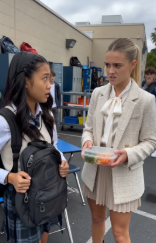
Blair Whitmore stood in front of me, still holding the empty tray.
She looked perfect.
Of course she did.
Cream tweed blazer. White silk blouse. Pleated skirt. New leather boots that had no business being anywhere near a car wash fundraiser. Her hair was smooth, her lip gloss untouched, her expression balanced between outrage and innocence like she had practiced both in a mirror.
“You should have stopped talking,” she said.
My face burned. My eyes stung. I could smell artificial cheese, soap, wet pavement, and the sharp chemical sweetness of car wax.
I wanted to disappear.
For one second, I almost apologized.
That was the worst part.
Not the sauce on my face. Not the phones. Not even the laughter that started small at the edge of the crowd before dying when a teacher finally turned around.
It was the tiny, traitorous part of me that thought: Just say sorry. Make them stop looking.
But then I saw Blair’s eyes.
They were not on me.
They were on the records table.
And that was when I remembered why I had not backed down.
My name was Kira Sato. I was seventeen, Japanese American, and I had never been the loudest person in any room. I was not rich. I did not have a family name painted on donor walls. I did not arrive at school in a car people recognized from dealership ads. I was the student who made spreadsheets for club fundraisers, refilled tape dispensers, counted cash twice, and noticed when one number tried to hide inside another.
Blair Whitmore was different.
Her father, Everett Whitmore, ran the school donor fund. That meant his name appeared everywhere adults wanted money to keep appearing. On event banners. On booster emails. On plaques near the theater. On polite invitations to “community leadership breakfasts” that somehow always turned into people praising the Whitmore family for generosity.
Blair did not have to raise her voice often.
Her last name did it for her.
That morning, the rumor reached me before Blair did.
Someone had stolen cash from the tip bucket.
The tip bucket had been found beside Maya Chen’s backpack.
Maya was a sophomore, quiet and anxious, there on a need-based scholarship, working the towel station because she needed volunteer hours and because she had asked me three times whether she was doing it correctly. She was the kind of student who apologized when someone else bumped into her.
By ten-thirty, people were already saying she took the money.
By ten-forty, someone said they saw me “defending her suspiciously hard.”
By ten-fifty, the rumor had twisted again: maybe I had moved the bucket to protect her.
That was how fast a lie could grow when the right people watered it.
I found Maya behind the storage shed, crying into her wrist.
“I didn’t touch it,” she said before I even asked.
“I know.”
“You don’t know.”
“I know you weren’t near the bucket after nine forty-five,” I said. “You were at the towel station with me.”
She stared at me, breathing hard.
“How do you remember that?”
“Because I logged the shift change.”
That was what nobody understood about records. They were not cold to me. They were not boring. Records were memory with a backbone. They were what you used when people with louder voices tried to rewrite what happened.
The car wash fundraiser was supposed to raise money for the senior service trip and the student emergency fund. Parents had donated snacks, local businesses had sponsored wash lanes, and the back lot had been transformed into organized chaos: hoses looping across asphalt, buckets of foam, hand-painted signs, folding tables, coolers, towels, and a bright yellow tip bucket near the check-in station.
I had been assigned to the records table.
Every car got logged. Every donation envelope got initialed. Every cash drop from the tip bucket was supposed to be counted by two students and one adult before being sealed in a blue deposit pouch.
At 9:30 a.m., the log showed $312 in tips.
At 10:15 a.m., the bucket was “missing.”
At 10:20 a.m., it was “found” beside Maya’s backpack near the supply tent.
At 10:23 a.m., Blair announced loudly that Maya had been acting nervous.
At 10:26 a.m., Maya was crying.
And at 10:31 a.m., I noticed the first real problem.
The source record had been edited.
Not the paper sign-in sheet. Not the public tally board. The digital source record on the fundraiser laptop.
The entry that had originally said “Tip bucket moved to locked table by K.S. and Mr. Dunn for count” had been changed to “Tip bucket located beside M.C. backpack after cash discrepancy.”
Whoever changed it had not just recorded a discovery.
They had rewritten the event so Maya looked guilty.
I checked the edit history.
One account.
B. Whitmore.
Blair.
My stomach went cold.
I printed the change log, because paper could not be deleted by someone leaning over a keyboard with a perfect manicure.
Then I walked to the records table to find Mr. Dunn.
Blair got there first.
She swept in with her little circle behind her: two girls from student council, one football player carrying towels he had not used all morning, and Madison Vale, Blair’s closest friend, already filming without looking like she was filming.
“Kira,” Blair said, her voice bright and dangerous, “why are you digging through private fundraiser files?”
“They’re not private. I’m assigned to records.”
“You’re assigned to help, not accuse people.”
“I’m not accusing. I’m checking the edit history.”
Her smile tightened.
That was when I knew she had not expected me to know how.
“You’re embarrassing the group,” she said.
“No. Someone changed the source record after the tip bucket was moved.”
The crowd around us thickened.
That was the thing about a fundraiser: people could pretend they were still working while drifting close enough to watch. Students wiped the same windshield for two minutes. Someone rinsed an already clean tire. A group near the snack table stopped pretending entirely.
Blair’s eyes jumped toward the laptop.
“Careful,” she said softly.
“Why?” I asked.
Her friends heard that. So did a few people behind me.
Blair’s cheeks flushed.
“You don’t get to act superior because you know how to click a spreadsheet.”
“I’m not acting superior. I’m saying the record was changed.”
“By who?”
I looked at her.
She already knew the answer.
So I said it anyway.
“Your account.”
For half a second, Blair’s face emptied.
Then she reached for the tray of mac and cheese from the snack table.
And dumped it over my face.
Now I stood there dripping in front of everyone while Blair tried to turn humiliation into proof that I had deserved it.
“She has been trying to blame me all morning,” Blair said, voice trembling for the audience. “She’s obsessed with making this about my family.”
Mr. Dunn finally pushed through the crowd.
He was the finance teacher, tall and usually cheerful, but his face changed when he saw me.
“What happened?”
Blair spoke first. Of course.
“Kira accused me of changing records. She was harassing everyone, and she wouldn’t stop.”
“She dumped food on me,” I said.
My voice sounded flat.
Maybe that was why people listened.
I wiped cheese from my cheek with the back of my hand and pointed to the laptop.
“The source record was changed after the bucket moved. The edit history shows Blair’s account.”
Blair laughed.
“That proves nothing. People use that laptop all day.”
Mr. Dunn’s eyes moved to the records table.
He stepped around me, opened the edit history, and clicked.
The crowd became so quiet I could hear water dripping from a sponge into a bucket.
One account.
B. Whitmore.
Timestamp: 10:18 a.m.
Mr. Dunn’s expression hardened.
“Blair,” he said, “why is your login on the cash source record?”
Blair’s father’s name could buy new scoreboards.
It could not answer that question for her.
“I don’t know,” she said.
But her eyes betrayed her again.
They flicked past Mr. Dunn, past the laptop, toward the row of cars parked along the fence.
Toward Whitmore Auto Group’s display tent.
Toward the security camera mounted above the neighboring coffee shop.
I followed her gaze.
And suddenly, I understood why she had panicked.
The school record was bad.
But footage would be worse.
Mr. Dunn closed the laptop halfway. “Everyone stop recording. Give Kira space. Ms. Alvarez, please take her inside.”
Ms. Alvarez, the counselor, appeared beside me with a stack of napkins and a look of controlled anger.
Before I let her guide me away, I said, “The coffee shop camera faces the back lot.”
Blair’s head snapped toward me.
Mr. Dunn looked at the camera.
Then at Blair.
Then back at the laptop.
“Office,” he said. “Now.”
The next hour moved like a storm through glass.
I sat in the nurse’s office while Ms. Alvarez helped me clean up. The sauce had gotten into my collar, under my hairline, onto my volunteer badge. My cheek was not bruised, but my pride felt like it had been scraped raw.
My mother arrived from work still wearing her pharmacy name tag.
She stopped in the doorway when she saw my shirt.
For one second, all the anger left her face and something softer, worse, appeared.
“Oh, Kira.”
“I’m okay,” I said quickly.
“No,” she said. “You are standing. That is not the same thing.”
That almost made me cry.
My mother was born in California, but my grandparents had come from Japan with two suitcases and an old family recipe book. My mother had grown up hearing that you survived by being composed, by never giving people the satisfaction of seeing you break. She had passed some of that to me. Stand straight. Speak clearly. Keep records.
But now she took my sticky hands in hers and said, “You do not have to be composed for people who humiliated you.”
So I cried.
Not loudly.
Just enough that the part of me trying to be stone finally cracked.
When we were called into the office conference room, Blair was already there with her father.
Everett Whitmore wore a pale blue button-down and the expression of a man accustomed to meetings ending in his favor. He sat beside Blair like she was the injured party. His phone lay face down on the table, but he kept touching it with two fingers.
Principal Rhodes sat at the head of the table. Mr. Dunn sat with the printed edit history. Ms. Alvarez sat beside me and my mother. A district finance coordinator had joined by video because fundraiser money was involved.
Everett Whitmore smiled at my mother.
“I’m sure emotions got out of hand,” he said. “These events are stressful for students.”
My mother did not smile back.
“My daughter was covered in food because she found a changed record.”
Blair’s mouth tightened.
Everett sighed gently. “Allegedly changed. We should be precise.”
Mr. Dunn slid the printed log across the table.
“It was changed from Blair’s account.”
Everett did not look at the paper.
“Student logins are not secure. That’s a school issue.”
I looked at Blair.
She stared at the table.
Principal Rhodes cleared his throat. “We have also contacted the coffee shop next door. Their exterior camera does face the back lot.”
Blair’s fingers curled around the edge of her skirt.
Everett’s smile faded.
“Without a formal request, I doubt they’ll release footage involving minors.”
“They already allowed me to review it on site,” Mr. Dunn said.
The room stopped.
Everett looked at him.
Mr. Dunn’s voice was calm now, but underneath it, I could hear anger.
“The footage shows Blair moving the yellow tip bucket from the records table area to behind a gray SUV at 10:12 a.m. At 10:17, Madison Vale carries it from behind the SUV to the supply tent and places it beside Maya Chen’s backpack. At 10:18, the source record is edited from Blair’s account.”
Blair whispered, “Madison said it would be fine.”
Her father turned slowly.
“Blair.”
One word.
It was not concern.
It was warning.
Blair closed her mouth immediately.
That was when I saw something I had missed before.
Blair was not only spoiled.
She was scared.
Not of the school.
Of him.
Principal Rhodes leaned forward. “Blair, are you saying Madison Vale was involved?”
Everett answered before she could.
“My daughter is saying she was pressured by peers and that the situation is more complex than a single screenshot.”
“No,” Blair said suddenly.
Everyone looked at her.
Her eyes were glossy, but her voice came out stronger than I expected.
“No. That’s not what I’m saying.”
Everett’s jaw tightened.
Blair swallowed hard.
“Madison helped move the bucket. But I changed the record.”
The silence felt heavy.
“Why?” Mr. Dunn asked.
Blair’s eyes filled with tears.
“Because the cash was already short.”
The district coordinator sat up straighter on the laptop screen.
“What do you mean already short?”
Blair looked at her father.
Everett’s face had gone pale.
And there it was.
The first crack in the bigger story.
Blair took a shaky breath.
“At the first count, there was supposed to be more than three hundred dollars. But Dad had already taken one of the blue pouches.”
My mother went still beside me.
Mr. Dunn stared at Everett.
Principal Rhodes said carefully, “Blair, are you saying your father removed fundraiser money?”
Everett stood so fast his chair scraped backward.
“This meeting is over.”
“No,” my mother said.
Her voice was quiet.
But nobody moved.
“You do not get to humiliate my child, blame another child, and then leave when the truth reaches your chair.”
Everett looked at her like he was not used to being spoken to by someone he could not sponsor or dismiss.
“My attorneys will respond to any further accusations.”
Then the district coordinator spoke from the laptop.
“Mr. Whitmore, please remain available. This is now a district financial investigation.”
Blair began crying silently.
For a moment, I almost felt sorry for her.
Then I remembered cheese sauce dripping from my face while she told everyone I was the problem.
Both things could be true.
She could be afraid.
And she could have hurt me.
The investigation expanded by the end of the day.
Maya Chen was cleared first. The school sent her family an apology, but apologies were small things after rumors had already run through hallways with muddy shoes.
Madison Vale was called in. She denied everything until the coffee shop footage was described. Then she cried and said Blair told her to move the bucket “as a joke” to make Maya look suspicious because Maya had supposedly “been weird around the cash.”
But when administrators checked Madison’s messages, they found something worse.
Blair had not invented the missing money panic on her own.
Her father had texted her at 9:58 a.m.
Need pouch gap covered until donor fund transfer clears. Move attention away from records. Temporary.
Temporary.
That word made me cold.
Like stealing from students was just a scheduling problem.
The blue pouch Everett had taken contained fundraiser cash intended for the student emergency fund. Later, adults would use careful phrases like “improper handling,” “misallocation,” and “pending reconciliation.” But I knew what it meant.
Money raised by students washing cars in the Texas heat had been used to plug a hole in the donor fund.
And Maya had nearly been sacrificed to cover it.
The next week was brutal.
Videos of Blair dumping mac and cheese on me spread first. Then the rumor mutated after people learned there was footage. Some called me brave. Some called me dramatic. Some said Blair deserved worse. Some said I should have stayed out of rich people’s business.
Maya stopped coming to lunch for three days.
On the fourth day, I found her in the library.
She was sitting behind a shelf of SAT books, twisting a bracelet around her wrist.
“I’m sorry,” she said.
I sat across from her. “For what?”
“You got humiliated because of me.”
“No,” I said. “I got humiliated because Blair chose to humiliate me.”
Maya’s eyes filled.
“Everyone thought I stole.”
“Not everyone.”
“Enough.”
I could not argue with that.
So I reached into my backpack and pulled out a printed copy of the corrected record.
Her name was cleared in black ink.
“I know it doesn’t erase what happened,” I said. “But I wanted you to have the truth in writing.”
She took it like it was fragile.
“Records matter to you, huh?”
I smiled a little.
“More than they probably should.”
“No,” Maya said, looking down at the paper. “Exactly as much as they should.”
That sentence stayed with me.
A formal school board meeting was scheduled two weeks later. By then, the story had become bigger than Westbridge Prep. Local news had picked it up because Everett Whitmore was not just any donor. He chaired multiple school fundraising committees across Fort Worth. His family name sat on scholarships, sports banquets, and “equity access” campaigns.
The irony made me want to scream.
The man whose fund claimed to support students in need had allowed a scholarship student to be framed for missing cash.
But the biggest twist had not come out yet.
It arrived the morning of the board meeting in a sealed envelope left in my locker.
No return name.
Inside was a copy of an old school record.
Three years earlier, before I attended Westbridge, another fundraiser had reported a cash discrepancy. A student volunteer had been removed from the scholarship leadership program afterward for “mishandling donation materials.”
The student’s name was Ren Ishikawa.
Japanese American.
Quiet.
Scholarship student.
My cousin.
I stared at the paper so long the hallway seemed to bend.
Ren was older than me, already in college now. He never talked much about Westbridge. My family always said he transferred senior year because the pressure got too intense. He had once told me, very softly, “Don’t trust nice plaques.”
I had thought he meant rich people were fake.
Now I understood.
I called him from the bathroom.
He answered on the third ring.
“Kira?”
“Did Everett Whitmore frame you?”
Silence.
Then he exhaled.
“Who told you?”
My knees weakened.
“Ren.”
“I couldn’t prove it,” he said. “The record changed. The pouch was found near my bag. People believed what they wanted. My parents didn’t want to fight because Whitmore offered to let me transfer quietly without losing scholarship credits.”
My hand tightened around the paper.
“Why didn’t you tell us?”
“You were fourteen. I didn’t want Westbridge to become a place you feared before you even got there.”
I laughed once, but it hurt.
“It became that anyway.”
“I know,” he whispered. “I’m sorry.”
“Can you come tonight?”
There was a pause.
Then Ren said, “I’ll be there.”
The board meeting filled the auditorium.
Parents lined the walls. Students packed the back rows. Reporters waited near the exits. Everett Whitmore arrived in a dark suit with two attorneys. Blair came with her mother, not her father, and sat near the side with her hands folded tightly in her lap.
She looked smaller than before.
Not innocent.
But smaller.
Maya sat beside her parents. Madison Vale sat across the aisle, crying before the meeting even started. My mother sat on my left. Ren sat on my right.
When the board chair opened public comments, Mr. Dunn presented the timeline: the original cash count, the blue pouch removal, the altered source record, the coffee shop footage, the student account logs, the messages from Everett to Blair, and the attempt to blame Maya.
Then the finance coordinator revealed the donor fund audit.
The missing fundraiser pouch was not the only irregularity.
There had been temporary “borrowings” from student activity accounts for years. Small amounts. Replaced later when donations cleared. Hidden through adjusted records. Always explained internally as timing issues.
But at least twice, when gaps were noticed too early, a student volunteer had been blamed.
Ren stood.
My cousin had always been calm in a way that made him seem distant. That night, under the auditorium lights, I saw it differently. His calm was armor.
“My name is Ren Ishikawa,” he said into the microphone. “Three years ago, I was accused of mishandling fundraiser cash at this school.”
A murmur moved through the room.
Everett’s attorney leaned toward him.
Ren continued.
“I did not steal. I did not move a pouch. I did not alter a record. But the record was changed, and I did not have proof. I transferred because staying here meant walking through hallways where people looked at me like I was guilty.”
My throat tightened.
Ren looked at me.
“My cousin Kira found what I couldn’t. Not because she wanted attention. Because she knew a wrong record could destroy the wrong student.”
My mother wiped her eyes.
Then Maya stood.
Her voice shook, but she spoke.
“I almost believed I had done something wrong just because everyone looked at me like I had. That scares me more than the accusation.”
The auditorium was silent.
Then Blair stood.
Her mother grabbed her wrist, but Blair pulled free.
Everett turned in his seat.
Blair walked to the microphone with tears already on her face.
“My name is Blair Whitmore,” she said. “I changed the record.”
A ripple went through the room.
“I moved the blame toward Maya because my father told me there was a gap that needed to be covered. Madison helped move the bucket, but I let it happen. Then I dumped food on Kira because she had proof and I was scared.”
She looked directly at me.
“I humiliated her because I thought if everyone laughed at her, they would stop listening to her.”
My chest ached.
Blair turned toward the board.
“My father taught me that image mattered more than truth. But I chose to believe him. I chose to hurt people. I’m sorry. And I’ll cooperate with the audit.”
Everett stood. “Blair, sit down.”
For the first time, she did not obey.
“No.”
That single word changed the room.
Not because it fixed anything.
Because it told the truth about where the fear had been coming from.
By the end of the night, Everett Whitmore was removed from all donor fund authority. The district referred the audit to law enforcement. Westbridge froze every account connected to the Whitmore fund. The school announced a new rule: no donor family member could access or influence student activity records, and every fundraiser source record would require adult dual approval and automatic edit history review.
Maya’s name was cleared publicly.
Ren’s record was corrected.
Mine was never stained.
And Blair received a suspension, community accountability requirements, and removal from all student leadership positions for the rest of the year.
Some students said she deserved worse.
Maybe she did.
But when I saw her leaving the auditorium without her father beside her, crying into her sleeve while her mother held her shoulder, I did not feel victory.
I felt the strange heaviness of a truth that had cost everyone something.
The happy ending came slower.
It came in small repairs.
Maya returned to the fundraiser committee, not because anyone pressured her, but because she said she wanted to stand where they had tried to shame her and not feel afraid.
Ren came back to Westbridge for the first time in three years to help design the new student record transparency system. He joked that he was charging the school emotionally, not financially.
Mr. Dunn apologized to him in person.
My mother made too much curry the night after the board meeting and sent containers home with Ren, Maya, and somehow even Mr. Dunn, who cried when she told him teachers needed feeding too.
Blair wrote me a letter.
I did not read it for two days.
When I finally opened it, it was not full of excuses. That surprised me. She wrote about the tray, about my face, about the way I had stood there and still told the truth. She wrote that she understood if I never forgave her. She wrote that she had started telling investigators about older fundraisers because she wanted Ren’s record corrected too.
At the end, she wrote:
I used to think power meant never being embarrassed. Now I think it means being able to tell the truth even when embarrassment is exactly what you deserve.
I folded the letter and put it in my desk drawer.
Not forgiven.
Not forgotten.
But recorded.
A month later, Westbridge held a replacement fundraiser for the student emergency fund.
No Whitmore banners.
No donor speeches.
No private cash pouches.
Just students, parents, teachers, folding tables, locked boxes, two adult counters, and a public digital tally projected on the gym wall.
This time, I was not at the records table alone.
Maya sat on one side of me. Ren sat on the other, pretending not to enjoy color-coding the deposit categories. Naomi from yearbook took photos. Mr. Dunn hovered so much that Maya finally told him, “Sir, accountability does not mean breathing on the spreadsheet.”
Everyone laughed.
Even me.
Near the end of the day, Blair appeared near the gym doors.
The laughter faded a little.
She was wearing jeans and a plain school hoodie. No tweed. No silk. No boots that announced money before she spoke. She held a sealed envelope in both hands.
She walked to Maya first.
“I’m sorry,” she said. “For trying to make you carry what my family did.”
Maya looked at her for a long moment.
Then she said, “I hope you understand I don’t have to make you feel better.”
Blair nodded. “I know.”
Then Blair came to me.
My body remembered the tray before my mind could stop it.
She noticed.
Her face crumpled slightly, but she did not ask me to comfort her.
“I brought something,” she said.
She handed me the envelope.
Inside was a printed photo from the coffee shop footage.
Blair moving the tip bucket behind the car.
I stared at it, confused.
“Why would you give me this?”
“Because it should never disappear,” she said. “Not this time.”
I looked at the photo.
Then at her.
“I don’t want to keep proof of the worst thing you did.”
Blair swallowed. “Then what do you want?”
I turned to the records table.
Maya’s cleared statement was there. Ren’s corrected record. The new fundraiser policy. The public tally.
I picked up a fresh sheet of paper and wrote one sentence at the top.
A record should protect the truth, not the person with the most power.
Then I slid it toward Blair.
“Sign this instead.”
Her eyes filled.
She signed.
Maya signed next.
Ren signed.
Mr. Dunn signed.
By the end of the fundraiser, half the school had signed it. The sentence was later framed outside the student activities office, not with anyone’s family name underneath it, but with all our signatures crowded together in different inks.
That was the picture that mattered most.
Not me covered in mac and cheese.
Not Blair moving the bucket.
Not Everett Whitmore sitting under auditorium lights while his own daughter refused to lie for him.
The best photo came weeks later, when Maya dropped coins into the new clear tip box and laughed as Ren pretended to audit her in slow motion. I was in the background, head bent over the record sheet, smiling without realizing it.
Blair stood near the door, stacking clean towels.
No audience.
No performance.
Just work.
When the final count came in, the fundraiser had raised more than any car wash in school history.
Every dollar matched.
Every pouch was sealed.
Every record stayed unchanged.
And for once, no one had to be humiliated for the truth to be seen.
THE END
