The worst part was not the food hitting my face.
It was the laughter right before it happened.
The locker hallway at Westfield North High in Omaha, Nebraska was louder than usual that morning because it was yearbook photo day, which meant everyone was pretending to be casual while secretly checking their hair in dark classroom windows. Seniors drifted through the halls in borrowed graduation gowns, freshmen carried combs and lip gloss like emergency supplies, and the yearbook staff kept shouting names over the noise.
I should have blended into all of it.
That was what I usually did.
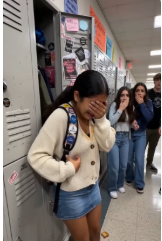
My name is Marisol Diaz. I was seventeen, Honduran American, and the kind of student teachers trusted because I never made them nervous. I wore a cream knit cardigan, a simple denim skirt, and sneakers that had survived two school years. My canvas backpack was covered with volunteer pins from food drives, library nights, peer tutoring, and community cleanups. I was not popular, but I was useful, and at school that often counted as long as you never asked who got thanked afterward.
That morning, I made the mistake of noticing the wrong detail.
A graduation gown had been shoved into the wrong locker.
At first, it looked like nothing. Just black fabric caught between a metal locker door and a stack of yearbook props. But I recognized the tag pinned inside the collar because I had checked out the borrowed gowns for the senior photo schedule.
The tag read: C. HARRINGTON.
Celeste Harrington.
Everyone knew Celeste.
She was eighteen, polished, confident, and connected in the way certain students did not even need to announce. Her mother chaired the booster committee. Her father donated to the performing arts wing. Her older brother had been class president before her, and teachers still mentioned him like he had personally invented school spirit.
Celeste walked through Westfield North like the hallways had been built for her entrance.
And her borrowed graduation gown was not supposed to be in locker B-214.
It was supposed to be hanging in the temporary photo-room rack, where Celeste herself had signed it in earlier that morning.
I knew that because I had been the one holding the clipboard.
I stared at the gown for three seconds too long.
That was all it took.
“Marisol?”
I turned.
Celeste stood behind me with two of her friends, Brianna Voss and Paige Calloway. Celeste’s hair was styled in loose waves, her makeup perfect for photos, her outfit expensive enough to look effortless. She held a plastic lunch tray from the cafeteria even though it was barely midmorning, some kind of yearbook committee breakfast plate with fruit, whipped topping, and syrupy pastry pieces.
Her eyes were not on me.
They were on the locker.
Then they moved to my clipboard.
Then back to my face.
“What are you doing?” she asked.
I should have lied.
I should have said nothing.
But I thought telling the truth quickly would keep it small.
“Your gown is in the wrong locker,” I said. “It was signed into the photo-room rack earlier. If it’s missing from there, someone might get blamed.”
The hallway noise thinned around us.
Celeste smiled, but the smile did not reach her eyes.
“Why are you touching my things?”
“I didn’t touch it.”
“You were standing over it.”
“I saw the tag.”
Brianna folded her arms. “That’s weird.”
I looked from her to Celeste. “It’s not weird. It’s a record issue.”
Celeste took one step closer.
“Everything with you is a record issue.”
I did not know what she meant by that then.
Later, I would.
“I’m just saying we should tell Ms. Ritter before the gown gets marked missing,” I said. “The locker camera can show when it was moved.”
The moment I said camera, Celeste’s face changed.
Only for half a second.
But I saw it.
Her jaw tightened. Her hand gripped the lunch tray. Her friends went quiet in a way that told me they had been waiting for a line not to be crossed.
Then Celeste lifted her arm and dumped the entire plate onto my face.
Cold fruit, sticky syrup, whipped topping, and crumbs slid down my cheek, into my cardigan, onto my backpack pins. The tray clattered to the floor with a sound so sharp the hallway stopped.
For one frozen second, no one spoke.
Then someone whispered, “Oh my God.”
I could feel syrup near my eye. My skin burned with humiliation. My throat tightened so badly I could barely breathe.
Celeste pointed at me.
“She was trying to set me up,” she said, voice shaking just enough to sound wounded. “She had my gown in her hands. I caught her.”
That was when the laughter died completely.
Because accusation had entered the hallway, and accusation was heavier than humiliation.
Students looked from me to the locker, from the food on my face to Celeste’s trembling finger. Phones came up. Teachers began pushing through the crowd. Somewhere, a yearbook camera flashed by accident, turning the whole scene white for an instant.
I wanted to disappear.
Instead, I heard myself say, “Check the camera.”
Celeste’s eyes flashed.
“Stop lying.”
“Check the camera,” I repeated.
Ms. Ritter, the yearbook adviser, arrived breathless with a lanyard swinging around her neck.
“What happened?”
Celeste answered before I could.
“She was messing with my graduation gown. I confronted her, and she started making up some story about records.”
“I did not touch the gown,” I said.
My voice sounded too calm, even to me. That was how I knew I was close to crying.
Ms. Ritter looked at the locker, then at my face. Her expression flickered with something like pity, but pity was not protection.
“Everyone back to class,” she ordered.
Nobody moved fast.
Celeste’s friend Paige muttered, “Some people can’t stand seeing seniors have one nice thing.”
I looked directly at Ms. Ritter.
“The gown was moved after Celeste signed it into the rack. The locker camera will show that.”
Celeste laughed once.
It was not a real laugh.
It was a warning.
“You are obsessed.”
Ms. Ritter hesitated.
That hesitation nearly broke me.
Because I understood what was happening. Celeste had dumped food on me in public so the adults would handle my embarrassment first and the record second. She had turned a missing gown into a scene. She had made herself loud and me stained.
And stained girls are easy to doubt.
The assistant principal, Mr. Dwyer, arrived next. He was a square-shouldered man with a careful voice and a habit of blinking slowly before saying anything inconvenient.
“We’ll sort this out in the office,” he said.
“No,” I said.
His eyebrows rose.
The hallway quieted further.
I wiped whipped topping from my cheek with the sleeve of my cardigan.
“If I’m being accused publicly, the record needs to be checked before people decide I did it.”
Celeste stepped forward. “You don’t get to control the process.”
I looked at her.
“Neither do you.”
That was the first time her confidence cracked.
Only a little.
But enough.
In the office conference room, the air smelled like coffee, printer toner, and the faint lemon cleaner they used to pretend schools were calm places. I sat at one side of the table with paper towels pressed against my cardigan. Celeste sat across from me, now clean and composed, her friends outside the glass wall pretending not to stare.
Ms. Ritter sat near the door, pale and silent.
Mr. Dwyer opened a laptop.
“We’re going to review the hallway camera near B-wing,” he said. “This should clarify the situation.”
Celeste’s mouth tightened.
“I don’t consent to being recorded for some kind of student witch hunt.”
Mr. Dwyer looked at her over his glasses. “It’s school security footage.”
“My mother should be here.”
“I’ve called her.”
Of course he had.
No one had called my mom yet.
I raised my hand slightly.
“Did anyone call my mother?”
Mr. Dwyer paused.
“I was about to.”
I nodded once, because if I spoke, my voice would shake.
He called her then. I listened to his careful version: incident, disagreement, accusation, food thrown, reviewing footage. He did not say Celeste attacked me. He did not say I was covered in cafeteria syrup. He did not say I had asked for proof before anyone else thought proof mattered.
My mom arrived twenty-two minutes later in her work blouse and black flats, hair pulled back too tightly, eyes searching my face before she even entered the room.
When she saw my cardigan, her expression changed.
Not loud anger.
Worse.
Quiet fury.
“Who did this?” she asked.
No one answered.
Celeste looked away.
My mother sat beside me and took my sticky hand in hers.
“Show the video,” she said.
Mr. Dwyer cleared his throat and opened the security portal.
The footage appeared grainy but clear enough.
B-wing hallway. 8:41 a.m.
Celeste entered the frame carrying her graduation gown over one arm. She stopped near the photo-room door, laughed with Brianna and Paige, then walked inside.
8:46 a.m.
Celeste came out without the gown.
Ms. Ritter pointed at the screen. “That matches sign-in. She hung it correctly.”
Celeste crossed her arms.
Mr. Dwyer fast-forwarded.
Students passed. Lockers opened and closed. A freshman dropped a folder. Two boys argued over a comb.
Then at 9:07 a.m., someone entered the hallway wearing a yearbook staff badge and a black hoodie pulled low.
The person walked directly to the photo room, came out with Celeste’s gown, and shoved it into locker B-214.
The room went silent.
Mr. Dwyer paused the footage.
“That’s not Marisol,” my mom said.
“No,” Ms. Ritter whispered.
The figure was taller than me. Different shoes. Different backpack. Different walk.
Celeste’s face had gone still.
Mr. Dwyer resumed the footage.
At 9:13 a.m., I entered the hallway with my clipboard. I noticed the locker. I leaned close enough to read the tag but did not touch the gown.
At 9:15 a.m., Celeste entered with her friends.
At 9:16 a.m., she dumped food on my face.
My mother inhaled sharply.
Mr. Dwyer stopped the video.
No one spoke.
The proof had done what I could not do in that moment.
It spoke clearly.
Celeste had hung the gown correctly.
Someone else had moved it.
I had not touched it.
The accusation against me fell apart in less than five minutes.
But Celeste did not look defeated.
She looked afraid of what came next.
That was when Ms. Ritter said, “There’s another file.”
Celeste’s head snapped toward her.
“What?”
Ms. Ritter swallowed.
“The yearbook team uploads photo-room check-in pictures to the shared archive. Automatically. Every time a badge scans in.”
Mr. Dwyer frowned. “I didn’t know that.”
“It’s new,” Ms. Ritter said. “For tracking props and borrowed items.”
Celeste stood.
“I want my mother here before you open anything else.”
My mom’s hand tightened around mine.
Mr. Dwyer looked at Celeste, then at me, then back at the laptop.
“Sit down.”
She did not.
He clicked the archive folder.
The second file opened.
And Celeste Harrington’s lie became much larger than a gown in the wrong locker.
The file was a sequence of still photos from the photo-room badge scanner. Each time a yearbook staff badge opened the prop storage door, the system captured a frame.
At 9:06 a.m., the black-hooded person had entered using badge number YB-14.
Ms. Ritter checked her list.
“YB-14 belongs to Paige Calloway,” she said.
Paige, Celeste’s friend.
Celeste whispered, “That doesn’t mean—”
But Mr. Dwyer clicked the frame.
The hoodie hid most of the face, but not the wrist.
A silver bracelet with a tiny blue enamel star.
Paige wore that bracelet every day.
Ms. Ritter covered her mouth.
But the file did not stop there.
At 8:02 a.m., before the gown was moved, before I found it, before Celeste dumped food on me, another archive image showed Celeste standing inside the photo room with Paige and Brianna.
They were not hanging gowns.
They were photographing a printed yearbook layout board.
Mr. Dwyer zoomed in.
My name was circled in red.
So was another name.
Leah Morrison.
A sophomore photography student from the special education peer-support club. Quiet, talented, and almost never credited properly unless someone forced the issue.
Under our names, in Celeste’s handwriting, were the words:
REMOVE FROM FINAL CREDIT SPREAD.
My stomach turned.
Ms. Ritter whispered, “Oh, Celeste.”
The room changed.
Until that second, the story had been about me being accused of touching a gown.
Now it became something uglier.
The yearbook photo spread for graduation day was supposed to include volunteer credits for students who had managed gowns, props, locker assignments, and accessibility support. Leah had designed the inclusive seating layout so students using mobility aids could be photographed comfortably. I had organized the borrowed gown system.
Celeste’s group had planned to remove both our names before the final submission.
Then, if anyone noticed, they would make the records look messy enough to blame us.
The wrong locker was not an accident.
It was bait.
And I had walked straight toward it because I believed the truth should be corrected quickly.
Celeste stared at the screen like she hated it for existing.
My mother spoke first.
“Why was my daughter’s name circled?”
Celeste said nothing.
Mr. Dwyer turned to her. “Answer.”
She swallowed.
“I didn’t want them in the senior spread.”
Ms. Ritter looked devastated. “They did the work.”
Celeste’s eyes shone with tears, but her voice sharpened.
“They were everywhere. Every time something needed fixing, Marisol was there with her clipboard. Leah’s seating layout got more praise than the whole photo concept. This was supposed to be our senior feature.”
“Our?” I said.
Celeste looked at me then, and the truth spilled out, ugly and small.
“You’re not even a senior.”
“No,” I said. “I’m the person who made sure your senior gown didn’t get lost.”
Her face twisted.
Before she could answer, the office door opened.
Mrs. Harrington arrived like a storm in a beige blazer.
She did not look at me.
She looked at Celeste.
Then at the laptop.
Then at Mr. Dwyer.
“I hope you have a very good reason for interrogating my daughter without me present.”
My mother stood.
“And I hope your daughter has a very good reason for dumping food on mine.”
Mrs. Harrington’s eyes flicked over my stained cardigan.
For one second, something like embarrassment crossed her face.
Then it vanished.
“I’m sure emotions ran high.”
My mom’s voice stayed calm.
“Do not make assault sound like weather.”
The room went silent again.
Mrs. Harrington looked at Mr. Dwyer. “What exactly are you accusing Celeste of?”
He turned the laptop toward her.
The footage played.
Celeste’s correct gown sign-in.
Paige moving the gown.
Me finding it without touching it.
Celeste attacking me.
Then the second file.
The circled names.
The instruction to remove us from the credit spread.
Mrs. Harrington’s face hardened with every second, not in shock, but in calculation.
When the video ended, she said, “This is a misunderstanding between students.”
“No,” Ms. Ritter said quietly.
Everyone looked at her.
She looked terrified, but she kept going.
“This is not the first time credit lines have changed around Celeste’s group.”
Celeste whispered, “Ms. Ritter.”
The yearbook adviser’s hands trembled.
“I told myself it was normal senior leadership. I told myself strong personalities take over. But last semester, Leah’s captions disappeared from the winter accessibility feature. Marisol’s volunteer system was submitted under the senior committee. Two art club students were left off the homecoming mural page.”
Mrs. Harrington snapped, “You are making serious claims.”
Ms. Ritter nodded.
“I know.”
Then she opened a drawer in the conference room cabinet and removed a folder.
“I printed the drafts,” she said. “Because something felt wrong.”
Celeste sat down slowly.
That was when I understood the second file had only opened the door.
Ms. Ritter had been standing behind it, holding months of proof.
The folder spread across the table like a quiet avalanche.
Draft one: student names accurate.
Draft two: names replaced.
Draft three: Celeste’s group moved to the top.
Comment notes: “Make senior leadership more visible.”
File edits: C. Harrington.
Photo credits reassigned.
Volunteer captions shortened.
Leah’s accessibility layout credited as “committee design.”
My borrowed gown system listed under “senior organizational team.”
The pattern was so obvious it became embarrassing.
Not for me.
For every adult who had missed it because Celeste smiled nicely.
My mom looked at me.
Her eyes were wet, but her voice was strong.
“Did you know?”
I shook my head.
“I thought they just forgot.”
She closed her eyes like those words hurt more than the stain on my cardigan.
Mrs. Harrington stood very straight.
“My daughter made poor editing choices,” she said. “That does not justify turning this into a disciplinary spectacle.”
Mr. Dwyer leaned back.
“She physically attacked another student and falsely accused her.”
Mrs. Harrington’s mouth tightened.
“I would like to speak to the principal.”
“You will,” he said.
Within an hour, the principal, the district communications officer, Leah Morrison, Leah’s parents, Paige, Brianna, and two school resource staff had all been pulled into the widening circle of truth.
Paige cried first.
Then Brianna.
Neither out of guilt at first. Mostly fear.
But fear has a way of loosening stories.
Paige admitted Celeste told her to move the gown and make sure I was the one who found it.
Brianna admitted they had planned to say I had been “obsessively hovering around senior materials” for weeks.
Celeste had wanted me discredited before final yearbook review because I was the only junior with access to the volunteer records.
Then Leah arrived.
She walked in wearing a yellow sweater and noise-canceling headphones around her neck, her father beside her and her mother holding a folder twice as thick as Ms. Ritter’s.
Leah looked at the table full of records.
Then at me.
Then at Celeste.
“I knew,” Leah said softly.
My heart twisted.
“You knew?”
She nodded.
“I didn’t know about the gown. But I knew my name was disappearing. I kept screenshots.”
Her mother placed the folder on the table.
Inside were email chains. Shared document histories. Screenshot comparisons. Captions Leah had written that later appeared under Celeste’s name. Accessibility notes Leah had drafted after interviewing students, later rewritten as if the senior committee had invented them.
Leah had not been silent because she had no proof.
She had been silent because no one had believed her the first time.
“I reported it in November,” Leah said.
Principal Warren, who had just entered, went pale.
“To who?” Mr. Dwyer asked.
Leah looked at the principal.
“To your office.”
The room became so quiet the vending machine humming outside sounded loud.
Principal Warren slowly removed his glasses.
“I never saw a report.”
Leah’s mother opened the folder to the final page.
“We emailed it. Twice.”
She slid the paper forward.
There it was.
Subject: Concern About Yearbook Credit Removal.
Sent to Principal Warren’s office account.
Forwarded internally to: CHarrington@westfieldnorth.edu.
Celeste’s student leadership email.
The principal stared at it.
Mrs. Harrington stopped breathing.
Celeste looked at her mother.
And that was the real twist.
Because the report Leah sent about Celeste had been quietly forwarded to Celeste before any adult investigated it.
Not by Principal Warren.
By his assistant.
Mrs. Harrington.
Celeste’s mother worked part-time as an administrative liaison for the booster and principal’s office.
She had seen Leah’s complaint.
She had warned Celeste.
Celeste had then spent months making sure anyone who could confirm the pattern looked unreliable.
Leah was “too sensitive.”
I was “obsessive.”
Other students were “confused.”
And on yearbook photo day, when the final credit spread was at risk of being checked, Celeste staged the gown incident to destroy my credibility before I could defend the records.
My mother looked at Mrs. Harrington with a kind of calm I had never seen before.
“You helped her.”
Mrs. Harrington’s face had gone ashen.
“I protected my daughter from a malicious accusation.”
Leah’s father stood.
“You protected her from accountability.”
Celeste turned on her mother suddenly.
“You said it would go away.”
Mrs. Harrington whispered, “Celeste.”
“You said nobody would check because Marisol always looks guilty when she’s nervous.”
The words hit me so personally that for a moment I forgot to breathe.
My mom moved closer to me.
Celeste kept going, crying now, angry and terrified and finally too cornered to perform.
“You told me Leah’s family would back down if it became complicated. You told me everyone already thinks Marisol over-documents because she wants attention.”
Mrs. Harrington gripped the edge of the table.
“Stop talking.”
But Celeste did not stop.
Maybe she could not.
“I didn’t want to dump the food. I just wanted her to leave it alone. But Paige moved the gown wrong and Marisol saw too much, and Mom said if I looked like the victim first, adults would hesitate.”
The room absorbed the confession slowly.
No one looked at me like I was the scandal anymore.
They looked at me like I had been standing in front of one for months without knowing its full shape.
The school suspended Celeste before the final bell.
Paige and Brianna were removed from yearbook leadership pending review. Mrs. Harrington was barred from administrative access while the district investigated. Principal Warren issued a temporary hold on the senior yearbook spread and ordered a full audit of student credit records from the past two years.
That sounded clean.
It did not feel clean.
After the meeting, I sat in the bathroom with my mom while she helped me rinse syrup from my hair in the sink. I had a spare T-shirt from the volunteer closet, but my cardigan was ruined. My backpack pins were sticky. A dried crumb clung stubbornly to the edge of my community garden pin.
My mom picked it off gently.
“When people try to shame you for noticing details,” she said, “it usually means the details are dangerous to them.”
I looked at her in the mirror.
“I was scared everyone believed her.”
My mom’s face softened.
“Some did.”
That honesty hurt, but I needed it.
“Will they apologize?” I asked.
“Some will.”
“And the others?”
She squeezed water from the end of my hair.
“They will pretend they knew better all along.”
Despite everything, I laughed.
It sounded small, but it was real.
The next week was strange.
Students who had filmed me now avoided my eyes. Some deleted their posts. Others posted dramatic stories about “truth coming out” as if they had not enjoyed the first version. Teachers suddenly thanked me for systems I had been running quietly for months. Ms. Ritter cried when she apologized to Leah, to me, and to the art club students whose names had been buried.
Leah and I became friends over spreadsheets.
That sounds boring until you understand that shared proof can feel like shared shelter.
We sat in the library after school comparing yearbook drafts, rebuilding credit lines, and laughing at how many times Celeste’s group had used the phrase “senior vision” to cover work they did not do.
“She really credited herself for my wheelchair spacing diagram,” Leah said one afternoon.
I stared at the file.
“She called it ‘flow aesthetic.’”
Leah snorted so hard the librarian shushed us.
The corrected yearbook spread became bigger than anyone expected.
Not because the school wanted drama, but because the district demanded transparency after the Harrington email scandal. The final spread included a full contributor list, process notes, and a new policy: every student project submitted for publication had to include edit history review before final approval.
Celeste did not return for three weeks.
When she did, she looked different.
No crowd around her. No perfect hallway performance. Her hair pulled back, her face bare, her eyes fixed mostly on the floor. I did not feel sorry for her exactly. But I did feel the uncomfortable truth that a person can be guilty and still look young.
She found me after school near the photo room.
For a second, the old fear moved through me.
Then she stopped several feet away.
“I’m not going to come closer,” she said quickly.
I nodded.
Her eyes were red.
“I’m sorry.”
The words sat between us.
I waited.
“I’m sorry I dumped food on you,” she continued. “I’m sorry I accused you. I’m sorry I helped erase Leah’s work. I’m sorry I let my mom convince me that protecting my reputation mattered more than telling the truth.”
It was a better apology than I expected.
Still not enough.
“Why did you do it?” I asked.
She looked down.
“Because I thought if I wasn’t seen as important, I’d disappear.”
I said nothing.
“My family is all Westfield,” she said. “My brother was class president. My mom runs half the school events. My dad still talks about his senior award. Everyone expected me to leave a legacy, and I didn’t know how to make one except by controlling what people saw.”
Her voice broke.
“That’s not an excuse.”
“No,” I said. “It isn’t.”
“I know.”
The hallway was quiet except for distant basketball sounds from the gym.
“I don’t forgive you,” I said.
She nodded, crying silently.
“But you should tell the board everything your mom did.”
“I already did.”
That surprised me.
Celeste wiped her face.
“I sent them the texts. The ones where she told me what to say about you and Leah.”
For the first time, I saw something other than shame in her expression.
Maybe fear.
Maybe relief.
Maybe the first painful inch of becoming someone else.
“My mom says I betrayed her,” she whispered.
I thought of Leah, of the erased names, of my ruined cardigan, of the way everyone had stared at me like humiliation was evidence.
“No,” I said. “You stopped helping her betray other people.”
Celeste cried harder at that.
The yearbook photo was retaken in April.
Not because the first one was unusable, but because Ms. Ritter insisted the corrected record deserved a corrected image.
This time, Leah stood in the center holding the accessibility layout board. I stood beside the gown rack with the volunteer clipboard. The senior committee stood too, smaller now, less polished, but real.
Celeste was not in the center.
She was at the side, where she had asked to stand.
When the photographer told us to smile, I did not think about the food on my face or the slap of the tray on the floor or the terrible silence after Celeste’s accusation.
I thought about the second file opening.
I thought about the way proof can sit quietly in a folder while people lie loudly around it.
I thought about Leah saying, “I kept screenshots.”
I thought about my mother telling me dangerous details make dishonest people nervous.
And I smiled.
At the end of the school year, the corrected yearbook arrived.
My hands shook when I opened to the senior photo day spread.
There it was.
A full page titled: THE PEOPLE WHO MADE THE DAY WORK.
Leah Morrison — Accessibility Layout Design.
Marisol Diaz — Borrowed Gown System and Volunteer Records.
Art Club Contributors.
Junior Volunteers.
Photo Assistants.
Prop Team.
Every name.
Every role.
No one hidden under “committee.”
No one erased into “senior vision.”
Folded inside my copy was a note from Leah.
You noticed the wrong locker and saved the right story.
I kept that note.
I still have it.
The final surprise came during the last assembly, when Principal Warren stepped up to the microphone looking like he had aged ten years in one semester.
He announced that the district investigation had finished. Mrs. Harrington had resigned from all school access roles. A new reporting system would prevent parent volunteers from intercepting student complaints. Yearbook archives would be audited annually.
Then he called Leah and me to the stage.
I wanted to vanish.
Leah grabbed my hand and dragged me up anyway.
The auditorium applauded.
Not perfectly. Not everyone. Some people clapped because clapping was easier than admitting they had been wrong.
But my mom stood in the front row, clapping like thunder.
Ms. Ritter cried openly.
Leah’s parents held each other.
And Celeste, sitting near the back without her old friend group, stood up.
Slowly, other students stood too.
The sound grew until it filled the room that had once swallowed Leah’s complaint and almost swallowed my name.
Principal Warren handed us each a certificate for student integrity.
It was nice.
But the real prize came afterward.
A younger student I barely knew approached me near the auditorium doors. She held a folder against her chest.
“Marisol?” she said. “Can I ask you something?”
“Sure.”
She glanced around, then lowered her voice.
“I think someone put their name on my science display. I have pictures, but I wasn’t sure if that mattered.”
I looked at the folder.
Then at Leah.
She smiled.
“It matters,” I said.
The girl exhaled like she had been holding that breath for days.
That was when I understood the happy ending was not Celeste getting punished.
It was not the corrected yearbook.
It was not even my name printed where it belonged.
The happy ending was that the next girl came with proof before shame convinced her to stay quiet.
The record had spoken for me once.
Now I knew how to speak with it.
And no one at Westfield North would ever again be able to say a missing name was just a mistake without wondering who was holding the file that proved otherwise.
THE END
