The slap made the thrift store go silent.
Not quiet.
Silent.
The kind of silence where even the old fluorescent lights seemed to stop buzzing, where the hangers on the metal racks stopped clicking, where every person in the room suddenly understood they had just watched something they could not unsee.
My cheek burned.
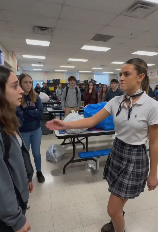
Ainsley Monroe stood in front of me with her hand still half-raised, her crisp white polo spotless, her plaid skirt perfectly pressed, her silk neck scarf tied like she had dressed for a private-school charity brochure instead of a community service project in Cleveland.
Around us, students froze between stacks of donated coats and plastic bins labeled WINTER DRIVE, FOOD PANTRY, FAMILY SHELTER, and SENIOR CENTER.
Someone gasped.
Someone whispered my name.
“Hannah…”
But nobody moved fast enough to help me.
My name is Hannah Cohen. I was seventeen, Jewish American, and used to being the girl people thanked when the work was finished but forgot to include when the photos were taken.
At school, I was the quiet helper.
The girl who stayed late after club meetings to stack chairs. The girl who remembered sign-up sheets, missing markers, allergy notes, permission forms, and who had rides home. The girl adults trusted because I rarely made trouble.
That day, trouble found me anyway.
Ainsley’s eyes shone with angry tears that looked rehearsed.
“You relabeled the donation bags,” she said loudly, turning so the students, teachers, and club advisers could hear every word. “You sent family shelter bags to the senior center pile and put food pantry supplies under the wrong recipient names. Do you have any idea what you almost ruined?”
My mouth opened, but air barely came out.
“I didn’t relabel anything.”
Ainsley laughed once, sharp and cold.
“Then why did we find your checklist beside the wrong bags?”
The crowd shifted.
That was all it took.
A checklist.
My handwriting.
A rich girl’s accusation.
Suddenly, every person in the thrift store looked at me like my silence had been suspicious all along.
I could still smell cafeteria food from the boxed lunches stacked near the register, mixed with floor cleaner, old clothes, cardboard, dust, and that strange metallic scent that comes when humiliation enters your bloodstream.
I touched my cheek.
Ainsley saw me do it and lifted her chin, as if my pain proved her point.
“You always act so helpful,” she said. “Maybe that’s how you get away with it.”
My eyes stung, but I refused to cry.
Not in front of her.
Not in front of the phones already rising behind the coat racks.
“Open the storage record,” I said.
Ainsley blinked.
“What?”
“The bags were sorted in the back room before lunch. There are storage camera timestamps. There are volunteer check-ins. There’s a digital log. Open the evidence.”
The smallest flicker crossed her face.
Fear.
Then it disappeared behind outrage.
“The more you ask for proof,” she snapped, “the guiltier you sound.”
That was the moment I understood.
She was not confused.
She was trying to win before the truth arrived.
Three hours earlier, the community service project had actually felt good.
Our school had partnered with a neighborhood thrift store on the east side of Cleveland to prepare winter donation bags for families, seniors, and local shelters. It was supposed to be simple: sort coats, scarves, canned goods, toiletries, children’s books, and gift cards into labeled bags based on requests from community organizations.
Ainsley Monroe had been selected as student project chair.
Of course she had.
Ainsley belonged to the elite circle at school, the kind of students whose parents attended fundraising dinners, whose names appeared on committee emails, whose mistakes were called misunderstandings. Her father owned several buildings downtown. Her mother sat on two nonprofit boards. Ainsley herself had a talent for looking generous in photographs.
She always knew where the camera was.
I was not project chair.
I was records assistant.
Which meant I did the work nobody wanted.
I checked recipient lists, verified label codes, matched request forms, and made sure donation bags went to the right organizations. The job mattered because the bags were not random. One shelter had infants. One senior center needed diabetic-safe food. One family had requested winter boots in specific sizes. One refugee support group needed school supplies and bus passes.
A wrong label was not just messy.
It could mean someone received what they could not use while someone else went without.
That morning, I caught three small mistakes before anyone noticed. A bag of toddler coats had been placed with adult winter wear. Two grocery gift cards were clipped to the wrong envelope. A box of kosher pantry items had been mixed with non-food supplies.
I fixed them quietly.
That was what I always did.
Quietly.
Near noon, I went to the back storage room with Mrs. Patel, the thrift store manager, and Mr. Levin, our club adviser. Ainsley came too, carrying a clipboard she barely used.
We checked the final bags.
Everything was correct.
I remembered it clearly because Mrs. Patel smiled at me and said, “You have careful eyes, Hannah.”
Ainsley’s smile tightened.
“She does love details,” she said.
It sounded like praise.
It was not.
We sorted the last row together.
Bag F-12: Family Shelter, winter coats, infant blankets, hygiene kit.
Bag S-07: Senior Center, low-sodium pantry items, warm socks, puzzle books.
Bag R-03: Refugee Support, school supplies, bus passes, children’s jackets.
Ainsley read the labels out loud. I checked them against the digital log. Mrs. Patel sealed the storage-room cart.
Correct.
Correct.
Correct.
Then everyone went to lunch.
I stayed behind for five minutes to update the checklist at the folding table near the register. My checklist showed the verified bag codes and their intended recipients.
At 12:26, I placed it under a paperweight shaped like a little ceramic cat.
At 12:31, I joined everyone in the break area.
At 12:58, the screaming started.
Ainsley burst out of the storage room holding my checklist like it was a bloody knife.
“These are wrong!”
Everyone turned.
“What’s wrong?” Mr. Levin asked.
Ainsley pointed toward the back. “The recipient labels were switched. Family shelter bags are under the senior center codes. The refugee support bags are mixed with thrift-store overflow. And Hannah’s checklist was right there.”
My stomach dropped.
I walked toward the storage room.
Ainsley stepped in front of me.
“Don’t touch anything.”
“I need to see the bags.”
“You already saw them,” she said. “That’s the problem.”
Students began gathering.
Ainsley’s best friend, Claire Whitcomb, stood near the doorway with her phone in her hand. Claire was usually Ainsley’s shadow, a soft-spoken girl with perfect nails and nervous eyes. That day, she looked pale.
I tried to look past Ainsley.
“Mr. Levin, please check the storage camera.”
Ainsley scoffed. “Of course. Blame the camera now.”
“I’m not blaming anything. I’m asking for proof.”
“You always do that,” she said loudly. “You make people jump through hoops because you think you’re smarter than everyone.”
My face heated.
“That’s not true.”
“You questioned me all morning.”
“I questioned labels.”
“You questioned my leadership.”
There it was.
The real wound.
Not the bags.
Not the recipients.
Her authority.
Mr. Levin raised both hands. “Everyone calm down.”
But calm was already leaving the room.
Ainsley turned toward the students. “Do you know what happens if these bags go to the wrong place? Families don’t get supplies. Seniors get the wrong food. The school looks careless.”
“I agree,” I said. “That’s why we need to verify what happened.”
Ainsley’s face hardened.
Then she slapped me.
The sound traveled through the thrift store like a dropped tray.
Afterward, people would say they were shocked.
But shock is easy after the truth is safe.
In that moment, most of them just stared.
Mr. Levin finally moved between us.
“Ainsley! Office area. Now.”
Ainsley’s eyes filled with tears on command.
“She almost ruined the whole project.”
“I said now.”
Mrs. Patel came from the storage room, her mouth tight.
“Nobody leaves,” she said. “I’m opening the camera system.”
Ainsley froze.
Only for half a second.
But I saw it.
So did Claire.
Mrs. Patel led us to the small manager’s office behind the register. It barely fit six people, but somehow twelve crowded around the doorway. Principal Darden had been called from school and arrived with two administrators. Mr. Levin stood beside me. Ainsley stood beside Claire. Her perfect scarf had shifted slightly, and for once she did not seem to notice.
Mrs. Patel typed into the thrift store computer.
The screen loaded slowly.
Ainsley crossed her arms.
“This is humiliating,” she said.
I touched my cheek again.
“Yes,” I said quietly. “It is.”
Her eyes flashed toward me.
Principal Darden looked at Mrs. Patel. “Can the footage show the storage room?”
“It can show the entrance, the sorting table, and the label station,” Mrs. Patel said. “Not every corner, but enough.”
Ainsley said, “This is unnecessary. The checklist already proves Hannah was involved.”
Mr. Levin frowned. “A checklist proving she checked the bags does not prove she changed them.”
Claire stared at the floor.
Mrs. Patel clicked the file from 11:54 a.m.
The footage appeared.
There we were: Mrs. Patel, Mr. Levin, Ainsley, and me in the storage room. The camera angle was high and grainy, but clear enough.
I watched myself stand by the table with the digital tablet. Mrs. Patel sealed bags. Mr. Levin checked boxes. Ainsley lifted labels and read them aloud.
Correctly.
The first bag.
Correctly.
The second bag.
Correctly.
The third bag.
Every single donation bag had been sorted properly while Ainsley was present.
The room grew quiet.
Mrs. Patel fast-forwarded.
At 12:18, I left the storage room.
At 12:20, Mr. Levin left.
At 12:22, Mrs. Patel left.
Ainsley stayed behind.
My heart began to pound.
Onscreen, Ainsley stood alone by the label station.
She looked toward the door.
Then she pulled out her phone.
Claire made a small sound beside her.
Ainsley whispered, “Please don’t.”
Mrs. Patel did not stop the footage.
Onscreen, Ainsley removed three printed recipient labels from the tray, peeled them off carefully, and switched them.
One bag.
Two bags.
Three bags.
Her movements were quick, practiced, precise.
Someone behind me whispered, “Oh my God.”
Ainsley’s face went white.
Principal Darden said, “Ainsley.”
But Mrs. Patel was not finished.
The footage continued.
Ainsley placed my checklist beside the wrong bags.
Then she took a photo of it.
Then she texted someone.
At the doorway, Claire’s phone buzzed.
Everyone turned toward her.
Claire looked at the screen.
Her lips parted.
Then she whispered, “Please tell me that’s not your account.”
Ainsley did not answer.
Principal Darden’s voice became very still.
“Claire, what do you mean?”
Claire looked like she might cry.
She turned her phone around.
The screen showed a message from an account named @ClevelandServiceTruth.
A draft post.
It had not gone public yet.
The caption read:
Quiet helper Hannah Cohen caught relabeling donation bags before community delivery. Some people fake kindness for attention.
Attached was the photo of my checklist beside the switched bags.
My stomach twisted.
Ainsley had planned more than an accusation.
She had planned a public story.
A perfect one.
A quiet girl exposed. A wealthy student leader saving the project. A scandal turned into a heroic post.
Principal Darden stared at Ainsley.
“Is that your account?”
Ainsley’s mouth opened.
Closed.
Her eyes flicked to Claire.
Claire stepped back from her.
That movement said more than words.
For the first time that day, people physically moved away from Ainsley.
Not from me.
From her.
“It was supposed to be a warning,” Ainsley said.
Her voice sounded small.
“A warning?” Mr. Levin repeated.
Ainsley looked at me, and something ugly flashed through her panic.
“She kept correcting everything. Everyone kept praising her like she was running the project. I was chair. It was my event.”
“So you framed her?” Mrs. Patel said.
Ainsley’s eyes filled. “I didn’t think it would get this serious.”
I almost laughed.
My cheek was still burning.
My name was sitting in a draft post like a match waiting for flame.
“You slapped me,” I said. “You were going to post that I faked kindness for attention.”
Ainsley’s tears fell now, but they had changed shape.
They were not weapons anymore.
They were damage leaking out.
“I just wanted people to know I was the one holding everything together.”
“You broke it,” I said.
No one spoke for a moment.
Then Principal Darden asked Mrs. Patel to save the footage. Mr. Levin requested screenshots of the account. Claire handed over the draft post. Ainsley sank into a chair like her bones had disappeared.
But the worst part had not opened yet.
Mrs. Patel rewound the footage to the moment Ainsley used her phone.
She paused, zoomed slightly, and frowned.
“What is that?”
Onscreen, when Ainsley’s phone lit up, a message preview appeared.
Not from Claire.
Not from a student.
From M. Monroe.
Her mother.
Mrs. Patel zoomed as much as the grainy footage allowed.
The preview was partly visible.
Make the Cohen girl the issue before they ask why our bags changed.
The office went cold.
Ainsley covered her mouth.
Principal Darden turned slowly toward her.
“What bags changed?”
Ainsley began shaking her head.
“No.”
Mr. Levin stepped forward. “Ainsley, what did your mother mean?”
“She didn’t mean anything.”
But Claire was crying now.
“Ainsley,” she whispered, “tell them.”
Ainsley looked at her best friend with betrayal and terror.
Claire swallowed.
“There were extra bags,” she said.
Ainsley squeezed her eyes shut.
“What extra bags?” Principal Darden asked.
Claire’s voice trembled. “VIP donor bags. Ainsley said her mom arranged them. I thought they were just thank-you gifts.”
Mrs. Patel’s expression hardened.
“This project does not include donor gift bags.”
Mr. Levin went to the storage room with Mrs. Patel and returned carrying two large white bags hidden behind a rack of old winter coats.
They were not labeled like the others.
Inside were the best items from the drive.
New boots. High-end coats with tags still attached. Gift cards. Sealed electronics. Brand-name blankets.
Items meant for families who needed them.
Items that had quietly been pulled aside.
Ainsley whispered, “I didn’t take them.”
“No,” I said, staring at the bags. “You just made sure nobody looked there.”
Her perfect story had not been about a few relabeled donation bags.
That had been the distraction.
The real secret was that her family had been skimming the most valuable donations to create private thank-you packages for donors and board friends, while the community recipients got whatever was left.
My knees felt weak.
Not because I was surprised that someone could be selfish.
Because I had almost been used to protect it.
The investigation moved fast after that.
Ainsley’s mother arrived furious, wearing a navy coat and pearls, demanding to know why her daughter was being questioned without her. But when Principal Darden showed her the saved footage, the account draft, the hidden bags, and the text preview, Mrs. Monroe’s anger hardened into silence.
That silence told us everything.
By evening, the school suspended Ainsley from all leadership roles. The community service committee was dissolved and rebuilt with adult oversight. The Monroe family’s nonprofit partnership was frozen pending review. The hidden donations were inventoried and returned to the correct recipient lists.
But the part that stayed with me happened after everyone left.
The thrift store was nearly dark. The racks cast long shadows across the floor. My cheek had faded from red to tender heat. I sat on a folding chair near the register, holding a cup of water I had not touched.
Claire approached slowly.
“I should have stopped her,” she said.
I looked up.
“Yes.”
She flinched but nodded.
“I knew she was angry at you. I didn’t know about the bags. I didn’t know about her mom. But I knew she wanted to embarrass you.”
I said nothing.
Claire wiped her face.
“I’m sorry.”
I wanted to hate her.
Part of me did.
But another part of me saw the way she had stepped back from Ainsley when it mattered, the way her whisper had cracked open the second door.
“Don’t just be sorry,” I said. “Be different when it costs you something.”
She nodded.
“I will.”
A week later, the service project was repeated.
This time, no student chair stood in front of cameras pretending to own kindness.
Mrs. Patel ran the floor. Mr. Levin managed records. Students worked in mixed groups. Every bag had two verifications, and every recipient list was checked by an adult and a student together.
Nobody asked me to hide in the back.
Nobody treated me like a problem.
In fact, Mrs. Patel asked me to train the volunteers on the new tracking system.
I stood at the front of the thrift store with a clipboard in my hands, looking at the same racks, the same bins, the same floor where I had been slapped.
For one second, my voice almost failed.
Then I remembered what my grandmother used to tell me when she lit Shabbat candles in her tiny kitchen.
“Light does not argue with darkness, Hannah. It arrives.”
So I arrived.
I explained the labels. The recipient codes. The storage checks. The camera timestamps. The reason proof mattered.
Not because people were untrustworthy by nature.
Because people in need deserved more than someone else’s performance of charity.
At the end of the day, the correct bags went to the correct recipients.
Families got winter coats.
Seniors got safe food.
Children got books and bus passes.
No cameras captured the best part.
That was fine with me.
Some things are more powerful when they are simply done right.
Ainsley transferred schools before graduation.
I heard she wrote an apology letter to the service committee. I read it once. It was careful, formal, probably reviewed by adults. But near the end, one sentence felt real.
I thought reputation was something you protected from truth, but now I understand it is something truth decides.
I did not forgive her immediately.
Maybe I never fully did.
But I stopped carrying her slap as if it belonged to me.
Months later, our school created the Cohen Community Records Award for students who showed integrity in service work. I hated the name at first. It embarrassed me. But when the first recipient was a freshman who had caught a food-allergy labeling error before a delivery, I cried quietly in the back row.
Not because my name was on a certificate.
Because someone else had learned to ask for proof before damage spread.
On graduation day, Principal Darden shook my hand and said, “You changed this school.”
I looked past her at the students laughing in their gowns, at parents taking photos, at teachers trying not to cry.
Then I thought of the thrift store.
The slap.
The phones.
The way people had looked at me when the lie sounded easier.
“I didn’t change it alone,” I said.
And that was true.
Mrs. Patel saved the footage.
Mr. Levin believed in procedure.
Claire whispered the question that opened the account.
And I stayed standing long enough for the evidence to load.
That was what I wanted to remember.
Not the pain.
Not the humiliation.
The moment the room looked again.
The moment my name disappeared from the accusation.
The moment Ainsley’s perfect story fell apart under the weight of the record she forgot would remember.
Because people can relabel bags.
They can relabel kindness.
They can even try to relabel you.
But the truth has a way of staying attached to the right name.
And when the school finally opened the evidence, the lie had nowhere left to hide.
THE END
