The first thing I heard when I stepped into the student media livestream room was laughter, but it died the moment Vivian Carrington saw the folder in my hand.
Not the big kind of laughter that fills a room because something is truly funny. This was sharper, polished, rehearsed—the kind of laughter popular students used when they wanted someone else to understand they had walked into the wrong place.
I paused just inside the door, one hand still on the metal handle, my backpack slipping down my shoulder. The media room smelled like warm computers, old carpet, hairspray, and the faint garlic-and-tomato scent of the spaghetti trays the cafeteria had donated for the after-school livestream crew. Three ring lights stood in the corners like artificial suns. Two cameras were already mounted. A monitor on the wall showed the waiting screen for Westbridge High’s weekly student broadcast: ASK WESTBRIDGE LIVE.
And at the center of it all sat Vivian.
Vivian Carrington was eighteen, tall, elegant, and impossible to ignore. She had straight light-brown hair that always looked like it had been brushed by someone who never had to rush for the bus. She wore ordinary sneakers, but somehow even those looked like part of a uniform for people who expected the world to step aside. She was English American, rich in the quiet way, the daughter of a board donor, the senior everyone called “future anchor” because adults said it before she did.
I was Jade Davis, seventeen, five-foot-three on a good day, wearing jeans, sneakers, and the same gray hoodie I had nearly worn holes into from pulling the sleeves over my hands whenever I got nervous. I was not there for drama. I was there because a question had appeared in the livestream queue that should not have been there.
And because it had my name all over it.
Vivian’s eyes flicked to the folder. Just once. Just long enough.
“What’s that?” she asked.
Her voice sounded casual, but her face had gone cold.
I looked past her at the screen where the question queue was open. I could see the rows of submitted questions, each with a timestamp, student ID, and moderation status. Most were harmless. “What’s the theme for senior night?” “Can we request songs for the winter dance?” “Will parking passes be cheaper next semester?”
Then there was the one I had printed.
“Why does Jade Davis get media club hours when she barely shows up and uses scholarship status to get sympathy?”
It had been approved under my login.
Except I had never written it.
The room held ten students, two club assistants, and Mr. Ortega, the media adviser, who was bent over a cable box near the storage closet. Nobody seemed to notice the silence stretching between Vivian and me until I spoke.
“I need to talk to Mr. Ortega.”
Vivian leaned back in her chair. “About what?”
“About a planted livestream question.”
The room shifted.
One girl at the snack table stopped opening a soda. A junior named Malik, who handled audio, lifted his head from the soundboard. The two students near the control desk exchanged a look that made my stomach tighten, because that look said they already knew there had been a rumor before I arrived.
Vivian smiled.
It was small and perfect and terrifying.
“A planted question?” she repeated. “That sounds dramatic.”
“It is dramatic when someone uses my login.”
A few heads turned fully now.
Mr. Ortega stood, brushing dust off his palms. “Jade? What’s going on?”
I walked toward him, holding out the folder. “I printed the moderation record from the shared dashboard before it got changed. This question was approved from my account at 3:42 p.m., but I was in chemistry lab until 3:55. Ms. Patel can confirm it. The record was edited after I messaged you.”
Vivian’s chair scraped lightly against the floor.
That tiny sound told me more than her face did.
Mr. Ortega took the paper. His brows pulled together. He was a tired man with silver at his temples and a soft voice that usually made students calm down. But now his eyes moved over the timestamps quickly, then again, slower.
“Where did you get this export?” he asked.
“From the queue before the permissions changed.”
“The permissions changed?” Malik asked.
Vivian laughed once. “Okay, this is getting ridiculous. Maybe Jade forgot she approved something. People do weird things when they want attention.”
My throat tightened, but I forced my voice to stay even.
“I didn’t forget.”
Vivian stood.
She was taller than me by enough that she did not need to move close to feel close. Still, she did. She crossed the room slowly, with every student watching, and stopped just a few feet away.
“You’re accusing someone,” she said.
“I’m asking for the edit history.”
“No, you’re accusing someone because you’re embarrassed.”
“I’m embarrassed because someone tried to make me look like I was attacking myself.”
Her eyes sharpened.
For one second, the polished mask slipped and I saw something raw underneath. Not fear exactly. Calculation.
“You should be careful,” Vivian said quietly. “People are already tired of your little innocent act.”
The words hit a place I hated. The place built from three years of being “the scholarship girl,” “the quiet helper,” “the one who got opportunities because the school wanted a better brochure.” I had worked every service event, every livestream, every fundraiser. I stayed after school until the janitors knew my coffee order, and still one planted sentence could make people look at me like I had stolen something.
I glanced at Mr. Ortega. “Can we open the edit history?”
Vivian turned to the room before he could answer. “Does anyone else find this weird? She walks in with a folder, makes a scene right before we go live, and suddenly we’re supposed to believe there’s a conspiracy?”
“I didn’t say conspiracy,” I said.
“No,” Vivian said. “You just implied everyone here is stupid enough to frame you badly.”
A couple of students looked down. Someone’s phone rose halfway.
That was when I realized Vivian did not need everyone to believe her forever. She only needed them to believe her first.
Mr. Ortega stepped toward the main computer. “Enough. We’ll check the history.”
Vivian moved faster than I expected.
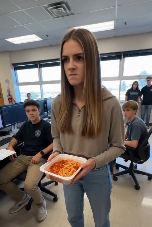
She grabbed one of the spaghetti trays from the snack table.
For a split second, my brain refused to understand what she was doing. The red sauce glistened under the ring lights. A plastic fork slid off the tray and clattered to the floor. Vivian’s expression was not angry anymore. It was almost blank.
Then she threw it.
Warm spaghetti and tomato sauce hit my chest, my neck, and my chin. The tray smacked against my hoodie and fell, pasta sliding down my jeans in heavy strands. Sauce splashed across the folder in Mr. Ortega’s hand. Someone gasped. Someone else said, “Oh my God.” A phone camera clicked on with that tiny electronic sound that turns humiliation into content.
For one awful second, I could not move.
I could feel sauce dripping from my hairline to my cheek. I could hear my own breathing. I could see Vivian standing there, chest rising, eyes bright with a victory she had not earned yet.
And I knew exactly what she wanted.
Shock.
Noise.
A new story.
Not the planted question. Not the dashboard. Not the timestamp.
Me, covered in cafeteria spaghetti, looking small and ridiculous while she stood clean.
“Vivian!” Mr. Ortega shouted.
Vivian pressed a hand to her mouth as if she had surprised herself. “I—she kept pushing me. She was accusing me in front of everyone.”
“I never said your name,” I whispered.
But the room had already changed.
The phones were up now. Some students looked horrified. Others looked hungry for the clip. My hands trembled, and I hated that they trembled, because Vivian saw it and her mouth almost curved.
Almost.
Then Malik spoke from the control desk.
“Mr. O,” he said, voice strange. “The edit history is still open.”
Everyone froze.
Vivian turned her head slowly.
On the wall monitor, behind the livestream waiting screen, a smaller admin window had opened. Malik must have clicked it when Mr. Ortega started toward the computer. The audit panel filled the screen in clean black text on white.
QUESTION CREATED: 3:41 P.M.
CREATED BY: GUEST SUBMISSION TERMINAL 2
QUESTION EDITED: 3:42 P.M.
EDITED BY: V.CARRINGTON
QUESTION APPROVED: 3:43 P.M.
APPROVED BY: J.DAVIS
LOGIN OVERRIDE: ADMIN TOKEN
Nobody spoke.
Not one person.
The sauce kept dripping from my sleeve.
Vivian stared at the monitor as if the screen had betrayed her personally.
Then the timestamp expanded.
A second line appeared underneath.
ADMIN TOKEN ISSUED BY: M. ORTEGA
The silence changed shape.
It moved away from Vivian.
Toward Mr. Ortega.
I looked at him.
His face had drained of color.
At first, I thought it had to be a mistake. Mr. Ortega was the teacher who had told me my voice mattered when I was too nervous to host the freshman orientation segment. He was the one who said the media room belonged to anyone willing to do the work. He wrote my recommendation letter for the youth journalism program. He had always been kind to me.
Kindness, I learned in that moment, could be a curtain.
“What is that?” I asked.
Mr. Ortega did not answer.
Vivian did.
“She wasn’t supposed to see that,” she whispered.
Every head snapped back to her.
Her lips parted as if she had not meant to speak. For once, Vivian Carrington looked eighteen. Not untouchable. Not trained. Just scared.
Mr. Ortega stepped forward quickly. “Turn that off.”
Malik did not move.
“Malik,” Mr. Ortega said, sharper this time. “Turn it off.”
Malik’s hand hovered over the mouse. His eyes flicked to me, then to the monitor. He was a junior, usually quiet, always careful. His mother worked in the district office, and maybe that was why he understood records better than most students did.
“No,” he said.
The word landed like a chair thrown across the room.
Mr. Ortega’s face hardened. “You do not understand what you are doing.”
“I think I do,” Malik said.
Vivian backed away from me, sneakers squeaking softly against the floor. “This is not what it looks like.”
I laughed once, but it came out broken. “Then what does it look like?”
Vivian looked at the phones. At the students. At the screen. At Mr. Ortega.
For the first time since I had known her, she did not know which audience to perform for.
Mr. Ortega tried again, smoother now. “Everyone calm down. The system is confusing. Admin tokens can attach to moderation actions automatically. We need context before anyone jumps to conclusions.”
“Then give us context,” I said.
He looked at me then, and his expression made my skin go cold.
It was not guilt.
It was annoyance.
Like I had failed to stay where he placed me.
“Jade,” he said softly, “you’re upset. Go clean yourself up.”
That did it.
Something inside me that had been shaking went still.
I wiped tomato sauce from my cheek with the sleeve of my hoodie and looked straight at him. “No.”
A few students inhaled.
“I’m not leaving the room while the record is on the screen,” I said. “Not this time.”
His eyes narrowed slightly. “This time?”
I did not know why I said it until the words were already there.
“Last semester. The scholarship panel clip.”
The room went quieter than before.
Vivian’s face changed.
Last semester, a clip from my student spotlight interview had gone around school. In it, I seemed to say, “Some students here only succeed because their parents pay.” I had never said that. My actual sentence had been, “People think some students here only succeed because their parents pay, but that’s not fair to everyone either.” The edited version made me look bitter and jealous. I lost friends over it. Teachers became careful around me. Vivian’s circle laughed about it for weeks.
Mr. Ortega had told me not to “feed the drama.”
He had said the original file was accidentally overwritten.
I looked at Vivian. “You knew.”
She did not answer.
I took a step forward, sauce squishing inside one sneaker. “You knew the clip was edited.”
Vivian’s mouth trembled, but she forced it flat. “Everyone knew.”
That hurt more than the spaghetti.
Everyone knew.
Not everyone suspected. Not everyone wondered.
Everyone knew.
The clip had not ruined me because people believed it completely. It had ruined me because believing it was convenient.
Malik clicked something.
The monitor changed to a search field inside the audit system. He typed my name. A list of older actions filled the screen.
INTERVIEW CLIP EXPORT.
CAPTION EDIT.
ARCHIVE CHANGE.
RAW FILE DELETED.
ADMIN TOKEN: M. ORTEGA.
SECONDARY USER: V.CARRINGTON.
A sound went through the room. Not a gasp, not a whisper. Something lower. The sound of a group realizing the floor was not where they thought it was.
Mr. Ortega lunged toward the computer.
Malik jumped back.
Two students shouted. A camera tripod rattled. Mr. Ortega grabbed the keyboard, but his hand slipped because the desk was crowded with cables and notes. In the scramble, the livestream software switched from the waiting screen to the room camera.
A red light blinked on.
LIVE.
For three seconds, nobody understood.
Then all of Westbridge High saw me standing in the media room covered in spaghetti sauce while the audit history glowed behind me with Vivian Carrington’s name and Mr. Ortega’s admin token on the wall monitor.
Malik saw the red light first.
“Oh no,” he breathed.
Mr. Ortega spun around. “Cut it!”
But the stream had already gone out. To the school site. To the parent newsletter link. To the district media archive. To every student who had been waiting for the weekly broadcast.
Vivian covered her face.
I stared at the camera.
My heart hammered so hard I could barely hear anything else. This was the nightmare version of being seen: messy, humiliated, exposed. But behind me was the record. Behind me was the thing they had counted on staying invisible.
So I stepped toward the camera.
“Don’t,” Mr. Ortega warned.
I ignored him.
“My name is Jade Davis,” I said, voice shaking but clear. “Someone planted a livestream question under my account. The edit history is on the screen behind me. Last semester, an interview clip of me was edited too. I was told the original was gone. I’m asking the school to preserve the records before they disappear again.”
The room was so quiet I could hear the livestream computer fan.
Then the door opened.
Principal Sloane walked in with two campus supervisors behind her, phone in hand, face pale.
“What is happening here?” she demanded.
Nobody answered at first.
Then Malik pointed at the screen.
“Everything,” he said.
The next hour blurred into fragments.
A supervisor handed me paper towels and a school sweatshirt from lost and found. Principal Sloane ordered everyone to put away their phones, which did nothing because half the school had already recorded the livestream. Mr. Ortega kept repeating that this was a misunderstanding. Vivian sat in the corner with her arms folded, staring at the floor, the queen of Westbridge reduced to a girl trying not to cry in front of witnesses.
I should have felt triumphant.
I didn’t.
I felt sick.
Because the names on the screen proved what happened, but they did not explain why.
By six o’clock, my mother arrived.
She worked double shifts as a clinic receptionist, and she came into the office still wearing her blue scrubs, hair pulled back, eyes wide with fear that turned into fury when she saw the sauce stains on my clothes.
“Who touched my daughter?” she asked.
Nobody in the front office seemed eager to answer.
I wanted to be brave. I wanted to say I handled it. Instead, the second she put her arms around me, I cried into her shoulder like I was ten years old.
“I didn’t do it,” I said.
“I know,” she whispered. “I know, baby.”
Across the office window, I could see Vivian’s parents arrive.
Her mother wore a cream coat and diamonds small enough to be expensive. Her father, Simon Carrington, walked in with the confidence of a man who expected rooms to rearrange themselves around him. He did not look at me. Not once. He went straight to Principal Sloane.
“This needs to be contained,” he said.
My mother heard him.
Her hand tightened on my shoulder.
Principal Sloane stiffened. “Mr. Carrington, a student was assaulted and school records appear to have been manipulated.”
His smile was thin. “Exactly. Which is why panic helps no one.”
Vivian sat behind him, smaller than I had ever seen her.
And then she looked at me.
For the first time, there was no sneer in her face. No performance. Just something almost like apology, buried under fear.
I looked away.
The investigation moved fast because the livestream had made slow impossible.
By morning, the district had locked the media server. Mr. Ortega was placed on leave. Vivian was suspended pending a conduct hearing. Students who had laughed at me the day before suddenly sent messages that began with “I’m sorry if…” which is not the same as “I’m sorry.” The clip of me speaking to the camera had spread beyond Westbridge, and by lunch, reporters were calling the front office.
But the real twist came three days later, when Vivian asked to speak to me.
I almost said no.
My mother said I didn’t owe Vivian anything. Principal Sloane said the meeting would be supervised. Malik said, “You know she’s going to spin it, right?” And part of me agreed. Vivian had thrown food at me in front of everyone. Vivian had helped plant the question. Vivian had helped bury the edited clip.
But I kept remembering her whisper.
She wasn’t supposed to see that.
Not “They weren’t supposed to see that.”
She.
Me.
So I went.
The meeting happened in the counselor’s conference room. Glass walls. Round table. Tissue box in the center like the school expected tears to solve policy failures.
Vivian sat across from me in a navy sweater, hair tied back, no makeup. Without the armor of her usual circle, she looked exhausted.
“I’m not here to ask forgiveness,” she said.
“Good,” I replied. “Because I’m not ready to give it.”
She flinched but nodded. “I know.”
The counselor sat near the door. Principal Sloane stood by the window. My mother sat beside me, arms crossed.
Vivian swallowed.
“My father wanted the media program protected,” she said.
I stared at her. “From what?”
“From you.”
My mother leaned forward. “Excuse me?”
Vivian rushed on. “Not because of you personally at first. Because of what you found.”
“What did I find?”
Vivian looked at Principal Sloane, then back at me. “The livestream question wasn’t the first planted submission. There were others. For months. Questions about students whose families complained about fees. Questions about scholarship kids. Questions about athletes who spoke up about injuries. They’d plant something humiliating, approve it under the student’s own login or another student account, then use the reaction to discredit them.”
My stomach turned.
Principal Sloane’s face went gray. “Who is ‘they’?”
“My father. Mr. Ortega. Two board members. Maybe more.”
The room seemed to tilt.
Vivian twisted her fingers together. “The media program wasn’t just a club. It was reputation control. They used it to test stories before they became problems. If a student complained, suddenly there’d be a rumor, a clip, a question, something that made them look unstable or jealous or dishonest.”
I thought of the interview clip. The laughter. The teachers becoming careful. The way my credibility had been weakened before I even knew I needed it.
“Why me?” I asked.
Vivian’s eyes filled.
“Because you printed the export logs last month.”
“I printed attendance logs for club credit.”
“You printed more than that. The system bundled audit data with the attendance report by mistake. Mr. Ortega realized after. My father said if you looked closely, you might see patterns.”
I remembered that day. The printer jammed. Pages spilled out. Mr. Ortega had hurried over, laughing too loudly, saying the system was a mess and he would take care of the extras.
One page had gone into my backpack by accident.
A page I never read.
A page that was still somewhere in my room.
I sat back slowly.
Vivian saw my face and understood before anyone else did.
“You still have it,” she whispered.
That was the second time Vivian Carrington said the wrong thing out loud.
Principal Sloane turned to me. “Jade?”
I did not answer immediately.
Because suddenly I understood the spaghetti. The planted question. The performance. The urgency. Vivian had not thrown food at me only to humiliate me.
She had thrown it to get the folder messy.
To ruin whatever she thought I was carrying.
But the folder had never held the page they feared.
It was at home, folded inside an old chemistry notebook, because I had used it as scrap paper to write a grocery list on the back.
My mother closed her eyes. “We’re going home.”
Nobody argued.
That night, our apartment felt smaller than usual, every shadow too sharp. My mother locked the door twice. Malik came over with his laptop because he refused to let me plug the page into any school device. We searched my room like detectives in a movie, except the stakes were real and my hands kept shaking.
We found the page at 9:17 p.m.
It was wrinkled. Half-covered with my handwriting: eggs, rice, detergent, bus card.
On the other side were lines of audit exports.
Names. Dates. Admin tokens. Edited clips. Deleted submissions. Student IDs. Board tags.
And at the bottom, one note field that made my mother sit down hard on the bed.
DAVIS PACKAGE: HOLD UNTIL SCHOLARSHIP RENEWAL. USE SELF-AUTHORED QUESTION IF NECESSARY.
For a moment, I could not breathe.
Package.
Not student.
Not girl.
Package.
They had reduced me to a file, a tactic, a problem to manage.
Malik scanned the page and backed it up in three places. My mother called a lawyer recommended by someone at the clinic. By midnight, the district had the file. By morning, so did the state education office.
By the end of the week, Westbridge High was no longer talking about spaghetti.
They were talking about a reputation-control scheme hidden inside a student media program.
Mr. Ortega resigned before the hearing and then tried to claim he had been pressured. Simon Carrington stepped down from the board after emails surfaced showing he had approved “narrative adjustments” for student complaints. Two other board members followed. The local news called it a scandal. Students called it what it was: a machine.
Vivian’s part was uglier and sadder than I expected.
She had helped because her father trained her to believe reputation was survival. She had edited captions, approved planted questions, and protected her circle. But she had also saved copies. Not out of goodness at first. Out of fear. Her father kept records on everyone, including her, and Vivian had learned from him too well.
At the conduct hearing, she admitted everything.
No excuses.
No tears for sympathy.
“I hurt Jade Davis because I thought if she fell, I could stay safe,” Vivian said, voice breaking only once. “But I was not safe. I was just useful.”
I watched from the back row with my mother beside me.
I did not forgive her that day.
But I believed her.
There is a difference.
The final twist came a month later, after the district announced reforms, after Mr. Ortega’s office was emptied, after the media room reopened with new locks, new oversight, and no private admin tokens.
Principal Sloane called me in before school.
Inside her office sat Malik, my mother, the new district investigator, and Vivian.
My first instinct was to turn around.
Then I saw what was on the desk.
A sealed envelope.
The investigator slid it toward me. “This was recovered from Mr. Carrington’s archived emails. It concerns your scholarship renewal.”
My fingers went cold.
I opened it.
Inside was a letter dated two months before the planted question. It recommended terminating my scholarship at Westbridge due to “conduct concerns,” “peer conflict,” and “questionable media ethics.”
At the bottom was a blank signature line for Principal Sloane.
She had never signed it.
I looked up at her.
Principal Sloane’s eyes were wet. “They sent it to me three times. I refused. I should have told you. I thought refusing was enough.”
My mother’s voice was sharp. “It wasn’t.”
“No,” Principal Sloane said. “It wasn’t.”
There was another page under the letter.
A new scholarship agreement.
Full renewal. Senior year fully covered. College media fellowship nomination restored. Public apology attached.
I stared at it until the words blurred.
Happy endings do not always feel like fireworks at first. Sometimes they feel like finally setting down something heavy you forgot you were carrying.
“What about the media program?” I asked.
The investigator smiled faintly. “That’s why Vivian is here.”
Vivian looked at me, nervous but steady. “The district wants a student advisory board to rebuild it. Malik already agreed. They asked me, but I said it shouldn’t happen unless you lead it.”
I almost laughed.
“You want me to lead the room where you threw spaghetti at me?”
Vivian’s face reddened. “No. I want you to lead the room where the truth survived me.”
That stayed with me.
The truth survived me.
I did not say yes because Vivian asked. I said yes because for too long, people like Mr. Ortega and Simon Carrington had treated student voices like raw footage they could cut, caption, and bury.
I wanted the room back.
Not for revenge.
For every student who had been made to look dramatic before they could be heard.
The first livestream of the rebuilt media program happened six weeks later.
The room looked different. The ring lights were softer. The question queue was public. Every edit created a visible log. No single person could approve a question alone. Malik ran audio. I hosted. Vivian sat at the far end of the table as a monitored volunteer, quiet, careful, doing the unglamorous work of earning trust one small task at a time.
Before we went live, I looked at the wall monitor.
For a second, I saw myself covered in sauce, shaking in front of everyone.
Then I saw the audit history behind me.
The quiet witness.
The record that did not blink.
Malik gave me a thumbs-up.
The red light turned on.
I looked into the camera.
“Welcome back to Ask Westbridge Live,” I said. “Today, every question you see has a history. So does every person in this room. Let’s start with the truth.”
Months later, people still remembered the fall.
They remembered Vivian throwing the spaghetti. They remembered the timestamp. They remembered Mr. Ortega reaching for the keyboard too late.
But I remembered something else.
I remembered the moment after humiliation, before proof, when I had to decide whether to leave the room or stay.
That was the real beginning.
Not the planted question.
Not the edit history.
Not Vivian Carrington thinking she could walk away.
The beginning was me, sauce dripping from my sleeve, looking at the people who expected me to disappear and saying no.
And this time, the whole school heard me.
THE END
