The first thing I noticed was not the food dripping down my face.
It was the silence.
One second earlier, the college counseling corner of Westbridge Academy’s auditorium had been buzzing with voices, folding chairs scraping the polished floor, parents asking about financial aid forms, students checking scholarship deadlines, and club officers rushing around with clipboards like the entire future of our senior class depended on neat stacks of paper.
Then Harper Sinclair threw a plate of cafeteria pasta at me.
The sauce hit my cheek first, warm and humiliating, sliding down my chin and onto the front of my gray cardigan. A noodle stuck to the sleeve of my shirt. Someone gasped. Someone else whispered my name like it was already a verdict.
Grace Thompson.
That was me.
Seventeen years old. Michigan-born, scholarship-hunting, quietly responsible Grace Thompson, the girl who checked forms twice because mistakes had consequences. The girl who carried extra pens. The girl teachers asked for help because I usually said yes.
And now I was standing in an Atlanta auditorium with food on my face while Harper Sinclair pointed at me like I had set fire to someone’s life.
“You ruined my scholarship folder,” Harper said, her voice shaking with just enough emotion to sound believable. “You moved it into the rejected pile because you were jealous.”
Every phone in the room seemed to rise at once.
I could feel the lenses before I could see them.
Harper stood in front of me in a pastel jumpsuit, silver bracelets glittering on her wrists, low heels clicking sharply against the floor. She looked perfect, even angry. Especially angry. Harper had the kind of face the school loved putting on posters: bright smile, polished hair, fundraiser-ready posture. She introduced visiting donors. She hosted assemblies. She appeared in every promotional video wearing school colors and saying things like opportunity and community with flawless sincerity.
I was not on posters.
I was usually behind tables.
And maybe that was why the room believed her before I even spoke.
My adviser, Mrs. Keller, rushed toward us from the scholarship station. “What happened?”
Harper turned to her instantly, eyes shining. “Grace moved my folder. I found it in the rejected pile. She tried to sabotage my application.”
“That’s not true,” I said.
My voice sounded smaller than I wanted.
Harper laughed once, sharp and wounded. “Of course you’d say that.”
The students around us shifted. Their faces told me everything. Some were shocked. Some were thrilled. Some were already deciding what caption to put over the video.
I wiped sauce from my mouth with the back of my hand. My fingers trembled.
“I didn’t move your folder,” I said. “I found it in the rejected pile.”
Harper’s eyes narrowed.
That tiny reaction told me more than her words did.
I had not come to the auditorium looking for a fight. I had come because the Future Leaders Club had been helping organize scholarship materials for the district college night. Each club had a table, and each scholarship folder had to be scanned, logged, and placed in the correct tray: submitted, pending, rejected, or incomplete.
At 3:40 p.m., I noticed Harper’s folder in the rejected pile.
That was strange because Harper Sinclair did not miss deadlines. Harper Sinclair did not submit incomplete forms. Harper Sinclair did not get rejected quietly in a side tray beside students whose printer pages had jammed or whose recommendation letters had not arrived.
So I checked.
Her folder had a timestamped receipt inside.
Submitted: 11:58 p.m., March 14.
Deadline: 11:59 p.m., March 14.
On time.
By one minute.
I had lifted the folder and taken it straight to Mrs. Keller because a wrong rejection could ruin a scholarship decision.
That was my mistake.
Not noticing the folder.
Not caring.
Not assuming someone else would fix it.
“I was trying to correct it,” I said.
Harper stepped closer. “You were caught touching my folder.”
“I picked it up because it was in the wrong tray.”
“You expect everyone to believe that?”
Mrs. Keller looked between us. “Grace, why didn’t you bring it directly to me?”
“I did,” I said. “I was walking toward you when Harper stopped me.”
Harper’s bracelets chimed as she lifted her hand dramatically. “She had my folder hidden under her clipboard.”
“It wasn’t hidden.”
“You wanted it gone because you knew I was applying for the same award.”
That part made the crowd stir.
The Sinclair Community Leadership Scholarship was one of the biggest local awards connected to Westbridge Academy. Tuition support, summer internship, recommendation letters from influential alumni. Harper had been expected to win it since freshman year.
I had applied too.
Quietly.
I had not told many people because I could not afford to hope out loud.
Harper knew that.
Now everyone knew.
“Grace,” Mrs. Keller said gently, but there was uncertainty in her voice, and that hurt more than the sauce on my skin. “Did you have access to the scholarship sorting table earlier?”
“Yes,” I said. “So did half the club.”
Harper folded her arms. “But only one person here had a reason to move my folder.”
I looked around.
At the students recording.
At the parents pretending not to listen while absolutely listening.
At the assistant principal near the stage, frozen with one hand on his radio.
At the rejected tray sitting on the table like a trap with paper edges.
I knew what Harper was doing.
She was not just accusing me. She was arranging the room around the accusation. She was making the scene so loud that the facts would feel boring when they finally arrived.
So I forced myself to breathe.
“Check the log,” I said.
Harper blinked.
Just once.
“The scholarship system keeps a scan record,” I continued. “Every folder has an email receipt, upload timestamp, and tray assignment. Check the log.”
The air shifted.
Mrs. Keller looked at the laptop on the counseling table.
Harper noticed.
“Why are you entertaining this?” Harper snapped. “She’s trying to confuse everyone.”
“I’m asking for the record,” I said.
“You’re asking for time to make up another lie.”
A boy near the front whispered, “Just check it.”
Harper heard him. Her face hardened.
Then she grabbed the plate from the refreshment table.
It happened so fast I barely moved.
One moment she was standing there, beautiful and furious. The next, pasta and sauce struck my face and chest.
A few people shouted.
Someone laughed, then stopped quickly when no one joined in.
I stood there, sauce dripping from my hair, and something inside me almost broke.
Almost.
Because Harper had made one mistake.
She thought humiliation would make me run.
But I had learned long ago that shame only wins when you leave it alone in the room to tell your story for you.
My mother used to say that after my father left.
Do not let someone else narrate your silence, Grace.
So I stayed.
I looked at Mrs. Keller.
“Open the system,” I said.
Mrs. Keller’s hand shook slightly as she turned to the laptop. “Mr. Alvarez, please come here.”
The assistant principal moved quickly now, as if permission had snapped him back into action.
Harper took one step back.
Her face still looked angry, but her eyes had changed.
Fear had entered them.
I saw it.
And once I saw it, I could not unsee it.
Mrs. Keller logged into the scholarship portal. The screen glowed blue-white beneath the auditorium lights. Students pressed closer, forming a half-circle. Harper’s friends hovered behind her, no longer whispering.
“Folder ID?” Mrs. Keller asked.
I pointed to the label visible through the clear plastic cover. “HS-417.”
Harper said, “This is ridiculous.”
Mrs. Keller typed.
The system loaded.
A list appeared.
HARPER SINCLAIR — SINCLAIR COMMUNITY LEADERSHIP SCHOLARSHIP — SUBMITTED 11:58 P.M. — STATUS: RECEIVED.
A murmur rippled through the crowd.
Mrs. Keller clicked the status history.
SUBMITTED BY APPLICANT: 11:58 P.M.
RECEIPT GENERATED: 11:58 P.M.
SYSTEM CONFIRMATION EMAIL SENT: 11:59 P.M.
FOLDER PRINTED FOR REVIEW: 8:02 A.M.
INITIAL TRAY ASSIGNMENT: SUBMITTED.
I exhaled.
The proof was there.
Harper’s file had been submitted on time.
It had not belonged in the rejected pile.
Mrs. Keller turned slowly toward the crowd. “The file was on time.”
Harper seized on it immediately. “Exactly! And Grace moved it into rejected after that.”
I felt my stomach sink.
Because the first record proved Harper was not late.
It did not prove who moved the folder.
Mrs. Keller clicked again.
“Tray movement history,” I said.
Harper’s head snapped toward me.
Mrs. Keller paused. “What?”
“The folders are scanned when they change trays,” I said. “You told us that during training. Every move logs a user ID.”
For a second, Mrs. Keller just stared at me.
Then she clicked the tab.
Harper whispered, “Don’t.”
The word was almost too quiet to hear.
But I heard it.
So did Mrs. Keller.
The tray history opened.
INITIAL TRAY: SUBMITTED — 8:02 A.M. — SYSTEM AUTO-ASSIGN.
MOVED TO REJECTED — 2:16 P.M. — USER: H.SINCLAIR_EVENT.
MOVED FROM REJECTED — 3:42 P.M. — USER: G.THOMPSON_CLUB.
The room went dead still.
Not quiet.
Dead.
Mrs. Keller’s face drained of color. “Harper?”
Harper stared at the screen.
Her friends stepped away from her like guilt might splash.
My heart was pounding so hard I could barely stand.
The name on the log was not mine.
It was hers.
H.SINCLAIR_EVENT.
Harper had moved her own folder into the rejected pile.
Then accused me of doing it.
Mr. Alvarez leaned over the laptop. “Harper, why would your event account move your own folder?”
“It wasn’t me,” she said too quickly.
“The user ID is yours,” Mrs. Keller said.
“Someone used my login.”
“Who?”
Harper looked at me. “Her.”
I almost laughed, but there was no joy in it.
“How would I have your login?”
“You’re always around the club tables. You probably saw it.”
Mrs. Keller’s expression tightened. “Grace moved the folder out of rejected at 3:42. That matches what she said. Harper, your account moved it into rejected at 2:16.”
Harper shook her head. “No. No, that’s not what happened.”
But nobody looked convinced anymore.
Phones lowered.
Some students looked ashamed.
Others looked disappointed, as if the story had become less fun once the villain changed.
I touched the sauce drying on my cheek.
“Why?” I asked.
The word came out before I could stop it.
Harper’s eyes flashed. “You don’t get to ask me that.”
“I do,” I said. “You dumped food on me in front of everyone. You accused me of trying to ruin you. So yes, I get to ask why.”
Harper’s face twisted.
For a moment I saw something underneath the perfect image. Something tired. Cornered. Desperate.
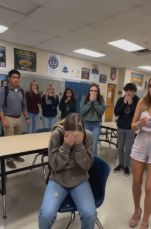
Then Mrs. Keller clicked one more tab.
“Email receipt,” she murmured.
The receipt opened.
It showed Harper’s submission confirmation, the exact time, and the automated email sent to her school account.
But beneath it was a linked administrative note.
Mrs. Keller frowned. “That’s odd.”
Mr. Alvarez leaned closer. “What note?”
Mrs. Keller opened it.
A message appeared.
REVIEW FLAG ADDED — 12:04 A.M.
FLAG REASON: APPLICANT ESSAY SIMILARITY CHECK PENDING.
FLAG ADDED BY: SYSTEM INTEGRITY BOT.
A second silence fell.
This one felt different.
Not about accusation.
About discovery.
Mrs. Keller clicked the flag.
The essay similarity report opened.
Several lines of Harper’s scholarship essay appeared on one side. On the other side was a matching document uploaded weeks earlier to the Future Leaders Club shared drive.
The author name on the earlier document made my breath stop.
GRACE THOMPSON — COMMUNITY SERVICE REFLECTION DRAFT.
My draft.
My words.
My private scholarship draft from the shared editing folder.
Harper had not moved her own folder because it was late.
She had moved it because her essay had been flagged for matching mine.
The room blurred.
Mrs. Keller covered her mouth. “Oh, Grace.”
Harper exploded.
“She didn’t even need it!” she shouted. “Everyone feels sorry for her anyway!”
There it was.
The truth, ugly and sharp.
My cheeks burned. “Feels sorry for me?”
Harper laughed, tears shining in her eyes now. “Your mother works two jobs. Your dad left. Teachers love helping you. You write one sad paragraph and everyone thinks you’re inspiring.”
I flinched.
Not because she was right.
Because she had taken pieces of my life I barely spoke about and turned them into weapons.
“You stole my essay,” I said.
“I improved it.”
The words stunned everyone.
Harper seemed to realize too late what she had admitted.
Mrs. Keller stood straighter. “Harper.”
But Harper kept going. Maybe because the mask had cracked and there was no way to hold it up anymore.
“You don’t understand what it’s like,” she said. “Everyone expects me to be perfect. Every event, every speech, every donor dinner, every camera. My parents already told everyone I was getting that scholarship. Do you know what happens if I lose it to someone like you?”
Someone like you.
That phrase hit harder than the food.
Because I knew exactly what she meant.
Someone without her money.
Someone without her connections.
Someone who was supposed to be grateful for scraps, not competition.
“You could have written your own essay,” I said.
Her laugh was bitter. “You think this is about writing?”
Mr. Alvarez closed the laptop halfway. “Harper, you need to come with me.”
“No,” Harper said, backing up.
Then a new voice cut through the auditorium.
“Open the attachment.”
Everyone turned.
At the edge of the counseling corner stood Mrs. Sinclair.
Harper’s mother.
She wore a cream blazer, a gold watch, and the expression of someone who had walked into chaos and expected it to rearrange itself around her. I recognized her from school videos. She chaired donor breakfasts, smiled beside principals, and spoke often about leadership.
Harper turned pale.
“Mom,” she whispered.
Mrs. Sinclair did not look at her daughter. She looked at Mrs. Keller.
“Open the attachment,” she said again.
Mrs. Keller hesitated. “Mrs. Sinclair, this is an active student matter.”
“And I am telling you that if you stop there, you will misunderstand everything.”
Her voice was calm.
Too calm.
Mr. Alvarez said, “We may need to continue this privately.”
“No,” Mrs. Sinclair said. “This became public when my daughter threw food at that girl.”
That girl.
Not Grace.
That girl.
My stomach twisted.
Mrs. Keller reopened the laptop. The similarity report had one unopened attachment: SOURCE ACCESS HISTORY.
She clicked it.
A list appeared showing who had opened my draft in the shared folder.
GRACE THOMPSON — CREATED DOCUMENT.
MRS. KELLER — COMMENTED.
HARPER SINCLAIR — VIEWED.
HARPER SINCLAIR — COPIED TEXT.
M. SINCLAIR_EXTERNAL — VIEWED VIA SHARED LINK.
M. SINCLAIR_EXTERNAL — DOWNLOADED.
The room seemed to tilt.
Mrs. Keller looked at Mrs. Sinclair. “You accessed Grace’s draft?”
Mrs. Sinclair’s face did not change. “Yes.”
Harper made a small sound. “Mom, don’t.”
But Mrs. Sinclair raised one hand.
“I accessed it because Harper sent it to me,” she said. “She was panicking. She said Grace had written a stronger essay. She said she couldn’t lose the scholarship. I told her to write her own.”
Harper’s head jerked up.
“That’s not true.”
Mrs. Sinclair finally looked at her. “It is true.”
Harper’s eyes filled with betrayal. “You told me it needed to be stronger.”
“I told you that you needed to become stronger,” her mother said. “There is a difference.”
A strange unease moved through the crowd.
This was no longer a simple story.
Not mean rich girl versus quiet scholarship girl.
Not jealous student versus innocent student.
Something else was underneath.
Mrs. Sinclair stepped closer to the laptop. “Open the email from March 13.”
Mrs. Keller scanned the attachment list. “Which email?”
“The one from my account to Harper.”
Harper whispered, “Please.”
But Mrs. Keller opened it.
The email appeared.
Harper,
I read the essay you sent. Grace’s draft is powerful because it is honest. You cannot copy honesty. If you want this scholarship, tell the truth about yourself for once. Tell them about the pressure, the image, the panic attacks before speeches, the way you hate being used as the perfect face of every campaign. That is your story. Use it.
—Mom
I stared at the screen.
Harper was crying now, silently, angrily.
Mrs. Sinclair’s face had softened, but only slightly. “She didn’t steal your essay because I told her to. She stole it because she was terrified of telling the truth.”
Harper snapped, “You don’t get to act like you didn’t build the cage.”
Mrs. Sinclair went still.
Harper wiped her face with both hands. “You put me on every poster. You corrected every sentence I said. You told me Sinclair girls do not look messy, do not sound needy, do not lose to people nobody knows. You don’t get to pretend you wanted honesty when honesty embarrassed you.”
The auditorium was so quiet I could hear the hum of the projector.
For the first time, Mrs. Sinclair looked shaken.
Not destroyed.
Not innocent.
Shaken.
I wanted to hate Harper completely.
Part of me still did.
But watching her stand there in her pastel jumpsuit, sauce staining my clothes, her perfect life cracking open in front of everyone, I realized something that made the whole thing worse.
Harper had hurt me because she had been hurt.
That did not excuse it.
It only made it sadder.
Mrs. Keller closed the laptop. “This needs to go to the scholarship committee and the principal immediately.”
Mr. Alvarez nodded. “Harper, Mrs. Sinclair, you both need to come with me.”
Harper looked at me.
Her mouth opened, then closed.
I expected an apology.
I expected an excuse.
Instead, she said, “I hated that your essay sounded like a real person.”
The words were quiet.
Almost childish.
Then she walked away with Mr. Alvarez and her mother.
Nobody clapped.
Nobody cheered.
The proof had landed too heavily for that.
I stood there in the ruined cardigan while the room slowly came back to life in broken pieces.
Mrs. Keller turned to me, eyes full of regret. “Grace, I should have checked before letting this happen.”
“You didn’t throw the food,” I said.
“No,” she said softly. “But I hesitated when you told the truth.”
That sentence stayed with me longer than I expected.
Because she was right.
Most people in that room had not attacked me.
But they had hesitated.
They had waited to see whether I was worth defending.
My mother arrived twenty minutes later.
She worked at a dental office during the day and cleaned medical billing records at night, and she came into the auditorium still wearing navy scrubs, her hair windblown from running across the parking lot.
When she saw my face, her expression changed in a way I had only seen once before: the day my father drove away with two suitcases and promised he would call.
“Grace,” she said.
I suddenly felt seven years old.
“I’m okay,” I whispered.
She walked straight to me and wrapped her arms around my shoulders, careful not to press the sauce deeper into my clothes.
“No,” she said. “You are standing. That is not the same thing as okay.”
I cried then.
Not loudly.
Just enough that the room blurred and my mother’s shoulder became the only solid thing left.
The investigation lasted three weeks.
Harper’s scholarship application was disqualified. She was removed as promotional host for spring events. The school changed shared-folder permissions and added a rule that student drafts could not be viewed by other applicants. Mrs. Sinclair resigned from two donor committees after the email records showed she had accessed student materials, even if she had not directly copied them.
People had opinions.
They always do.
Some said Harper deserved worse.
Some said I should forgive her because she had pressure at home.
Some said Mrs. Sinclair was the real villain.
Some said I was lucky the proof existed.
Lucky.
That word bothered me.
I was not lucky that my work had been stolen.
I was not lucky that food had been thrown at my face.
I was not lucky that people needed a receipt before they believed me.
But I was grateful the receipt existed.
There was a difference.
I returned to school the following Monday in a clean cardigan and jeans, my hair tied back, my backpack heavier than usual because I had packed three extra copies of every scholarship document I owned.
When I walked into the hallway, conversations dipped.
I kept walking.
At my locker, I found a folded note slipped through the vent.
I almost threw it away.
Then I opened it.
Grace,
I recorded instead of helping. I am sorry. You deserved better before the proof.
—Lena
By lunch, there were five more notes.
By the end of the week, there were seventeen.
Some were awkward. Some were short. Some were clearly written by people who had no idea how to apologize without making themselves feel better.
But one line appeared again and again.
You deserved better before the proof.
I taped that sentence above my desk at home.
Not because it fixed anything.
Because it told the truth.
Two weeks before graduation, Mrs. Keller called me into the counseling office.
My stomach tightened automatically when I saw the scholarship folders on her desk.
She noticed. “Nothing bad,” she said quickly.
I sat down.
She folded her hands. “The Sinclair Community Leadership Scholarship committee reviewed everything.”
I looked at the floor.
I had assumed the award would be canceled.
Maybe that was easier than hoping.
Mrs. Keller smiled gently. “They selected a new recipient.”
My heart started pounding.
“Grace, they chose you.”
For a moment, I heard nothing.
No hallway noise.
No printer humming.
No students laughing outside.
Just the echo of a door opening somewhere I had thought was locked.
“They chose me?” I whispered.
“Yes.”
“But after everything—”
“Because of everything,” she said. “Your application was strong before. But the committee said your conduct under pressure showed exactly the kind of integrity the scholarship was meant to support.”
I covered my mouth.
My mother cried when I told her.
Not the quiet kind this time.
The full, laughing, breathless kind that made her sit on the kitchen floor because her knees gave out. I sat beside her, and we held each other between the refrigerator and the sink, laughing and crying like two people who had been carrying a heavy box for years and had finally been allowed to put it down.
The night before graduation, I received one more email.
From Harper.
I almost deleted it.
Then I read it.
Grace,
I know I don’t deserve a reply. I am not writing to ask for one. I am sorry I stole your words. I am sorry I accused you. I am sorry I hurt you in a room full of people and made your pain part of my performance.
My mother was wrong about many things, but I was the one who threw the food. I was the one who lied. I was the one who chose cowardice.
I am writing my own essay now. It is terrible. It is honest. I think that is a start.
Harper
I sat with the email for a long time.
Then I typed one sentence back.
Keep it honest.
I did not forgive her that night.
But I did not hate her as much either.
At graduation, the auditorium was decorated with blue and silver ribbons. The same corner where everything had happened was now covered with flower stands and photo backdrops. Parents filled the seats. Teachers lined the aisle. Students adjusted caps and whispered about summer plans.
I stood backstage holding my scholarship certificate.
My mother sat in the front row, wearing the blue dress she saved for important days. When she saw me looking, she pressed both hands to her heart.
Harper was there too.
She stood across the stage in her cap and gown, quieter than I had ever seen her. No crowd around her. No camera-ready smile. Just a girl holding a folded program with both hands.
Before the ceremony started, she walked over.
“I meant what I wrote,” she said.
“I know.”
She looked toward the audience. “I’m transferring next semester. New school. Smaller. No promotional ambassador nonsense.”
“That sounds good.”
She nodded. “I hope you win everything.”
I almost smiled. “Not everything. Just enough.”
For the first time, Harper smiled like a real person.
Then the music began.
One by one, names were called.
When mine echoed through the auditorium, I walked across the stage with my hands steady. Mrs. Keller handed me my diploma. Principal Hargrove shook my hand. Somewhere in the audience, my mother shouted, “That’s my girl!” so loudly that people laughed.
And I laughed too.
Because months earlier, in that same room, Harper had pointed at me like I was the scandal.
Now I stood under the lights with my name clear, my record clean, and my future wide open.
The receipt had silenced the school.
But it had done more than prove Harper lied.
It proved something I would carry long after graduation, long after the scholarship money arrived, long after the videos were forgotten.
The truth does not always shout first.
Sometimes it waits in a timestamp.
Sometimes it hides in an email.
Sometimes it sits quietly in a receipt while everyone else chooses sides.
But when it finally opens, the whole room has to listen.
THE END
